This basket is for someone who wants several technology businesses in one fund, rather than a single company. Chip businesses are a narrower slice of information technology. A semiconductor ETF keeps chip design, manufacturing, and equipment, and leaves out much of the software and services in a broader technology basket. Settle that difference in coverage before comparing fees or weight caps. The narrower chip fund does not replace the wider basket.
Key Takeaways
- A technology ETF holds a basket of technology companies. An S&P information-technology sector fund and a Nasdaq-100 fund are not the same list.
- The sector fund's businesses come from the information-technology classification. Software is one sleeve. Semiconductors, hardware, and IT services sit in the same basket.
- The fee is a holding cost. A constituent cap only limits weight. Neither one rewrites who is allowed in.
- A semiconductor fund overlaps a technology sector fund on chip companies. A daily 3x Nasdaq product and a CFD are not technology-sector shares.
What businesses sit inside a technology ETF?
A technology-sector fund usually holds information-technology businesses, not software companies alone. On the S&P side those industries are software, semiconductors and semiconductor equipment, technology hardware, storage and peripherals, communications equipment, IT services, and electronic equipment, instruments, and components.
The industry list follows the index classification, not everyday speech. A company people call a technology firm stays out when its classification is consumer, communication services, or another sector. Communications equipment can remain inside information technology. A communication-services business or a retailer does not cross that line on the strength of the label.
Why do an S&P technology sector fund and the Nasdaq-100 hold different stocks?
The holdings differ because the entry rules differ. XLK tracks the Technology Select Sector Index and holds the information-technology names inside the S&P 500. QQQ tracks the Nasdaq-100, about 100 of the largest non-financial companies listed on Nasdaq. That list is technology-heavy and also includes consumer and other non-technology companies, so QQQ is not a pure information-technology sector ETF.
XLK is the Technology Select Sector SPDR Fund, managed by State Street. The fund uses full replication, so it holds the index constituents rather than a sampled substitute. The fund profile is the Technology Select Sector SPDR Fund.
QQQ is the Invesco QQQ Trust. It tracks the Nasdaq-100, not the information-technology sector index. A Nasdaq listing is part of the test, and financial companies are left out. An information-technology company listed on the New York Stock Exchange can remain in the S&P technology sector and still miss the Nasdaq-100 list.
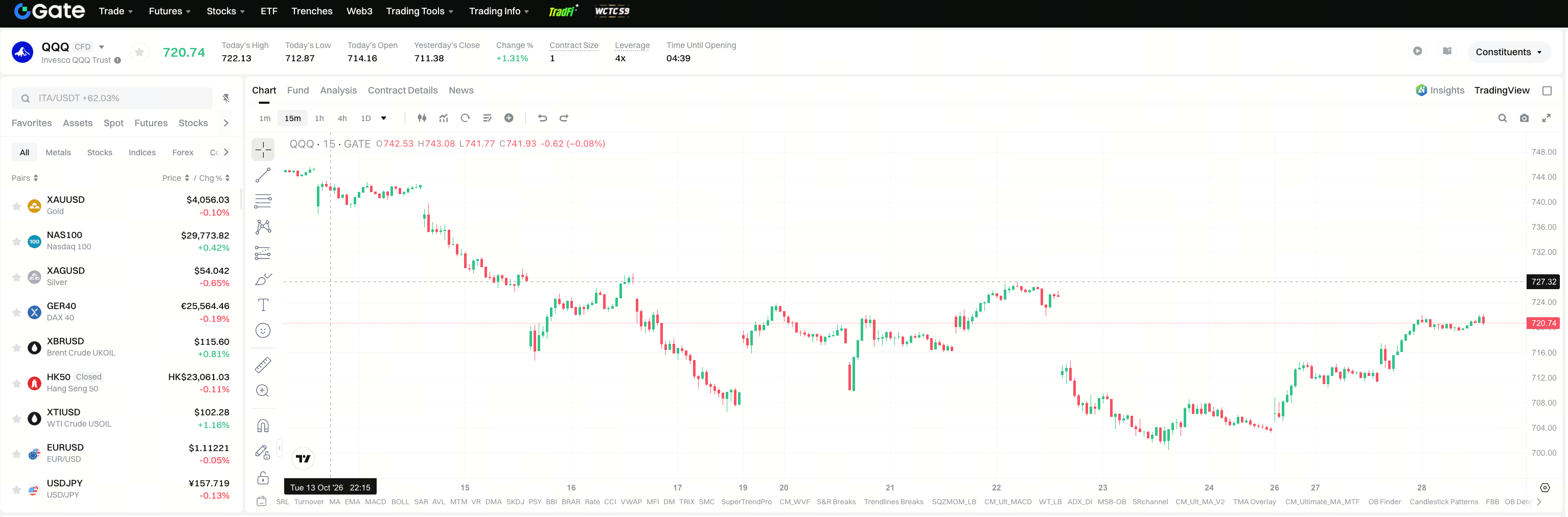
| Fund |
Index |
What it includes |
What it leaves out |
Gate CFD |
| XLK |
Technology Select Sector Index |
Information-technology companies inside the S&P 500; the fund uses full replication |
Companies outside information technology, and companies that are not in the S&P 500 |
XLK |
| QQQ |
Nasdaq-100 |
About 100 of the largest non-financial companies listed on Nasdaq; technology-heavy, and also consumer and other non-technology companies |
Financial companies, and companies not listed on Nasdaq; not a pure information-technology sector ETF |
QQQ |
| TQQQ |
Nasdaq-100 with a daily 3x objective |
Daily leveraged exposure to the same Nasdaq-100 basket |
A technology-sector basket; multi-day results are path dependent and are not three times the period move |
TQQQ |
The three rows are not one basket under three names. The first two rows split on membership rules. The third row, TQQQ, is still a daily 3x Nasdaq-100 product, not a relabeled technology-sector fund. The Gate CFD column names a price contract. It does not change which companies the fund holds.
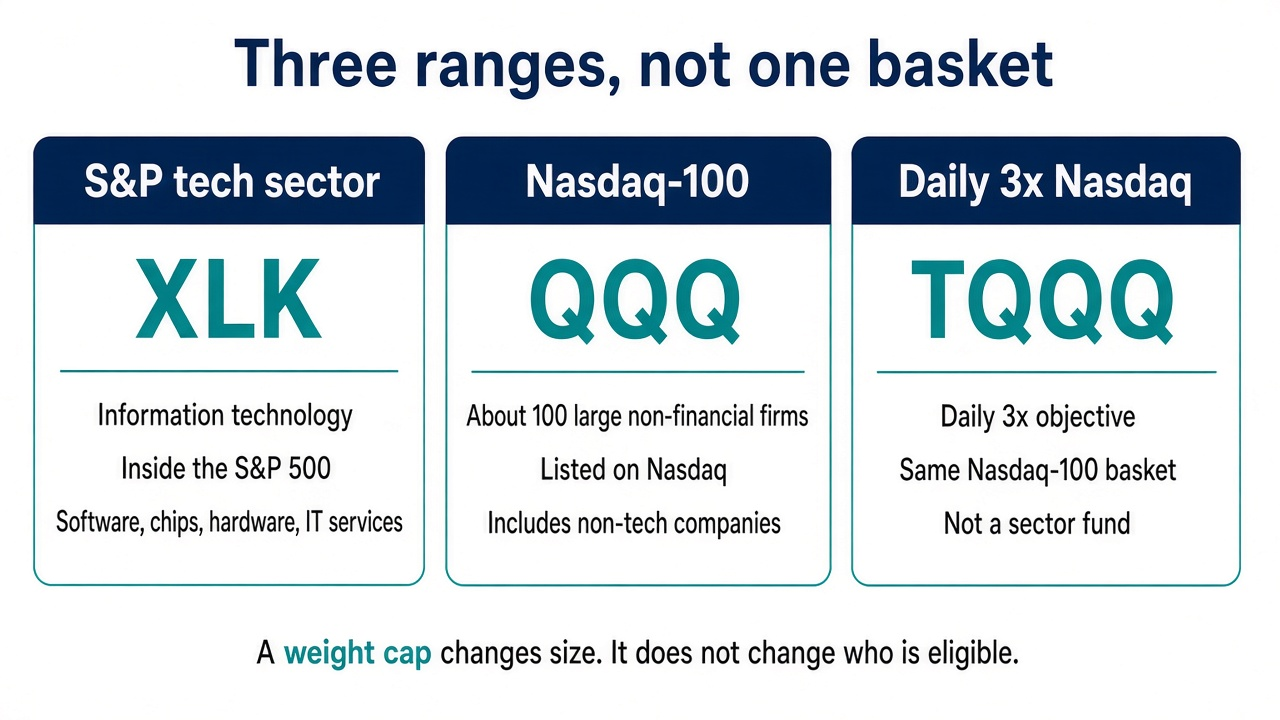
Figure 1. A technology sector fund, the Nasdaq-100, and a daily leveraged product cover different ranges.
How do fees and constituent caps compare?
A fee and a constituent cap answer different questions. The fee is the ongoing cost of holding the fund, and the figure is published on the issuer's fund page. The cap limits how large one company can be inside the basket. A lower fee does not turn the two lists into one list, and a cap does not admit a company that fails the sector or listing test.
The Technology Select Sector Index starts from float-adjusted market capitalization. At the quarterly rebalance, if any company's float-adjusted weight is above 24%, constituent weights are capped at 23%. Companies weighted above 4.8% cannot together exceed 50% of the index. The Nasdaq-100 uses modified market-cap weights and applies separate constraints to a single issuer, a single security, and a low-float company. Those thresholds are not the sector index's thresholds, and they apply only to names already in the Nasdaq-100.
A cap changes weight, not eligibility. Between quarterly rebalances, prices can pull a weight away from the rebalance-day figure. Membership rules, fees, and weight caps have to be checked separately, and no one of them replaces the other two. A daily leveraged product also carries financing and reset costs that are not the same line as a sector-fund expense ratio.
Where do a technology ETF and a semiconductor ETF overlap?
The overlap is the large chip companies that already sit inside the information-technology sector. A semiconductor fund is a narrower slice. Holding both stacks that chip exposure a second time. It does not add an industry that sat outside technology.
The double count usually falls on chip design, semiconductor manufacturing, and semiconductor equipment. Software, IT services, and hardware that is not itself a chip business are not copied again by the chip fund. When the same chip company ranks near the top of both funds, the combined chip weight is the two lines added together, not the larger of the two.
Why is a leveraged Nasdaq product not a substitute for a technology sector fund?
TQQQ is a daily 3x Nasdaq-100 product. Results over more than one day are path dependent. TQQQ is not a technology-sector fund, and it does not stand in for an information-technology basket such as XLK.
The 3x objective resets each trading day. Suppose the index rises 10% one day and falls 10% the next. The two-day index result is a 1% decline: 100 becomes 110, then 99 after multiplying by 0.9. A daily 3x reset applies a 30% rise and then a 30% decline: 100 becomes 130, then 91 after multiplying by 0.7, a 9% decline. Nine percent is not three times a 1% decline, and it is not three times the technology sector's two-day move. The leverage still multiplies the Nasdaq-100, including its consumer and other non-technology companies. The figures exclude fees and are not a historical result.
How does a CFD on an ETF differ from holding the shares?
A CFD on an ETF is price exposure. It is not ownership of the ETF shares, and it carries no vote on those shares.
Dividend cash adjustment, financing, and trading hours are terms of the contract specification, and they cannot be inferred from the fund name. When an investor holds the ETF shares, the fund holds the basket of stocks. A CFD does not deliver those shares. Matching tickers such as XLK or QQQ only identify the reference price. They do not mean the CFD buyer has purchased the fund.
Summary
A technology ETF is a basket of companies, and the list depends on the index rule. An information-technology sector fund holds the S&P 500 companies classified as information technology. A Nasdaq-100 fund holds the largest non-financial companies listed on Nasdaq. Those are different lists.
Fees and constituent caps set the cost of holding the fund and how large one company can be. They do not change who is allowed in. A semiconductor fund overlaps the technology sector on chip companies. A daily leveraged Nasdaq product changes the one-day multiple and the path of returns. A CFD is a price position. It does not include the share or the vote.
FAQ
Does a technology ETF hold only software companies?
No. A technology ETF in the information-technology sector usually holds software, semiconductors and semiconductor equipment, technology hardware, communications equipment, IT services, and electronic components together. Software is one line of business. Hardware firms and chip firms can sit in the same basket.
Is QQQ a pure technology sector ETF?
No. QQQ is the Invesco QQQ Trust. It tracks the Nasdaq-100, about 100 of the largest non-financial companies listed on Nasdaq. The list is technology-heavy and also includes consumer and other non-technology companies. It is not the S&P 500 information-technology sector.
Which index does XLK track?
XLK tracks the Technology Select Sector Index, the information-technology companies inside the S&P 500. State Street manages the fund, and the fund uses full replication. XLK does not track the Nasdaq-100.
What happens when a technology ETF is held with a semiconductor ETF?
The shared names are mostly large chip companies, so the pair raises semiconductors relative to software and IT services. The semiconductor fund does not copy the sector fund's software holdings a second time. If the same chip company has weight in both, those chip weights are added.
Does a CFD on a technology ETF mean buying the ETF shares?
No. A CFD is price exposure. The buyer does not receive the ETF shares and has no vote. Dividend cash adjustment, financing, and trading hours have to be read on that contract's specification. The fund's name does not state them.