Readers comparing chip-sector funds should settle the sector boundary before they line up tickers. A technology ETF folds software, internet platforms, and hardware into one portfolio, which leaves chip companies as a single layer inside a wider mix. A chip ETF keeps to design, wafer manufacturing, production equipment, or memory. Shared names can still appear in both, but the weight beside those names, and the other businesses in the basket, are not the same, so the two funds do not have to react to the same event. That boundary matters more than the ticker alone.
Key Takeaways
- A semiconductor ETF tracks an index with chip-company stocks. The share is a claim on that portfolio, not on physical chips.
- SMH tracks the MVIS US Listed Semiconductor 25 Index. SOXX targets about 30 large US-listed semiconductor companies, with separate caps for the top five, other names, and ADRs.
- Design, manufacturing, equipment, and memory do not earn revenue the same way. DRAM keeps to memory-related revenue and caps one company at 25%.
- The expense ratio is on the issuer page. SOXL and SOXS reset daily, so a multi-day result is not three times the period move. A CFD tracks price and is not share ownership.
Which companies does a semiconductor ETF hold?
Semiconductor ETFs hold the chip-company stocks a rule selects. The funds do not hold wafer inventory or finished chips. SMH and SOXX pick companies through their own indexes. DRAM picks companies through memory-related revenue. One list does not transfer to the other two.
SMH, SOXX, and DRAM do not screen the same universe, and their index focus and weight rules differ as well. SMH (VanEck Semiconductor ETF) tracks the MVIS US Listed Semiconductor 25 Index. The MVIS US Listed Semiconductor 25 Index covers US-listed companies in semiconductor production and equipment, and the index can include US-listed foreign companies. The VanEck page is where the index method and the holdings file sit.
SOXX (iShares Semiconductor ETF) targets about 30 of the largest US-listed companies in semiconductors and seeks to track a US equity index built from those companies. The product name changed on 2021-06-21 from iShares PHLX Semiconductor ETF. A new name does not rewrite the weight caps. The iShares page is the entry for the index rules and the holdings file.
These products are exchange-traded funds. They offer a listed claim on companies that design, make, or equip semiconductors. They do not offer a pile of semiconductors. People who already hold an information technology fund will see many of the same companies again, because semiconductors sit inside that sector. Broadcom Inc. and Applied Materials Inc. are the kind of US-listed names an index of semiconductors can include. NVIDIA and Taiwan Semiconductor Manufacturing can sit there when the listing rules allow. The weight on any date is the holdings file. Trading the shares and trading a CFD are different claims, and the returns of a daily leveraged contract follow the path of each session.
DRAM (Roundhill Memory ETF) screens for memory-related revenue only, covering HBM, DRAM, NAND, and related lines. Roundhill applies modified market-cap weights to DRAM. The table lines up ticker, index focus, weight rule, and the Gate CFD.
| Ticker |
Index focus |
Weight rule |
Gate CFD |
| SMH |
MVIS US Listed Semiconductor 25 Index |
Weighted by the MVIS index market-cap and liquidity rules; any single-stock ceiling follows the index rules |
SMH |
| SOXX |
About 30 of the largest US-listed semiconductor companies |
Top five securities 8% each, other securities 4% each, ADR cumulative weight 10%; reconstituted annually, rebalanced quarterly |
SOXX |
| DRAM |
Memory revenue (HBM, DRAM, NAND, and related) |
Modified market-cap weights, single-company cap 25%, rebalanced at least quarterly |
DRAM |
The table separates who is in the basket from how large one stock is allowed to be. SMH takes its weights from the MVIS US Listed Semiconductor 25 Index and does not automatically use the SOXX ceilings of 8% and 4%. The DRAM cap of 25% binds only a single company inside the memory theme. Read the weight rule before comparing price moves. Otherwise a large weight in one company gets mistaken for a swing in the whole chip industry.
How do market-cap weights and caps change one stock's weight?
Market-cap weights give a larger company a larger slice of the fund. An index cap sends any excess above the ceiling back to the other constituents. Without that ceiling, one large chip designer can set the tone for a single day's move in a semiconductor ETF.
The SOXX index rules limit each of the top five securities to 8%, each other security to 4%, and the cumulative weight of ADRs to 10%. Names are reconstituted once a year. Weights are rebalanced once a quarter. Reconstitution decides who stays on the list. Rebalance decides whether the weights of those names are back inside the caps. The two steps are not the same action.
DRAM uses modified market-cap weights, caps any one company at 25%, and rebalances at least quarterly. A 25% ceiling sits above the SOXX cap on a single security, so a memory leader can pull DRAM harder. SMH does not borrow either set of numbers. A single stock's weight in SMH follows only the rules of the MVIS US Listed Semiconductor 25 Index.
Why split design, manufacturing, equipment, and memory?
Design, manufacturing, equipment, and memory collect revenue at different points, so a broad semiconductor ETF and a memory-only product do not have to move by the same amount on the same news. When the four layers sit inside one set of weights, the share price does not show which layer did the work.
Design companies sell architectures and products and often run no wafer plant of their own. Manufacturers build chips to a customer's order, and their spending cycle is longer. Equipment companies sell the lithography and etch tools on a production line, and their orders follow fab construction. Memory companies earn from HBM, DRAM, NAND, and related products, and those prices and shipment volumes can split from logic chips. TSMC sits in manufacturing and ASML sits in equipment. That business label does not mean either company appears in every semiconductor ETF.
DRAM admits only memory-related revenue. A broad semiconductor ETF can hold design, manufacturing, equipment, and memory names at the same time. Read a holdings list by placing each company back into one of the four layers, then read the weight. Otherwise a swing in equipment spending gets misread as a swing in memory prices.
What should you check on fees and tracking?
On a semiconductor ETF, read the expense ratio listed on the issuer page first. Then check whether the fund tries to hold the full index or only a sample, and how often names and weights are reset. The expense ratio is the annual cost of holding the shares. It is not a yield.
The expense ratio to use is the figure on the issuer page. A gap versus the index can come from that fee, from constituents the fund did not buy, or from the timing of rebalance trades. VanEck Semiconductor ETF seeks, before fees and expenses, to track the price and yield of the MVIS US Listed Semiconductor 25 Index as closely as possible. Tracking the index does not mean the trade price equals net asset value at every moment.
SOXX reconstitutes constituents once a year and rebalances weights once a quarter. DRAM rebalances at least quarterly. Share ETFs use creation and redemption so the market price stays near net asset value, and a premium or discount can still appear during the session. Compare the trade price with net asset value. Do not infer the premium or discount from the expense ratio.
Why is a leveraged semiconductor ETF not a multi-day multiple?
SOXL seeks a daily move of positive three times a semiconductor index before fees. SOXS seeks a daily move of negative three times before fees. After the daily reset, a run of sessions depends on the path of gains and losses. The result is not the period's move multiplied by three.
A short arithmetic example shows the path dependence. The figures leave fees out, and they are not a record of SOXL or SOXS. An index that rises 10% and then falls 10% is down about 1% over the two sessions: 100 becomes 110, and 110 times 0.9 is 99. A daily positive three-times path goes from 100 to 130, and 130 times 0.7 is 91, about a 9% loss over the same two sessions. A 9% loss is not three times a 1% loss.
SOXL and SOXS each anchor the multiple to a single trading day. The order of up days and down days changes the cumulative result. Holding across several sessions does not lock the daily multiple into a multiple of the whole period. The inverse product falls, by its rule, on a day the index rises. SOXS is not a long-run mirror of SOXL.
How does a CFD on an ETF differ from holding the shares?
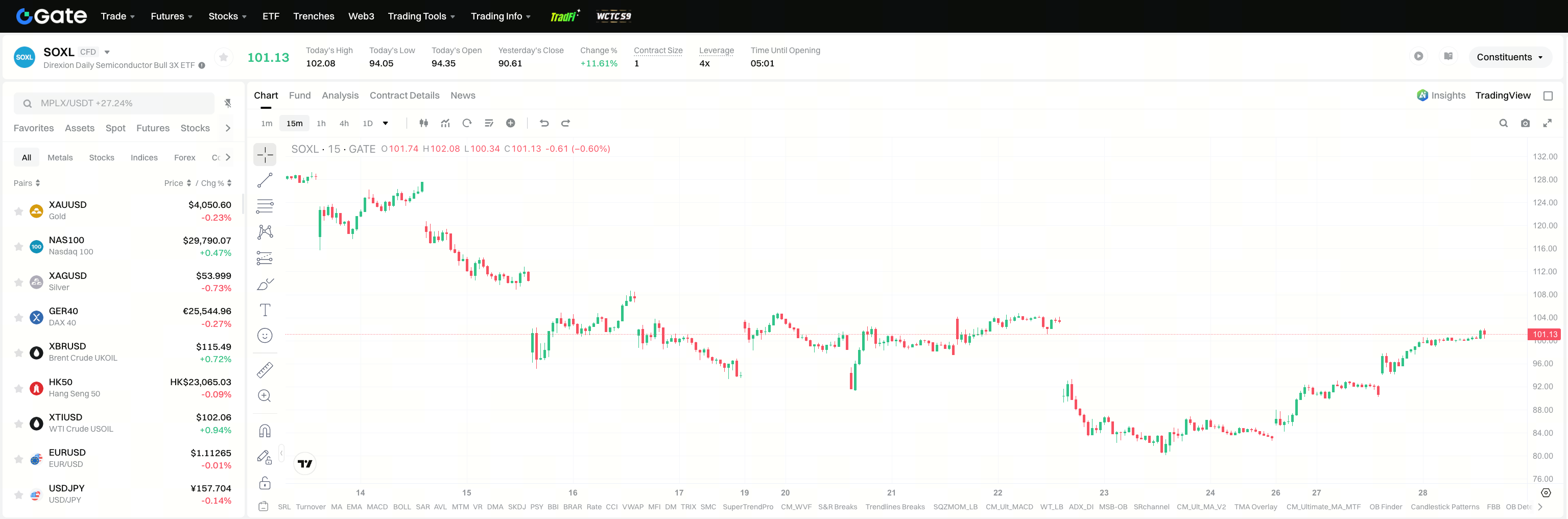
A CFD on a semiconductor ETF tracks the price. The contract is not ownership of the ETF shares, and it carries no shareholder vote. A holder of fund shares has a claim on the basket of stocks inside the fund. A holder of the CFD has price exposure on the contract.
Whether a fund dividend becomes a cash adjustment on the CFD, how overnight financing is calculated, and which hours the contract trades, are all items on the contract specification. Those terms cannot be inferred from the dividend record of the ETF shares. Until the specification is read, there is no basis to assume the CFD pays the same cash on the same calendar as a shareholder.
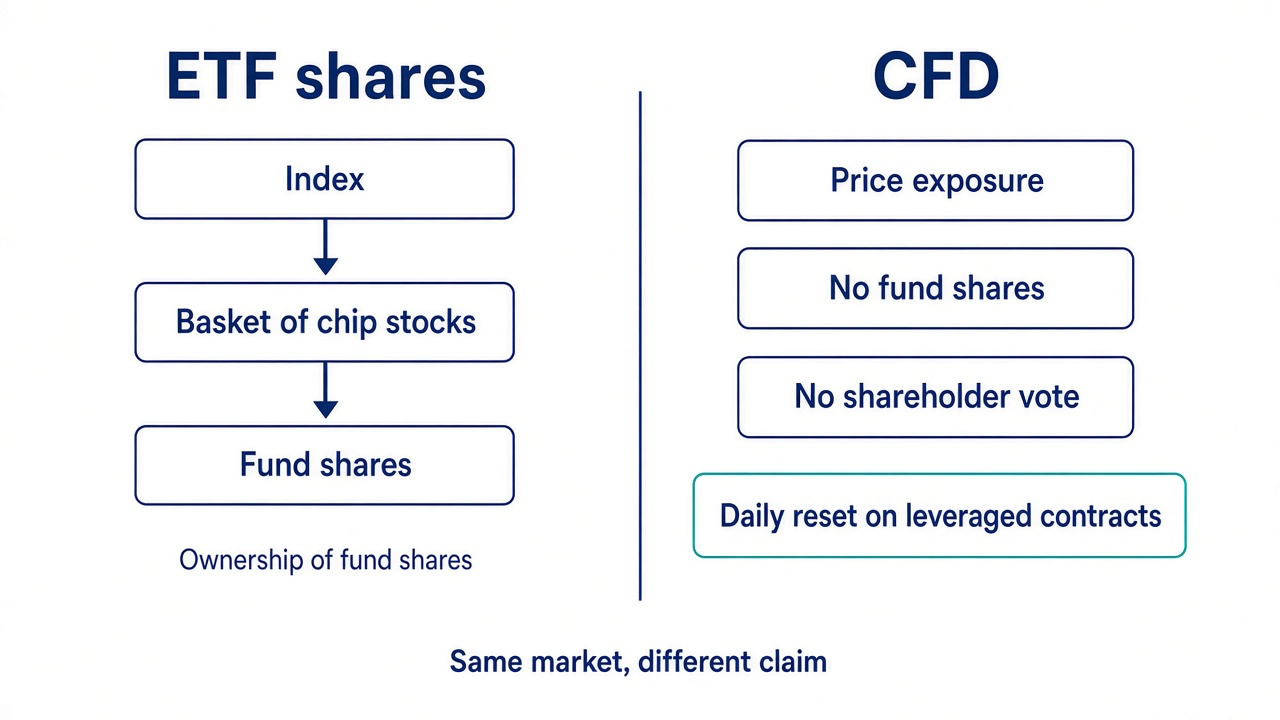
Figure 1. Share ownership and a CFD are different claims on a semiconductor ETF.
Summary
A semiconductor ETF uses a basket of chip-company stocks to track a semiconductor index. SMH follows the MVIS US Listed Semiconductor 25 Index. SOXX follows about 30 of the largest US-listed semiconductor companies, with caps of 8% on each of the top five, 4% on each other security, and 10% cumulative on ADRs. DRAM follows memory-related revenue, with a 25% cap on one company. Design, manufacturing, equipment, and memory do not share one revenue driver, and the weight rule sets how far one stock can pull the fund.
The expense ratio to read is the one on the issuer page. The three-times objective of SOXL and SOXS resets each trading day, and a multi-day result follows the path. A CFD supplies price exposure and does not supply share ownership or a vote. Dividend cash adjustments, overnight financing, and trading hours belong to the contract specification.
FAQ
Does a semiconductor ETF hold chip-company stocks or the chips?
A semiconductor ETF holds the chip-company stocks selected by an index or by a screen, plus the cash-like assets used to run the fund. The fund does not hold wafers, packaged chips, or chip inventory. The buyer receives fund shares, and those shares are a claim on the stock basket. Physical inventory inside a wafer plant stays on the company's books and does not move to the fund shareholder.
How do the index rules for SMH and SOXX differ?
SMH tracks the MVIS US Listed Semiconductor 25 Index, so the constituents are the US-listed semiconductor companies that index selects. SOXX targets about 30 of the largest US-listed semiconductor companies, caps each of the top five securities at 8%, caps each other security at 4%, caps cumulative ADR weight at 10%, reconstitutes yearly, and rebalances quarterly. Under the two rule sets, the same company need not have the same weight.
Can a semiconductor ETF include TSMC or ASML?
Whether TSMC or ASML is included depends on listing venue and eligibility rules, not on where the company is headquartered. The MVIS US Listed Semiconductor 25 Index looks at US-listed securities and can include US-listed foreign companies. SOXX places a 10% cumulative weight cap on ADRs. That cap limits the group of ADRs. The cap is not a promise to include either company. Whether a given semiconductor ETF's holdings file contains the two companies is a question for index eligibility and that holdings file.
Does a daily leveraged ETF stay at three times after several days?
No. The multiple does not remain three times the move over the whole holding period. SOXL and SOXS reset the multiple each trading day, and a run of days depends on the order of those daily moves. An index that rises and then falls can finish in a different place from an index that falls and then rises. Extra sessions do not convert the daily objective into a three-times result for the whole stretch.
Does a CFD on a semiconductor ETF receive the fund dividend?
A CFD is not an ETF share, so the holder does not collect the fund dividend as a shareholder and has no vote. If a dividend shows up on the contract, it shows up as a cash adjustment written in the contract specification, not as the fund's distribution posted onto the CFD. Whether an adjustment is made, when it is made, and how overnight financing is charged, are questions for that specification. The dividend calendars of SMH, SOXX, and DRAM do not answer them.