The share is the unit of account in this structure, and the price is only the cost of entry. Settlement value does not follow the traded price; it is fixed by the event outcome, so the same share can quote at different prices across two sessions and still settle at either 1 USDT or zero. Pricing is only one layer. Every market also carries pre-set resolution criteria and a designated resolution source, and how an outcome is confirmed or disputed sits in that market's rulebook, while the resolution process turns that text into a settlement.
Separating prediction markets from Gate event contracts is the first step in reading the rules. In Chinese, event contract refers to short-cycle price-direction products on BTC and ETH, where the underlying is the price itself. A prediction market's underlying is whether a real-world event occurs. The resolution sources differ, so the rules are not interchangeable.
Key Takeaways
- A prediction market trades Yes and No shares on the outcome of a real-world event, with a correct share settling at 1 USDT and an incorrect one at zero.
- Share prices are quoted in USDT; the price can be converted into a probability, but a probability is not a promise.
- A market passes through three states: active trading, closed with locked funds, and settled at the outcome.
- The account route and the wallet route differ in funding and in where settlement lands; voucher principal cannot be withdrawn, while profit follows the product rules.
- Prediction markets and Gate event contracts are two product lines with different underlyings and different resolution inputs.
What are Gate prediction markets?
Gate prediction markets are a market where the traded object is an event outcome. Each market turns one question into a tradable instrument: participants buy shares on either the Yes or the No side, and once the outcome is confirmed, correct shares are paid out while incorrect shares expire.
The division of labour behind the product is set out in the help centre. Polymarket provides the tradable events, the order-matching capability, and the settlement capability, while Gate supplies the trading entry point and the account system, so participants can take part directly through a Gate account. The platform does not trade in this structure and does not set prices: fills happen between market participants, and the platform does not act as the counterparty to a user's order. The same product appears as Gate Prediction Market on the product page and as event market in the help centre.
Compared with a price-based product, the underlying here is whether an event occurs rather than the level of an asset's price. The wording of the question therefore decides everything: the same event phrased as "will it happen" and phrased as "will a figure exceed a threshold" produces two different shares.

How are Yes and No shares priced?
Share prices are formed by the order book and quoted in USDT, so a quote maps onto a 0% to 100% probability range. Buyers and sellers each post the price at which they will trade, a match produces a traded price, and that price keeps moving with supply, demand, and new information.
Each market offers two sides. A participant who expects the event to occur buys Yes; one who expects it not to occur buys No. The two sides carry separate quotes, and the side that turns out to be wrong settles at zero.
The closer a quote sits to either end of the range, the more convinced the market is, but conviction is not confirmation. New information during the event rewrites quotes, and the size of the rewrite depends on trading depth and on how willing both sides are to trade.
How is a price read as a probability?
A Yes price of 0.65 reads as roughly a 65% probability for that outcome. The conversion treats the quote as a ratio between zero and one: 0.65 maps to 65%, and 0.20 maps to 20%.
The number is a conversion of the traded price, not a promise about the outcome and not an objective probability. It records the price at which buyers and sellers are currently willing to trade, not an independent measurement. As information arrives, the reading moves, and the same market will show a different probability repeatedly as the event unfolds.
Price level and payoff space run in opposite directions. A lower entry price leaves a wider spread per share if the call is right, but the probability the market assigns is also lower. Buying one share at 0.65 USDT and being correct leaves a spread of 0.35 USDT per share before fees; buying at 0.20 USDT leaves 0.80 USDT, while the market assigns that outcome only a one-in-five chance. The size of the spread describes where the price sits, not how easy the call is.
One share settles at 1 USDT: payoff structure and maximum loss
Settlement value is fixed, so the payoff can be calculated before ordering. A correct share settles at 1 USDT; an incorrect share is worth zero.
Holding to settlement, the payoff is settlement value minus entry price. Buying at 0.65 USDT and being correct yields 0.35 USDT per share, less the fee charged at execution. Being wrong costs the entry price.
The other route is to sell before settlement. During the active period a position can be sold in part or in full, the price change produces the difference, and there is no need to wait for the result. The two routes differ in which risk is carried: holding to settlement carries outcome risk, while selling early carries price risk.
Under either route, the maximum loss is capped at the capital committed when the shares were bought: an incorrect share settles at zero, so the loss equals the entry cost.
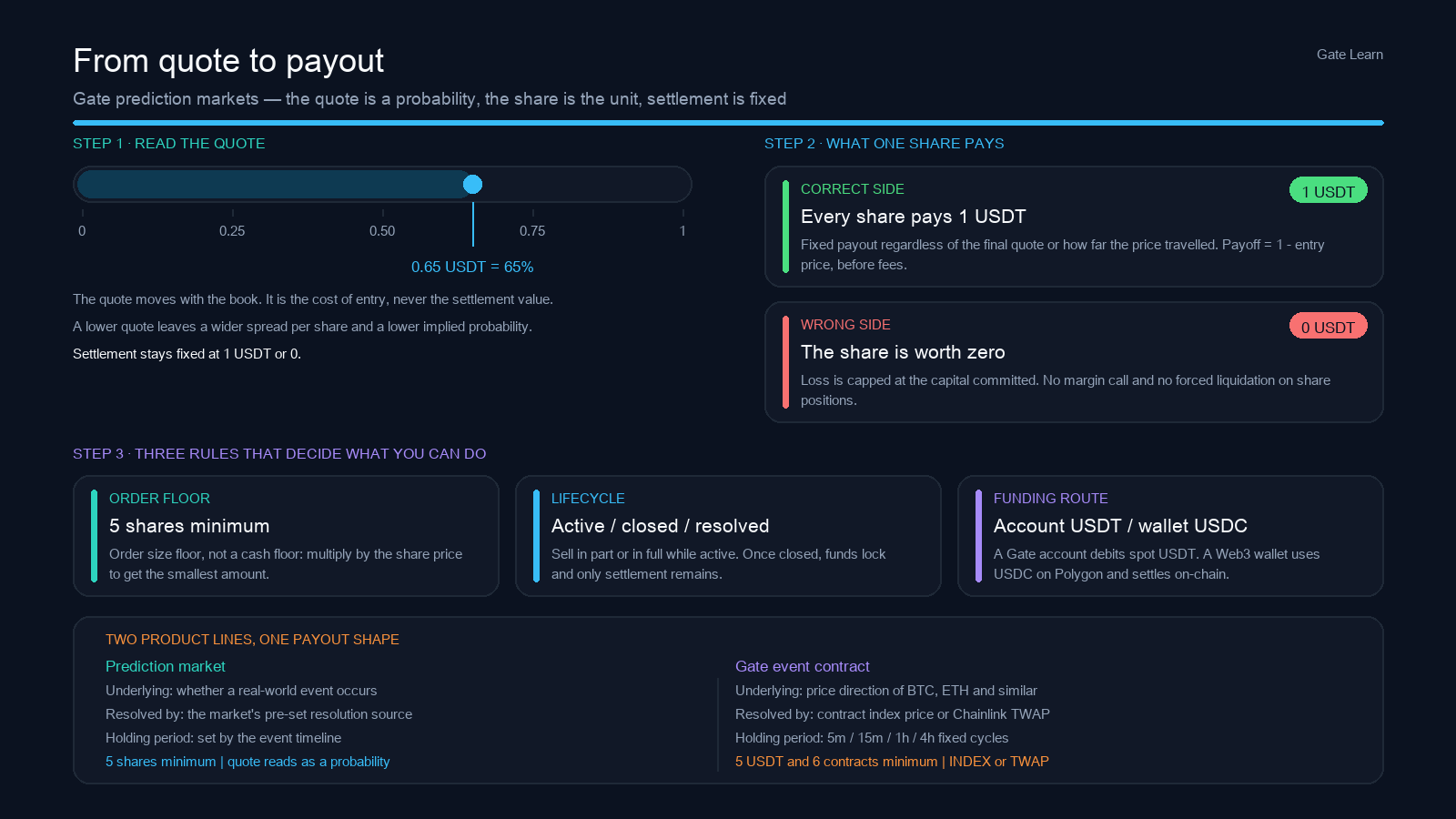
Figure 1. The quote reads as a probability, the share is the unit, and settlement is fixed at 1 USDT or zero.
Two account routes: a Gate account and a Web3 wallet
There are two ways in, and they differ in where the money sits and where settlement lands. Through a Gate account, an order debits USDT from the spot account and needs no separate on-chain action. Through a Web3 wallet login, the order uses USDC on the Polygon network and settles on-chain.
Both routes reach the same set of markets; the difference is the account structure and the location of the funds. On the account route a fill debits the spot account and settlement returns to that spot account; on the wallet route the order uses on-chain balances and both the trade and the settlement happen on-chain. Fees and availability follow what the page displays.
What to confirm before choosing a route is custody and availability rather than price. The same share settles at the same value under either route; the differences are how funds enter, where settlement arrives, and the other limits that come with an account structure.
Market lifecycle: active, closed, resolved
Every market passes through three states, and each state allows a different set of actions.
While active, shares can be bought and sold in part or in full, and prices keep moving. Once closed, the event time has arrived or matching has stopped, funds are locked, and no further buying or selling is possible while the result is confirmed. Once resolved, the system pays out, correct shares settle at 1 USDT, and funds return.
A dispute can change the timing of the third state. When an outcome is contested, the market may enter delayed settlement and pay out only after the result is confirmed. Settlement is completed by the underlying event-market platform, which runs the proposal, challenge window, and vote as separate resolution stages. A resolved outcome is final and cannot be modified or reversed, and a filled order cannot be cancelled.
Minimum order size, order types, and fees
A single order must be for at least 5 shares. That floor sets the smallest tradable size, and only when multiplied by the share price does it become the smallest cash amount.
Two order types are available. A market order fills immediately at the best available price and can face slippage in volatile conditions; a limit order sets the price a participant will accept, which controls cost but does not guarantee a fill.
Fees are charged at execution under the platform's published fee schedule. The platform does not share in trading profit and does not receive extra revenue because a particular outcome occurs, so the fee line and the settlement value of a share are separate matters.
How prediction markets differ from Gate event contracts, and the naming overlap in English
Both settle on a fixed 1 USDT payout, but the underlying and the resolution input differ, so the two rule sets cannot be swapped.
|
Prediction market |
Gate event contract |
| Underlying |
Whether a real-world event occurs |
Price direction of BTC, ETH, and similar assets |
| Resolution input |
The market's pre-set resolution source and criteria |
Contract index price or the Chainlink time-weighted average price |
| Minimum order |
5 shares |
5 USDT, minimum 6 contracts |
| Holding period |
Set by the event timeline |
Fixed cycles such as 5 minutes, 15 minutes, 1 hour, 4 hours |
The difference in underlying changes what the participant manages. An event contract runs on a product-set cycle and settles automatically at expiry; a prediction market runs on the event's own timeline, which can end around a release date or stretch when a fixture is postponed or rescheduled. Event contract pricing splits into INDEX and TWAP benchmarks, while a prediction market has no benchmark choice to make because its anchor is the resolution source. The other product runs on its own cycle and price benchmark, so its pricing and settlement rules differ from these.
English adds a second layer of confusion. In US regulatory usage, event contract means a binary contract with a fixed payout, typically structured as a swap, with the Commodity Futures Trading Commission setting out the framework. Gate's Chinese term for its short-cycle price product translates to the same two words. One English phrase therefore covers two different products, and check which of the two an English-language source describes.
Prediction market vouchers: principal and profit
Some Gate prediction market campaigns issue rewards as trading vouchers, and a voucher is not cash. The face amount cannot be withdrawn, transferred, or converted into cash and can only be used to trade prediction markets on the platform; profit generated by trading with the voucher can be withdrawn under the product rules.
A voucher carries an expiry date counted from issuance, and any unused balance lapses automatically after that date. The face amount is not a withdrawable balance and does not change how a share settles: settlement still runs at 1 USDT or zero, and the voucher only changes where the entry capital comes from.
Keeping that distinction in view prevents treating the face amount as a return. The voucher supplies capital that can be traded for a period; the result still depends on whether the call is right, and when it is wrong that capital also goes to zero.
Summary
Gate prediction markets trade the outcome of real-world events through Yes and No shares. Each share settles at either 1 USDT or zero, quotes move with the order book, and the quote converts into a probability that reflects the current price rather than a forecast.
Three boundaries matter in practice: shares can be traded while the market is active and only held once it closes; the account route and the wallet route differ in funding and in where settlement lands; and a voucher's face amount cannot be withdrawn, while profit generated with it can be. A fourth boundary separates prediction markets from event contracts, whose underlying, resolution input, and holding period all differ.
How an outcome is confirmed and how a dispute is handled belong to each market's rulebook rather than to the price. Read that text first, then read the quote.
FAQ
Is a price of 0.65 the same as betting odds?
No. 0.65 is the traded price of a Yes share, which converts into roughly a 65% probability for that outcome. Odds are a different expression, usually set by the party posting them and carrying that party's cost. A prediction market price is formed by the order book between participants and moves continuously. Both can be rendered as a probability, but they come from different places.
Can shares be sold before settlement?
Yes. While the market is active, a position can be sold in part or in full, and the price change produces the difference without waiting for the result. Once the market closes, trading stops, funds are locked, and the participant waits for settlement. A filled order cannot be cancelled.
Why is the minimum order 5 shares?
Five shares is the platform's minimum order size, set so that an order can be filled validly. Multiplied by the share price, it determines the smallest cash amount, which changes as the price changes. Orders below that size cannot be submitted.
Is a prediction market the same product as a Gate event contract?
No. A prediction market trades whether a real-world event occurs, and resolves against that market's pre-set resolution source. A Gate event contract trades the price direction of assets such as BTC and ETH, resolves against an index price or a time-weighted average price, and runs on fixed cycles of 5 minutes, 15 minutes, 1 hour, or 4 hours. Both settle on a fixed 1 USDT payout, but that does not make the rule sets interchangeable.
Can a voucher's face amount be withdrawn directly?
No. The face amount cannot be withdrawn, transferred, or converted into cash and can only be used to trade prediction markets, within its validity period. Profit generated by trading with the voucher can be withdrawn under the product rules. The face amount is entry capital, not a realised return.