Settlement rules deserve a separate reading because they carry different information from the share price. The price says what the market thinks right now, and the rules say what the market will ultimately resolve against; the price can be rewritten many times as an event unfolds, while the outcome lands once. How shares are priced and how the market lifecycle runs belongs to share pricing and market states; settlement is a separate layer.
The scope is Yes and No shares on real-world events. It does not cover short-cycle price products on BTC and ETH, which settle on fixed cycles against a price benchmark and follow a different resolution logic, so the rules are not interchangeable.
Key Takeaways
- Settlement runs on the resolution source and criteria pre-set in each market, not on headlines or market consensus.
- A proposer submits the outcome with a bond, anyone may challenge during the window, and a challenge escalates to a token-holder vote.
- A voided market returns initial capital proportionally; a market postponed but still scheduled usually stays active until it completes.
- Whether a draw resolves and how it resolves depends on whether the market offers a draw option and on its rule text.
- A resolved outcome is final and a filled order cannot be cancelled; a disputed market may enter delayed settlement.
What three things need checking before a result is determined?
Three things need checking before a result is determined: the triggering condition, the time boundary, and the resolution source. All three live in the market's rule text, not in its title.
The triggering condition answers what counts as having happened. Whether a touch is enough or a close above a level is required, whether an official announcement suffices or an enactment step must be completed, decides the answer. Different wording can turn the same event into opposite conclusions.
The time boundary answers which window counts. A contract written to year-end and one written to expire before a given month look similar but are two different agreements, and the closer a market sits to its deadline, the more sensitive the price is to new information.
The resolution source answers whose publication governs. A government agency, a statistics office, an exchange notice, and a company filing each imply a different verification path. Without all three, any discussion of price loses its anchor.
Who decides the result: the resolution source
The result is decided by the source designated for that market, not by the price or by public opinion. Each market pre-sets a resolution source, such as an official announcement or a statistical release, and the outcome is read from that publication.
This design keeps resolution independent of price. Quotes form on the order book and participants order on their own views, but trading behaviour cannot rewrite the resolution source. When the price drifts away from what the source eventually reports, settlement still follows the source.
Reading the rules before the price therefore has an order to it. The question sits in the market title and the resolution method sits in the rules; when the two wordings do not fully align, the rules govern.
Proposal, challenge window, and dispute
Result confirmation begins with a proposal. When the event ends, a proposer submits the outcome and posts a bond, the proposal then enters the challenge window, and once the result is confirmed the system settles automatically on that outcome.
During that window any participant may challenge a proposal believed to be wrong. The length of the window, the bond a challenge requires, and the arbitration steps follow the settlement mechanism's rules and the market details rather than the price screen.
With no challenge, the proposal stands and the market settles on that outcome. With a challenge, resolution moves to UMA, where token holders vote and the side supported by the vote prevails. A dispute therefore has a defined route instead of staying a disagreement between two parties. The underlying mechanism runs the proposal, challenge window, and vote as separate resolution stages.
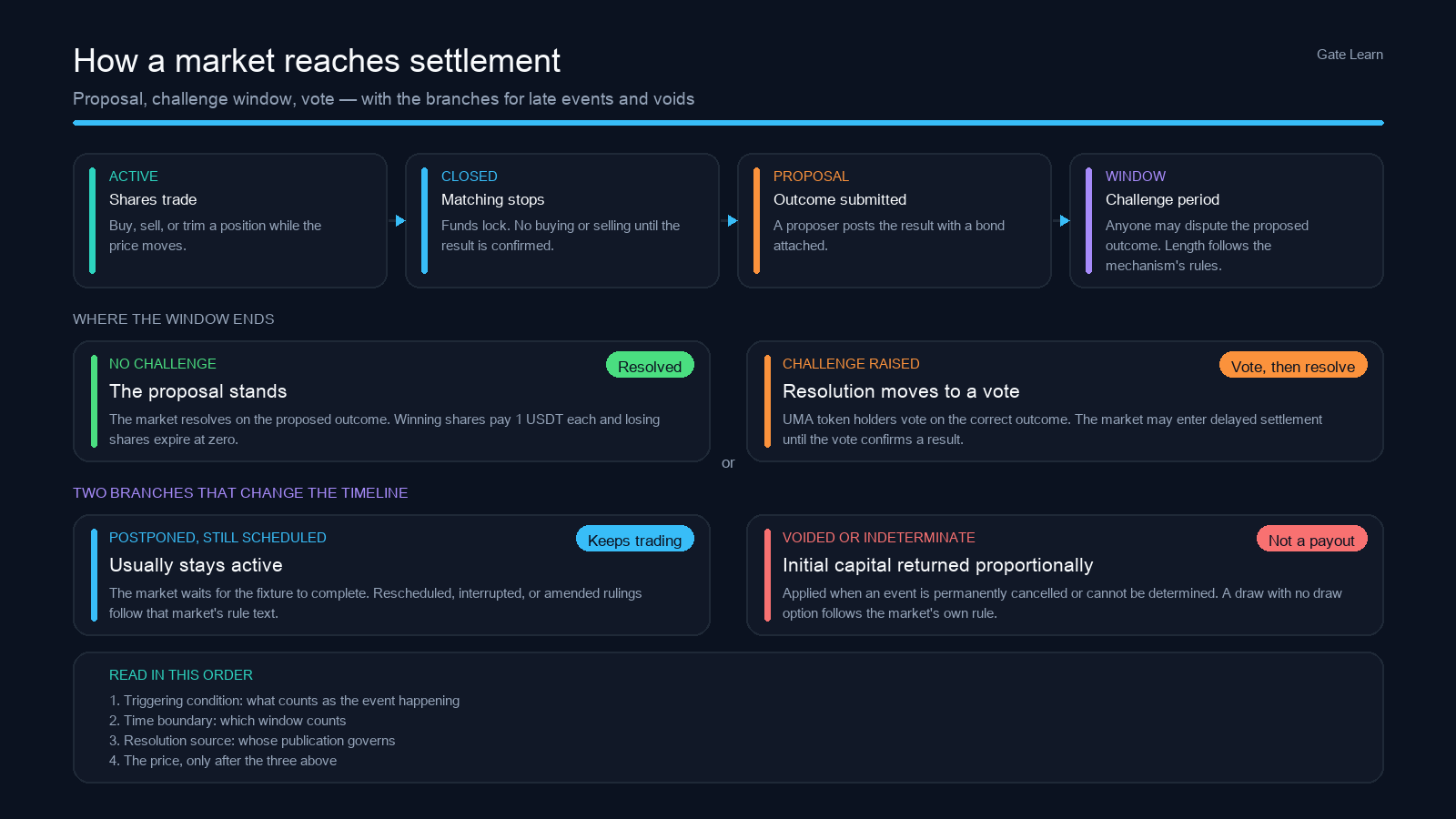
Figure 1. The path from proposal to settlement, plus the void and postponement branches.
Settlement timeline and where the funds go
The timeline has three stages: the market closes, the result is confirmed, and funds move. Closing stops matching and locks funds, so no further buying or selling is possible; once the result is confirmed, the system completes the payout.
A resolved market pays winning shares at 1 USDT each. On the account route settlement returns to the spot account, and on the wallet route settlement completes on-chain.
The waiting period offers no new trading opportunity. Once a market closes, trading stops and no new traded price forms, and the only useful work left is checking the rules and waiting, which is why confirming that a position matches your reading matters before the close.
How macro and election markets are judged
Macro and election markets first need to be split into two kinds of question. One asks whether something happens, such as whether a particular candidate wins. The other asks whether a figure crosses a threshold, such as whether a data release lands above a stated level. The triggering conditions differ, and the two are separate markets.
The resolution input sits with the source pre-set in that market, typically a public carrier such as an official announcement or a statistical release, and the market rules state which publication and which body govern. Headlines can carry information but cannot replace the source. Data can also be revised and re-released, so the rule text decides whether the first print or a revised figure governs.
Delays belong in the same reading. Postponed releases, closed markets, and settlement anomalies are the kind of situations the rules pre-address, and the platform may adjust, suspend, or cancel the affected markets accordingly. What a participant needs to check is that market's terms, not the arrangements of one past campaign.
What happens when a match is postponed, rescheduled, or cancelled?
Sports markets have no single payout formula; the treatment turns on whether the event will still take place. The dividing line written into the rules is between postponed but still scheduled and unable to complete.
A market postponed but still scheduled usually stays active until the fixture is completed; rescheduling, interruption, cancellation, and changes to a ruling follow that market's rule text. Different competitions and different question types can carry different terms, so a result in one market cannot be carried over to another.
Changes to a ruling are the easiest item to overlook. Post-match amendments, adjusted standings, and official revisions can all change the judgement, and the designated result source decides which version counts.
The order to check is therefore: first confirm whether the question asks for the final result or a stage result, then confirm which result source the rules designate, and finally confirm the postponement and interruption clauses. Only with all three clear does the question of whether the price is sensible arise.
Which number does "beat quarterly earnings" refer to?
Earnings markets first need the word estimate pinned down. The question only appears to ask whether expectations were beaten; the benchmark has to be fixed first: which earnings measure is used, which analysts' estimates are aggregated into the consensus, and as of which point in time. The market rules state these, and a consensus estimate is the general name for that kind of benchmark.
The basis itself can change the answer. A figure calculated under general accounting standards and one calculated on an adjusted basis can differ, and a company may publish both; the rules state which one applies, and the judgement follows that choice.
Whether matching the estimate counts as a beat depends on how the rule is worded. A rule that says above the estimate fails a match; one that says not below reverses the conclusion. This matters most when a quote sits near either end of the range, because the two readings settle in opposite directions on a boundary outcome.
A second family of questions is not about beating a figure at all but about whether a specific revenue line exceeds a stated amount, such as a product line, a region, or a business segment. Those threshold questions are judged on the reported segment figure and are separate markets from whether the company beat overall expectations.
Does a voided market mean a full refund?
A void is neither a payout on the outcome nor a settlement at the last traded price. The written treatment is a proportional return of initial capital, applied when an event is permanently cancelled by force majeure or cannot be determined.
Other platforms treat voids differently: some settle both sides at a fixed proportion, and others settle at the last price before a postponement. On encountering the word void, the correct move is to return to that market's rule text and confirm which arrangement applies.
Edge cases sit alongside voids. When the result is a draw and the market offers no draw option, the judgement follows that market's specific rule text; a fixture permanently abandoned with no result is the typical case, but whether it voids the market still depends on that market's clauses. None of these can be derived from the price; only the rule text supplies the answer.
The funding path does not change with the treatment applied. A return or payout on the account route lands in the spot account, whatever the settlement source or traded price was.
What happens to a position during a dispute?
A dispute usually arises after a market closes, when trading has already stopped, so the position stays locked while the challenge and the vote proceed within the rule framework and the holding stays unchanged until the outcome is confirmed.
Operating room in this window is limited to verification. Confirming your direction, confirming whether the designated source has published, and confirming whether that market is in delayed settlement is more useful than looking for a verdict in a chat group.
A resolved outcome is final and a filled order cannot be cancelled. Dispute handling moves the settlement time; it does not unwind a trade, which is the reason to read the source and the clauses before ordering rather than after.
Summary
Rules decide settlement, not the price. Each market pre-sets a triggering condition, a time boundary, and a resolution source; once the event ends, a proposal starts the process, and a challenge window followed by possible arbitration completes it.
The exceptional cases each have their own treatment: a void returns initial capital proportionally, a postponed but still scheduled market stays active until completion, and a draw follows that market's rule text. The differences among sports, macro, and earnings events sit in how the source and the threshold are worded.
A resolved outcome is final. Confirming those three items before ordering is more effective than looking for an explanation afterwards.
FAQ
Who decides the result of a prediction market?
The market's pre-set resolution source decides, such as an official announcement or a statistical release, rather than the price, public opinion, or a majority of participants. After the event ends, a proposer submits the outcome with a bond, the proposal can be challenged during the window, and a challenge escalates to a UMA token-holder vote.
What happens to the capital if a market is cancelled?
It follows the market rules. When an event is permanently cancelled by force majeure or cannot be determined, the market resolves as invalid and initial capital is returned proportionally. On the account route the return lands in the spot account, and on the wallet route it completes on-chain. The specific clauses come from that market's rule text.
Does the original deadline still apply if a match is postponed?
It depends on the dividing line written into the rules. A market postponed but still scheduled usually stays active until the fixture completes, so the original time is usually no longer the settlement point; when a fixture is cancelled, interrupted, or cannot complete, the market's rule text governs. Terms can differ across competitions and question types.
What happens to my position if a settlement is disputed?
Trading stops once the market closes, and the position stays locked until the result is confirmed while the challenge and the vote run within the rule framework; settlement then follows the outcome the vote confirms. A dispute moves the settlement time; it does not reverse a filled order.
Does beating quarterly earnings mean the stock price rises?
No. These markets are judged by comparing the reported figure with the expected figure the rules designate, on the basis the rules state; whether matching the estimate counts as a beat depends on the rule wording. The share price is a separate matter and is not a settlement input.