After buying USDT, deposit, withdraw, or self-custody moves require network choice: TRC-20, ERC-20, and other supported chains. TRC-20 and ERC-20 are not "two different dollars"—they are USDT on TRON vs Ethereum token standards. Wrong network is among the most frequent irreversible stablecoin transfer mistakes. What's the difference between TRC20-USDT and ERC20-USDT in practice? Both represent Tether USD on a blockchain, but each rail uses a different ledger, fee model, and address book—so a router cannot silently rewrite a completed send onto another chain.
How to Buy USDT covers fiat and swap paths. Network choice answers a different question: when a network is required, how to verify it, and what happens if it is wrong. After buying on Gate, withdraw network selection follows the live deposit/withdraw page and Gate Help Center. Which network to use depends on where the recipient can receive funds—not on a single universal “best” label. USDT also appears on other rails such as BEP-20, Solana, and L2s, yet TRC-20 USDT and ERC-20 USDT remain the two beginners meet most often.
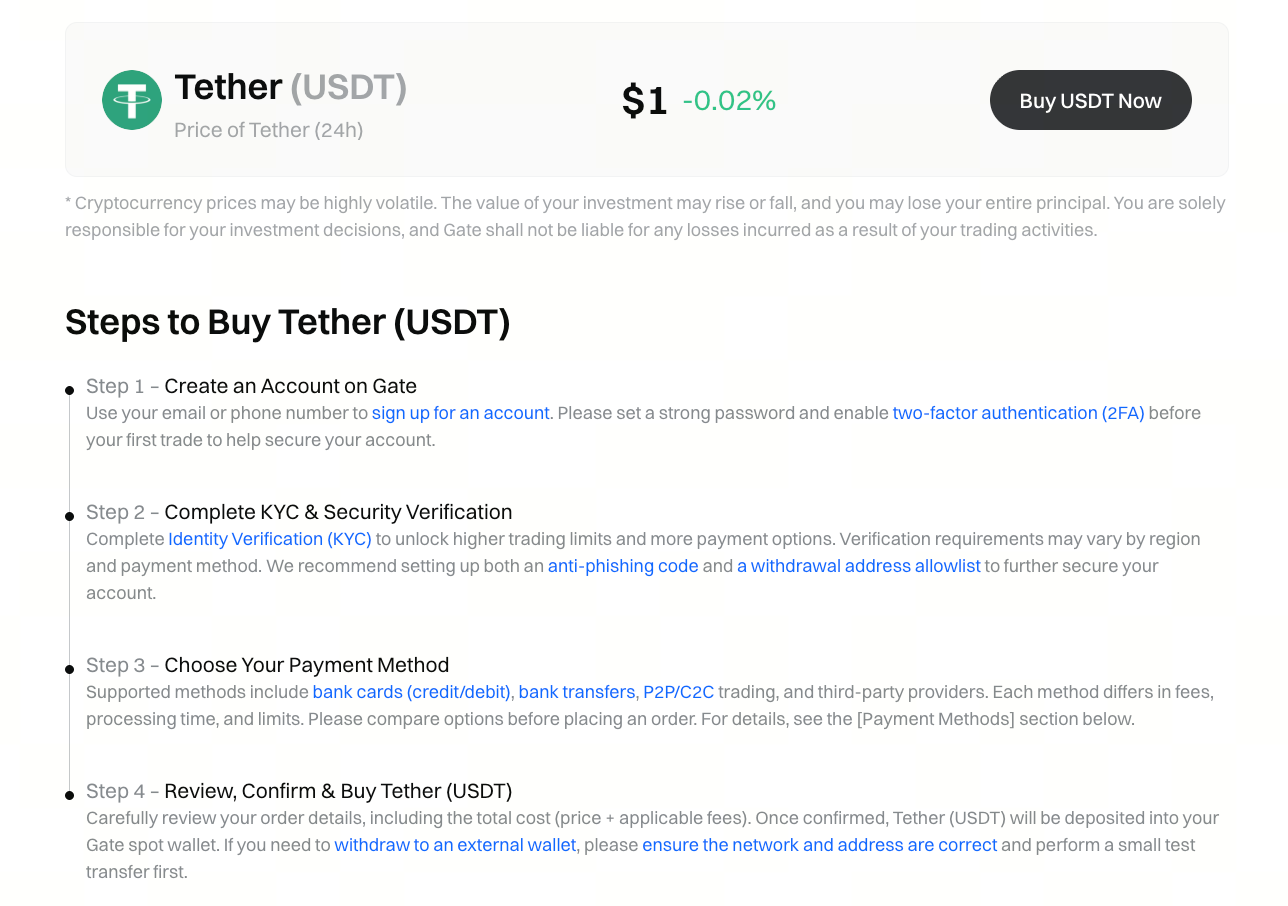
Why Does Network Matter When Buying USDT?
Fiat buy (Quick Buy or P2P) usually credits exchange ledger balance first—often without selecting TRC-20 or ERC-20. Once "Deposit" generates an address or "Withdraw" asks for an external address, the platform requires network selection because on-chain transfer must broadcast on the matching ledger.
"How to buy USDT" and "how to move USDT" are two phases. A typical mistake is assuming purchased USDT "comes on" a specific chain, or treating exchange balance display as identical to an on-chain token contract. Tether is the issuer brand; TRC-20 USDT is one blockchain deployment of that brand. Ignoring Ethereum gas requirements (needing ETH) or skipping exchange network support checks are common transfer mistakes.
| Stage |
Network required? |
Notes |
| Fiat Quick Buy / P2P |
Usually no |
Account balance first |
| In-exchange spot transfer |
No |
Internal ledger |
| On-chain deposit |
Yes |
Address bound to network |
| On-chain withdraw |
Yes |
Target chain must match |
The stage table separates in-account balance from on-chain movement: the first two rows usually need no network pick, while deposit and withdraw always do.
What Is the Difference Between TRC-20 USDT and ERC-20 USDT?
TRC-20 and ERC-20 are token standards on TRON and Ethereum. TRC-20 USDT follows TRON’s TRC-20 standard; ERC-20 USDT follows Ethereum’s ERC-20 standard. Issuance and dollar-peg logic sit under Tether’s stablecoin product line, but settlement, address format, fees, and confirmation rules belong to each network.
| Dimension |
TRC-20 USDT |
ERC-20 USDT |
| Base network |
TRON |
Ethereum |
| Token standard |
TRC-20 |
ERC-20 |
| Address format |
TRON address |
Ethereum address (0x…) |
| Fee profile |
Often relatively lower (energy/bandwidth and platform pricing) |
Gas varies with ETH congestion |
| Ecosystem role |
Widely used for exchange deposit/withdraw and transfers |
Widely used in Ethereum DeFi and wallets |
The table supports pre-transfer checks, not an investment ranking of chains. TRC-20 is often cheaper and faster for simple CEX-to-CEX transfers when energy/bandwidth pricing is favorable; ERC-20 remains the default for many Ethereum wallets and DeFi workflows. Supported networks, minimum withdraw, and fees follow live deposit/withdraw pages. Use other rails only when both sender and receiver list the same network—never substitute because the ticker still says USDT.
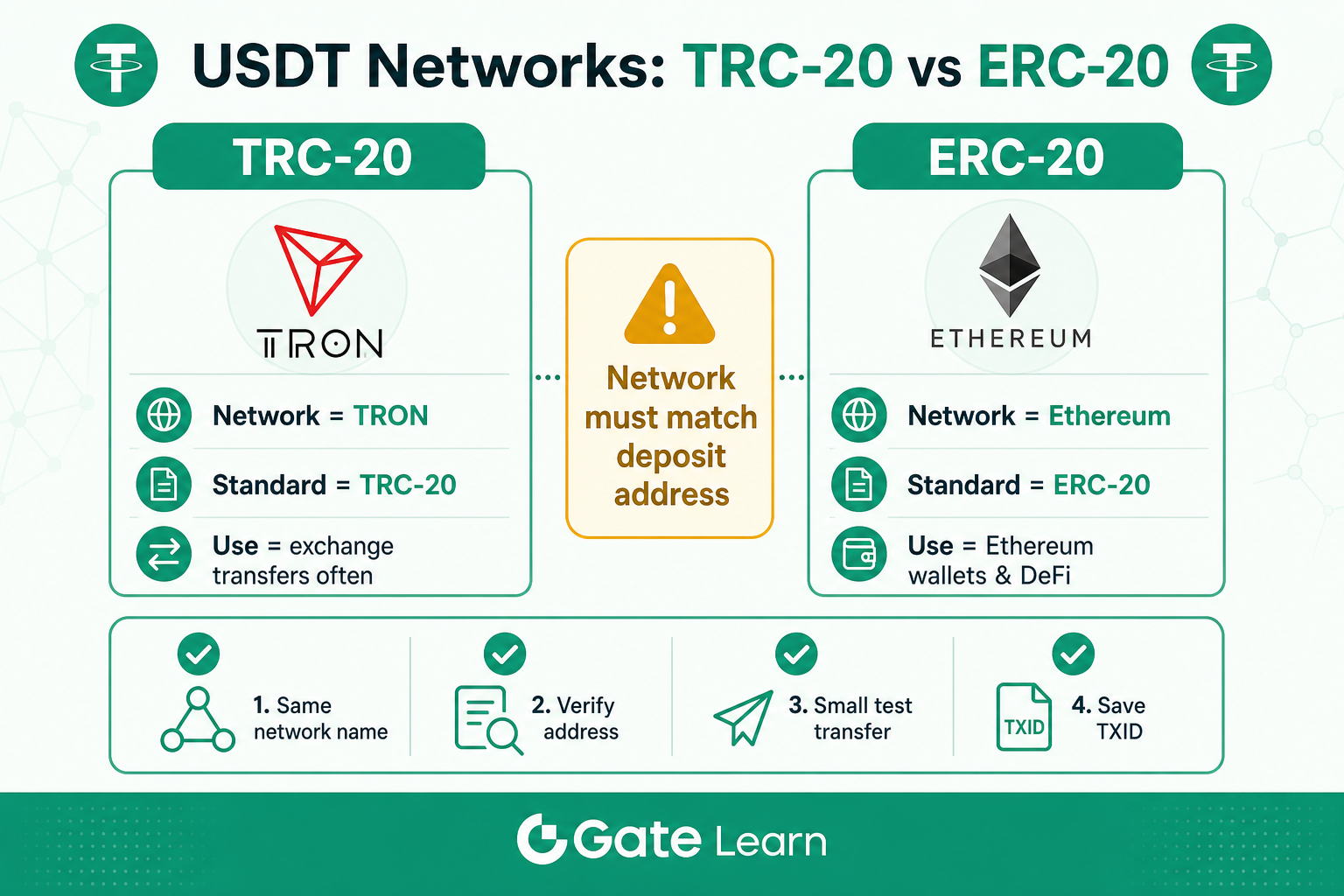
Figure 1. USDT on TRC-20 vs ERC-20: base chain, address format, and deposit/withdraw checkpoints.
How Do You Choose the Correct Network for Deposit or Withdraw?
Correct sequence: confirm recipient wallet network and address → select the identical network name on the exchange → small test transfer → verify TXID on a block explorer → send remainder. Matching "USDT" text alone without matching network is insufficient.
- Confirm recipient network: Wallet or target exchange deposit page states TRC-20, ERC-20, or other explicitly.
- Copy and re-paste address: Reduces clipboard malware tampering risk. Do not treat every 0x address as Ethereum USDT—other EVM chains use the same format.
- Select same network on sender side: Names must match; don't substitute a "similar-looking" chain.
- Check minimum and fees: Below minimum withdrawal may block submission or cause errors. Live fee fields beat folklore about which chain is cheaper.
- Small test: First transfer uses a small amount; send the rest after confirmation.
- Save TXID: On delay, query the explorer by network—don't repeat withdraw blindly.
External wallets must add the official USDT contract, not a name-squat scam token. Cross-check with Tether, wallet trusted lists, and platform announcements. Moving between TRC-20 and ERC-20 requires an exchange conversion or a supported bridge/swap—never assume a same-address auto hop.
What Happens If You Pick the Wrong Network? Can Funds Be Recovered?
Typical wrong-network outcome: transaction confirms on the source chain but the target platform or wallet cannot auto-credit on the expected network. Recovery depends on whether the destination address is controlled by the same entity, whether the platform supports manual recovery, and whether chains/address formats are compatible. Many cases are irreversible—platforms cannot force a network replay.
Prevention beats recovery: small tests, no guessing network from address prefix alone, no "switch network" instructions from chat apps. If already sent wrong, keep TXID, screenshots, and order ID; submit via official support—never pay stranger addresses to "top up" or "activate wallet."
Do You Need TRC-20 If You Only Trade on an Exchange Without Withdrawing?
If USDT stays on one centralized exchange for spot, futures margin, or internal transfers, users usually don't pick TRC-20 or ERC-20 on every trade. Network choice appears at deposit address generation and withdraw submission. Self-custody or cross-platform moves require deciding a usual network and practicing with small amounts.
The full path from fiat buy to withdraw starts with path selection to obtain balance, then fee and confirmation differences in USDT P2P vs Quick Buy, and only then network checks: first obtain balance, then move on-chain safely.
Summary
TRC-20 and ERC-20 are USDT on different blockchains; buying in-account balance may not require network choice, but deposit and withdraw always do. Verification order: recipient network → address → sender network → small test → TXID. Wrong network can leave assets uncredited and hard to recover—prevention and small tests beat post-hoc fixes.
FAQ
Are TRC-20 USDT and ERC-20 USDT Two Different Coins?
They are the same dollar stablecoin brand on different chains—not interchangeable without bridge, exchange swap, or platform conversion. Deposit and withdraw must treat each network separately.
Why Do People Say "Withdraw USDT on TRC-20"?
On many exchanges, TRON USDT gained wide use for fees and settlement experience, but that is not universally optimal. Availability and cost depend on platform support, network conditions, and whether the receiver supports TRC-20.
Addresses Look Like Random Strings—How Do You Tell the Network?
Don't guess visually. Wallet and exchange network labels are authoritative; Ethereum-style 0x prefixes appear on other EVM chains too, so "0x = ERC-20 USDT" is insufficient. Use the network dropdown and deposit page hints.
Is Exchange USDT Balance TRC-20 or ERC-20?
Total balance is usually an aggregated ledger; specific network appears when generating a deposit address or submitting withdraw. Check Deposit → USDT → network list for supported chains before you send.
How Much Should a Small Test Transfer Be?
Enough to cover minimum deposit/withdraw plus network fee with an acceptable loss if wrong—exact amount varies by platform. The goal is verifying network and address match, not moving the full amount in one shot.