Buying USDT (Tether) means exchanging fiat currency or other crypto assets for a dollar-pegged stablecoin balance. Common entry points include centralized exchange Quick Buy, P2P markets, spot trading pairs, and on-chain deposits. USDT is issued by Tether Limited and widely used for pricing, fiat on/off ramps, and trading margin; each purchase path differs in fees, settlement speed, identity checks, and counterparty risk.
The key to buying USDT is not memorizing a single button label but separating four questions: where funds come from, who is on the other side of the trade, which account or chain holds the USDT, and how to verify or dispute errors. Wrong-path mistakes often show up as higher fees, delayed credit, wrong network selection making assets invisible, or phishing sites posing as legitimate exchanges.
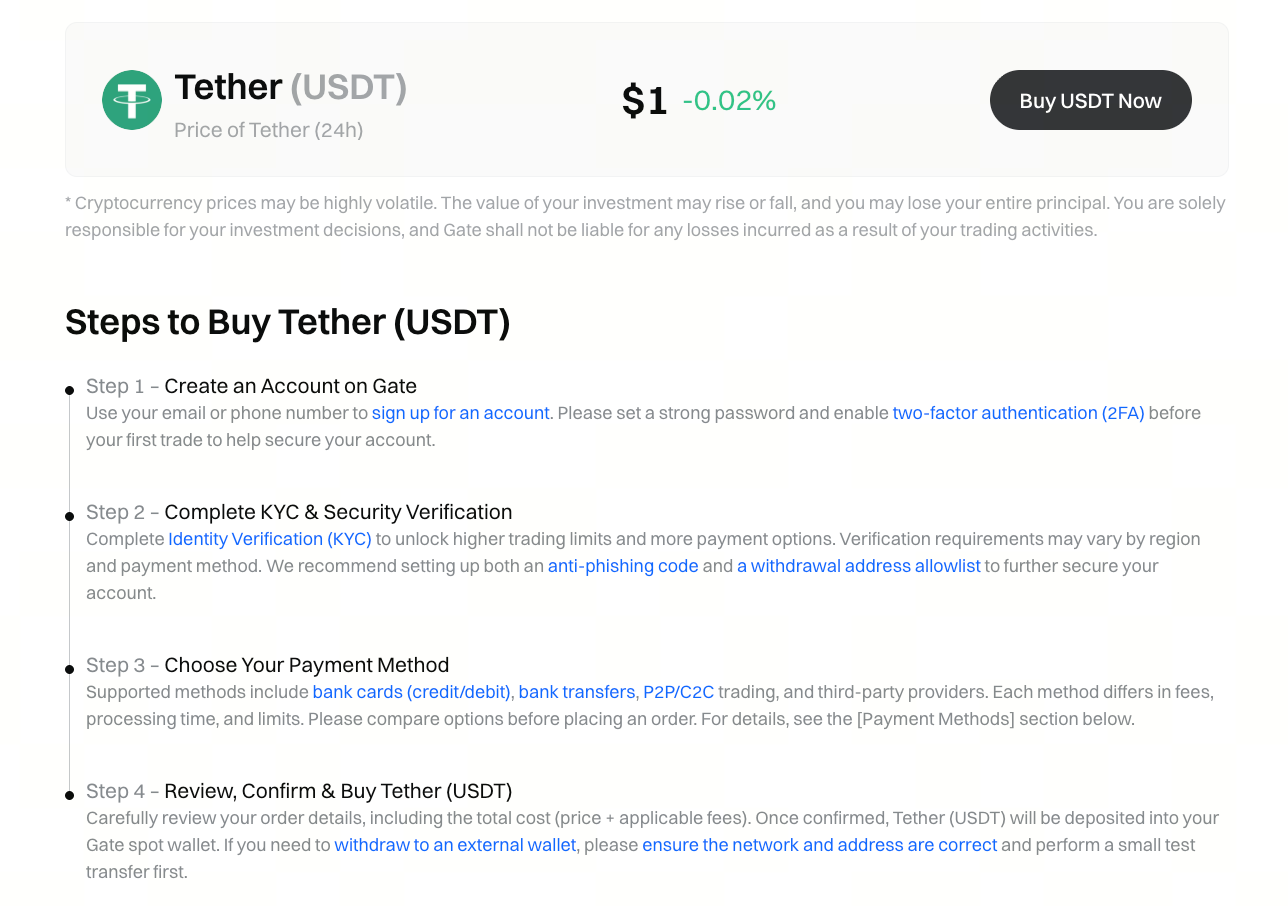
For beginners, a safer sequence is: complete account and security setup → run a small test purchase end to end → then decide whether to withdraw to an external wallet. USDT P2P vs Quick Buy compares the two main fiat routes on fees and risk; Gate-specific steps are covered under “How Do You Buy USDT on Gate?” and on Gate Help Center live pages.
What Do You Need Before Buying USDT?
Before buying USDT, confirm four preparation items: an available payment method, completed identity verification (KYC) level, account security controls (such as two-factor authentication), and the ability to verify the destination account or on-chain address. Missing any one can block orders, cap limits, or send funds to the wrong place.
| Preparation item |
What to verify |
Common impact |
| Account & KYC |
Registration done; verification level meets buy/deposit/withdraw rules |
Cannot place orders or limits too low |
| Payment method |
Bank card, e-wallet, bank transfer available locally |
Order cannot be paid or times out |
| Security settings |
2FA, anti-phishing code, withdrawal whitelist |
Lowers account takeover and phishing risk |
| Settlement check |
Spot balance, order status, chain name and contract |
Avoids "paid but not credited" confusion |
The goal of preparation is to rule out "can see the page but cannot pay" or "paid but don't know where to look." A small test purchase helps validate the payment channel, settlement delay, and field meanings before scaling up.
What Are the Common Ways to Buy USDT?
Common ways to buy USDT include fiat Quick Buy (bank card / third-party channels), P2P peer-to-peer trading, swapping Bitcoin or other tokens into USDT on the spot market, and depositing existing USDT from an external wallet or another platform. All four paths aim for USDT balance but differ in fee structure, counterparty, and complexity.
| Method |
Typical funding source |
Main traits |
Better fit |
| Quick Buy |
Debit card, Apple Pay, Google Pay, bank card, e-wallet, etc. (if locally supported) |
Short flow; fees may be higher |
First small purchase; speed priority |
| P2P |
Local payment to merchant/user |
Often flexible rates; verify merchant and proof |
Local fiat on/off ramp; price filtering |
| Spot swap |
Existing crypto |
Trade pairs; no new fiat channel |
Already hold crypto; want stablecoin |
| On-chain deposit |
External wallet or exchange |
Must match network and address |
Already hold USDT; only need transfer |
The comparison table describes path differences, not a ranked "best" option. On the same platform, Quick Buy and P2P may appear side by side—confirm which path is active before entering an amount.
The process is designed to be straightforward for first-time users, but payment options vary by region and channel.
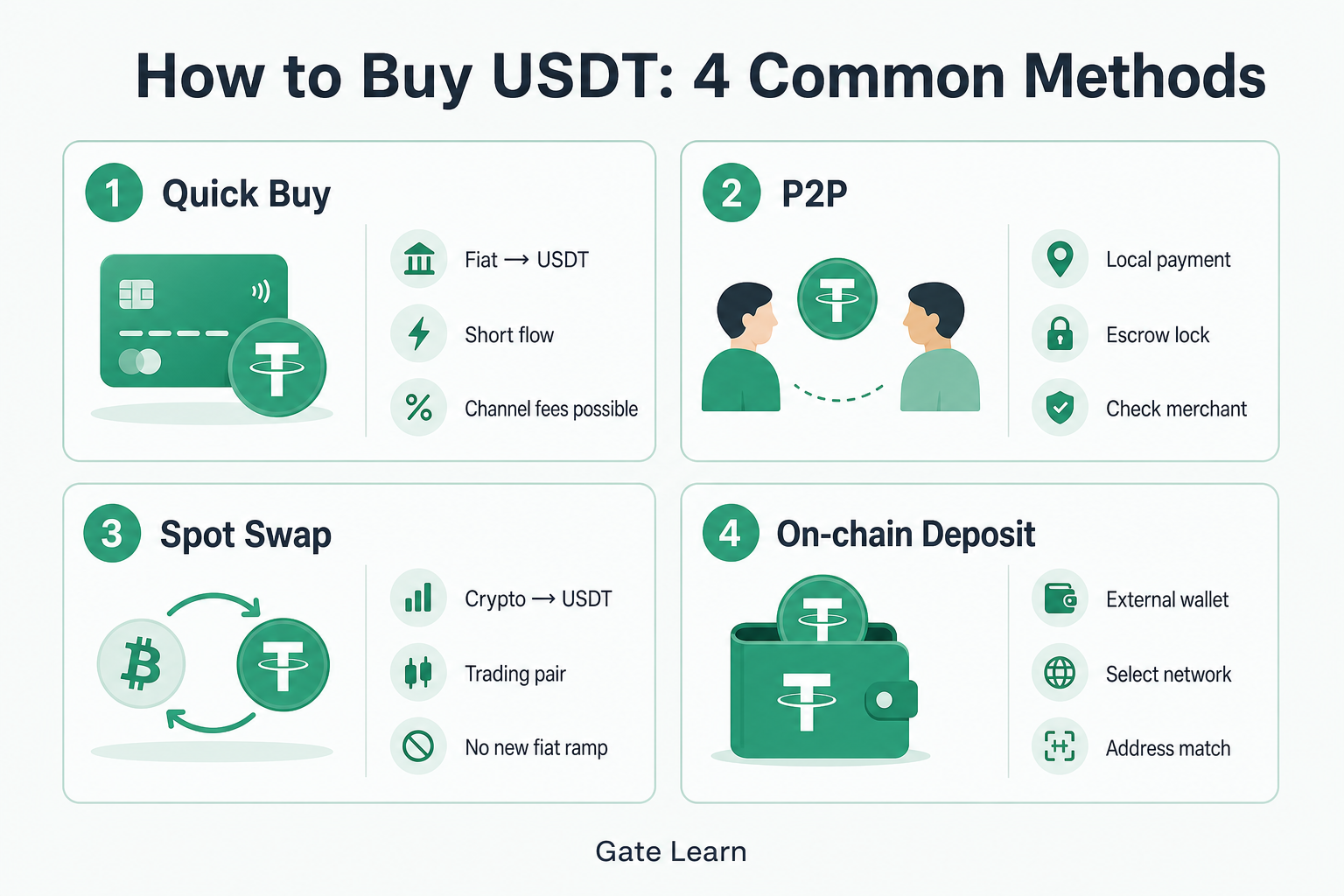
Figure 1. Four common paths to buy USDT: Quick Buy, P2P, spot swap, and on-chain deposit.
How Do You Buy USDT Step by Step?
The general purchase flow has six steps: create and verify the account → enable security settings → choose purchase method → enter amount and verify quote/limits → complete payment or trade → confirm credit in balance and order pages. Whether Quick Buy or P2P, do not confirm payment before verifying payee details or network name.
- Register and sign in: Use the official domain and official app; avoid lookalike sites in search results.
- Complete identity verification: Submit ID and liveness as required; confirm buy and withdraw permissions are active.
- Choose path: Quick Buy, P2P, spot, or deposit—confirm fiat currency and payment method; some channels support USD and EUR depending on region.
- Verify order fields: Amount, unit or total price, fee hints, payment time limit, merchant/channel name, and any stated purchase cap before paying.
- Complete payment or place order: P2P requires paying within the limit via seller instructions and tapping "I have paid"; Quick Buy follows channel guidance.
- Recheck credit: Spot/funding balance, order "completed" status; if withdrawing later, verify network separately.
Some providers accept Visa and Mastercard for Quick Buy, subject to local availability. Purchase limits vary by verification level and channel—always rely on the live order page for the exact cap.
"I have paid" does not equal "credited." In P2P, the platform usually locks the seller's USDT until the seller confirms fiat receipt; Quick Buy credits via channel callback and platform ledger. On errors, keep payment proof and use the platform order page to query or appeal—never transfer to off-platform accounts on instructions from unknown "support."
How Do You Buy USDT on Gate?
On Gate, Web users typically enter through Buy Crypto → Quick Buy or P2P Trading. Gate Help Center How to Buy USDT on Gate (Web) summarizes: complete registration and verification → choose purchase method → pay via Quick Buy or P2P. Users can access USDT through card, bank transfer, or local providers, depending on what Gate makes available on the page. Enable security features after purchase. USDT defaults to the spot account and can be transferred to futures or other accounts as needed.
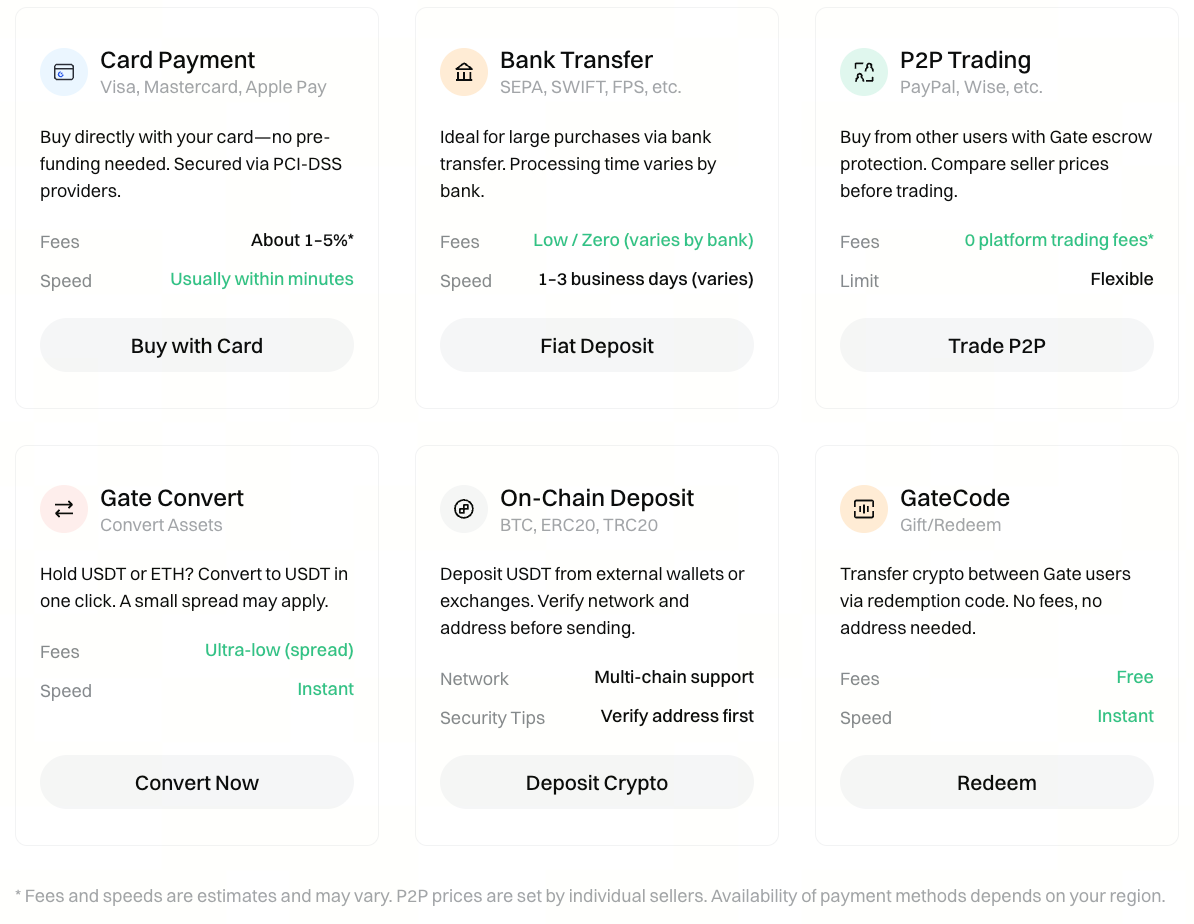
Gate Help notes Quick Buy often credits within minutes after payment confirmation; P2P depends on seller confirmation, commonly on the order of 15–30 minutes after "I have paid" (follow live order status). Limits vary by verification level, payment method, region, and path—always use the order page display. Button labels may change with product updates.
How Do You Choose a Network (TRC-20 / ERC-20) When Buying USDT?
When the goal includes withdrawing to an external wallet or depositing from outside, USDT network must be chosen separately. Common options include TRC-20 (TRON), ERC-20 (Ethereum), and other chains the platform lists. USDT can exist on multiple blockchains while remaining a dollar-pegged stablecoin, but the destination wallet must match the selected chain exactly. Wrong network usually means assets will not show as expected in the target wallet, and on-chain transfers are irreversible.
Before depositing or withdrawing, check four items: network name on the page matches the wallet network; address is copied from wallet/platform labels rather than guessed from prefix; the external wallet shows the official USDT contract, not a name-squat token; fees and confirmation times for that network are acceptable. If trading only inside one exchange account with no on-chain in/out, USDT ledger balance usually does not require choosing TRC-20 or ERC-20 each time. Once deposit or withdraw is clicked, network choice becomes mandatory. USDT TRC-20 vs ERC-20 Networks explains the two common rails and what happens when they are mismatched.
How Do Fees and Settlement Times Differ When Buying USDT?
Fees typically come from three layers: payment channel or bank fees, exchange/counterparty fees or spread, and on-chain deposit/withdraw network fees. Settlement time depends on payment clearing, P2P counterparty confirmation, spot matching, and block confirmations. Educational materials often describe bank-card channels as higher fee but faster; bank transfer as cheaper but slower; P2P platform fees tied to merchant quotes.
When comparing total cost, look at displayed unit price, channel fees, whether network fees are included, and cost of failed retries. Comparing advertised rates while ignoring spread or withdraw fees understates real spend. Specific rates follow the order confirmation and fee pages at order time and vary by region, payment method, and VIP tier.
What Are the Main Risks When Buying and Holding USDT?
Main risks include stablecoin issuer and reserve transparency, platform custody and account security, P2P payment and fraud, wrong network or address errors, and regulatory or service availability changes. USDT is designed to track the U.S. dollar closely, but that does not mean zero risk, government insurance, or a guaranteed peg under every market condition.
| Risk type |
How it shows up |
Verification action |
| Account & phishing |
Fake sites, fake support asking for codes |
Use official domain only; never share codes off-platform |
| P2P fraud |
Unpaid "confirmed," fake receipts, off-platform chat |
Stay in-platform; pay per order; keep proof |
| Network error |
Wrong withdraw chain; deposit to unsupported network |
Small test withdraw; verify chain and address |
| Custody concentration |
Large balances on one platform long term |
Assess whether self-custody is needed |
| Issuer & compliance |
Reserve, disclosure, jurisdiction limits |
Read issuer and platform public disclosures |
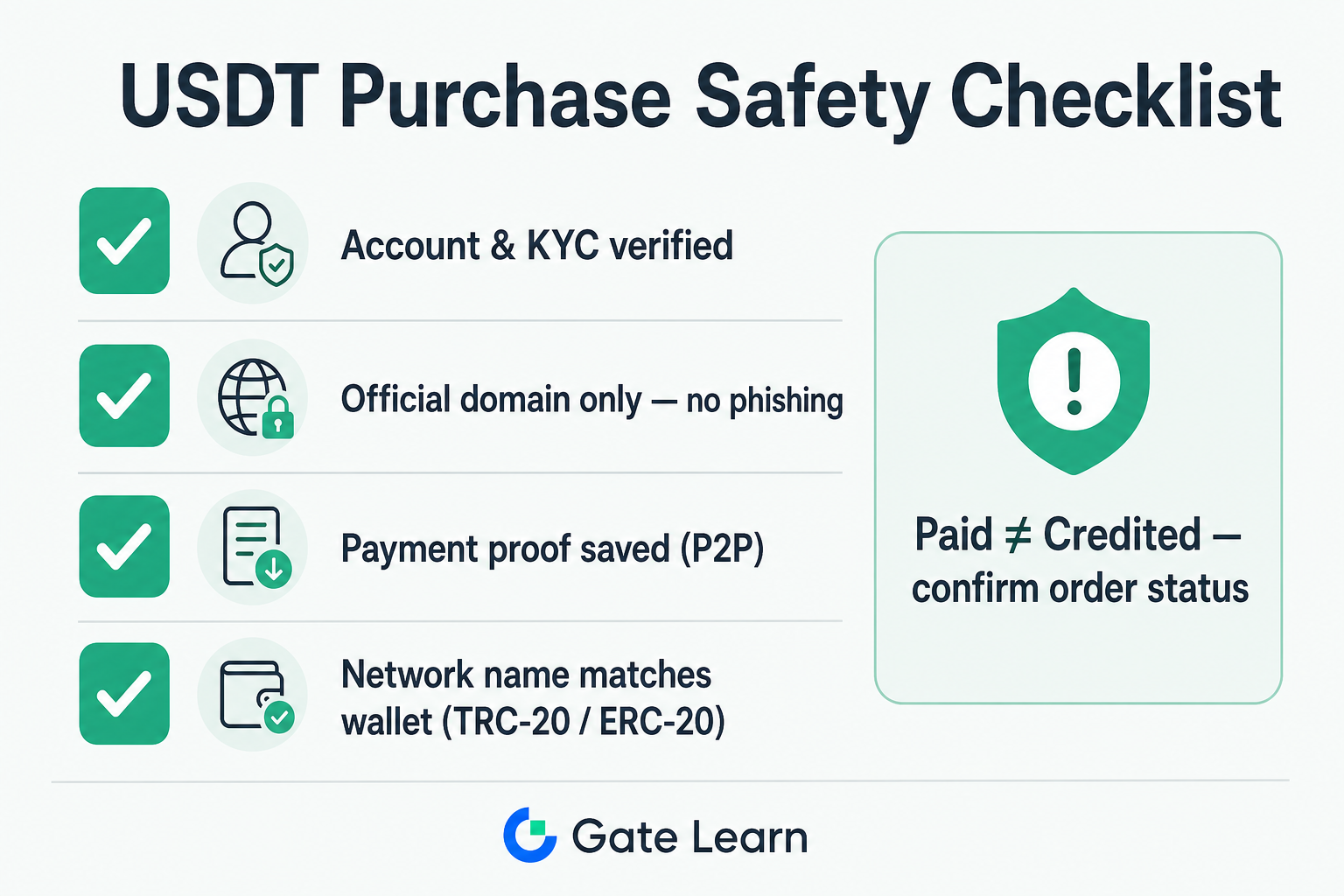
Figure 2. USDT purchase safety checklist: account & KYC, payment proof, network match, escrow rules.
The risk checklist is for pre-trade self-check, not investment advice. Any "guaranteed returns," "support will operate for you," or "transfer first then open account" messaging should be treated as high-risk.
Summary
Buying USDT comes down to choosing the right path, verifying price and fees, and confirming settlement account or network. Quick Buy favors speed; P2P favors local payment and merchant verification; spot swap serves users who already hold crypto; on-chain deposit serves users moving existing USDT. On Gate, use the official Buy Crypto entry for Quick Buy or P2P, recheck spot balance after credit, and handle TRC-20 / ERC-20 separately when withdrawing.
FAQ
What Is USDT? What Are You Buying When You Buy USDT?
USDT (Tether) is a dollar-pegged stablecoin issued by Tether Limited. Buying USDT means obtaining token balance in an account or on-chain—for trading pricing, fiat bridges, or margin—not buying equity or a bank deposit certificate. It is widely used as a settlement asset across exchanges and wallets, but issuer reserves, platform custody, and network selection still need separate checks.
Can You Buy USDT Without a Debit Card?
In some regions, e-wallets, local payment methods, or P2P merchant-supported options may work. Availability depends on the platform and merchant ads shown on the buy page and P2P filters. If no payment method matches, switch path or complete required verification.
Is KYC Required to Buy USDT?
Most centralized exchanges require identity verification (KYC) for fiat buy, deposit, and withdraw. Without verification, common outcomes are blocked orders, very low limits, or no withdraw. Exact tiers follow the account center display.
Is P2P Safe for Buying USDT?
P2P usually locks the seller's crypto in platform escrow; the buyer pays fiat per the order and the seller releases after confirming receipt. Safety depends on in-platform communication, verifying merchant and payment details, and keeping payment proof. Off-platform chat on Telegram, or marking "paid" before paying, are high-risk patterns.
Why Can't You See USDT in Balance After Purchase?
Common causes: funds in funding account vs the spot view currently open, order still pending, wrong coin filter, or on-chain deposit unconfirmed/wrong network. Check order details and transfer history first, then deposit TXID and network name for chain transfers.
USDT vs USDC: Which Should You Buy?
USDT and USDC are both common dollar stablecoins, but they differ in issuer, compliance structure, on-chain distribution, and platform support depth. Choice usually depends on pair liquidity, deposit/withdraw network support, and preference for issuer disclosures—not a single universal "better" answer.