Purchases associated with Strategy’s “Bitcoin Drive Engaged” signal may add buying pressure across Bitcoin and the wider crypto market, although even a record-high acquisition would not guarantee an instant rally. Market analysis must consider the amount of money deployed, the firm’s execution route, available liquidity, trader expectations, derivatives positioning, and the level of consensus already reflected in prices. The public view of Michael Saylor, Strategy’s co-founder and executive chairman, may also influence sentiment, but buyers and sellers across countries ultimately maintain control over the market response.
TL;DR
-
Strategy’s purchases can create direct demand for Bitcoin and reduce the amount of liquid BTC available to other buyers.
-
OTC execution may limit the initial effect on exchange order books, although dealers can create delayed demand when replenishing inventory.
-
An official purchase announcement can affect sentiment more visibly than the completed transaction itself.
-
A Bitcoin rally may spread into Ethereum, altcoins, derivatives, and crypto-related equities, but this transmission is not guaranteed.
-
ETF flows, macroeconomic conditions, leverage, miner selling, and profit-taking may outweigh the impact of a single corporate purchase.
Why Strategy’s Buying Bitcoin Purchases Attract Market Attention
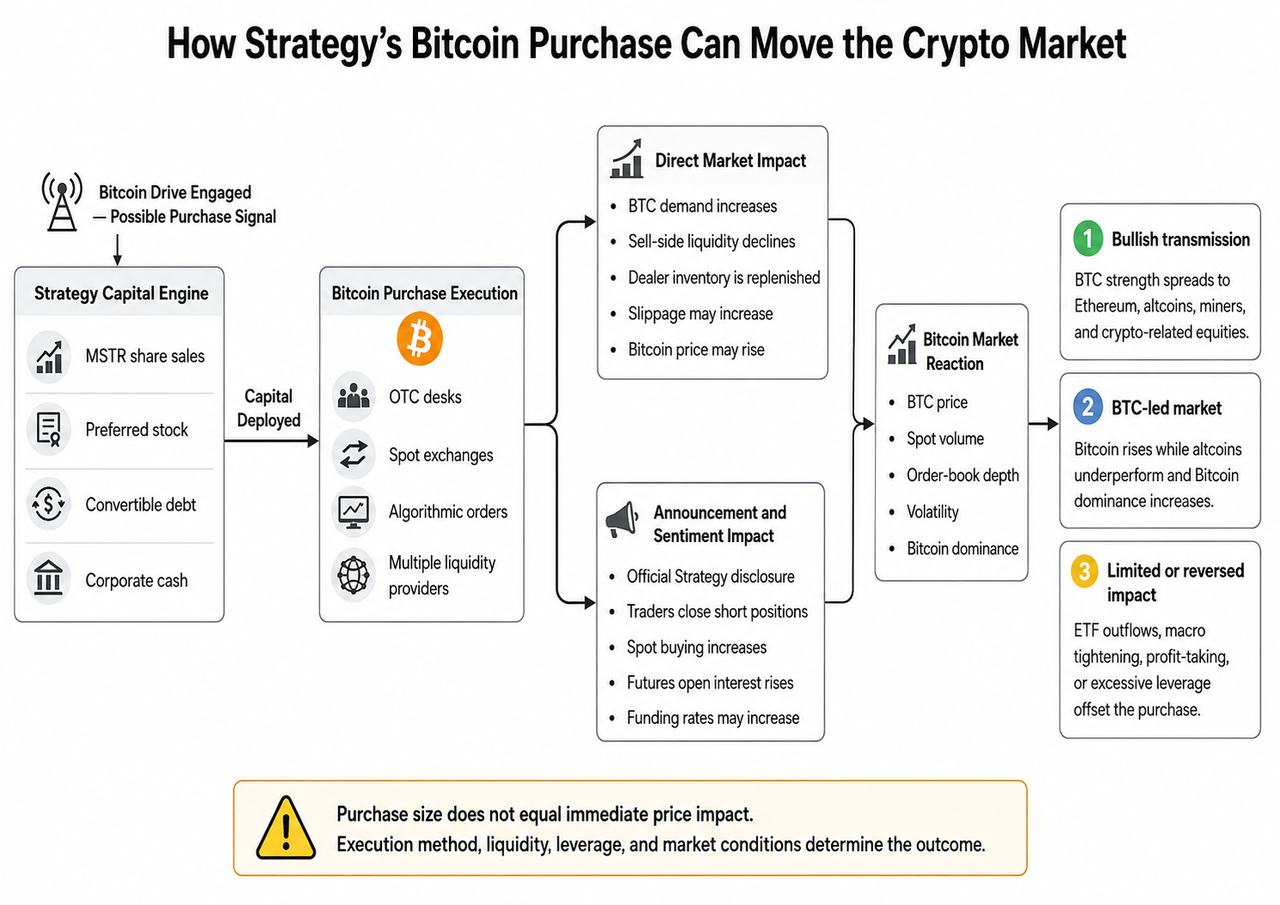
Corporate treasury buying bitcoin has largely faded among public companies, but Strategy still follows a recurring process to raise capital and convert part of it into Bitcoin as a treasury asset carried on its balance sheet. That makes the short answer to “could Strategy's bitcoin purchases move the crypto market” yes: its purchases can create direct demand and reduce liquid supply, but any effect depends on purchase size, execution, market liquidity, expectations, and broader conditions rather than causing an automatic price jump. Its funding methods can include common-share sales, preferred stock, debt instruments, and corporate cash, so understanding how Strategy finances Bitcoin purchases helps traders and investors judge the possible size, timing, and frequency of future acquisitions.
A Michael Saylor post containing the phrase “Bitcoin Drive Engaged” is generally interpreted as a possible acquisition signal, not proof that Strategy has completed another transaction. Confirmation normally comes through an official company announcement or an SEC filing that identifies the number of bitcoins acquired, total purchase cost, average price, funding source, and updated holdings. Because institutional purchases can improve confidence in Bitcoin as an asset, these signals draw attention from sophisticated retail traders, investors, and institutional participants trying to separate sentiment from actual market impact.
The scale of Strategy’s treasury operations gives these disclosures unusual visibility and makes the company one to watch when evaluating whether institutional demand could spread through spot markets, derivatives, and even altcoins. Strategy bought $2 billion worth of Bitcoin last week, and disclosure-driven updates like that matter more than social hints because they let the market assess execution method, possible OTC activity, supply-squeeze implications, and the limits of claiming direct causation from any single purchase.
These figures do not prove that every Strategy acquisition moves Bitcoin’s price. They show why market participants watch the company as a potentially persistent source of institutional demand and why understanding its acquisition process can improve how they read price action, sentiment shifts, and risk across crypto markets.
How a Strategy Purchase Could Move Bitcoin
The most direct mechanism is the interaction between buying demand and available sell-side liquidity. Large purchases can create upward price pressure when demand is already strong and investor interest is steady. A buyer seeking a large quantity of Bitcoin must find holders willing to sell or choose to hold less. When insufficient BTC is available near the current market price, the buyer may need to accept progressively higher prices, producing slippage and upward market impact.
However, institutional buyers rarely place an entire acquisition as one visible market order. They may divide purchases across time, exchanges, liquidity providers, execution algorithms, or over-the-counter desks.
Crypto OTC trading allows large transactions to be negotiated away from public order books. Request-for-quote systems and algorithmic execution can help institutions obtain liquidity while reducing immediate slippage and visible market disruption, though aggressive buying sprees can still absorb circulating supply and drive up Bitcoin's price even when execution is spread out.
OTC execution does not eliminate the economic effect of the purchase. A dealer may sell BTC from existing inventory and later replenish that inventory through exchanges, miners, market makers, or other large holders. Buying pressure may therefore reach the public market gradually rather than appearing as one large price candle, and the eventual impact still depends on market liquidity.
| Purchase condition |
Possible market effect |
| Large market order on a thin order book |
Strong immediate slippage |
| Order divided across exchanges and time |
More gradual price impact |
| OTC block matched with an existing seller |
Limited initial exchange impact |
| Dealer later replenishes BTC inventory |
Delayed buying pressure |
| Purchase anticipated before disclosure |
Muted announcement reaction |
| Purchase substantially exceeds expectations |
Stronger sentiment response |
The important distinction is between transaction size and effective market impact. Essentially, two equally sized purchases can produce different outcomes because liquidity, timing, execution, and trader positioning are different.
Why the Michael Saylor Announcement May Matter More Than the Trade
Strategy normally discloses an acquisition after the purchase period has ended. Consequently, some direct buying pressure may already be reflected in Bitcoin’s price by the time the announcement becomes public.
The disclosure can still create a second market reaction. It confirms that Strategy obtained financing, deployed capital, increased its Bitcoin holdings, and may remain capable of making additional purchases. Traders may interpret repeated acquisitions as evidence of continuing corporate demand, while rising prices can also invite FOMO among retail investors.
That reaction can lead participants to buy spot Bitcoin, close short positions, increase exposure to MSTR, or open leveraged futures positions. Because market sentiment is sensitive not just to buying but also to shifts in selling bitcoin strategies by major holders, the announcement-driven move can be more visible than the original institutional execution.
The market can also react negatively. A smaller-than-expected purchase, expensive financing, substantial share issuance, or signs that Strategy’s buying capacity is weakening may disappoint traders who had already positioned for a larger acquisition. Point: one risk traders watch is whether Michael Saylor’s company may eventually start selling Bitcoin to maximize returns, because that could unsettle Bitcoin’s market psychology.
How the Effect Could Spread Across Crypto
Bitcoin serves as the principal liquidity and risk benchmark for the crypto market, and its price often influences the broader cryptocurrency market. When Strategy-related demand contributes to a sustained BTC breakout, the effect may spread through several channels.
First, stronger Bitcoin prices can improve market sentiment. Capital may rotate from BTC into Ethereum and higher-volatility altcoins as traders seek additional exposure. This pattern is sometimes described as capital rotation, but it is conditional rather than automatic.
Second, rising BTC prices can increase the collateral value of accounts holding Bitcoin or crypto-linked assets. Higher account equity may support additional derivatives activity, potentially increasing open interest, funding rates, and trading volume.
Third, Bitcoin-related equities, miners, exchanges, and other treasury companies may respond to changing BTC expectations. MSTR can behave like a leveraged Bitcoin proxy, but it also reflects share dilution, preferred dividends, debt obligations, financing conditions, and its market-value premium or discount. The impact of Bitcoin purchases on Strategy and MSTR investors therefore differs from holding Bitcoin directly.
A BTC rally does not ensure that altcoins will outperform. Bitcoin dominance may rise when capital remains concentrated in BTC, causing smaller assets to underperform Bitcoin even when their US-dollar prices increase.
How Traders Can Evaluate the Market Impact at an All Time High
Traders should avoid attributing every Bitcoin move near a Strategy announcement to one corporate buyer. A more reliable assessment relies on market data rather than headlines alone and considers five variables:
-
Purchase size versus liquidity: Compare the acquisition with spot volume, order-book depth, and available sell-side liquidity rather than Bitcoin’s total market capitalization alone.
-
Execution period: Separate the dates when BTC was purchased from the later disclosure date, and remember that on-chain transparency can let traders observe large wallet movements that shape perception before formal disclosures.
-
Funding source: Equity sales, preferred stock, debt, and corporate cash have different implications for future purchasing capacity.
-
Derivatives positioning: High funding rates and rapidly rising open interest may indicate that leverage, rather than spot demand, is driving the move.
-
Broader conditions: ETF flows, interest-rate expectations, dollar liquidity, miner sales, regulation, and geopolitical risk may reinforce or overwhelm Strategy’s activity; sentiment can differ in bullish versus bearish conditions, and broader macroeconomic conditions can mitigate the effect of any single purchase.
Today, Bitcoin market structure is more diverse, so lasting trends depend more on wider demand and economic conditions than on one trade.
For example, a trader assessing whether a confirmed purchase supports a breakout can use an exchange like Gate to compare the live BTC/USDT spot chart with trading volume, order-book depth, and nearby resistance. A breakout supported by sustained spot activity may be more durable than a brief headline-driven price spike.
If the trader wants to determine whether speculation has become excessive, they can compare spot activity with the BTC/USDT perpetual futures market. Rising spot demand alongside moderate funding may indicate broader participation, whereas rapidly expanding open interest and expensive positive funding can increase the risk of a long-liquidation reversal.
Could Repeated Purchases on the Balance Sheet Create a Bitcoin Supply Squeeze?
Repeated Strategy purchases can reduce liquid supply when acquired Bitcoin moves into long-term custody instead of returning quickly to exchanges. The result is not that Bitcoin becomes unavailable. Higher prices can motivate miners, long-term holders, funds, and other institutions to sell.
A more accurate interpretation is that persistent demand may increase the price required to attract enough sellers. The effect becomes stronger when Strategy, spot Bitcoin funds, corporations, and long-term investors are accumulating simultaneously while exchange liquidity is declining.
This process normally develops over weeks or months rather than minutes. OTC inventory, profit-taking, miner production, ETF outflows, and sales by existing holders can absorb demand. A genuine supply squeeze requires sustained accumulation combined with limited willingness to sell—not merely one large purchase announcement.
Risks and Limitations
Strategy purchase announcements are not standalone buy signals. The transaction may have been completed before disclosure, anticipated by the market, or executed without materially affecting public order books, and Bitcoin can remain highly volatile even during accumulation phases, with daily moves of 5% often ordinary. Buying immediately after an announcement can therefore mean entering after the original demand has passed.
Leverage can amplify both directions. A bullish announcement may attract crowded long positions, but failure to continue higher can trigger liquidations and a rapid reversal. Macro tightening, ETF outflows, miner selling, regulatory shocks, or broad risk aversion may outweigh corporate demand. Even large-scale Bitcoin accumulation by corporate treasuries can influence market volatility rather than remove downside risk; Bitcoin once saw a nearly 80% drop from its all time high.
Causation is also difficult to establish. Bitcoin trades continuously across global exchanges, OTC desks, funds, derivatives venues, and peer-to-peer markets. A price move occurring near a Strategy disclosure may reflect several forces operating at the same time.
Conclusion
Strategy’s “Bitcoin Drive Engaged” purchases can affect Bitcoin and the wider crypto market through direct demand, reduced liquid supply, dealer inventory replenishment, and changing expectations about future institutional buying. Their influence is greatest when acquisitions are large relative to available liquidity and supported by other sources of spot demand.
The announcement may produce a stronger visible reaction than the purchase itself because traders respond collectively after the transaction becomes public. Any resulting Bitcoin move can spread into derivatives, MSTR, Ethereum, and altcoins, although capital rotation is neither immediate nor guaranteed.
Purchase size, execution timing, funding, spot volume, derivatives leverage, ETF flows, and macro conditions should be evaluated together. Strategy is an important market participant, but its acquisitions cannot determine Bitcoin’s direction independently.
Disclaimer: This content is for educational purposes only and does not constitute financial, investment, or trading advice. Crypto prices are volatile, and historical market reactions do not guarantee future performance.
FAQ
What is Bitcoin’s current price?
Bitcoin's price has struggled for six consecutive months since March 2026 and is trading at approximately $63,633 as of August 4, 2026. The asset remains well below its late-2025 record high, although its live price can change continuously across exchanges.
How much Bitcoin does Strategy currently hold?
Strategy, formerly known as MicroStrategy, currently holds 842,138 BTC following the sale of 1,638 BTC between July 27 and August 2, 2026. The company reported a total acquisition cost of approximately $63.51 billion, equal to an average cost of $75,419 per BTC.
What are Strategy’s Bitcoin holdings worth today?
At Bitcoin’s current price of approximately $63,633, Strategy’s 842,138 BTC are worth about $53.59 billion. This market valuation is roughly $9.9 billion below the company’s reported aggregate acquisition cost, although the figure changes whenever Bitcoin’s price moves.
What percentage of Bitcoin supply does Strategy hold?
Strategy’s 842,138 BTC represent approximately 4.01% of Bitcoin’s fixed 21 million maximum supply. As one organization accumulates a larger share of Bitcoin supply, concentration risk increases, although ownership does not give Strategy control over the Bitcoin network.
Is Strategy still buying Bitcoin at its fastest pace in a year?
No. The earlier claim that MicroStrategy was buying Bitcoin at its fastest pace in a year is no longer current. Strategy paused its accumulation and sold 1,638 BTC during the week ending August 2, 2026 to support preferred-stock dividends and share repurchases.
Did Bitcoin recently fall to around $76,000?
Yes, Bitcoin traded near $76,000 during the broader 2026 decline, but it has since fallen further. At approximately $63,633 on August 4, 2026, Bitcoin trades about 16% below $76,000.
Is Bitcoin’s volatility decreasing with adoption?
Bitcoin’s long-term volatility may moderate as liquidity, institutional participation, regulated funds, and market infrastructure expand. However, the decline from above $120,000 in late 2025 to below $60,000 during June 2026 shows that substantial price swings and drawdowns remain possible.