Michael Saylor’s “Bitcoin Drive Engaged” post may not be surprised to crypto community which point to another Strategy Bitcoin purchase, but the real impact on MSTR investors would not become clear until the funding details are known. The manner in which Strategy raises capital can make a significant difference: common-stock sales may dilute existing shareholders, preferred shares and convertible debt can increase financial obligations or leverage, while corporate cash can reduce available liquidity. Investors should therefore interpret the signal carefully, pay attention to Bitcoin per share and shareholder value, and remember that weak demand for MSTR or broader market uncertainty could change the extent of the outcome.
This analysis explains how a confirmed purchase could affect Strategy’s balance sheet, MSTR’s market price and the financial risk carried by existing shareholders. It is intended for MSTR investors, Bitcoin market participants and readers studying how a corporate Bitcoin treasury can amplify both gains and losses.
TL;DR
-
“Bitcoin Drive Engaged” may signal possible buying activity, but a post does not confirm that a transaction has happened.
-
Frequent Bitcoin purchases can dilute shareholders when Strategy finances them by issuing additional MSTR shares.
-
A purchase may still benefit investors when Bitcoin per diluted share rises after accounting for the new securities.
-
Debt and preferred stock can reduce immediate common-share dilution but add interest, dividends, conversion risk and refinancing obligations.
-
Weak demand for MSTR or fragile Bitcoin market conditions can compress its mNAV premium and produce sharper drawdowns than direct BTC ownership.
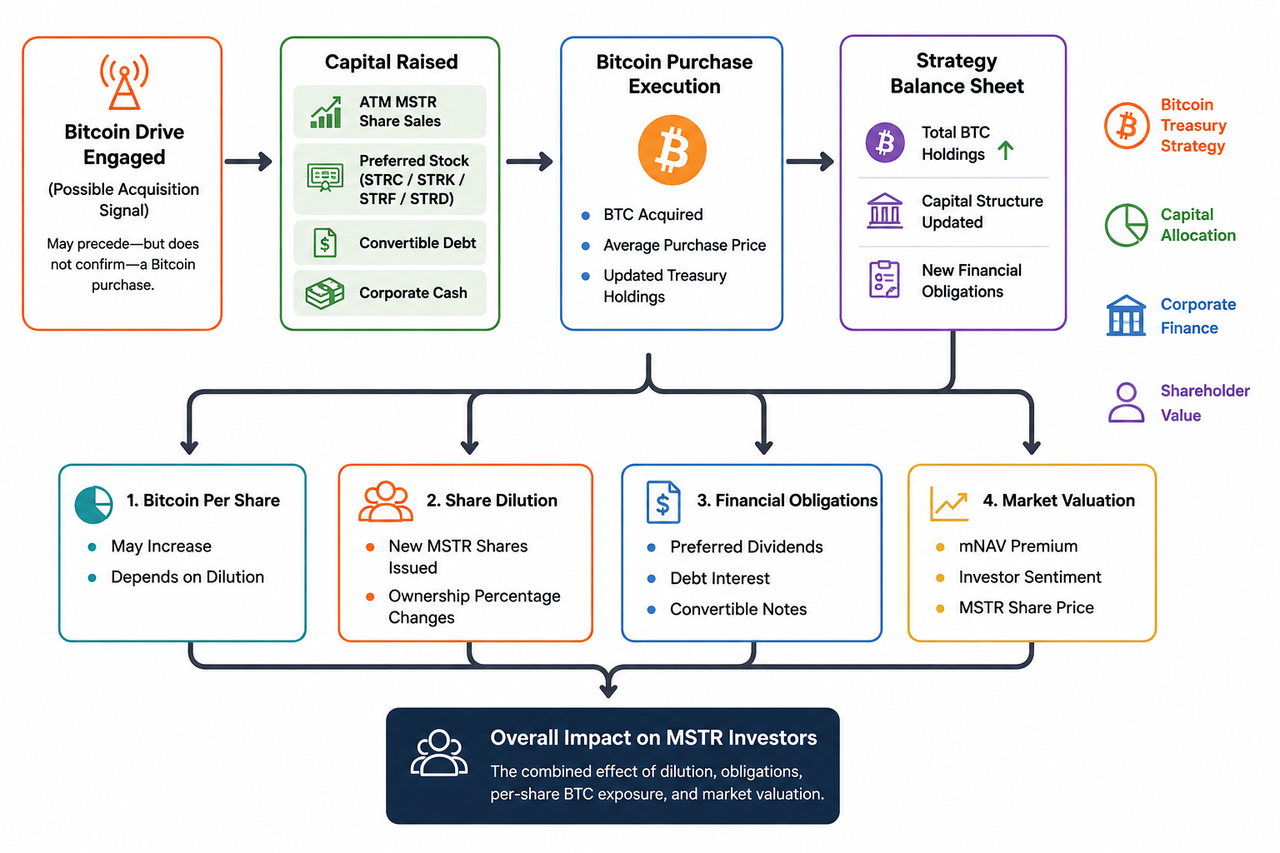
What Does “Bitcoin Drive Engaged” Mean?
The meaning of “Bitcoin Drive Engaged” is informal rather than contractual, but for MSTR investors the practical question is straightforward: a new Bitcoin purchase can help if Bitcoin per diluted share rises, or hurt if Strategy funds the buy with new common stock that dilutes existing holders; preferred stock, convertible debt, or cash change the tradeoff through dividends, debt obligations, or reduced liquidity. Investors commonly interpret the phrase as a possible signal that Michael Saylor and the Strategy team are preparing, executing, or considering another Bitcoin acquisition.
The wording should not be treated as confirmation. It does not tell the reader how much BTC Strategy may buy, what price it may pay, when settlement will happen, or which funding tool will support the transaction, and those details are what determine the effect on shareholder value, MSTR’s net asset value profile, and risk. That is why sophisticated MSTR shareholders, active traders, and crypto investors tracking MicroStrategy’s Bitcoin strategy should wait for the company announcement or SEC filing before drawing conclusions.
This section focuses on what “Bitcoin Drive Engaged” means, how to separate a social-media signal from a confirmed purchase, and which disclosed facts deserve attention first: acquisition cost, average BTC price, updated holdings, source of capital, and the likely dilution or leverage impact. That difference matters because market sentiment can move before the financing terms are known, and MSTR often reacts not just to Bitcoin itself but to how Strategy chooses to buy it.
How Financing Changes the Outcome for MSTR Investors
The manner in which Strategy raises money can matter as much as the Bitcoin purchase itself. The company can use common equity, preferred stock, convertible notes, cash reserves or a combination of these tools. Strategy reported 843,738 BTC, $6.7 billion of convertible-note principal and $15.5 billion of preferred stock outstanding as of May 25, 2026, illustrating the scale and complexity of its capital structure.
Common-Stock Issuance
The mechanics behind how Strategy finances Bitcoin purchases often begin with at-the-market MSTR share sales. Strategy sells newly issued shares and uses the proceeds to acquire BTC.
New share issuance reduces each existing investor’s percentage ownership. Frequent Bitcoin purchases can therefore dilute shareholders when the amount of stock issued grows faster than the Bitcoin exposure attributable to each share.
Dilution is not automatically destructive. When MSTR trades at a strong premium to the net value of Strategy’s assets, the company may raise enough capital per new share to increase Bitcoin per diluted share. Under weak demand, however, a lower stock price or contracting premium can make the same funding method less efficient.
Preferred Stock
Preferred shares can provide capital without immediately expanding the MSTR common-share count to the same degree. The cost appears through continuing dividend commitments and claims that generally rank ahead of common shareholders.
Strategy reported $692.5 million in cumulative preferred dividends declared and paid by May 3, 2026. Growing dividend requirements can reduce financial flexibility and increase pressure on liquidity during an extended Bitcoin downturn.
Convertible Debt
Convertible notes postpone some potential dilution until conversion conditions are met. They nevertheless add maturity, repayment and refinancing risk.
A substantial rise in MSTR may encourage conversion into common shares, increasing the diluted share count. If conversion does not occur, Strategy may need cash or replacement financing when the notes mature.
Corporate Cash
Using cash avoids issuing new securities, but the transaction can still pressure Strategy’s balance sheet. Money allocated to Bitcoin is no longer immediately available for operating expenses, debt management, preferred dividends or the company’s software business.
Why Bitcoin Per Share Matters
Total BTC holdings tell only part of the story. MSTR shareholders own equity in Strategy rather than a fixed slice of its Bitcoin wallet, so they need to study whether Bitcoin exposure is increasing faster than the diluted share count.
Suppose Strategy sells $1 billion of new MSTR shares and buys $1 billion of BTC. The company’s total Bitcoin holdings rise, but the result for existing investors depends on how many shares were issued. When the added BTC per new share exceeds the previous per-share exposure, the purchase may be accretive. When the share count grows faster, investors absorb dilution without a comparable improvement.
Strategy reported 220,900 satoshis of Bitcoin per share as of May 25, 2026. This company-defined measure can help explain the direction of per-share exposure, but it should be studied alongside debt, preferred obligations, cash reserves and conventional financial statements.
How a Purchase Could Happen and Affect MSTR’s mNAV
MSTR can trade at a premium or discount to the estimated net asset value of Strategy’s Bitcoin, operating business and other balance-sheet items. This relationship is often expressed through mNAV.
A strong Bitcoin acquisition may be interpreted as bullish when investors expect the company to keep increasing BTC per share. Positive sentiment can lift MSTR’s premium and make future equity financing more efficient.
The cycle can turn in the opposite direction. Weak demand, falling Bitcoin prices or fear of further dilution may cut the mNAV premium. Strategy’s public metrics showed mNAV close to 1.05 when accessed, far below the elevated multiples MSTR has received during stronger phases.
This feedback loop explains why market conditions affect how MSTR reacts to a purchase. The same acquisition may be welcomed during a rising Bitcoin market but considered an additional balance-sheet risk during a fragile or uncertain period.
Why Weak Demand Can Make MSTR Fall Faster Than Bitcoin
MicroStrategy’s stock has often acted as a high-beta proxy for Bitcoin because shareholders receive indirect BTC exposure through a traditional listed equity. A 2025 analysis reported a stronger historical correlation between MSTR and Bitcoin than between MSTR and software-sector equities.
However, MSTR contains risks that direct Bitcoin holders do not face:
-
common-share dilution;
-
preferred dividend commitments;
-
convertible-debt obligations;
-
changing mNAV;
-
corporate governance and operating risk;
-
dependence on capital-market access.
These additional variables can produce sharper losses. MSTR fell below $100 in June 2026 after losing roughly 80% from its record level, while current reporting has also highlighted a substantial decline from its 52-week high.
Buying Bitcoin during a falling market may also increase unrealized losses if BTC continues lower after the purchase. Fair-value accounting means changes in the value of Strategy’s Bitcoin can materially affect reported earnings even when the company does not immediately sell the asset.
How Investors Can Evaluate the Next Purchase
Investors can use the following sequence after Strategy confirms another acquisition:
-
Verify what happened. Check the amount of BTC purchased, total cost, average price and transaction date.
-
Identify the funding source. Determine whether the company used MSTR shares, preferred stock, debt or cash.
-
Measure dilution. Compare basic and diluted shares before and after the financing.
-
Review Bitcoin per share. Establish whether per-share BTC exposure improved.
-
Examine financial risk. Consider dividends, debt maturities, cash reserves and mNAV.
For example, an investor can compare Strategy’s disclosed purchase price with the current Bitcoin price and historical chart to understand whether buying occurred during a decline, consolidation or recovery phase.
If a trader wants to study whether the announcement is affecting BTC rather than only MSTR sentiment, they can compare the stock’s reaction with the live BTC/USDT market, price structure and trading volume on an exchange like Gate.com.
The broader cryptocurrency market can provide additional context when Bitcoin demand remains weak or divided. Federal Reserve expectations, liquidity conditions, derivatives positioning and general risk sentiment may have a greater effect on BTC than one corporate purchase.
A large Strategy order can attract attention and affect short-term sentiment, but a Strategy Bitcoin purchase cannot independently determine the wider market direction.
Risks and Limitations
Another Bitcoin purchase could strengthen Strategy’s treasury while simultaneously increasing financial pressure. The outcome depends on the purchase price, funding cost, future Bitcoin performance and continued demand for MSTR or Strategy’s preferred securities.
The broader market also remains vulnerable to uncertainty. Analysts in July 2026 suggested that macroeconomic pressure could restrain Bitcoin through the third quarter and leave a possible—but unconfirmed—bottoming process extending toward Q4. That view represents a market forecast rather than a verified future event.
Investors should remain careful when interpreting bullish posts, analyst comments or AI-generated price explanations. No model, market story or historical cycle can confirm where Bitcoin will bottom or how far MSTR may rise or fall.
Conclusion
A purchase associated with “Bitcoin Drive Engaged” may expand Strategy’s Bitcoin holdings, but the effect on MSTR investors depends on what the company gives up to fund it. Equity can dilute shareholders, preferred stock creates dividend commitments, debt adds refinancing risk and cash purchases reduce liquidity.
The strongest situation occurs when Strategy acquires more Bitcoin per diluted share without placing excessive pressure on its balance sheet. The main warning is that weak demand, falling BTC prices or a contracting mNAV premium can turn the same acquisition strategy into a source of amplified losses.
MSTR investors should therefore judge each purchase through its per-share economics and financing terms rather than assuming that more corporate Bitcoin is always positive.
FAQ
Can frequent Strategy Bitcoin purchases dilute MSTR investors?
Yes. Dilution occurs when Strategy issues additional common shares to finance purchases. The economic effect depends on whether Bitcoin per diluted share rises enough to compensate for the larger share count.
Can a Bitcoin purchase be a bullish signal for MSTR?
It can support bullish sentiment when investors expect the acquisition to improve Bitcoin per share and future capital-raising capacity. The signal remains conditional on the purchase price, funding structure and market environment.
Why can MSTR experience larger drawdowns than Bitcoin?
MSTR combines Bitcoin exposure with dilution, debt, preferred dividends, mNAV and corporate risk. These additional factors can amplify losses when BTC falls or demand for the stock weakens.
Could another purchase increase Strategy’s unrealized losses?
Yes. When Strategy buys BTC and the market price subsequently falls below the acquisition price, the value of that purchase declines. The eventual effect depends on future price movements and the relevant accounting period.
Is MSTR the same as owning Bitcoin directly?
No. MSTR provides indirect Bitcoin exposure through a public company with an operating business and an actively managed capital structure. Its performance can differ substantially from BTC.