For Bitcoin traders, MSTR investors, and other market participants trying to read Strategy’s corporate-finance signals, that distinction matters. Strategy has built a repeatable system for turning capital-market access into Bitcoin exposure, and understanding Saylor’s wording helps readers evaluate how the company finances purchases, how signal differs from confirmation, and how any move could affect share dilution, financing costs, Bitcoin per share versus total holdings, and near-term market reaction. Bitcoin traders and MSTR investors should therefore treat the phrase as an early corporate-finance signal rather than a confirmed purchase or standalone trading instruction.
TL;DR
-
“Bitcoin Drive engaged” suggests that Strategy’s Bitcoin acquisition machinery may be active or preparing for deployment.
-
Michael Saylor’s post does not specify a purchase amount, execution date, average price, or financing source.
-
Strategy can finance Bitcoin purchases through MSTR share sales, preferred securities, convertible debt, corporate cash, or other capital-management actions.
-
A confirmed acquisition should disclose the BTC purchased, total cost, average purchase price, updated holdings, and relevant financing activity.
-
More BTC does not automatically benefit MSTR shareholders; Bitcoin per share, dilution, financing costs, debt, and preferred-stock claims also matter.
-
Strategy’s activity may affect Bitcoin demand and sentiment, but one corporate buyer cannot determine the broader market trend.
What Does “Bitcoin Drive Engaged” Actually Mean?
“Bitcoin Drive engaged” uses the language of an operating or propulsion system. “Drive” represents the corporate machinery through which Strategy raises and allocates capital, while “engaged” suggests that this machinery has been switched on for what may signal aggressive accumulation of Bitcoin rather than a confirmed purchase.
The phrase is not an official accounting term, SEC classification, financing instrument, or Strategy performance metric. It is informal language used by Michael Saylor, Strategy’s founder and executive chairman, whose role includes overseeing the company’s Bitcoin acquisition strategy, and it often works as a social-media teaser for possible treasury activity rather than a formal disclosure.
The most accurate interpretation is:
“Bitcoin Drive engaged” suggests that Strategy may be preparing to raise or deploy capital toward Bitcoin, but an acquisition remains unconfirmed until the company publishes transaction details.
Saylor’s post did not state how much Bitcoin Strategy intended to acquire, whether an order had already been executed, or which financial instrument might fund the transaction. The post therefore communicates Strategy’s ongoing commitment to Bitcoin accumulation more clearly than completed action, while still stopping short of confirming execution.
Why Michael Saylor’s Signals Receive Attention
Michael Saylor has become closely associated with Strategy’s Bitcoin treasury policy. When he posts short Bitcoin-related messages, traders often compare them with Strategy’s previous announcements, acquisition patterns, and the time those signals appeared, while trader and investor reactions to his messages and later announcements can move Bitcoin’s price even before formal confirmation.
This attention creates two different effects.
The first is an expectation effect. Market participants may anticipate that Strategy will publish a purchase disclosure, raise additional capital, or resume accumulation after a pause.
The second is an information effect. Once Strategy releases an official filing, investors can evaluate the purchase amount, financing source, average price, updated holdings, and effect on the company’s capital structure.
Confusing these stages can produce premature conclusions. A social-media signal may affect sentiment, but it does not carry the evidentiary weight of a Strategy dashboard update or Form 8-K.
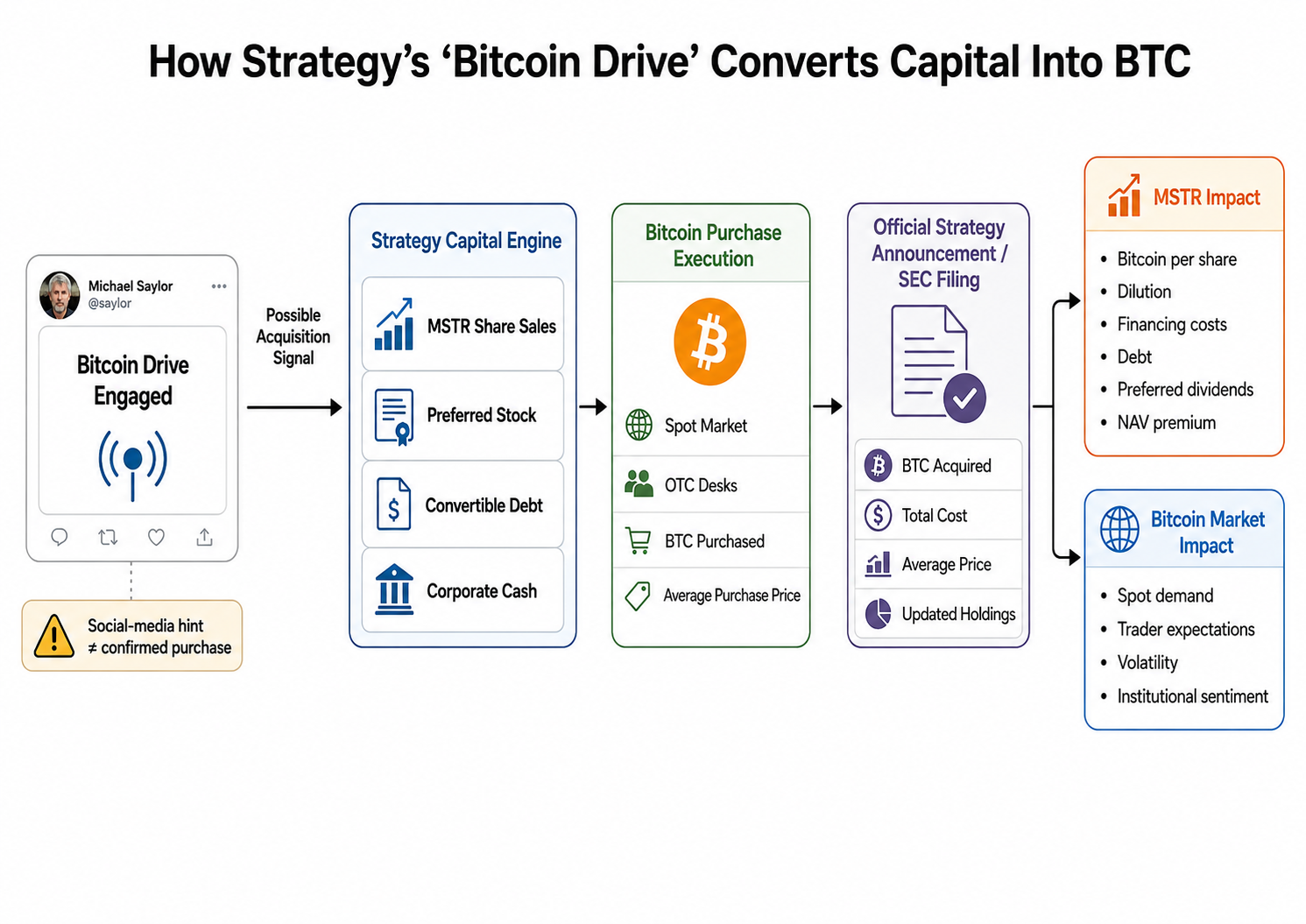
How Strategy’s Bitcoin Drive Converts Capital Into BTC
Strategy’s Bitcoin drive is a capital-markets process rather than a simple decision to spend spare cash. In practice, an engaged drive suggests active capital-raising and purchase execution mechanics may already be in motion. The company must consider the price of Bitcoin, the valuation of MSTR and its preferred securities, investor demand, financing costs, liquidity needs, debt obligations, expected dividends, and the confidence level it has in market conditions.
The process generally follows four stages:
-
Capital assessment: Strategy evaluates Bitcoin market conditions and the relative attractiveness of issuing, repurchasing, or holding its securities.
-
Financing: Capital may be raised through common equity, preferred stock, convertible notes, corporate cash, or a combination of sources, with equity issuance depending in part on valuation conditions, including whether the stock trades at a premium to Bitcoin net asset value.
-
Bitcoin execution: Approved capital can be deployed through institutional execution channels, including spot markets and over-the-counter desks, and large treasury buying can help stabilize demand during market downturns without eliminating downside risk.
-
Disclosure: Strategy reports material activity through company announcements, its public dashboard, and regulatory filings.
The mechanics behind how Strategy finances Bitcoin purchases determine the economic trade-off created by each acquisition.
Common-stock issuance has no scheduled repayment date, but it increases the number of shares outstanding. Preferred securities can limit immediate common-share dilution while introducing dividend and liquidation claims. Convertible debt may provide lower-cost capital under favorable conditions, but it creates repayment, refinancing, or conversion exposure. Corporate cash avoids new securities but reduces liquidity available for operations and financial obligations.
Strategy’s long-running model has consequently evolved beyond simply using excess corporate cash. Its treasury structure can combine equity, credit, preferred capital, Bitcoin holdings, and active balance-sheet management.
Signal Versus Confirmation: What Evidence Matters?
A Michael Saylor post is a signal. A Strategy disclosure is evidence.
Strategy states that its website dashboard serves as a public disclosure channel for information including Bitcoin purchases, aggregate holdings, security prices, and company-defined key performance indicators. Material updates may also appear in an SEC filing.
A confirmed Bitcoin purchase should normally identify:
-
the number of BTC acquired;
-
the aggregate purchase price;
-
the average price per BTC;
-
the purchase period;
-
Strategy’s updated aggregate holdings;
-
and related capital-raising activity where applicable.
Investors can then compare the acquisition with changes in diluted shares, debt, preferred securities, cash reserves, and financing costs.
For example, a trader reacting to “Bitcoin Drive engaged” may examine the live BTC/USDT chart on an exchange like gate.com to see whether price, spot volume, and volatility are responding to the message. Those indicators can measure market reaction, but they cannot confirm that Strategy has purchased Bitcoin.
Why Bitcoin per Share Matters More Than Total BTC
A company can increase its total Bitcoin holdings without increasing the Bitcoin exposure represented by each common share.
Suppose Strategy issues a large number of new MSTR shares and uses the proceeds to buy BTC. Total holdings rise, but the shareholder base also expands. The transaction becomes more attractive to existing common shareholders when Bitcoin holdings grow faster than the diluted share count.
Strategy uses Bitcoin Per Share to express gross Bitcoin holdings relative to assumed diluted shares outstanding. It also reports BTC Yield, a company-defined metric intended to measure the percentage change in Bitcoin per share over a period. Strategy cautions that BTC Yield is not investment yield, shareholder return, operating income, or a complete measure of financial performance.
This distinction is central to understanding the effect of another Bitcoin purchase on Strategy and MSTR.
| Factor |
Why It Matters |
| BTC acquired |
Shows the growth in Strategy’s Bitcoin reserve |
| Bitcoin per diluted share |
Indicates whether BTC growth exceeded dilution |
| MSTR shares issued |
Shows the common-equity cost of the purchase |
| Preferred stock issued |
Adds senior dividend and liquidation claims |
| Convertible debt |
Adds repayment, refinancing, or conversion exposure |
| Financing cost |
Determines the recurring burden created by new capital |
| Liquidity reserves |
Support interest and preferred-dividend payments |
| MSTR valuation |
Influences whether equity issuance may be accretive or dilutive |
No single metric captures the full outcome. Total holdings, Bitcoin per share, financing costs, and senior claims must be considered together.
What Could the Signal Mean for MSTR Investors?
For MSTR investors, “Bitcoin Drive engaged” may suggest renewed efforts to expand Strategy’s Bitcoin exposure. A confirmed purchase could support sentiment when investors believe that the financing will increase Bitcoin per diluted share without creating disproportionate obligations, and Saylor’s approach has also encouraged other companies considering Bitcoin as a treasury asset.
The reaction may be less favorable when the acquisition involves substantial common-share dilution, expensive preferred dividends, rising debt, weak liquidity coverage, or securities issued at unattractive valuations, especially if management does not intend to act like a passive observer when dislocations appear.
MSTR is therefore not equivalent to spot Bitcoin. Its market price reflects Bitcoin exposure alongside:
-
common and preferred securities;
-
debt and refinancing requirements;
-
dividend and interest obligations;
-
corporate liquidity;
-
software operations;
-
management execution;
-
and the premium or discount assigned to the treasury model, including whether investors sustain a premium valuation relative to Bitcoin’s net asset value.
This capital structure explains why Bitcoin treasury companies can move differently from BTC. MSTR shareholders own equity in a company with corporate liabilities and strategic choices; they do not have direct redemption rights over Strategy’s Bitcoin.
Could “Bitcoin Drive Engaged” Move Bitcoin?
The phrase may affect Bitcoin expectations before any acquisition is verified. Bitcoin traded around $63,364 when Saylor posted the message. Traders may position for a possible Strategy announcement or interpret Saylor’s message as evidence that institutional demand remains active, especially if price action looks ready to break.
A completed purchase can influence Bitcoin through two channels.
Direct market impact comes from actual buying activity. Its strength depends on the purchase size, execution schedule, available liquidity, market volatility, and whether the transaction occurs through spot or over-the-counter channels.
Signaling impact occurs when traders react to Saylor’s post, Strategy’s disclosure, or the possibility that other companies could adopt similar treasury policies.
The market impact of Strategy’s Bitcoin purchases should therefore not be measured only by Bitcoin’s price immediately after an announcement. Some purchases may be executed over several days, absorbed by institutional liquidity, or anticipated before disclosure.
Strategy is a major institutional Bitcoin holder, but Bitcoin trades globally across spot exchanges, derivatives platforms, exchange-traded products, institutional desks, and OTC markets. A Strategy acquisition can influence demand and sentiment without independently controlling the wider trend.
August 2026 Context
The event-specific figures should be treated as dated context rather than permanent characteristics of Strategy’s model.
Michael Saylor posted “Bitcoin Drive engaged” on Aug. 2, 2026. The message followed Strategy’s July 30 financial results, which reported 843,775 BTC as of July 26, 2026, equal to over 4% of bitcoin's total maximum supply, with an original cost basis of approximately $63.69 billion, an average purchase price of approximately $75,476 per coin, and a market value of about $53.3 billion at the time. Strategy also reported a $3.75 billion USD Reserve and $17.06 billion spent through at-the-market programs during 2026 up to that date.
Strategy had made no weekly purchases during the week ending July 26, and in July 2026 the company sold $218.4 million worth of Bitcoin, creating additional interest in whether Saylor’s new post signaled a return to accumulation. That backdrop included an $8.22 billion loss in the second quarter, driven by unrealized, paper based declines exceeding $10 billion, so the phrase could be read today as marking the end of the company's forced defensive phase and a move back toward buying on Monday.
These values will change as Strategy raises capital, buys or sells Bitcoin, repurchases securities, or adjusts its reserve policy. The durable question is not whether one dated figure rises or falls, but how efficiently the company converts capital into net Bitcoin exposure for shareholders.
How Strategy’s Capital Framework Changes the Meaning
Strategy’s treasury policy is no longer limited to one-way Bitcoin accumulation. Its Digital Credit Capital Framework includes a USD Reserve policy, preferred-security management, MSTR and preferred-stock repurchase authorizations, and a BTC Monetization Program. The company states that Bitcoin remains its primary treasury reserve asset while acknowledging the need for liquidity and active capital management, and because Strategy controls a significant share of Bitcoin in circulation, those choices can influence market dynamics.
This means “Bitcoin Drive engaged” should not be interpreted as proof that every dollar raised will immediately be converted into BTC. Strategy may also use capital to:
-
support preferred dividends and debt interest;
-
strengthen its USD Reserve;
-
repurchase preferred securities at discounts;
-
repurchase MSTR shares when authorized;
-
refinance or reduce debt;
-
fund an issue of new shares if needed;
-
or preserve liquidity during adverse market conditions, including BTC monetization activity such as the July sale of $218.4 million worth of Bitcoin rather than only accumulating more tokens.
The phrase indicates a possible direction, but the financing details determine the economic result.
Risks and Common Misinterpretations
The first risk is treating the phrase as a confirmed acquisition. Even if readers take “Bitcoin Drive engaged” as the end of a defensive holding period, Strategy may still alter the amount, timing, or financing route before executing a purchase.
The second is assuming that more BTC always benefits MSTR shareholders. Total holdings can increase while dilution, preferred dividends, debt, or financing costs reduce the benefit to common equity.
The third is relying on BTC Yield as a complete valuation measure. It does not represent cash income, shareholder return, financial liquidity, or future MSTR performance.
The fourth is assuming that Strategy can only buy Bitcoin. Its capital framework permits limited BTC monetization for defined liquidity and capital-management purposes.
Finally, neither Saylor’s conviction nor Strategy’s historical purchases predict Bitcoin’s next move. His signature posting style can function as a bullish teaser, but traders should not treat that language as proof of a trend reversal or immediate buying pressure. They should evaluate market structure, liquidity, leverage, macroeconomic conditions, ETF flows, and risk controls instead of relying on one social-media post.
Conclusion
“Bitcoin Drive engaged” most likely means that Michael Saylor is signaling activity within Strategy’s Bitcoin-focused capital engine. The phrase may precede capital raising or another acquisition, but it does not confirm that Strategy has purchased BTC.
Its long-term value as a market concept comes from the process behind it: Strategy raises capital, allocates funds, executes Bitcoin purchases, and then reports the result. For MSTR investors, the financing cost, dilution, senior claims, and effect on Bitcoin per share matter as much as the purchase size. For Bitcoin traders, the phrase is a sentiment signal that requires official confirmation and broader market analysis.
FAQs
What does “Bitcoin Drive engaged” mean?
“Bitcoin Drive engaged” suggests that Strategy’s Bitcoin acquisition and capital-raising machinery may be active. It is an informal Michael Saylor expression rather than an official financial or regulatory term.
Does the phrase confirm that Strategy bought Bitcoin?
No. A Strategy dashboard update, company announcement, or SEC filing is required to verify a completed purchase and its transaction details.
How does Strategy finance Bitcoin purchases?
Strategy can use MSTR share sales, preferred securities, convertible debt, corporate cash, or a combination of financing sources. Each route affects dilution, dividends, debt, liquidity, and shareholder exposure differently.
Why does Bitcoin per share matter?
Bitcoin per share shows whether Strategy’s gross Bitcoin holdings are growing faster than its diluted share count. It provides more context than total BTC alone, although it does not capture every liability or financing cost.
Is “Bitcoin Drive engaged” a Bitcoin buy signal?
No. The phrase may influence sentiment, but it does not guarantee a Strategy purchase or a rise in Bitcoin’s price.
Can Strategy sell Bitcoin?
Yes. Strategy’s capital framework permits limited BTC monetization for specified liquidity, dividend, interest, and capital-management purposes, subject to company policies and market conditions.
Disclaimer: This content is for educational purposes and does not constitute financial, investment, tax, or trading advice. Strategy’s holdings, financing programs, reserve policies, and capital-allocation decisions can change. Social-media signals and historical transactions do not guarantee future purchases or market performance.