This analysis is aimed at sophisticated retail crypto traders and investors, institutional participants, and businesses tracking Strategy’s Bitcoin playbook and its market implications. It focuses on how Strategy funds acquisitions, what “Bitcoin Drive Engaged” may signal, how common stock, preferred stock, convertible debt, and cash differ as funding tools, and where the main capital-markets and balance-sheet risks sit. The goal is practical: understand the financing mechanics behind large Bitcoin buys so you can better judge market sentiment, dilution risk, and potential BTC price impact.
TL;DR
-
Strategy’s at-the-market share programs can convert investor demand for MSTR into capital for additional Bitcoin purchases.
-
Preferred securities such as STRC, STRK, STRF, and STRD provide alternative funding channels with different dividend and conversion terms.
-
Convertible notes can raise large amounts of capital but add interest, maturity, refinancing, and potential dilution risks.
-
Corporate cash may fund a smaller purchase, although Strategy must preserve liquidity for operations, interest, and preferred dividends.
-
“Bitcoin Drive Engaged” is a possible acquisition signal, not proof that a purchase has already occurred.
What Does “Bitcoin Drive Engaged” Mean?
“Bitcoin Drive Engaged” appears to fit Saylor's broader signaling pattern that Michael Saylor and Strategy may be preparing for another stage of Bitcoin accumulation. The phrase reflects Strategy’s established approach of using corporate finance and capital markets to increase its BTC holdings rather than relying only on operating cash flow.
However, a social-media post does not establish whether an order has been executed. It also does not disclose the amount of Bitcoin involved, the acquisition period, the average purchase price, or the financing instrument. The meaning and limitations of the signal are addressed in what “Bitcoin Drive Engaged” means for Strategy.
This kind of teaser often leads investors to speculate on future Bitcoin transactions.
Investors generally need to wait for a Form 8-K, earnings release, or official holdings update, which often arrives on Monday after the relevant reporting period closes. For example, a filing may clarify whether Strategy bought no Bitcoin during the week ending a stated date, while also stating the number of BTC acquired, aggregate cost, average purchase price, updated Bitcoin holdings, and whether the purchase used proceeds from an at-the-market offering.
How Strategy’s Bitcoin Financing Engine Works
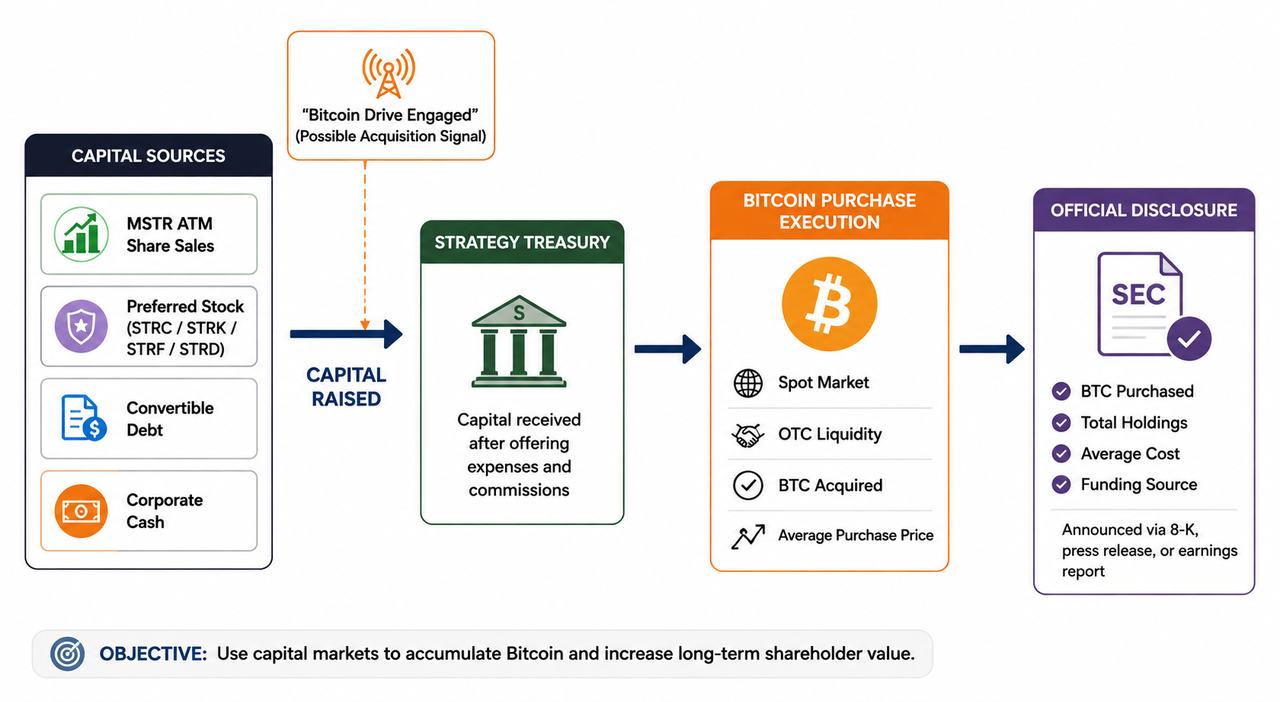
Strategy has developed a capital structure that can issue securities to investors and redirect the net proceeds toward Bitcoin. The process can be summarized as:
-
Strategy selects a financing instrument.
-
Investors purchase MSTR shares, preferred stock, or debt securities.
-
Strategy receives cash after commissions and offering expenses.
-
The company executes Bitcoin purchases through institutional trading channels.
-
Strategy reports the acquisition and updated BTC holdings.
This structure allows Strategy to raise capital beyond the cash generated by its software operations, and it also had a 3.75 billion cash reserve as an internal liquidity source. Strategy also controls a large BTC position, and each additional coin it buys depends on financing conditions. Flexible asset management can also provide secondary liquidity between capital raises. It also connects the company’s Bitcoin acquisition capacity to investor demand, security valuations, market liquidity, and its cost of capital.
Strategy reported raising $11.68 billion during the opening months of 2026 and holding 818,334 BTC as of May 3, 2026, a notable share of bitcoin's total maximum supply. The same first-quarter release said STRC had raised $5.58 billion, demonstrating how preferred securities had become a significant part of the funding model.
Selling MSTR Common Shares
An at-the-market, or ATM, offering is likely to remain one of Strategy’s most flexible financing routes. An ATM program allows the company to sell newly issued MSTR shares gradually at prevailing market prices instead of completing a single fixed-price offering.
Strategy’s SEC filings repeatedly state that reported Bitcoin purchases were financed with proceeds from shares sold under ATM programs. An April 2026 filing also referred to an additional $21 billion MSTR offering capacity, so new shares remain one route even though Strategy has a cash reserve of $3.75 billion available.
Common-stock issuance is most attractive when MSTR trades at a premium to the underlying value of Strategy’s Bitcoin and operating assets. A higher share valuation allows the company to raise a given amount of capital by issuing fewer shares.
The trade-off is dilution. Each new share reduces existing investors’ proportional ownership unless the resulting Bitcoin acquisition creates enough additional value per share to offset that effect. The potential consequences for equity holders depend on the purchase price, issuance price, Bitcoin performance, and changes in Strategy’s Bitcoin exposure and MSTR shareholder risk.
Issuing Preferred Stock
Preferred stock gives Strategy another way to raise capital without relying entirely on MSTR common shares. The company has created several preferred securities, including STRC, STRK, STRF, and STRD, with different dividend, seniority, volatility, and conversion characteristics.
These instruments may appeal to investors who want exposure to Strategy’s capital structure but prefer income-oriented securities over the volatility of MSTR common stock. Strategy can sell preferred shares through public offerings or ATM programs and use the net proceeds for Bitcoin purchases and general corporate purposes.
Preferred financing can reduce immediate common-share dilution, but it creates dividend obligations. If Strategy issues more preferred stock, the company must generate or retain dedicated liquidity to make those payments; Strategy previously sold 3,588 BTC in July to fund preferred stock distributions. Its filings state that the company expects to issue additional preferred stock and continue carrying fixed financial obligations as part of its Bitcoin strategy.
Raising Convertible Debt
Convertible notes allow Strategy to borrow capital while giving investors the possibility of converting their debt into MSTR shares under specified conditions. This feature can make the notes more attractive than conventional corporate bonds and may reduce the interest rate investors demand.
Strategy can then allocate the proceeds to Bitcoin without immediately issuing common stock. Conversion may occur later if MSTR reaches the agreed conditions, meaning dilution is delayed rather than necessarily avoided.
Convertible debt introduces several risks. Strategy must manage interest expenses, maturity dates, refinancing conditions, and potential conversion into additional shares. A weaker MSTR price, tighter credit market, or lower demand for Bitcoin-linked securities could also raise the cost of future borrowing.
Using Corporate Cash and the USD Reserve
Strategy could use available corporate cash for a smaller Bitcoin acquisition, but its cash balance also supports software operations and a dollar reserve set aside for obligations. In December 2025, the company established a USD reserve intended to help fund preferred-stock dividends and interest on outstanding debt.
Using that reserve for Bitcoin would avoid an immediate securities issuance. Strategy recently sold $218.4 million worth of Bitcoin to replenish that reserve. But it could reduce Strategy’s liquidity buffer. Management does not intend to rely only on that reserve for major Bitcoin accumulation, and it is still too early to write off external financing routes while reserve usage is being evaluated. Management must therefore compare the expected benefit of acquiring more BTC with the need to preserve cash for preferred stock distributions, debt service, operating costs, and periods of market stress.
Corporate cash is consequently more likely to supplement an equity or preferred-stock raise than replace capital-market financing for a major purchase.
Which Financing Method Is Most Likely?
Common-stock and preferred-stock sales appear to be the most plausible near-term financing sources, although Strategy and Executive Chairman Michael Saylor have not confirmed the method for any purchase implied by “Bitcoin Drive Engaged.”
Recent SEC disclosures show repeated use of ATM proceeds for Bitcoin acquisitions. As of Aug. 2, Strategy holds 843,775 BTC valued at approximately $53.25 billion. That financing scale also looks different when its average price paid per bitcoin is $75,653. Strategy’s 2026 results show rapid growth in preferred funding. Convertible debt remains available in principle, but it carries repayment and refinancing requirements that equity does not.
The practical choice depends on several variables:
| Factor |
Financing implication |
| Strong MSTR valuation |
Common-stock issuance may become more efficient |
| Demand for STRC or other preferred shares |
Preferred issuance may raise capital with less immediate common dilution |
| High borrowing costs |
Convertible debt may become less attractive |
| Large liquidity reserve |
Cash may supplement a purchase |
| Weak capital-market demand |
Strategy’s acquisition capacity may decrease |
For example, a trader evaluating whether a new Strategy purchase could influence Bitcoin can compare the disclosure with the live BTC/USDT market, trading volume, order-book conditions, and the timing of the acquisition on a exchange like Gate.com. A corporate purchase announcement alone does not establish that Bitcoin’s price will rise.
Could Strategy Use Several Funding Sources Together?
Strategy could combine common shares, preferred stock, and cash within the same acquisition period. A blended approach would allow the company to avoid depending excessively on one investor group or financing instrument.
For example, MSTR ATM proceeds could provide most of the capital, preferred-stock sales could add incremental funding, and corporate cash could cover the remaining amount or transaction expenses. This approach offers flexibility but creates a more complicated capital structure with several layers of shareholder, dividend, and creditor claims.
The broader model resembles the financing cycle used by Bitcoin treasury companies that raise capital to expand crypto reserves. Strategy’s scale and range of securities make its approach more developed than a simple decision to hold Bitcoin on a corporate balance sheet.
Risks and Limitations
Every financing method transfers risk to a different part of Strategy’s capital structure. In the second quarter of 2026, Strategy reported an $8.33 billion operating loss. During the reporting period, its unrealized loss on Bitcoin exceeded $10 billion. Common-share sales create dilution, preferred shares create dividend commitments, debt creates repayment obligations, and cash purchases reduce liquidity.
Bitcoin concentration also exposes Strategy to substantial price volatility. SEC disclosures warn that concentrating corporate assets in Bitcoin reduces the diversification benefits available from holding a broader portfolio.
A large purchase may affect market sentiment without causing an immediate or lasting Bitcoin price increase. Market impact depends on whether the purchase was already anticipated, how it was executed, available liquidity, derivatives positioning, and broader investor demand. These variables shape how Strategy’s Bitcoin purchases could affect the crypto market.
Conclusion
Michael Saylor could finance Strategy’s next Bitcoin purchase through MSTR share sales, preferred-stock issuance, convertible debt, corporate cash, or a combination of these channels. Recent financing activity makes common and preferred equity the most plausible routes, but that remains an evidence-based inference rather than a confirmed transaction plan.
“Bitcoin Drive Engaged” may indicate that Strategy’s capital and acquisition process is active. The decisive confirmation, based on what is known today, will come from an official disclosure stating how much Bitcoin was acquired, the average purchase price, and which financing instrument supplied the capital.
This content is for educational purposes only and does not constitute financial or investment advice. Bitcoin, MSTR, preferred securities, and corporate debt involve market, liquidity, dilution, credit, and capital-structure risks.
FAQs
Does Michael Saylor need to sell Bitcoin before buying more?
No. Strategy is not a passive observer of the market and already holds 843,775 BTC valued at about $53.25 billion. Strategy has historically expanded its Bitcoin holdings by raising new capital rather than selling existing BTC. Depending on market conditions, the company can issue common shares, preferred stock, convertible debt, or use available corporate cash to finance additional purchases while continuing its long-term Bitcoin treasury strategy.
Why doesn't Strategy simply use operating profits to buy Bitcoin?
Strategy's software business generates cash flow, but it is relatively small compared with the size of its Bitcoin acquisitions. Large purchases have generally been financed through capital markets, allowing the company to acquire substantially more Bitcoin than operating cash alone could support while preserving liquidity for business operations.
Could Strategy combine multiple financing methods for one Bitcoin purchase?
Yes. Strategy could combine several funding sources within the same acquisition period. For example, proceeds from an MSTR at-the-market offering could be supplemented by preferred-stock issuance or existing cash reserves. The exact financing mix depends on market conditions, investor demand, and the company's capital allocation strategy.
Does a "Bitcoin Drive Engaged" post guarantee that Strategy has bought Bitcoin?
No. "Bitcoin Drive Engaged" should be viewed as a possible acquisition signal rather than confirmation of a completed purchase. At the time of publication, Saylor's posts often lead investors to speculate on future Bitcoin transactions, but confirmation still depends on company statements and SEC filings that disclose the purchase amount, average acquisition price, funding source, and updated Bitcoin holdings.
Could another Strategy Bitcoin purchase affect Bitcoin's market price?
It can influence market sentiment, but the price impact is not guaranteed. The effect depends on factors such as the purchase size, execution method, overall market liquidity, investor expectations, and broader macroeconomic conditions. Large institutional purchases may already be priced into the market before an official announcement.