In the Bitcoin Liquidity Finance (BLF) system, it has become common for different assets to serve different functions. Lorenzo separates BTC principal, liquidity, and yield rights into different assets, creating a higher level of capital efficiency and financial composability. Understanding how these three assets relate to one another is an important foundation for understanding the structure of the Lorenzo Protocol ecosystem.
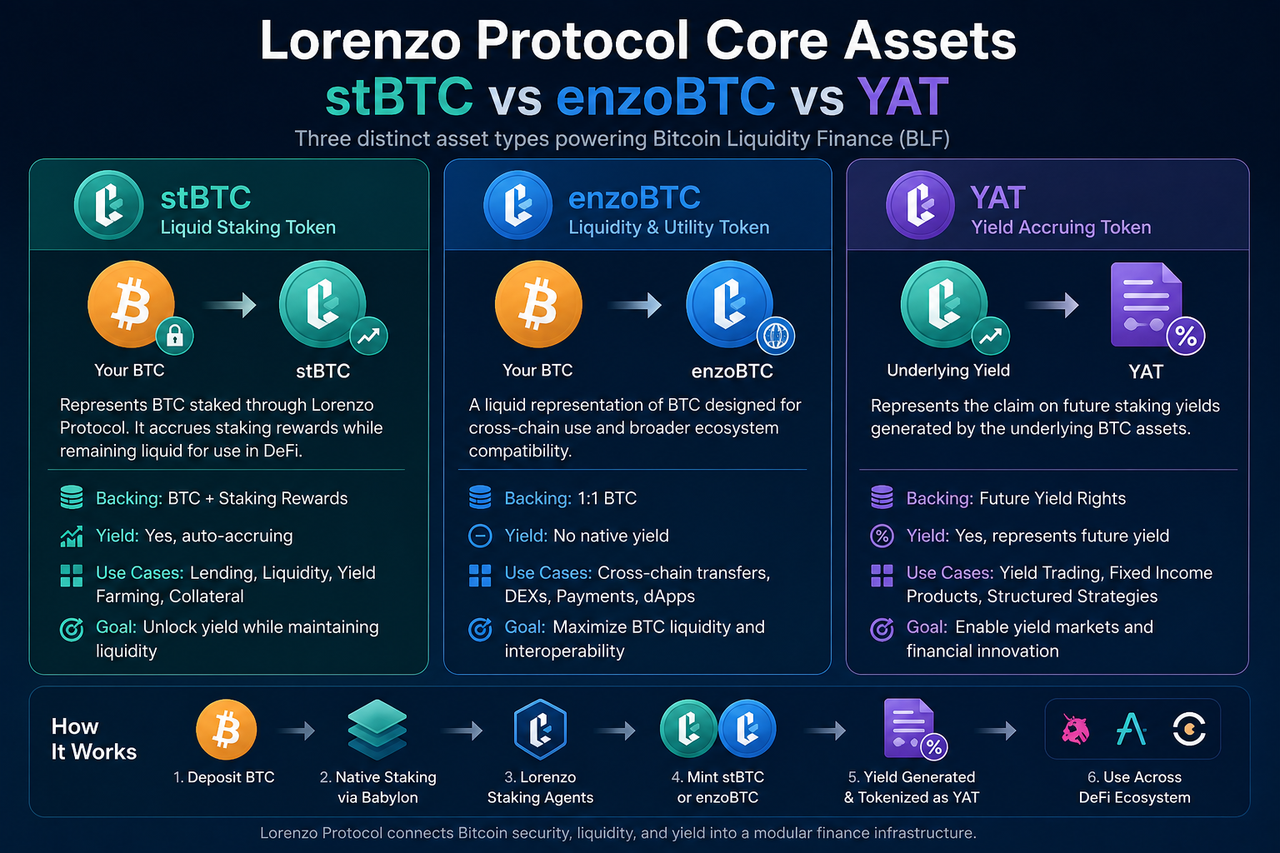
What Is stBTC?
stBTC represents the liquid staking asset users receive after participating in Bitcoin native staking.
When BTC enters the staking system supported by Lorenzo, the protocol issues a corresponding amount of stBTC to the user. This asset represents the user’s rights to the underlying BTC and its related yield while preserving on-chain liquidity.
The core value of stBTC lies in solving the liquidity loss caused by traditional staking lockups.
Holders can earn underlying staking yield while using stBTC in lending, liquidity pools, or other DeFi scenarios.
As a result, stBTC is usually regarded as the base liquidity asset in the Lorenzo ecosystem.
What Is enzoBTC?
enzoBTC mainly supports the expansion of BTC liquidity across ecosystems.
Compared with stBTC, which emphasizes yield accrual, enzoBTC focuses more on the efficiency of asset circulation across different blockchain networks and application scenarios.
Through enzoBTC, Bitcoin can enter more on-chain application ecosystems in a unified form.
This design helps improve BTC usability in a multi-chain environment and reduces the complexity of asset migration.
For this reason, enzoBTC is closer to a liquidity bridging and asset mapping tool.
What Is YAT?
YAT (Yield Accruing Token) is a yield rights certificate asset designed by Lorenzo.
YAT corresponds to the future yield generated by underlying BTC staking, rather than to the BTC principal itself.
This design draws on the logic in traditional financial markets where yield certificates and principal certificates are separated.
Through YAT, yield rights can be traded, priced, and managed independently.
Once yield and principal are separated, market participants can choose to hold principal assets or yield assets according to their own needs, creating a richer yield market structure.
How Do the Design Goals of the Three Assets Differ?
Although all three assets originate from the BTC ecosystem, they solve entirely different problems.
stBTC mainly addresses liquid staking.
enzoBTC mainly addresses cross chain liquidity.
YAT mainly addresses the independent circulation of yield rights.
From a financial perspective, the three correspond to:
This layered design allows BTC to have yield potential, liquidity, and financial composability within the same system.
How Do Their Underlying Sources of Value Differ?
The value sources behind these assets are not the same.
The value of stBTC comes from the underlying BTC and its accumulated yield.
As staking rewards increase, the asset value represented by stBTC gradually grows.
The value of enzoBTC mainly comes from the corresponding BTC asset itself.
Therefore, enzoBTC places more emphasis on asset mapping and cross chain use than on yield growth.
The value of YAT comes directly from future staking yield.
If future yield increases, the yield value represented by YAT will also change.
In essence, YAT is closer to a yield rights asset.
How Do Their Yield Mechanisms Differ?
The yield structure is the part where the three assets are most easily confused.
stBTC carries both principal rights and yield rights.
After holding stBTC, users can indirectly receive the rewards generated by underlying BTC staking.
enzoBTC usually does not directly carry a yield accrual function.
Its core goal is to provide liquidity and composability, rather than generate yield.
YAT, by contrast, is specifically tied to the yield component.
Holding YAT means holding rights to future yield, but not necessarily ownership rights to the underlying BTC principal.
For this reason, YAT is closer to the concept of a yield certificate in fixed income markets.
How Do Their DeFi Use Cases Differ?
In the DeFi ecosystem, the three assets also have clearly different uses.
stBTC is usually used for:
enzoBTC is usually used for:
-
Cross chain asset movement;
-
Multi chain ecosystem interaction;
-
A unified BTC liquidity entry point.
YAT is usually used for:
At the application level, stBTC serves foundational DeFi liquidity, enzoBTC supports asset circulation, and YAT serves the yield finance market.
Core Differences Between stBTC, enzoBTC, and YAT
The most direct differences between the three assets can be compared in the table below.
| Comparison Dimension |
stBTC |
enzoBTC |
YAT |
| Asset Type |
Liquid staking asset |
Liquidity mapping asset |
Yield certificate asset |
| Corresponding Rights |
BTC principal + yield |
BTC principal |
BTC future yield |
| Yield Accrual |
Supported |
Usually not supported |
Yield itself |
| Liquidity Use |
High |
High |
Moderate |
| DeFi Compatibility |
High |
High |
Specific scenarios |
| Core Goal |
Liquid staking |
Cross chain liquidity |
Yield tokenization |
| Risk Source |
Staking and protocol risk |
Cross chain and mapping risk |
Yield volatility risk |
From the perspective of the overall architecture, stBTC is closer to an LST asset, enzoBTC is closer to a BTC liquidity carrier, and YAT belongs to the category of yield finance tools.
Why Did Lorenzo Design Three Different Assets?
The core reason Lorenzo Protocol uses a multi asset architecture is to improve BTC capital efficiency.
Traditional BTC assets can only serve as a store of value.
By separating principal, liquidity, and yield rights, the protocol allows different types of users to choose the asset form that best matches their needs.
This design has some similarities with how bond principal, coupons, and derivatives are separated in traditional financial markets.
The more granular the asset separation, the richer the range of financial products a market can usually support.
For this reason, a multi asset structure is an important part of Bitcoin Liquidity Finance.
Conclusion
stBTC, enzoBTC, and YAT respectively represent the liquid staking asset, liquidity mapping asset, and yield rights asset in the Lorenzo Protocol ecosystem. Although all three are built on BTC, their functions are entirely different.
stBTC connects Bitcoin staking with the DeFi ecosystem, enzoBTC is responsible for expanding cross chain liquidity, and YAT enables the independent circulation of yield rights. By separating principal, liquidity, and yield into different asset layers, Lorenzo builds a more flexible Bitcoin Liquidity Finance system, allowing BTC to participate in more complex on-chain financial activities.
FAQs
What Is the Biggest Difference Between stBTC and enzoBTC?
stBTC represents liquid staking rights after participating in Bitcoin staking and accrues underlying yield at the same time. enzoBTC is mainly used to improve BTC cross chain liquidity and ecosystem compatibility, and it usually does not carry a yield accrual function.
Does YAT Represent BTC Principal?
YAT does not represent BTC principal. YAT mainly corresponds to the future yield rights generated by the underlying asset, so holding YAT is not the same as holding the underlying BTC asset.
Does stBTC Continue to Earn Yield?
stBTC usually reflects the yield generated by underlying BTC staking, so its corresponding value may grow as yield accumulates.
Why Does Lorenzo Separate Yield From Principal?
Separating yield from principal allows yield rights to be traded independently. This lets market participants manage principal risk and yield risk separately, improving the flexibility of financial products.
Is enzoBTC a Liquid Staking Asset?
enzoBTC is mainly positioned as a liquidity mapping tool and cross chain asset carrier, rather than a typical liquid staking asset. Its design focus is clearly different from that of stBTC.
Which Asset Is Best Suited for DeFi Applications?
In the Lorenzo ecosystem, stBTC usually has the highest DeFi compatibility and can be used in scenarios such as lending, liquidity pools, and yield aggregation. As a result, it is one of the most common assets used in DeFi applications.