As the Bitcoin ecosystem gradually evolves from a store of value into a yield finance market, more protocols are exploring ways to improve BTC capital efficiency. Lorenzo Protocol and Solv Protocol represent two different development paths. One leans toward infrastructure building, while the other focuses more on yield management platforms, making both important representative projects in the Bitcoin Finance sector.
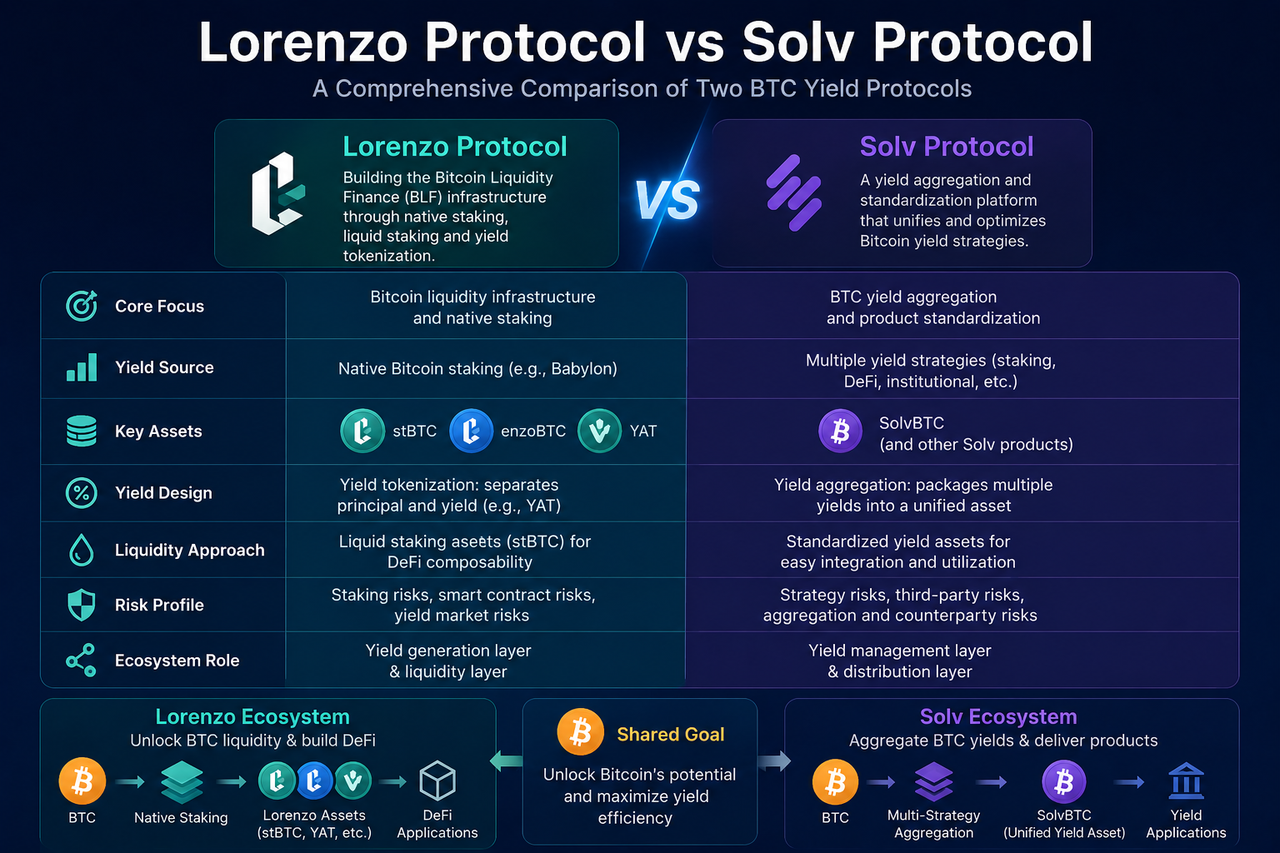
What Is Lorenzo Protocol?
As a liquidity finance protocol built for the Bitcoin ecosystem, Lorenzo Protocol’s core goal is to unlock BTC capital efficiency through native staking, liquid staking assets, and yield tokenization.
Lorenzo is built on Bitcoin native staking infrastructure. By connecting the security layer, liquidity layer, and application layer, it creates a complete Bitcoin Liquidity Finance (BLF) system.
In the Lorenzo ecosystem, BTC can not only generate yield, but also continue participating in DeFi applications through assets such as stBTC.
For this reason, Lorenzo is closer to a BTC financial infrastructure network.
What Is Solv Protocol?
As a protocol focused on digital asset yield management and yield standardization, Solv Protocol initially explored on-chain bonds and yield certificates, then gradually expanded into the BTC yield market and launched product systems such as SolvBTC.
Solv’s core idea is to package BTC yields from different sources into a unified structure and provide users with standardized yield assets.
For this reason, Solv is closer to a BTC yield aggregation platform than a protocol based on a single yield source.
How Do Their Core Positions Differ?
The biggest difference between Lorenzo Protocol and Solv Protocol lies in their ecosystem positioning.
Lorenzo aims to build BTC liquidity finance infrastructure, with a focus on native staking, liquid staking, yield tokenization, and the financial product layer.
Solv focuses more on yield management and yield aggregation, aiming to integrate multiple yield sources into a unified asset framework.
Simply put:
Lorenzo creates and unlocks yield.
Solv integrates and manages yield.
How Do Their BTC Yield Sources Differ?
Yield source is one of the most important differences between the two.
Lorenzo’s Yield Source
Lorenzo mainly relies on Bitcoin native staking.
After BTC enters the underlying staking system, it earns rewards, which are then distributed to users through the protocol.
As a result, the yield source is relatively direct and clearly defined.
Solv’s Yield Source
Solv uses a multi strategy yield model.
Its yield may come from BTC staking, liquidity mining, DeFi yield strategies, institutional grade yield products, and other on-chain yield sources, making Solv more like a yield aggregator.
By comparison, Lorenzo is closer to a yield production layer.
How Do Their Asset Architectures Differ?
The asset system reflects the core design logic of each protocol.
Lorenzo’s Asset Architecture
Lorenzo mainly builds a multi layer financial system around stBTC, enzoBTC, and YAT, where principal, liquidity, and yield rights can be managed separately.
Solv’s Asset Architecture
Solv mainly builds a unified yield asset framework around SolvBTC and the SolvBTC Yield Vault.
Users interact more with standardized yield products rather than multiple functionally separated assets.
Therefore, Lorenzo uses an asset separation model, while Solv uses an asset aggregation model.
How Do Their Liquidity Designs Differ?
Liquidity design reflects the different development directions of the two protocols.
Lorenzo focuses on liquid staking.
After receiving stBTC, users can continue participating in lending, DEX liquidity pools, and yield protocols.
Liquidity and yield exist at the same time.
Solv, by contrast, emphasizes the standardization of yield assets.
Its liquidity mainly serves the circulation of yield products and yield management needs.
Therefore, both protocols support on-chain liquidity, but that liquidity serves different purposes.
How Do Their Yield Tokenization Methods Differ?
Yield tokenization is an important feature of Lorenzo.
Through the YAT mechanism, Lorenzo separates future yield from principal.
The market can trade the following independently:
-
BTC principal;
-
BTC yield rights.
This model is relatively close to traditional fixed income markets.
Although Solv also provides yield assets, it usually uses yield aggregation and unified packaging.
Yield is not split into an independent market in the same way it is with Lorenzo.
Therefore, Lorenzo places greater emphasis on the financialization of yield.
Solv places greater emphasis on the productization of yield.
How Do Their Risk Structures Differ?
Different design paths also lead to different sources of risk.
Lorenzo’s Main Risks
The main risks Lorenzo faces include:
Solv’s Main Risks
The risks Solv faces are more diverse.
They include:
In theory, the more yield sources a protocol uses, the more potential risk dimensions it may face.
For this reason, the risk structures of the two protocols are fundamentally different.
Which Model Is Better Suited to the Bitcoin Finance Ecosystem?
The two models are not necessarily substitutes for each other.
Lorenzo mainly addresses how BTC can generate yield.
Solv mainly addresses how BTC yield can be managed.
From an industry value chain perspective:
As the BTC financial market continues to mature, both types of protocols may become important parts of the ecosystem.
Therefore, the two are more like upstream and downstream components than completely overlapping competitors.
Core Comparison of Lorenzo Protocol and Solv Protocol
| Comparison Dimension |
Lorenzo Protocol |
Solv Protocol |
| Core Positioning |
BTC liquidity finance layer |
BTC yield aggregation platform |
| Core Goal |
Unlock BTC liquidity |
Aggregate BTC yield |
| Main Yield Source |
Native BTC staking |
Multi strategy yield |
| Core Assets |
stBTC, enzoBTC, YAT |
SolvBTC |
| Yield Structure |
Yield separation |
Yield aggregation |
| Liquid Staking |
Supported |
Partially supported |
| Yield Tokenization |
Strong |
Moderate |
| Application Direction |
BTC financial infrastructure |
BTC yield management |
| Ecosystem Role |
Yield production layer |
Yield management layer |
Overall, Lorenzo focuses on building financial infrastructure, while Solv focuses on integrating yield products.
Conclusion
Lorenzo Protocol and Solv Protocol both aim to improve Bitcoin capital efficiency, but they follow different development paths. Lorenzo builds a Bitcoin Liquidity Finance system around native staking, liquid staking, and yield tokenization, allowing BTC to gain both yield potential and liquidity. Solv, meanwhile, uses yield aggregation and standardized asset design to integrate BTC yields from different sources into unified products.
From an ecosystem positioning perspective, Lorenzo is closer to BTC yield production infrastructure, while Solv is closer to a BTC yield management platform. Together, they help push Bitcoin’s evolution from a store of value into a yield bearing financial asset, but they focus on different parts of the value chain.
FAQs
What Is the Biggest Difference Between Lorenzo Protocol and Solv Protocol?
Lorenzo Protocol mainly builds its ecosystem around Bitcoin native staking and liquidity finance, while Solv Protocol mainly focuses on BTC yield aggregation and standardized yield asset management. Their core positioning is different.
Where Does Lorenzo Protocol’s Yield Mainly Come From?
Lorenzo Protocol’s yield mainly comes from staking rewards generated by the underlying Bitcoin native staking network and is distributed through liquid staking assets and yield certificates.
Is Solv Protocol a Liquid Staking Protocol?
Solv Protocol is not a typical liquid staking protocol. Solv focuses more on integrating BTC yields from different sources and providing users with yield products through standardized assets.
What Is the Difference Between Lorenzo’s YAT and SolvBTC?
YAT represents future yield rights and is a yield tokenization asset. SolvBTC is a standardized BTC yield asset that integrates multiple yield sources. The two follow clearly different design logic.
Are Lorenzo Protocol and Solv Protocol Competitors?
Lorenzo Protocol and Solv Protocol overlap in some markets, but their value positioning is different. Lorenzo focuses on yield generation and liquidity release, while Solv focuses on yield management and asset integration.