As the DeFi market gradually shifts from high volatility speculation toward stable yield products, “yield bearing stablecoins” are becoming an important direction in on-chain finance. Compared with traditional stablecoins, which are mainly used for payments and trading, yield bearing stablecoins aim to maintain price stability while continuously generating returns for users. This trend has also encouraged more protocols to explore yield models based on funding rates, arbitrage structures, and market neutral strategies.
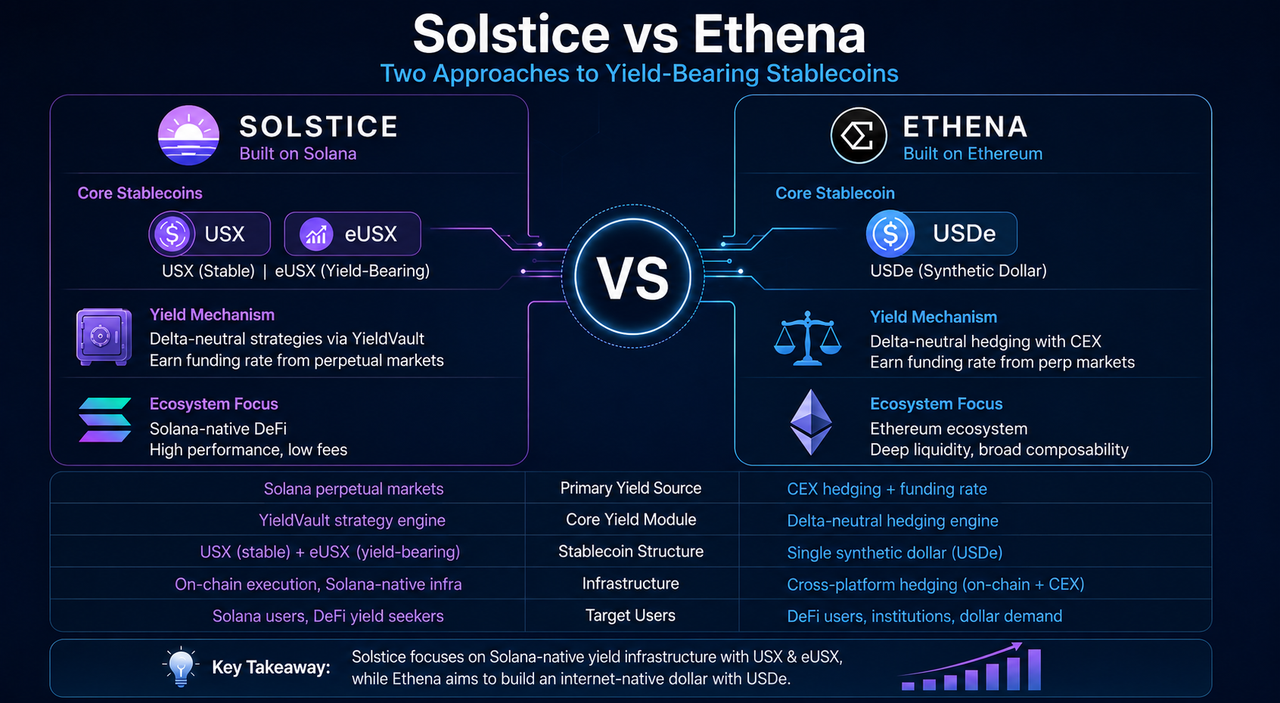
Solstice and Ethena are two of the more closely watched yield bearing stablecoin protocols in the current market. Although both use Delta neutral strategies and funding rate logic, they differ clearly in underlying ecosystem, protocol positioning, and product structure.
What Is Solstice?
As a yield bearing stablecoin protocol built on Solana, Solstice’s core products include USX, eUSX, and the YieldVault yield module.
The protocol generates yield through Delta neutral strategies and perpetual contract funding rates, then reflects that yield in assets such as eUSX. Compared with traditional stablecoin protocols, Solstice places greater emphasis on “how stable assets generate yield.”
Its core positioning is not simply that of a stablecoin, but rather yield infrastructure within Solana DeFi. Through structured yield strategies, on-chain asset management, and a stablecoin system, the protocol aims to provide users with institutional grade yield products.
What Is Ethena?
As a yield bearing stablecoin protocol built within the Ethereum ecosystem, Ethena’s core product is the synthetic dollar USDe.
Unlike traditional fiat backed stablecoins, USDe does not rely entirely on bank reserves. Instead, it uses spot assets and short positions in perpetual contracts to build a Delta neutral hedging system.
Ethena’s core logic is that the protocol holds spot assets such as BTC and ETH while opening corresponding short positions on centralized exchanges. This helps reduce directional market risk while generating yield through funding rates.
Because its goal is to build an “internet native dollar,” Ethena places greater emphasis on dollar substitution logic and a cross platform liquidity system.
How Do Solstice and Ethena Differ in Stablecoin Structure?
Both are yield bearing stablecoin protocols, but their stablecoin design logic is not the same.
Solstice’s core assets include USX and eUSX. USX is closer to the stablecoin itself, while eUSX represents an asset share with yield bearing characteristics.
Ethena’s core asset is USDe, which itself is a synthetic dollar with a yield structure.
From a design perspective:
There are also differences in asset custody and hedging structure. Ethena relies more on cross platform hedging and centralized exchange liquidity, while Solstice leans more toward a Solana native on-chain yield system.
How Do Their Yield Sources Differ?
The core yield sources of Solstice and Ethena are both related to funding rates, but the implementation paths differ.
Solstice’s yield mainly comes from funding rates in Solana perpetual markets and on-chain yield strategies. The protocol executes Delta neutral strategies through YieldVault and distributes the yield to eUSX holders.
Ethena’s yield depends more on the hedging structure between the Ethereum ecosystem and centralized exchanges. The protocol manages both on-chain assets and short positions on centralized platforms.
The differences are:
| Comparison Dimension |
Solstice |
Ethena |
| Core Yield Source |
Solana perpetual market funding rates |
CEX hedging and funding rates |
| Yield Module |
YieldVault |
Delta neutral synthetic dollar structure |
| Main Market |
Solana native market |
Ethereum + centralized exchanges |
| Yield Reflection Method |
Growth in eUSX value |
USDe yield structure |
| Product Direction |
Yield infrastructure |
Synthetic dollar system |
Solstice is more focused on on-chain yield management, while Ethena places greater emphasis on a dollar asset system.
How Do Solstice and Ethena Differ in Risk Models?
Although both use Delta neutral structures, their sources of risk are not exactly the same.
Solstice depends more on the Solana DeFi ecosystem, so its main risks include:
Ethena relies more on cross platform hedging, so it also faces:
-
Centralized exchange risk
-
Custody risk
-
Cross platform liquidation risk
-
Synthetic dollar structure risk
In addition, because Ethena is larger in scale, its systemic risk has also attracted more market attention.
It is important to note that a market neutral strategy does not mean “risk free.” Even if a protocol reduces price volatility risk, it may still be affected by liquidity conditions, funding rates, and extreme market volatility.
Why Have Solana and Ethereum Developed Different Yield Stablecoin Directions?
The differences between Solana and Ethereum’s ecosystem structures have also shaped the development paths of yield bearing stablecoins.
Ethereum places more emphasis on global liquidity, institutional capital, and dollar asset systems. As a result, Ethena is more inclined to build an “on-chain dollar.”
Solana, by contrast, places more emphasis on high performance DeFi and on-chain trading efficiency. This is why Solstice focuses more on yield strategies and on-chain asset management.
From a network characteristics perspective:
As a result, the development directions of these two types of yield bearing stablecoins have gradually diverged.
Which Users Are Solstice and Ethena Suitable For?
Solstice is more suitable for users focused on the Solana DeFi yield ecosystem.
Because the protocol is deeply integrated with Solana native infrastructure, its products lean more toward on-chain yield management and yield stablecoin portfolios.
Ethena is more suitable for users focused on the “on-chain dollar” narrative and liquidity in the Ethereum ecosystem.
For institutional capital, Ethena’s dollar system and scaled liquidity may be more attractive. For Solana DeFi users, Solstice’s yield strategies and on-chain integration capabilities may offer stronger advantages.
The two protocols do not have exactly the same core objectives, so it is difficult to simply say which one is better.
Conclusion
Solstice and Ethena are both yield bearing stablecoin protocols, and both use Delta neutral strategies and funding rate logic to generate yield.
However, they differ clearly in underlying ecosystem, product structure, and protocol positioning. Solstice is more of a Solana native yield infrastructure protocol, building an on-chain yield system through YieldVault and eUSX. Ethena, by contrast, places more emphasis on the synthetic dollar and internet native dollar logic within the Ethereum ecosystem.
FAQs
What Is the Biggest Difference Between Solstice and Ethena?
Solstice is more focused on Solana native yield infrastructure, while Ethena places greater emphasis on a synthetic dollar system within the Ethereum ecosystem.
What Are Solstice’s Core Assets?
Solstice’s core assets include USX, eUSX, and the YieldVault yield module.
What Is Ethena’s Core Asset?
Ethena’s core asset is the synthetic dollar USDe.
Where Do Their Yields Mainly Come From?
Both protocols generate yield related to funding rates, but Solstice leans more toward Solana native yield markets, while Ethena depends more on a cross platform hedging structure.
Are Yield Bearing Stablecoins Completely Risk Free?
No. These protocols still face funding rate changes, market volatility, liquidity risk, and smart contract risk.