RWA (Real-World Assets) refers to an asset category in which blockchain tokens represent, hold, and transfer economic interests in real-world financial assets such as government bonds, money market funds, private credit, and real estate. As asset tokenization gradually expands from issuance and holding into collateralized financing, the integration of on-chain government bonds with DeFi lending protocols is becoming an important development in the institutional digital asset market. Tokenized assets can serve not only as yield-generating investment instruments but also potentially as a foundation for on-chain financing, margin management, and liquidity allocation.
Traditional DeFi lending primarily centers on crypto assets such as ETH, BTC, and stablecoins, with borrowing rates typically adjusting dynamically based on pool utilization. This model accommodates the flexible funding needs of crypto markets. However, for institutions holding government bonds, money market funds, or private credit products, uncertain financing costs may conflict with the relatively stable return structures of the underlying assets. When borrowing rates rise or financing terms do not align with asset redemption cycles, borrowers may face cash flow pressure even if the underlying assets have not experienced a credit default.
As the use of on-chain government bonds, tokenized money market funds, and private credit products continues to expand, the RWA market is extending beyond asset tokenization into collateralized financing and institutional credit. Fixed-rate, fixed-term lending is therefore gradually becoming important infrastructure connecting RWA and DeFi. Its development involves not only financing cost management but also collateral valuation, asset redemption, liquidation liquidity, and off-chain legal enforcement.
Key Takeaways
-
Fixed-rate lending can make RWA financing costs more predictable. Compared with floating rates that change with pool utilization, fixed rates help institutions lock in financing costs in advance and better align them with the underlying assets' return structures and holding periods.
-
On-chain government bonds are evolving from yield-generating assets into financing collateral. Eligible investors can use tokenized government bonds or money market fund shares as collateral to borrow stablecoins, obtaining liquidity without immediately selling their assets.
-
Matching interest rates and maturities is an important issue in the RWA credit market. When collateral yields remain relatively stable while financing costs continually change, borrowers may face narrowing yield spreads, cash flow pressure, and refinancing risk.
-
Morpho and Aave Horizon are advancing RWA-backed lending. Protocols differ in market structure, risk isolation, institutional access, and collateral management, but supporting RWA collateral does not mean offering fixed interest rates.
-
Fixed rates cannot eliminate all risks in RWA lending. Asset valuation, redemption cycles, liquidation liquidity, smart contract security, and legal enforcement remain key factors in determining the sustainability of on-chain credit.
Why Does RWA Need Fixed-Rate Lending?
The core reason RWA needs fixed-rate lending is that real-world financial assets typically have relatively well-defined return structures and holding periods, while traditional DeFi borrowing costs often fluctuate with market funding supply and demand. For tokenized U.S. Treasuries, for example, investors may hold shares in a fund that invests in short-term Treasuries. Its returns are primarily influenced by Treasury rates, fund fees, and changes in the asset portfolio. Unlike crypto assets with substantial price volatility, these products typically place greater emphasis on stable returns, capital preservation, and cash flow management. Predictable financing costs are therefore important for institutional funding arrangements.
An institution seeking liquidity without selling its Treasury assets can pledge eligible tokenized fund shares as collateral and borrow stablecoins such as USDC. This allows it to retain economic exposure to the underlying assets while using the borrowed funds for operations, settlement, or other investment activities. However, if the financing uses a floating rate, borrowing costs may increase as funding demand in DeFi markets rises. For example, suppose a tokenized Treasury product has an expected annualized yield of 4.5%, and an institution initially borrows stablecoins at a rate of 3.5%. The two rates provide a positive spread of 1 percentage point. If the borrowing rate rises to 7%, financing costs exceed the underlying asset's yield, potentially turning a positive-spread strategy into a negative-spread strategy.
Fixed-rate lending can mitigate this issue. By establishing the interest rate, term, and repayment conditions at the start of financing, borrowers can estimate funding costs over the entire financing period and plan cash flows based on the underlying asset's returns. For institutions that need to continue holding bonds or fund shares, this certainty helps reduce the impact of interest rate fluctuations on operating budgets and asset-liability management. The main value of fixed-rate lending is therefore not to generate higher returns, but to reduce uncertainty in financing costs and make on-chain credit better suited to managing real-world financial assets.
What Is the Difference Between Floating and Fixed Rates in DeFi?
DeFi floating rates typically adjust dynamically based on pool utilization. When a pool has more stablecoins available to lend and borrowing demand is low, protocols generally maintain lower rates to encourage borrowing. When borrowing demand increases and available funds decline, borrowing rates rise to attract new deposits and curb excessive borrowing. In lending protocols such as Aave, interest rate curves typically have a specific utilization kink. Once pool utilization exceeds that level, borrowing costs may rise much more rapidly. This mechanism helps protocols manage liquidity dynamically, but it also means borrowers must bear continually changing financing costs.
Fixed-rate lending establishes financing costs in advance, allowing borrowers to predict interest expenses more accurately over the contractually agreed term. For RWA investors who need to hold assets for months or even years, fixed rates help reduce the impact of changing funding costs on return projections. Neither model is inherently superior. Floating rates are better suited to borrowers who prioritize funding flexibility, while fixed rates are better suited to institutions that need to plan financing budgets and repayment schedules in advance.
| Comparison Dimension |
Floating-Rate Lending |
Fixed-Rate Lending |
| Rate Determination |
Adjusts dynamically based on factors such as pool utilization |
Set at the start of financing |
| Financing Costs |
Change with market funding supply and demand |
Relatively stable over the agreed term |
| Loan Term |
Commonly open-ended |
Usually has a defined maturity date |
| Funding Flexibility |
Relatively flexible borrowing and repayment |
May include early repayment or exit restrictions |
| Use Cases |
Crypto trading, short-term funding needs |
RWA-backed financing, institutional treasury management |
| Main Risks |
Rising interest rates, liquidation risk |
Maturity mismatch, liquidity and credit risks |
Note that fixed rates and fixed terms are not the same. A fixed rate describes how financing costs are determined, while a fixed term describes when a loan matures. They can be used together or appear separately in different products. In addition, fixed rates cannot eliminate collateral price volatility or default risk. Even if financing costs are locked in, borrowers may still need to add collateral or face liquidation if collateral values decline and the loan-to-value ratio exceeds protocol limits. For RWA, what truly matters is selecting an appropriate interest rate and maturity structure based on asset returns, holding periods, and cash flow needs.
What Are On-Chain Government Bonds, and Why Can They Serve as DeFi Loan Collateral?
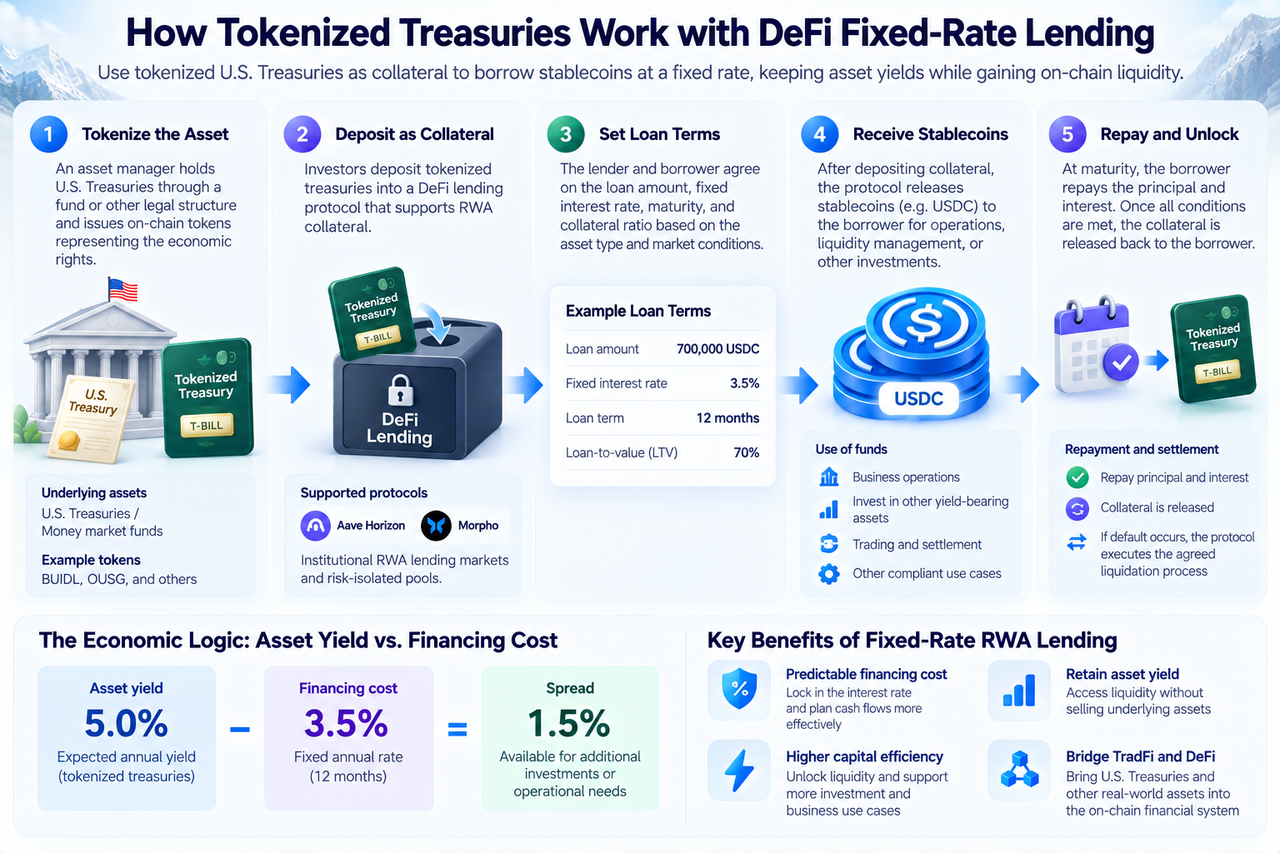
On-chain government bonds generally refer to tokenized structures that represent economic interests in U.S. Treasuries or shares of funds investing in government bonds as blockchain tokens. Asset management firms, fund managers, or dedicated issuing entities typically operate these products. The on-chain tokens represent fund shares or economic interests under a specific legal structure; they do not mean that the U.S. Treasury directly issues these tokens on a public blockchain. Products such as BlackRock's BUIDL and Ondo's OUSG use tokenized structures to allow eligible investors to hold interests associated with traditional yield-generating financial assets through a blockchain.
Unlike crypto-native assets such as ETH, the value of tokenized Treasury products is typically linked to the underlying securities, fund net asset value, and accrued returns. For institutional investors, these assets can not only generate returns but also potentially serve as financing collateral, improving capital efficiency. For example, suppose an institution holds tokenized Treasury fund shares worth $1 million. If a lending protocol allows financing at a 70% loan-to-value (LTV) ratio, the institution could borrow up to approximately $700,000 in stablecoins, subject to the relevant conditions. This allows the institution to obtain additional liquidity without immediately selling the underlying assets, while the protocol or associated custody arrangements manage the collateral.
However, on-chain government bonds do not mean that all asset interests can be freely transferred. Some tokenized funds impose restrictions on investor eligibility, allowlisting, redemption timing, and jurisdiction. Even if an asset has been issued on a public blockchain, its transfer and liquidation may still be governed by off-chain legal documents. Whether on-chain government bonds can serve as DeFi collateral therefore depends not only on smart contract support for the tokens, but also on whether the issuer permits their use as collateral, whether the protocol can value them accurately, and whether liquidators are eligible to receive and dispose of them. This is an important distinction between RWA-backed financing and ordinary crypto asset lending.
How Can On-Chain Government Bonds Integrate with DeFi Fixed-Rate Lending?
The core of combining on-chain government bonds with fixed-rate lending is enabling real-world financial assets with relatively stable returns to support on-chain financing with more clearly defined costs and terms. In this model, tokenized government bonds serve as collateral, DeFi lending protocols manage loan-to-value ratios, financing conditions, and repayment processes, and stablecoins provide the borrowed funds and settlement instruments. The process typically begins with asset tokenization: an issuer holds U.S. Treasuries through a fund or another legal structure and issues corresponding on-chain tokens to eligible investors. The issuance documents and product terms determine the specific rights represented by the tokens.
When an investor seeks financing, the lending protocol or risk management firm must assess the token's legal rights, liquidity, pricing sources, redemption cycle, and transfer restrictions to determine whether it can serve as collateral. The borrower and funding provider then agree on the financing amount, fixed interest rate, loan term, loan-to-value ratio, and default procedures. After locking or placing eligible RWA tokens into custody as required by the agreement, the borrower can receive USDC or another agreed stablecoin. At maturity, the borrower repays principal and interest and retrieves the collateral after satisfying all contractual conditions. If the borrower cannot repay on time, the protocol or relevant service provider follows the agreed default procedures.
This model resembles traditional securities-backed financing, but blockchain can provide more transparent collateral records, programmable fund settlement, and automation of some risk management processes. At the same time, financing backed by on-chain government bonds still depends on off-chain financial infrastructure. Treasury custody, fund net asset value calculations, redemption processing, and legal recovery generally cannot be completed independently through smart contracts alone. RWA fixed-rate lending therefore does not fully replace traditional finance. Instead, it uses blockchain to improve how financial assets circulate and obtain financing, allowing traditional yield-generating assets to participate in more flexible on-chain capital allocation.
How Can RWA Fixed-Rate Lending Improve Capital Efficiency Through Yield Spread Strategies?
The yield spread is an important measure for understanding the economic value of RWA fixed-rate lending. For institutions holding yield-generating assets, financing decisions typically require comparing asset yields with borrowing costs. If an asset's expected yield exceeds financing costs, an institution may improve capital efficiency through collateralized financing. If financing costs exceed asset returns, it may face a negative spread. The advantage of a fixed rate is that borrowers can determine interest expenses over the agreed term in advance, allowing more accurate calculations of breakeven points and funding needs.
Suppose an institution holds tokenized Treasury fund shares worth $1 million, with an expected annualized yield of 5%, and borrows $700,000 in stablecoins at a fixed annual interest rate of 3.5%. Under these assumptions, the underlying assets' expected annual return is $50,000, borrowing interest costs are $24,500, and the difference is $25,500.
| Item |
Assumed Value |
| Collateral Value |
$1,000,000 |
| Expected Annualized Asset Yield |
5% |
| Stablecoin Loan Amount |
$700,000 |
| Fixed Annual Borrowing Rate |
3.50% |
| Expected Asset Return for One Year |
$50,000 |
| Financing Interest Cost for One Year |
$24,500 |
| Asset Return Minus Financing Interest |
$25,500 |
These figures illustrate the financing mechanism only and do not represent actual market rates or investment returns. Note that $25,500 is simply the collateral's return minus financing interest, not the final net profit of a leveraged strategy. How the borrowed $700,000 is used, whether it generates additional returns, and any associated fees or potential losses must be calculated separately.
If the institution uses the borrowed stablecoins to buy additional yield-generating assets and then pledges those new assets to obtain further financing, it creates a looping structure. This strategy can increase asset exposure, but it also amplifies risk. A decline in the underlying assets' net asset value, larger collateral haircuts, or an inability to refinance at maturity may force the institution to sell assets early to repay debt. Even if the assets' nominal yield exceeds the financing rate, final profitability is not assured. The value of fixed rates therefore lies mainly in making financing costs more predictable, not in eliminating leverage risk or creating arbitrage opportunities without risk.
Why Do RWA Redemption Cycles Affect DeFi Liquidations?
A core issue in RWA-backed financing is the time gap between on-chain transactions and off-chain asset settlement. Major crypto assets such as ETH and BTC can typically trade in markets that operate around the clock. Tokenized government bonds, money market funds, and private credit products, however, may be subject to fund business days, asset redemption procedures, and compliance reviews. Some fund products may require one or more business days to complete redemption, while private credit assets may take longer to recover funds. By contrast, DeFi lending protocols typically need to monitor collateral values continuously and execute liquidations quickly when loan-to-value ratios exceed specified thresholds.
When collateral consists of liquid crypto assets, liquidators can sell the assets through on-chain markets and recover funds. But if the collateral is RWA with transfer restrictions or redemption delays, liquidators may be unable to obtain the corresponding cash immediately. This creates a liquidity mismatch between immediate on-chain liquidation and delayed off-chain redemption. Even with a fixed-rate loan, a protocol may still face bad debt risk if the collateral cannot be sold or redeemed promptly. Fixed-term financing can therefore help borrowers schedule repayments, but it cannot independently resolve collateral disposal issues.
To reduce these risks, RWA lending markets typically need more conservative loan-to-value ratios, professional liquidators, liquidity buffers, and redemption mechanisms coordinated with asset issuers. For tokenized assets subject to allowlist restrictions, liquidators must also be legally eligible to receive and hold the tokens. Protocols must additionally account for asset valuation, market discounts, and cross-border legal enforcement under extreme conditions. Risk management in RWA-backed lending therefore cannot rely solely on on-chain price oracles and automated liquidation. It must also consider the trading rules and legal constraints governing real-world assets.
How Does Morpho Advance RWA-Backed Lending and Fixed-Rate Markets?
Morpho is lending infrastructure in the Ethereum ecosystem. One of its important features is the ability to create lending markets with independent risk parameters. In a traditional shared-pool model, different collateral assets may be subject to a unified risk management framework. Morpho's isolated market structure, by contrast, allows loan-to-value ratios, price oracles, liquidation parameters, and interest rate models to be configured for specific collateral. This design is particularly important for RWA because tokenized government bonds, money market funds, and private credit products have different credit risks, redemption cycles, and market liquidity. Applying identical loan-to-value ratios and liquidation rules may not accurately reflect each asset category's risk characteristics.
Through isolated markets, professional risk managers can design financing conditions around the characteristics of different assets, providing more tailored collateralized lending support for eligible RWA. However, isolated markets and fixed rates are two different concepts. Morpho's isolated market architecture provides risk isolation and parameter configuration, but lending markets using this architecture do not necessarily offer fixed rates. Some markets still adjust borrowing costs dynamically based on funding utilization. For institutional RWA financing, fixed-rate, fixed-term arrangements can further complement isolated market structures, allowing borrowers to manage financing costs according to asset returns and holding periods.
Over the long term, the value of modular lending infrastructure such as Morpho lies in allowing different types of collateral and financing needs to use differentiated designs, rather than requiring all borrowers to accept the same pool rules. Its actual development still depends on stablecoin liquidity, risk management quality, collateral liquidatability, and funding providers' acceptance of the relevant markets. If more tokenized government bonds and institutional credit products gain reliable valuation and liquidation support in the future, isolated lending markets could become an important part of RWA financing.
How Does Aave Horizon Connect Institutional RWA with DeFi Credit?
Aave Horizon is a lending market designed for institutional RWA-backed financing needs. It aims to allow eligible participants to use tokenized government bonds, money market funds, and other qualifying real-world assets as collateral to obtain stablecoin liquidity. The core value of this model is connecting institutions' yield-generating assets with on-chain lending markets. In traditional finance, institutions can obtain funding through securities-backed financing, but the process typically involves multiple intermediaries, custody arrangements, and settlement systems. RWA tokenization can move some asset ownership and collateral records on-chain, making it easier for lending protocols to identify collateral status and manage borrowing under predefined rules.
However, institutional RWA lending differs substantially from ordinary DeFi markets. Some tokenized funds restrict investor eligibility, so lending protocols must address KYC, allowlisting, and asset transfer permissions. At the same time, valuation and redemption of underlying assets may not occur in real time, requiring protocols to establish reliable pricing sources and liquidation arrangements. Institutions also typically pay closer attention to funding costs, financing terms, risk exposure, and legal liabilities. On-chain lending products therefore need to be compatible with traditional asset-liability management practices.
Importantly, Aave Horizon's ability to support RWA-backed lending does not mean that all its financing uses fixed rates. RWA collateral eligibility and fixed-rate financing are two separate product dimensions. A market can support on-chain government bonds as collateral while still using floating borrowing rates. When selecting these products, institutions must therefore separately confirm collateral eligibility, the borrowing rate mechanism, loan terms, liquidation rules, and compliance requirements. They should not assume that a product offers fixed rates simply because it belongs to an RWA market.
What Is the Difference Between Morpho and Aave Horizon?
Morpho and Aave Horizon both contribute to the development of RWA-backed lending, but their product positioning and market structures differ. Morpho places greater emphasis on modular market design, allowing professional participants to establish lending markets with independent parameters for different collateral assets. This suits asset categories that require differentiated risk management. Aave Horizon focuses more specifically on institutional RWA-backed financing, emphasizing access for eligible real-world assets to on-chain stablecoin lending markets while addressing institutional eligibility and asset transfer requirements.
| Comparison Dimension |
Morpho |
Aave Horizon |
| Core Positioning |
Modular lending infrastructure |
Lending market for institutional RWA |
| Market Structure |
Isolated lending markets |
Market dedicated to RWA-backed financing |
| Collateral Management |
Risk parameters configurable for different assets |
Focus on eligible tokenized real-world assets |
| Primary Users |
DeFi users, institutions, and professional risk managers |
Institutional borrowers and related market participants |
| Interest Rate Mechanism |
Depends on the specific market design |
Depends on the rules of the specific lending market |
| Main Advantages |
Flexible configuration, risk isolation |
RWA access, institutional financing use cases |
| Main Challenges |
Fragmented market liquidity, parameter management |
Asset compliance, valuation, and off-chain liquidation |
The two are not simply substitutes. Morpho's isolated market structure can support multiple asset types and financing models, while Aave Horizon reflects how DeFi protocols are designing products for institutional RWA needs. For borrowers, protocol selection depends on more than brand or market size. More important considerations include whether the specific collateral is supported, whether borrowing costs are reasonable, and whether liquidation or repayment can proceed smoothly during market stress. As the RWA market develops, modular lending and dedicated institutional markets may continue to coexist, serving different types of funding needs.
What Risks Does RWA Fixed-Rate Lending Face?
Fixed rates can reduce uncertainty in financing costs, but they cannot eliminate other risks in RWA lending. The first is credit risk. The quality of underlying assets varies substantially across RWA: U.S. Treasuries, money market funds, and private credit have different sources of risk. They cannot be treated as equally safe collateral simply because they all exist in token form. The second is liquidity risk. Some RWA products have limited secondary-market trading, and redemptions may be subject to timing and eligibility restrictions. When a lending protocol needs to dispose of collateral quickly, the actual sale price may fall below its recorded net asset value.
Valuation risk also warrants attention. The net asset values of some real-world financial assets are not updated in real time. If on-chain price oracles rely on delayed valuation data, a protocol may fail to identify collateral value changes promptly. Meanwhile, lending protocols, token contracts, price oracles, and other related infrastructure may contain smart contract vulnerabilities or experience operational failures, affecting collateral security and fund settlement. For products that rely on off-chain asset managers, operational problems at custodians, fund managers, or related service providers may further affect asset redeemability.
In addition, maturity mismatch and legal risk are key factors institutions need to assess. Even if the borrowing rate is fixed, a borrower may still be unable to repay on time if the loan matures before the underlying assets can be redeemed. Token holders' rights to underlying assets, recovery procedures after default, and liquidators' eligibility to hold assets all depend on the specific product's legal structure. Looping and leveraged financing may amplify these risks. When assets of the same type are repeatedly pledged, market price changes or declining liquidity may trigger cascading liquidations. Assessing RWA fixed-rate lending therefore requires more than comparing asset yields with borrowing rates. It also requires a comprehensive review of loan-to-value ratios, financing terms, redemption capacity, and exit arrangements under extreme market conditions.
How Will Fixed-Rate Lending Affect the Future of RWA and DeFi?
RWA development is pushing DeFi beyond crypto-native asset lending toward a more diversified market for financial collateral. Early DeFi lending primarily relied on ETH, BTC, and stablecoins, with financing demand closely tied to crypto asset trading activity. As government bonds, money market funds, and private credit gradually become tokenized, on-chain lending markets are gaining exposure to real-world financial assets with different return sources and maturity structures. But asset tokenization is only the first step. If on-chain government bonds can only be held and cannot be used effectively for collateralized financing, liquidity management, or margin arrangements, their capital efficiency remains limited.
Fixed-rate lending can provide more predictable financing conditions for these assets, allowing on-chain credit to gradually adapt to institutional asset-liability management needs. In the future, more tokenized government bonds and fund products may gain support from lending protocols, expanding the range of eligible collateral. As collaboration among asset issuers, custodians, and lending protocols strengthens, RWA financing applications could expand beyond a small number of specialized markets into more institutional use cases. At the same time, fixed-rate and fixed-term products may develop further, allowing institutions to plan financing around asset cash flows and holding periods rather than relying entirely on borrowing costs that fluctuate with pool utilization.
Another important direction is the integration of on-chain and off-chain liquidity infrastructure. Instant redemption arrangements, professional liquidators, compliant asset transfer networks, and reliable valuation services will be important conditions for scaling RWA lending. However, the maturity of the RWA market should not be measured solely by the total value of tokenized assets. Actual borrowing demand, financing costs, default losses, collateral turnover efficiency, and risk-adjusted returns also determine whether the market can develop sustainably. Only when on-chain financing delivers tangible value in efficiency, cost, and risk control can fixed-rate lending potentially become long-term infrastructure connecting traditional finance and DeFi.
Summary
RWA needs fixed-rate lending not because floating-rate models cannot function, but because real-world assets have different return, maturity, and liquidity characteristics from crypto-native assets. On-chain government bonds, money market funds, and private credit typically have relatively well-defined return structures, but redemption and settlement may take several business days. By contrast, financing rates in traditional DeFi lending pools may change rapidly with funding utilization, potentially exposing institutions to rising financing costs and asset-liability maturity mismatches.
Fixed-rate, fixed-term lending can help institutions determine financing costs in advance and better align loan terms with collateral holding periods. Protocols such as Morpho and Aave Horizon are advancing RWA-backed lending, but products differ in market structure, institutional access, and interest rate mechanisms. Supporting RWA collateral does not automatically mean offering fixed rates.
Over the long term, integrating RWA and DeFi could help on-chain finance evolve beyond collateralized crypto asset trading into a comprehensive financing market supporting government bonds, funds, and institutional credit. However, fixed rates cannot eliminate credit, liquidity, or liquidation risks. A truly mature RWA credit market still requires reliable asset valuation, compliant liquidation, stable funding sources, and a robust off-chain legal enforcement framework.
FAQ
Why does RWA need fixed-rate lending?
Because many RWA have relatively well-defined return structures and holding periods, fixed rates help borrowers determine financing costs in advance, reduce uncertainty from rising floating rates, and better align financing arrangements with asset cash flows.
Can on-chain government bonds serve as DeFi collateral?
Yes, but this depends on the tokenized product's legal structure, transfer restrictions, asset valuation methods, and lending protocol support. Not all on-chain government bonds can be used directly for collateralized financing, and some products also require participants to meet specific investor eligibility criteria.
How does RWA fixed-rate lending differ from traditional DeFi lending?
Traditional DeFi lending typically uses floating rates that change with pool utilization. Fixed-rate lending establishes financing costs over an agreed term, making it more suitable for institutional borrowers who need to plan funding budgets and repayment schedules in advance.
What is RWA looping?
RWA looping is a strategy in which investors hold yield-generating assets, pledge them as collateral to borrow funds, and then invest those borrowed funds in other assets or assets of the same type to increase financial exposure. This model may improve capital efficiency, but it also amplifies leverage and liquidation risks.
Does Morpho support RWA-backed lending?
Morpho's isolated lending markets can set risk parameters for different collateral types and support financing for RWA that meet market eligibility requirements. Whether a specific market uses fixed rates must be determined from its actual product rules.
Does Aave Horizon offer fixed-rate loans?
Aave Horizon primarily serves institutional RWA-backed lending needs, but accepting RWA collateral does not mean all loans use fixed rates. Specific borrowing costs and maturity arrangements depend on the relevant market's product design.
Does fixed-rate RWA lending carry liquidation risk?
Yes. Fixed rates only lock in agreed financing costs. Declining collateral values, excessive loan-to-value ratios, delayed asset redemptions, or failure to repay at maturity can all trigger liquidation or default.
What are the future development directions for RWA fixed-rate lending?
Key directions include expanding the range of tokenized assets eligible as collateral, developing fixed-rate and fixed-term financing markets, improving RWA redemption and liquidation efficiency, and establishing asset valuation, compliance management, and legal enforcement infrastructure that meets institutional requirements.