Readers who already know a GPU can train or serve a model still have to separate three designs: work that creates the block, work that validators score, and work a buyer pays for. Pearl sits in the first design. A score or a lease can still be useful to a buyer while the host chain keeps producing blocks without that GPU job.
A passed job, a high validator score, and a winning tile answer different questions. Price and uptime do not place a network in the same design.
Key Takeaways
- Pearl's block lottery is a GPU matrix multiplication on its own chain. Bittensor pays TAO when validators score subnet output. Akash and Render charge for a lease or a job, and their host chains produce blocks by staking.
- A valid Pearl proof shows that a selected output tile recomputed and met difficulty. It does not show that the matrices came from a paying model's forward pass.
- Hardware lists from third-party miners are not protocol constants. Pearl's documented path is a node plus a vLLM miner. Akash lists container resources. Render assigns GPU jobs to node operators.
- The native assets do different work: PRL is the Pearl block subsidy, TAO follows aggregated scores, staked AKT produces Akash blocks while a lease is paid from ACT, and RENDER is burned to pay for a job while operators are paid from a separate emissions schedule.
What Does Each Network Actually Do?
Pearl is a Layer 1 blockchain whose unit of work is matrix multiplication on a GPU. The Pearl INT whitepaper specifies a proof-of-useful-work design in which that multiply can also serve as the block proof. The miner chooses the matrices, and tiles of the product act as lottery tickets. The miner who finds a winning ticket publishes the block and is paid in PRL. On Gate the spot symbol for that native asset is PEARL.
Bittensor is an open network of subnets. Miners produce a commodity such as compute, inference, storage, or prediction. Validators score miners by setting weights, and Yuma Consensus aggregates those weights rather than scoring the work itself. Subnet creators define the incentive, stakers back validators with TAO, and the chain pays TAO from that aggregate. A high score is a judgment under that subnet's incentive, not a rule that a matrix product must be the preimage of the next block.
Akash Network is a marketplace for containerized compute built with the Cosmos SDK and CometBFT. A tenant describes CPU, memory, storage, and, where offered, GPU in a deployment file. Providers bid, the tenant accepts a bid, and the chain records a lease. Delegated proof of stake selects Akash validators. The GPU that serves the container is the leased product, not the puzzle those validators solve.
Render Network assigns GPU jobs, especially rendering and related compute, to node operators. RENDER is an SPL asset on Solana. A creator burns RENDER for work credits that submit a job, and node operators are paid from a separate emissions schedule rather than from the burned tokens. Solana validators produce Solana blocks. Settling a job updates the Render work record, not the Solana block lottery.
Does Useful Work Like Matrix Multiplication Produce the Block?
Useful work produces the block only in the Pearl design among these four. Pearl miners search for a tile whose hash meets the difficulty target. That search is the proof of work. Repeating those multiplies until a tile wins is what makes a competing history expensive to produce.
The other three can serve a buyer and still keep block production elsewhere. Bittensor pays for whatever a subnet defines, and TAO follows the weights Yuma aggregates. Akash pays for a container under a lease. Render pays for a finished job. Those chains can keep producing blocks if the GPU market goes quiet: Bittensor's chain uses proof of authority, Akash and Solana use stake, and none of the three uses the GPU job as the block puzzle.
| Question |
Pearl |
Bittensor |
Akash |
Render |
| What is paid for? |
A matrix-multiply tile that meets difficulty |
Subnet output that validators score |
An accepted container lease |
A completed GPU job |
| Does that work produce the block? |
Yes. The tile is the Pearl block lottery |
No. Scores allocate TAO |
No. Staked validators run CometBFT |
No. Solana validators produce blocks |
| Native asset |
PRL, spot symbol PEARL |
TAO |
AKT |
RENDER |
| What failure looks like |
No winning tile, so no subsidy on that hardware |
A low score, so little or no emission |
No bid accepted, or a lease that does not stay up |
A job not settled to the operator |
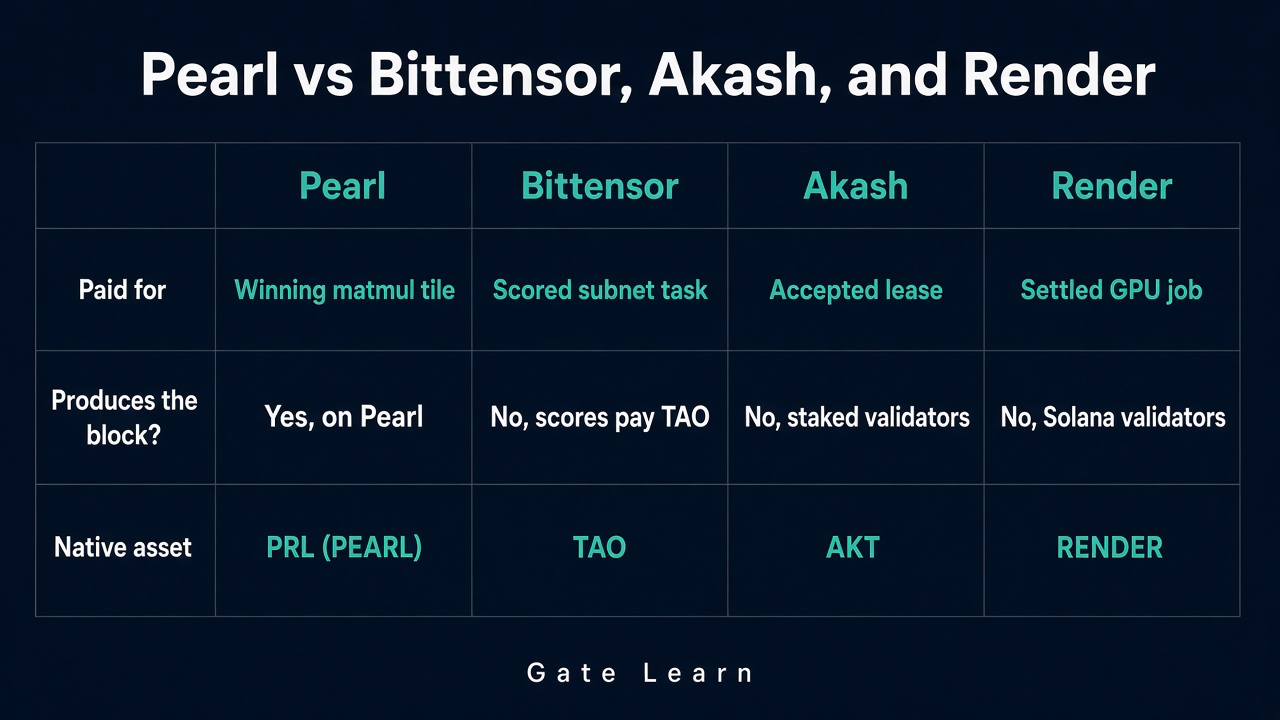
Figure 1. Pearl pays for a winning matrix-multiply tile that produces the block. The other three pay for a score, a lease, or a job.
A marketplace can have paying customers while its chain runs on stake. A proof-of-useful-work chain can produce blocks from multiplies that no customer requested. A Pearl miss ends that try with no subsidy, a low Bittensor weight ends that emission, a rejected Akash bid ends that offer, and a failed Render settlement ends that job.
What Does a Passed Check Actually Prove?
Pearl's check proves a narrow fact. The floating-point specification extends an integer matrix-multiply proof: the miner commits to inputs, noise from those commitments is applied, and the product is tiled. The verifier does not recompute the whole product. It opens one tile, checks the Merkle proofs, derives the noise seeds, recomputes that tile, and tests the ticket against difficulty.
A pass means that tile matches and the ticket wins. It does not mean a customer received tokens from a model. The miner chooses the inputs, because an open network cannot assume an honest task giver. The security argument is the cost of the multiply, including on degenerate inputs, not a registry of approved models.
An independent study of this boundary, The Usefulness Gap in Proof-of-Useful-Work, reports that verification accepts a completed matrix product and does not test whether the matrices came from a model. Random matrices can clear the check. The study also reports that mining software dominant in its sample did not contain inference code. A sound tile check can stand while a paid inference workload remains optional.
Bittensor's pass is a score. Validators examine miner output under the subnet's incentive and set weights. A high weight means those validators assigned value. It does not mean every subnet is selling inference to an outside customer, and it does not mean the miner's math was re-executed as a consensus tile. Bittensor's introduction states the split: miners produce the commodity, validators score the miners, and stakers back validators with TAO.
Akash's pass is a lease. The chain records the bid, the tenant's acceptance, and the terms. Delivery is then an operational fact about a container on a provider's machines. A closed lease does not prove that the provider's GPUs are training a named model unless the tenant's workload is that job.
Render's pass is job settlement. A node operator is paid when the network accepts the work under its job and reputation rules. Settlement proves the job record, not that the same GPU cycles were a Solana block proof. Reputation can rise or fall with delivered work. That service score sits with Bittensor's weights, and apart from Pearl's tile check.
How Do the Hardware and Software Paths Differ?
Pearl's documented miner path is a GPU stack built around a vLLM miner plus a Pearl node. The node hands out block templates. The miner address is a Taproot address prefixed prl1p on mainnet. Reward arrives when that work finds a block: the subsidy plus fees, not a payment per hour of uptime.
Third-party programs publish their own device lists and hashrate figures. Those figures measure that software build, not a protocol constant. A program that asks for a seed phrase is taking the wallet, because mining needs only a receive address. A pool can smooth variance. The work unit stays matrix multiplication.
Bittensor hardware follows the subnet. An inference subnet may want GPUs. A storage or prediction subnet may not. Registration, the miner software, and validator scoring decide whether the machine is paid.
Akash hardware is whatever the provider lists and the tenant's deployment file requests. Winning the work means winning the bid and keeping the lease, not beating a difficulty target. A provider can be paid for a lease with no chance of producing an Akash block.
Render hardware is a GPU node that takes routed jobs. The operator's reputation and the job class matter. A card that never wins a Pearl tile can still settle a Render job, because that job is not a Pearl ticket.
Are Token Rewards the Same Thing as Compute Fees?
They are not. Pearl issues PRL through the block subsidy. Supply is capped at 2.1 billion and approached by a smooth curve with no halving step, on a target interval of about 194 seconds. A miner's PRL is a claim on that issuance, not on a customer's GPU invoice. Pearl mining tracks that curve beside the difficulty adjustment.
Bittensor pays TAO from the emission that Yuma's aggregated scores direct. A miner needs weight on a subnet. A staker delegates to validators. Neither flow is a customer payment for a GPU-hour. The token is the meter for scores.
Akash separates block production from the lease payment. Staked AKT backs validators and therefore block production. A tenant funds the lease with ACT, a USD-pegged compute credit, and the escrow pays the provider in ACT. Burning AKT is how that credit is minted. A provider can be paid for a lease without authoring blocks, and a validator can author blocks without offering a GPU.
RENDER is the asset used to pay for a job. Burning RENDER creates work credits and removes that RENDER from supply. Node operators are paid from a separate emissions schedule, not by receiving the burned tokens. A Solana account that holds RENDER is not a Pearl UTXO, and a Solana transfer does not settle a Pearl coinbase. Supply can fall when jobs burn RENDER and rise when emissions are issued, rather than when a matrix tile hits a Pearl difficulty target.
A receipt that says "GPU" can be a block subsidy, a score-weighted emission, a lease payment, or an emissions payment after a burned job. Only the first is Pearl.
What Should You Verify Before Calling These the Same Design?
A winning Pearl tile certifies that the multiply met difficulty. It does not certify that a customer received model output. A Bittensor weight certifies a validator score. An Akash lease certifies an accepted bid. A Render settlement certifies a finished job.
The native Pearl asset has no contract address on another chain, and mainnet receive addresses begin with prl1p. Gate's PEARL market is that asset. Gate's PRL market is Perle, a separate project. A contract address, an 0x address, or a Solana address is a different asset even when the name matches.
Summary
Pearl vs Bittensor, Akash, and Render is a split in what the GPU is proving. Pearl pays PRL when a matrix-multiply tile wins the block lottery on its own chain, and the verifier's pass certifies that tile, not a customer invoice. Bittensor pays TAO when validators score subnet output. Akash pays an accepted lease from ACT while staked validators produce blocks, and Render burns RENDER to pay for a job while operator rewards come from emissions and Solana produces the blocks.
FAQ
How is Pearl different from Bittensor, Akash, and Render?
Pearl makes GPU matrix multiplication the work that can win a block and pays the winner in PRL. Bittensor pays TAO for subnet output after validators set scores. Akash records a container lease on a proof-of-stake chain and pays that lease from ACT escrow. Render charges for GPU jobs by burning RENDER for work credits on Solana, and pays node operators from a separate emissions schedule.
Does a valid Pearl proof mean the GPU ran a paid AI model?
No. A valid Pearl proof shows that the opened tile recomputes and that the ticket meets difficulty. The miner chooses the matrices, and random matrices can pass. A paid inference workload can be the source of those matrices, but the check does not require that origin.
Do Akash and Render use proof-of-useful-work?
No. Akash records leases on a CometBFT proof-of-stake chain. Render settles jobs with RENDER on Solana, whose validators produce blocks by staking. Both can sell useful GPU time, and that sale is not the block puzzle.
Can any GPU mine Pearl the same way it can take an Akash or Render job?
No. An Akash provider lists the resources a tenant requested and wins a bid, while a Render node operator takes a routed job. Pearl's documented path is a node plus a miner that performs the protocol multiply, with payout only when a block is found. A card that can take a marketplace job is not automatically a Pearl miner.
Is Gate's PRL market the same asset as Pearl?
No. Gate lists the native Pearl asset under the symbol PEARL. The PRL market on Gate is Perle, a separate project. Native Pearl is received at a prl1p address on the Pearl network and has no contract address on another chain.