Pearl is a Layer 1 blockchain built on Proof-of-Useful-Work (PoUW). Its core mining mechanism uses GPUs for matrix multiplication, enabling GPU computation to support both blockchain proof-of-work and AI computing infrastructure. Unlike traditional PoW, which relies primarily on hashing operations such as SHA-256, Pearl is designed to make the types of computations GPUs perform well part of network consensus.
As demand for GPUs in AI model training and inference continues to grow, GPU Hashrate is gradually becoming more than a simple computing resource—it is becoming economically valuable infrastructure. Pearl's design is built around this shift: miners contribute GPU computing power, the network rewards verified Work with PRL, and AI computing offers a potential additional use for those GPU resources.
Understanding Pearl mining therefore requires more than determining which GPU delivers the highest Hashrate. It also requires understanding block rewards, network difficulty, the issuance curve, and mining pool distribution. For miners, profitability depends not on a GPU's absolute Hashrate, but on its share of the network's total Hashrate and the amount of PRL earned per unit of computing resources.
Key Points
-
Pearl mining is centered on GPU matrix computation. Through Proof-of-Useful-Work, Pearl brings Matrix Multiplication (MatMul) into PoW, making GPU computation part of the network's proof-of-work.
-
GPU performance directly affects a miner's ability to generate Work. Publicly available mining software currently supports the NVIDIA RTX 30 Series and newer architectures. Public tests show substantial differences in Pearl Hashrate among devices such as the RTX 4090 and H100, although real-world performance varies with power consumption, temperature, software version, and mining pool difficulty.
-
Pearl does not use a fixed block reward. Its polynomial decay issuance mechanism causes the block subsidy to change continuously with block height rather than adjust through Bitcoin-style periodic halvings.
-
PRL has a maximum supply of 2.1 billion tokens. The white paper defines 2.1 billion as the fully diluted total supply and uses an issuance curve to control the rate of token release over time.
-
Mining profitability cannot be judged by GPU Hashrate alone. Total network Hashrate, difficulty, the current block subsidy, PRL price, device power consumption, and electricity costs all affect profitability. Comparing the theoretical Hashrate of different GPUs alone is therefore insufficient to determine actual returns.
What GPUs and Hardware Are Needed for Pearl Mining?
Pearl's mining architecture is GPU-centric, making the graphics card the primary hardware component for participating in network computation. Pearl's official mining code currently includes CUDA, GPU Mining, and vLLM-related components, and its official miner documentation requires an NVIDIA GPU and a CUDA environment. In public code testing, some tests for pearl-gemm and vllm-miner target NVIDIA Hopper architecture devices, including the H100 and H200. Meanwhile, community mining software has expanded support to additional NVIDIA GPUs.
For example, the 6block Pearl Miner README states that its software supports the NVIDIA 30 Series and newer architectures, including Ampere, Ada, and Hopper. It also lists typical Hashrate figures for the RTX 3080, RTX 3090, RTX 4090, and H100. Its published data shows approximately 112 TH/s for the RTX 3080, 120 TH/s for the RTX 3090, 305 TH/s for the RTX 4090, and 760 TH/s for the H100. These figures reflect specific mining software and testing conditions; they are not fixed Hashrate standards defined by the Pearl protocol.
Actual GPU mining performance is also influenced by VRAM, power consumption, core frequency, cooling, driver version, and miner software optimization. The same GPU model, for instance, may produce different effective Hashrate levels under different power limits and ambient temperatures. Evaluating whether a device is suitable for Pearl mining therefore requires considering both Hashrate and Hashrate per unit of power. Beyond the GPU itself, miners must prepare the software environment needed to run a node or connect to a mining pool. Pearl's official node supports the getblocktemplate RPC and requires mining rewards to be sent to a Taproot address.
How PRL Miners Participate in the Pearl Network
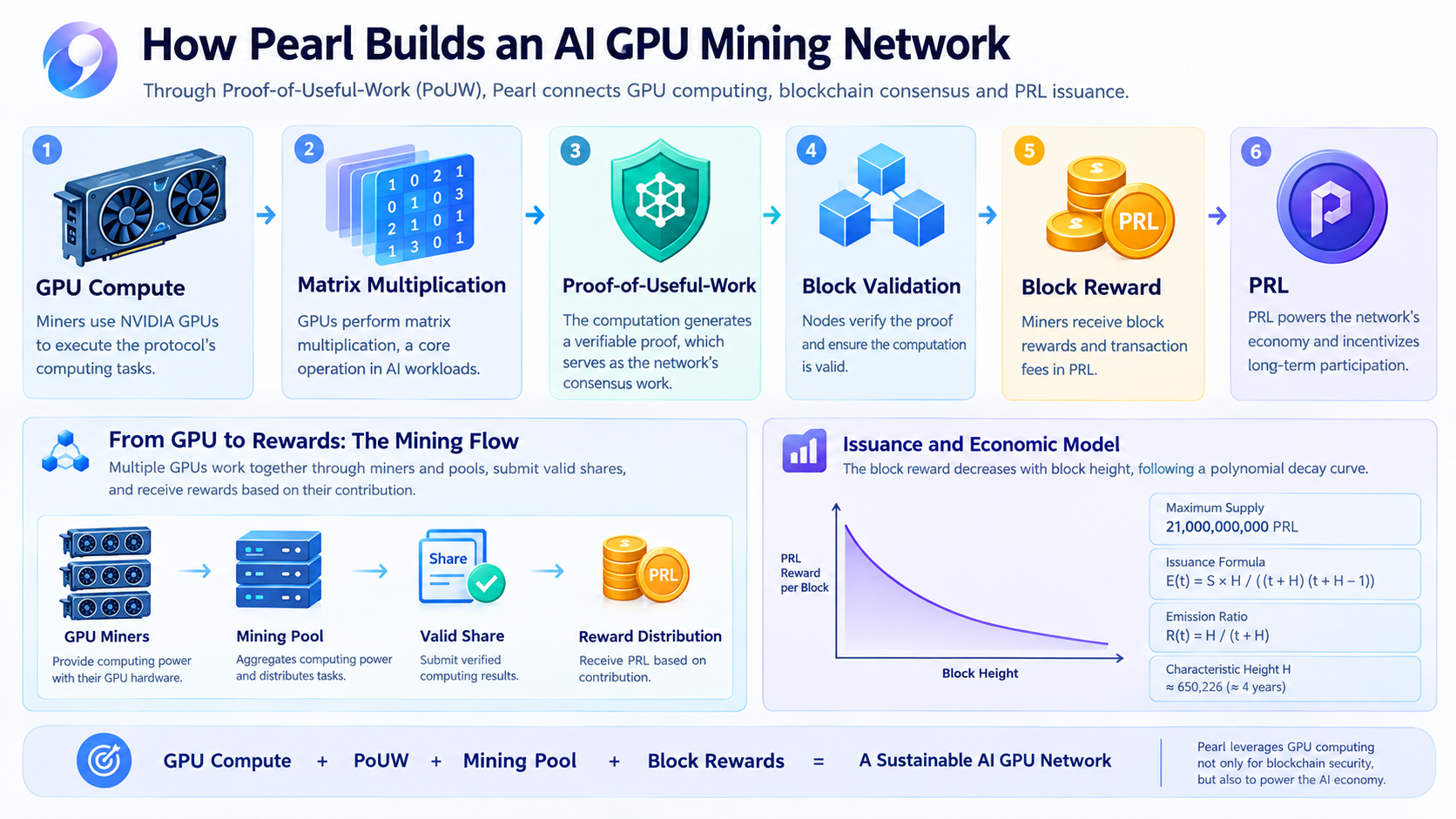
The basic Pearl mining process resembles that of other PoW networks in some respects, but the underlying computational task is different. Miners first create a Pearl wallet address and configure the mining reward address. They can then run a Pearl node and connect it to the network. When using a mining pool, they can connect to a pool protocol such as Stratum through Pearl-compatible mining software. When operating a node independently, Pearl's official documentation requires miners to configure miningaddr to specify the Taproot address that receives mining rewards. The node provides block templates to miners through RPCs such as getblocktemplate, and miners use GPUs to perform computations that satisfy Pearl's PoUW requirements. With a mining pool, the process is further streamlined. The pool coordinates multiple miners, distributes network computation among different GPUs, and settles returns based on valid Shares submitted or each miner's proportional contribution.
Pearl miners generally participate in one of two ways:
-
Solo Mining: A miner operates a node and competes for blocks independently. The miner receives the block reward directly, but returns are typically more volatile.
-
Pool Mining: Multiple miners contribute computing power through a mining pool. The pool coordinates tasks and distributes returns based on each miner's contribution.
For participants with relatively few GPUs, pool mining typically provides a more consistent record of returns. However, actual profitability must still account for costs such as mining pool fees.
How Are Pearl Block Rewards Calculated?
Pearl's block rewards consist of the block subsidy and transaction fees. The block subsidy is a major source of newly issued PRL.
A defining feature of Pearl is that its block subsidy does not remain constant. Because the network uses an issuance formula that varies with block height, the theoretical block reward is not exactly the same at every height.
The block issuance formula in Pearl's white paper is: E(t) = S × H / ((t + H)(t + H − 1))
Here, S represents the total supply, H is the characteristic block height of the issuance curve, and t is the current block height. Actual issuance is rounded to the smallest unit, Grain. As t increases, the amount of newly issued PRL per block gradually decreases.
Network data from September 2026 already shows specific Pearl block subsidies. For example, the block explorer records a subsidy of approximately 2,354.74 PRL for block 111,276, along with network difficulty of approximately 20.47M and network Hashrate of approximately 29.70 EH/s. This illustrates that block rewards, difficulty, and network Hashrate are all dynamic. Miners therefore cannot estimate long-term profitability simply by multiplying the current block reward by the number of blocks produced per day. The block subsidy declines as block height increases, while network Hashrate and difficulty continue to change.
How Do Network Difficulty and GPU Hashrate Affect Mining Efficiency?
Pearl also uses a difficulty adjustment mechanism to maintain a relatively stable block interval. The white paper sets a target block time of approximately 194 seconds—about 3 minutes and 14 seconds.
Network difficulty represents the threshold miners must overcome to compete for blocks. As difficulty rises, the probability that the same GPU will find a valid block or submit a valid Share within a given period declines. When difficulty falls, the theoretical output associated with the same Hashrate increases.
Pearl uses WTEMA (Weighted-Target Exponential Moving Average) for difficulty adjustment rather than Bitcoin's simple adjustment every 2,016 blocks. According to the white paper, more continuous adjustments help the network maintain its target block time when Hashrate changes rapidly.
For miners, a simplified measure of mining efficiency is: individual effective Hashrate share ≈ individual effective Hashrate ÷ total network effective Hashrate.
Holding other factors constant, a larger share of total network Hashrate theoretically translates into a larger share of block rewards.
In practice, miners must also account for mining pool Shares, software efficiency, and hardware power consumption. If a GPU's Hashrate rises by 10% while power consumption rises by 20%, returns per unit of electricity may not increase accordingly. For GPU mining, Hashrate per unit of power is therefore generally more meaningful than TH/s alone.
How Are PRL's Issuance Mechanism and Maximum Supply Designed?
Pearl sets PRL's maximum supply at 2.1 billion tokens. The white paper defines this as the fully diluted total supply and uses the issuance curve to determine how many tokens enter circulation at each stage.
Pearl is not designed to release all PRL rapidly during the network's early period. Instead, token issuance remains continuously linked to block height. Each block generates a block subsidy according to the current issuance curve, and the amount of new PRL issued per block declines as the network continues to operate.
This creates a direct link between Pearl's token issuance and GPU mining: miners supply computing power that meets PoUW requirements, the network generates block subsidies, and those subsidies provide the economic incentive for GPU participation.
The model differs substantially from a simple premine or one-time issuance. New PRL supply is generated primarily alongside network blocks, and miners must perform computational Work to earn it.
Why Does Pearl Use an Issuance Curve That Changes With Block Height?
Rather than adopting Bitcoin-style fixed-period halvings, Pearl uses a smooth polynomial decay issuance curve.
The white paper defines the remaining supply ratio as: R(t) = H / (t + H)
Here, H is the characteristic time scale. Pearl sets H at approximately 650,226 blocks, equivalent to roughly four years of block time, so that the remaining unissued supply falls to approximately 50% around that height. This design has two notable characteristics.
First, issuance does not suddenly fall by half at a specific block. Bitcoin's halving mechanism creates distinct issuance inflection points, whereas Pearl's per-block reward changes continuously, producing a smoother issuance curve.
Second, a small but persistent tail of issuance remains over the long term. The Pearl white paper argues that excessively low long-term issuance could weaken miners' future economic incentive to maintain network security. It therefore adopts a smoother long-term issuance structure.
For miners, this means early mining rewards are higher, but current profitability should not be expected to persist indefinitely. As block height rises, the per-block subsidy gradually declines. Miners must then rely on more efficient hardware, lower energy costs, network computing demand, or other income sources to remain economically viable.
How Do Mining Pools Participate in Pearl Hashrate Distribution?
Mining pools aggregate the computing power of many independent GPUs.
For a solo miner, the chance of receiving a block reward is highly random. A mining pool divides tasks into numerous Shares and tracks returns based on each miner's valid submitted Work.
Multiple Pearl GPU Mining projects are already available. For example, 6block's Pearl Miner supports Stratum connections to mining pools and lists pool endpoints such as Fortune Pool. Its July 2026 release also added F2Pool support.
For mining pools, one major challenge is validating the Shares miners submit. Discussions among Pearl community developers indicate that pools must balance verification cost, Share volume, and security. They cannot simply trust miners' self-reported computational results, but fully verifying every Share also cannot be prohibitively expensive.
A mining pool is therefore more than a platform for distributing returns. It provides core infrastructure for task coordination, Share validation, miner statistics, and reward settlement.
How Does Pearl GPU Mining Differ From Traditional AI GPU Cloud Services?
Pearl GPU Mining and traditional AI GPU cloud services both depend on GPUs, but their economic models are fundamentally different.
Traditional GPU cloud services operate on a customer-pays-for-computing model: GPU providers supply computing resources, while customers pay for their use. An AI company, for example, may rent GPUs for model training or inference, with the provider charging based on usage time, GPU type, or computing volume.
Pearl's PoUW model is centered on blockchain consensus. GPU miners perform protocol-defined computations and receive PRL block rewards, while the computing resources initially serve the Work required by network security and token issuance.
Pearl's white paper outlines a long-term goal of integrating AI training and inference more closely with the mining process. Its design aims to integrate a Mining Kernel into AI frameworks so that GPUs can use idle capacity to participate in Pearl Mining while performing standard AI computations.
The primary differences are summarized below:
| Dimension |
Pearl GPU Mining |
Traditional AI GPU Cloud Services |
| Core purpose |
Blockchain consensus and PRL issuance |
AI training and inference |
| Source of GPU returns |
Block rewards, transaction fees, and more |
Customer-paid computing fees |
| Computing tasks |
PoUW-defined computations |
Customer-specified AI workloads |
| Economic unit |
PRL |
Fiat currency, stablecoins, and more |
| Core participants |
Miners, nodes, and mining pools |
Cloud service providers and AI developers |
| Resource allocation |
Coordinated by the network and mining pools |
Scheduled by cloud platforms |
| Role in network security |
GPU Hashrate directly participates in PoW |
Typically does not support blockchain consensus |
AI GPUs and GPU mining are therefore not the same concept. Pearl's distinctive proposition is its attempt to bring these two economic activities into a single GPU computing framework. Whether it can ultimately create a stable AI computing market will depend on real demand for computation, protocol efficiency, and miner economics.
Summary
Pearl's GPU mining mechanism is built on Proof-of-Useful-Work. By using GPU matrix computation, it links computing resources, blockchain consensus, and PRL issuance. Miners can participate by running nodes and GPU Mining software, or they can aggregate Hashrate through mining pools and receive returns based on their contributions.
From a hardware perspective, publicly available mining software now supports the NVIDIA RTX 30 Series and newer architectures. Devices such as the RTX 4090 and H100 can achieve high Hashrate in public tests, but actual mining efficiency remains subject to power consumption, temperature, software version, and network difficulty.
From a token economics perspective, Pearl has a maximum supply of 2.1 billion PRL and uses a polynomial issuance curve that gradually declines with block height. This approach is intended to avoid the abrupt issuance changes associated with traditional halving mechanisms while preserving long-term incentives for miners.
For miners, Pearl's key variables include effective GPU Hashrate, total network Hashrate, current difficulty, block subsidy, PRL price, electricity costs, and mining pool fees. Together, these factors determine actual mining profitability.
The more significant question is whether Pearl can develop PoUW from a GPU mining mechanism into genuine AI computing infrastructure. If AI inference and training generate sustained, real-world computing demand and become more tightly integrated with Pearl's GPU Mining mechanism, the economic value of GPUs may extend beyond traditional AI cloud services and cryptocurrency mining. They could instead support a new resource market that combines computing services with blockchain incentives.