As AI, DeFi, GameFi, AI Agents, and on-chain automation applications rapidly advance, blockchain's demands for data quality and trustworthiness are steadily increasing. Traditional oracles address how data enters the blockchain, and traditional databases handle how data is stored and queried, but existing architectures still have clear limitations regarding questions like "Is the data authentic?", "Is the computation process trustworthy?", and "Has the result been tampered with?" Data trustworthiness is becoming a critical direction in the evolution of Web3 infrastructure, and verifiable data networks are consequently gaining industry attention.
From a technological evolution standpoint, the VDI built by Orochi](https://www.gate.com/learn/articles/what-is-orochi-network-on-exploring-verifiable-data-infrastructure-and-zero-knowledge-data-networks">Orochi) is not merely an upgrade to databases or oracles—it aims to establish a new data trust mechanism. By introducing cryptographic proofs into the data lifecycle, Orochi seeks to make data as open, transparent, and verifiable as blockchain transactions, providing a more trustworthy data foundation for future AI, DeFi, on-chain gaming, and cross-chain applications.
What Is Verifiable Data Infrastructure (VDI)
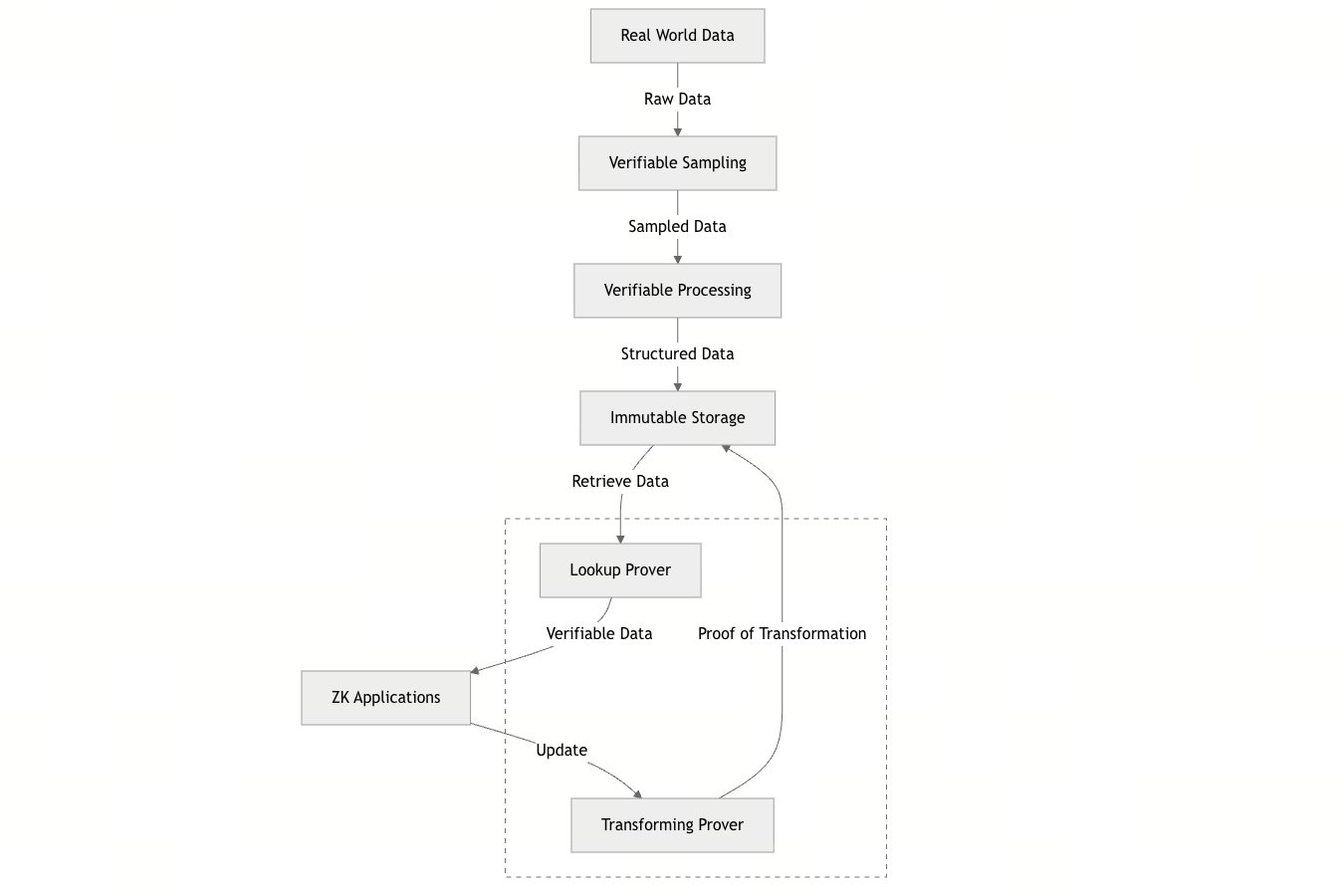
Verifiable Data Infrastructure, or VDI, is the core technological concept proposed by Orochi Network. Simply put, it is an infrastructure system built around "data verifiability," with the goal of making all data in a Web3 environment independently provable for authenticity, without relying on third-party endorsements.
Traditional data systems typically focus on storage efficiency, query speed, and computational power, requiring users to trust that database operators or data providers will not maliciously alter data. However, as blockchain applications begin to handle increasingly complex data demands, relying solely on trust is no longer sufficient. Especially in AI, on-chain finance, and automated systems, erroneous data or unverifiable computation results can directly compromise the security of the entire application.
VDI is designed precisely to redefine this trust relationship. In Orochi's design, data is not just a set of information but a digital resource whose authenticity can be mathematically proven. Whether the data originates on-chain or off-chain, users can verify the credibility of the data source, whether the data has been altered during transmission, and whether the computation results comply with established rules.
This model means data trustworthiness no longer depends on platform reputation but is built on cryptographic proofs. For Web3, this also represents a significant step from a trusted ledger toward a trusted data network.
How Orochi's zkDatabase Enables a Verifiable Database
Databases are a fundamental part of the digital world, but traditional databases universally suffer from one problem: users must unconditionally trust the database operator.
Whether it's a relational or NoSQL database, when the system returns query results, users typically cannot confirm whether the data has been tampered with, nor can they verify the true state of the database at a specific point in time. This centralized trust model has clear limitations in high-trust scenarios such as finance, AI, and blockchain. To solve this, Orochi introduced zkDatabase. zkDatabase is essentially a verifiable database based on Zero-Knowledge Proofs. Unlike traditional databases that only return query results, zkDatabase generates corresponding cryptographic proofs alongside the data. Users or applications can use these proofs to independently verify that the query was executed correctly, that the returned data comes from the specified database state, and that no tampering occurred during the query process.
For example, a DeFi protocol needs the asset price at a historical point in time. Traditionally, the protocol can only trust the data returned by the database. Under the zkDatabase architecture, the protocol not only obtains the price information but can also verify that this data indeed existed at the specified block height and was not modified by any node.
This shift from "trusting the database" to "verifying the database" allows data trustworthiness to be confirmed through mathematical proof for the first time, making it a key component of Orochi's verifiable data network.
How the Verifiable Data Pipeline Ensures Data Integrity
In real-world applications, data is not static; it goes through multiple stages including collection, processing, storage, computation, and output. While traditional systems can ensure security in some stages, they struggle to uniformly verify the entire data lifecycle. If any single step is tampered with, the final result may be skewed, and users often cannot trace where the problem occurred.
Orochi's Verifiable Data Pipeline aims to cover the entire data flow process with cryptographic proofs, making every step independently verifiable. When the system fetches data from an off-chain API, it records the data source and generates a proof. During data cleaning and computation, the system also generates corresponding Zero-Knowledge Proofs for the computation steps. When the final result is output, all proofs are combined into a complete proof chain.
This means users not only get the final result but can also trace where the data came from, what processing it underwent, and whether each computation step complied with the rules.
Compared to traditional data processing architectures, the Verifiable Data Pipeline is more like a verifiable data supply chain, ensuring transparency and traceability throughout the entire process from data generation to usage.
How Orocle Differs from Traditional Oracles
Oracles are a critical bridge connecting blockchain to the real world, primarily responsible for transmitting off-chain data to smart contracts—such as asset prices, weather information, sports results, or financial indicators. However, traditional oracles focus more on the "how" of data transmission, with relatively limited capabilities for verifying data authenticity. Users often have to trust that oracle nodes or operating entities will provide data honestly, a model that still carries centralized trust risks.
Orochi's Orocle upgrades the oracle from a data transmission tool to a verifiable data service. In Orocle's architecture, every data output comes with a corresponding Zero-Knowledge Proof. The smart contract not only receives the data result but can also verify whether the data came from the specified source, whether the processing followed the rules, and whether any abnormal modifications occurred during transmission. In other words, Orocle's core function is not to provide data but to prove it.
This shift from "Trust Oracle" to "Verify Oracle" transforms data trustworthiness from depending on node reputation to relying on cryptographic proofs, ushering the oracle infrastructure into the verifiable era.
How Orand Provides Verifiable Random Number Services
Random numbers are an indispensable part of many blockchain applications. Equipment drops in on-chain games, NFT lotteries, prediction markets, and some AI Agent decision logic all rely on random number generation. However, blockchain's inherent openness and transparency often raise questions about the randomness generation process. Users typically worry whether the random number was pre-generated, whether it can be manipulated, and whether the final result is truly fair.
To address this, Orochi launched Orand. Orand is a Verifiable Randomness service designed to maintain randomness while ensuring the resulting random output is verifiable.
Whenever an application requests a random number, the system not only generates the random value but also produces a corresponding cryptographic proof. Any third party can independently verify that the random number generation process followed the established rules, without needing to trust the service provider itself.
This design means that even the system operator cannot modify the random result after it has been generated. For on-chain games, NFTs, and AI applications, verifiable randomness not only enhances fairness but also reduces the risk of system manipulation.
How ZKP, FHE, and TEE Work Together
Orochi's technical system does not rely solely on Zero-Knowledge Proofs; it builds a trusted computing environment by combining three technologies: ZKP, FHE, and TEE.
-
ZKP handles proving the correctness of computations. The system can prove to the outside world that a computation was performed correctly without revealing all the raw data, thus balancing verification capability with privacy protection.
-
FHE, or Fully Homomorphic Encryption, further enhances privacy-preserving computation. Users' data can participate directly in computations even while encrypted, without needing to be decrypted first. This means sensitive information can remain encrypted at all times while still being computationally usable.
-
TEE provides a Trusted Execution Environment, protecting program execution through hardware isolation. Even during complex computations, external systems cannot read memory contents or tamper with execution flow, ensuring the security of the runtime environment.
When these three technologies are combined, Orochi builds a data processing system that balances trust, privacy, and security. Data can not only be verified but also securely computed while preserving privacy—a crucial technical foundation for future AI and Web3 applications.
How Orochi Differs from Traditional Data Infrastructure
The development logic of traditional data infrastructure is essentially built on centralized trust. Databases require trust in the operating entity, oracles require trust in nodes, random number services require trust in providers, and cloud computing requires trust in the platform itself.
While this model worked well in the internet era, it still has limitations for Web3, which emphasizes openness, transparency, and decentralization.
Orochi aims to change this trust relationship, shifting from "trusting institutions" to "verifying proofs."
In its architecture, database queries can be verified, oracle outputs can be verified, random number results can be verified, and even complex computation processes can be verified. Users do not need to know who is running the system in the background, nor do they need to rely on the operator's reputation—they confirm data authenticity through open, transparent cryptographic proofs.
This shift implies that future data infrastructure may no longer be built around centralized institutions but around openly verifiable data systems. As AI and blockchain further converge, the importance of verifiable data networks is expected to continue growing.
Future Development Directions of Orochi Technology
As AI Agents, on-chain AI, DePIN, and automated financial applications continue to grow, data authenticity and computation trustworthiness are becoming new technical requirements. Orochi's development direction is also expanding from a single focus on data verification into wider verifiable computing territory.
The application scenarios for zkDatabase are continuously expanding. Beyond traditional on-chain data management, future applications may include AI dataset verification, DeFi risk models, and digital identity systems. For AI, proving that training data is authentic and trustworthy, and that model inference processes have not been tampered with, is becoming an increasingly important industry topic.
At the same time, the integration of verifiable computing and privacy-preserving computing is progressing. Through the collaboration of ZKP, FHE, and TEE, Orochi aims to provide a trustworthy data foundation for future AI applications, allowing models to maintain privacy while keeping results verifiable.
From a longer-term perspective, Orochi is attempting to establish a complete Verifiable Data Ecosystem, bringing multiple stages such as data collection, storage, computation, random number generation, and AI inference into a unified verification framework. As Web3's demand for trustworthy data continues to rise, verifiable data infrastructure is poised to become a key development direction in the next phase.
Summary
Orochi Network is a verifiable data network built around Verifiable Data Infrastructure. Its core goal is not merely to improve data processing efficiency but to redefine the data trust mechanism in the Web3 era. Through technological components like zkDatabase, Verifiable Data Pipeline, Orocle, Orand, ZKP, FHE, and TEE, Orochi aims to make the entire data lifecycle—from generation, storage, and computation to final output—independently verifiable and traceable.
As AI, DeFi, on-chain automation, and data-driven applications continue to develop, the importance of verifiable data is steadily increasing. Compared to traditional data systems that rely on the reputation of centralized institutions, the Verifiable Data Infrastructure built on cryptographic proofs is becoming a key direction in Web3 infrastructure evolution. The technological path Orochi is exploring also reflects the new trend of blockchain moving from a trusted ledger toward a trusted data network.