The Meme Coin Market is strongly driven by market sentiment. A token's price may be influenced by the combined effects of social media exposure, community attention, exchange liquidity, on-chain capital flows, and overall market risk appetite. Compared with assets that have relatively mature valuation frameworks, many meme coins lack stable cash flows, clear product revenue, or sustainable fundamental metrics. As a result, traders often need to pay closer attention to market behavior and trading conditions.
Against this backdrop, Memecoin Copy Trading (meme coin copy trading) has gradually become a participation method that has attracted attention. Users do not have to rely entirely on their own judgment to find every trading opportunity. Instead, they can follow the actions of specific traders and attempt to replicate their market strategies. For people with limited trading experience, this approach may appear to shorten the learning curve. For experienced traders, it may also serve as a tool for observing other strategies, comparing trading performance, and managing multiple trading approaches.
However, copy trading does not mean automatically acquiring the original trader's trading capabilities. The fact that a trader can buy at a certain price does not mean that followers can obtain the same price. The original trader may have a larger amount of capital, faster execution, or a higher risk tolerance. This is especially relevant in the meme coin market, where liquidity can change rapidly and significant differences may arise between trading signals and actual execution results.
Therefore, understanding meme coin copy trading should not stop at "selecting a trader and copying orders." Users also need to understand the different ways copy trading is implemented, how trading strategies are replicated, where differences in returns come from, and how to determine whether a trader is suitable for their capital size and risk tolerance.
What Is Memecoin Copy Trading?
Memecoin Copy Trading (meme coin copy trading) refers to a method in which users follow other traders' buying, selling, or position-adjustment activities through specific tools or platforms. Copy traders do not necessarily need to generate every trading signal independently. Instead, based on their selected traders and preset rules, they replicate some or all of those traders' operations.
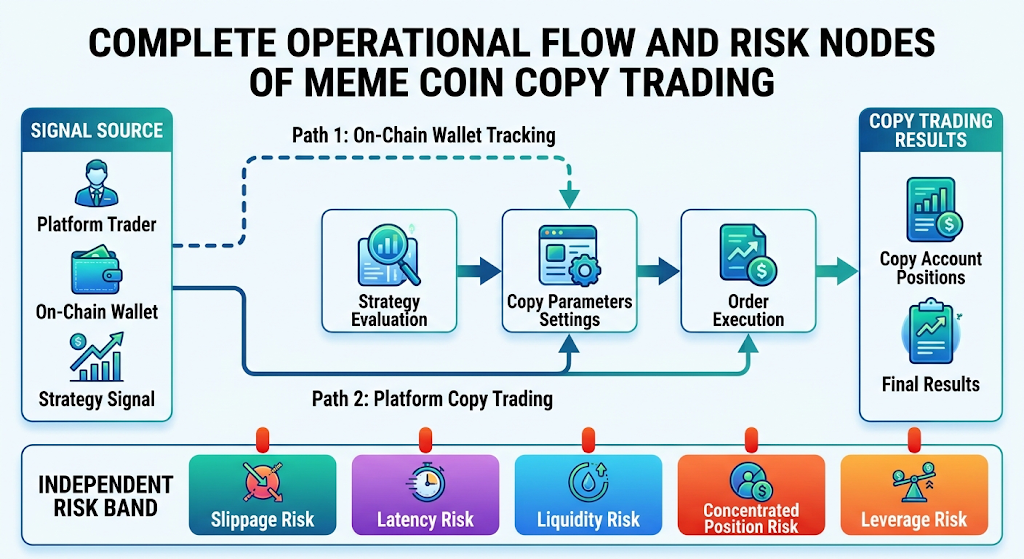
In terms of implementation methods, meme coin copy trading can generally be divided into two categories.
The first is on-chain wallet tracking and trade replication. Users monitor the on-chain trading activity of a public wallet address. When the address buys or sells a token, the monitoring tool identifies the relevant transaction, after which the user manually executes the corresponding trade or an authorized automated tool does so. This method typically relies on blockchain explorers, wallet monitoring tools, trading bots, and on-chain trading interfaces.
The second is copy trading through a trading platform. The platform uses trading accounts and order systems to synchronize the operations of lead traders to the accounts of copy traders. Users generally need to select a trader and set the copy trading capital and related parameters. The platform then executes trades according to the product rules. Compared with on-chain wallet tracking, this method does not necessarily require users to directly monitor a public wallet address. Instead, it relies on the trading relationships and order mechanisms within the platform.
Although both methods may be called "copy trading," they are not exactly the same product. On-chain wallet tracking focuses on address activity and on-chain trade execution, while platform copy trading focuses on trader strategies, account parameters, and order synchronization. Before participating, users should first confirm which model the specific tool uses, as well as how trading permissions, fund management, and fees are handled.
How Does Meme Coin Copy Trading Differ from Copy Trading for Regular Crypto Assets?
Copy trading for regular crypto assets may cover Bitcoin, Ethereum, and other assets with relatively mature trading markets. Meme coin copy trading relies more heavily on market sentiment, short-term liquidity, and community exposure. Both involve execution discrepancies, but the trading environment in the meme coin market may make these discrepancies more pronounced.
First, meme coin liquidity often varies significantly. Some tokens may see their market depth increase rapidly when they attract strong market attention. Once attention declines, the order book may quickly become thinner. Orders that a trader can complete may not be replicated by multiple copy trading accounts at the same price and quantity.
Second, meme coin price discovery may be influenced by social exposure. Community discussions, content creators' views, and market trends can attract capital inflows within a short period. However, these factors do not necessarily mean that the project's long-term value has changed. By the time followers copy a trader's purchase, the market may have already experienced the first rapid increase, meaning that copy traders may enter at a later point.
Third, the effective period of a strategy in the meme coin market may be short. Some traders rely on rapid trades during the initial phase of a market trend, while others seek opportunities through changes in liquidity and short-term price fluctuations. If market conditions change, a strategy that was previously effective may quickly lose its advantage.
This means that meme coin copy trading cannot simply apply the approach of ranking returns used for copy trading in regular assets. A trader's historical performance, trading frequency, asset concentration, exit discipline, and actual execution conditions all need to be evaluated in light of the characteristics of the meme coin market.
Basic Process of Meme Coin Copy Trading
Although the specific features of different tools vary, a typical copy trading process generally includes the following steps.
Step 1: Determine the Signal Source.
Users should first confirm what they are following. It may be a lead trader on a platform, a public on-chain wallet address, or an account that publishes strategy signals through a trading tool. Different signal sources represent different levels of information transparency and different execution methods.
For example, on-chain wallet transaction records can be verified through a blockchain explorer. However, the actual person controlling the wallet, the source of its funds, and the motivation behind its trades may not be directly confirmed. Platform traders may provide historical returns and trading metrics, but users still need to understand the statistical period, risk measurement criteria, and strategy limitations behind that data.
Step 2: Evaluate the Trading Strategy.
Users should not focus only on a trader's recent returns. They should also observe the trader's trading frequency, holding period, drawdown, asset distribution, and trading style. For meme coin traders, users should also determine whether the trader relies heavily on a small number of popular tokens, frequently builds positions when liquidity is insufficient, or has clear exit rules.
Step 3: Set Copy Trading Parameters.
On tools that support parameter settings, users may need to determine the copy trading amount, order ratio, maximum investment amount, leverage, stop-loss, or other limits. Settings vary across platforms, so the parameters of one product should not be directly applied to another.
Step 4: Monitor Actual Execution Results.
After copy trading begins, users should monitor whether orders are executed successfully, whether execution prices deviate from signal prices, whether actual positions match the preset ratios, and whether partial fills, failed trades, or risk-limit restrictions occur.
Step 5: Review the Strategy Regularly.
A copy trading relationship should not be viewed as permanently valid. A trader may change their strategy, market liquidity may decline, and previously effective trading logic may no longer work. Users need to review trading performance regularly and decide whether to continue following the trader based on their own risk budget.
How to Choose a Meme Coin Copy Trading Strategy That Suits You
Meme coin copy trading strategies can be distinguished based on trading period, signal source, and risk appetite. When choosing a strategy, the most important consideration is not finding the trader with the highest short-term returns, but determining whether the trader's approach suits your capital size and risk tolerance.
Short-Term Trading Strategies
Short-term traders typically focus on price movements, trading volume, market sentiment, and short-term liquidity. They may open and close positions multiple times within a short period. This type of strategy is relatively sensitive to execution speed and trading costs. If copy traders experience significant delays, they may miss the original trader's entry price.
Swing Trading Strategies
Swing traders typically focus on price trends, market structure, and capital flows over a period of time, and their holding periods may be longer than those of short-term strategies. Compared with high-frequency trading, this type of strategy may be less dependent on millisecond-level execution speed. However, users still need to monitor price pullbacks, changes in liquidity, and trend reversals.
On-Chain Wallet Tracking Strategies
This type of strategy uses the trading behavior of a public wallet as the object of observation and is suitable for studying on-chain capital flows and the behavior of trading addresses. However, a wallet transaction does not necessarily represent a clear investment view. An address may be used for multiple strategies, or it may be involved in transfers, fund consolidation, or other non-trading activities. Users must distinguish actual buying and selling activity from ordinary asset transfers.
Portfolio Copy Trading Strategies
Some users may follow multiple traders or different types of trading signals at the same time to reduce their reliance on a single strategy. However, multiple traders may hold the same popular tokens, so apparent diversification does not necessarily mean that risk is actually diversified. Portfolio management requires monitoring the overlap among underlying assets and overall risk exposure.
The Most Commonly Overlooked Risks in Meme Coin Copy Trading
The core risk of meme coin copy trading is not simply price volatility. It is that users may mistakenly believe that replicating trading activity means they can replicate the original trader's trading conditions.
Liquidity and Slippage Risk
Slippage is the difference between the actual execution price and the expected price. In the meme coin market, trades may incur significant slippage when the trading size is large, the order book is thin, or on-chain liquidity pool depth is insufficient. Even when the trading signals are exactly the same, copy traders may have different purchase costs and sale proceeds.
Execution Delay Risk
On-chain trades need to be submitted and confirmed by the network, while platform copy trading requires synchronization according to the platform's internal systems and order rules. When market prices change rapidly, execution delays may cause copy traders to execute at less favorable prices or even prevent orders from being executed.
Strategy Transparency Risk
A public wallet can only display on-chain activity and may not explain the trader's complete strategy. A platform trader's historical performance also cannot fully indicate their current risk appetite. Users should avoid evaluating strategy quality based solely on promotional descriptions or a single return figure.
Concentrated Position Risk
If multiple copy trading targets favor the same popular meme coins, users may unknowingly build highly concentrated risk exposure. If the token experiences a liquidity contraction or a rapid price decline, multiple strategies may suffer losses at the same time.
Smart Contract and Authorization Risk
On-chain automated copy trading may involve wallet authorizations, trade routing, and third-party contracts. Users need to confirm the tool's permission scope, contract source, and asset management method. They should avoid granting unnecessary asset control permissions to untrusted services.
Leverage and Liquidation Risk
If copy trading takes place in a leveraged trading scenario such as perpetual contracts, adverse market movements may result in margin losses or forced liquidation. Differences in the follower's and lead trader's margin, leverage, and position size may also lead to different risk outcomes.
The Relationship Between Gate Copy Trading Features and Meme Coin Trading
Gate provides a Futures Copy Trading feature that allows users to view lead traders and their trading performance and set copy trading parameters within the scope supported by the product. Gate's related information also states that the returns of copy traders and lead traders may differ due to factors such as self-initiated position closures, contract costs, changes in margin, leverage differences, copy trading multipliers, slippage, and risk limits.
This means that platform copy trading does not simply copy a trader's return rate to the user. Instead, it synchronizes the relevant operations through the trading system, while the final results still depend on the copy trading account's own capital conditions and actual execution.
Regarding meme coin-related trading, Gate previously announced that PAID Perpetual Contracts would support copy trading and trading bot features. PAID is a token related to the Solana Meme Creator Fee payment protocol. This example shows that some contract assets related to the Meme ecosystem can enter a platform copy trading scenario. However, it does not mean that all meme coin spot assets, on-chain tokens, or wallet transactions support Gate copy trading.
Before using the feature, users should confirm through Gate's actual trading page whether a specific contract supports copy trading, as well as its trading parameters and risk rules. Users should also read the relevant product information.
FAQ
What Is Memecoin Copy Trading?
Memecoin Copy Trading (meme coin copy trading) is a way to participate in the meme coin market by following other traders' buying and selling activities. It can be implemented through on-chain wallet monitoring tools or a trading platform's copy trading feature.
Does Meme Coin Copy Trading Guarantee the Same Returns as the Trader?
No. Differences in execution prices, trading costs, slippage, execution delays, capital size, and leverage may cause copy trading results to differ from those of the original trader.
What Is the Difference Between On-Chain Wallet Tracking and Platform Copy Trading?
On-chain wallet tracking primarily monitors the on-chain trading activity of a public address and uses tools to execute corresponding operations. Platform copy trading synchronizes the operations of a lead trader through the platform's trading system. The two methods differ in their signal sources, execution processes, and permission structures.
Is Meme Coin Copy Trading Suitable for Beginners?
Copy trading may lower some of the barriers to trading research and execution, but it does not mean that the risks are lower. Beginners still need to understand asset liquidity, trading costs, position management, and copy trading rules.
What Should You Pay the Most Attention to When Copy Trading?
In addition to the return rate, users should monitor maximum drawdown, trading frequency, position concentration, strategy stability, execution discrepancies, and fund management methods.
Does Gate Support Copy Trading for All Meme Coins?
That should not be assumed. Gate's copy trading feature depends on the actual support available for specific products and trading pairs. Some Meme-related contracts have previously supported copy trading, but this does not mean that all meme coin assets support the feature.