When a meme coin trader buys a token, followers may want to open a position in the same direction. However, a trade is not automatically copied simply because it has been detected. Several technical and trading steps take place between signal identification, order submission, and final execution.
For on-chain wallet tracking tools, the system must identify trading activity associated with a wallet address, determine whether a transaction represents the buying or selling of a target token, and then execute the corresponding action through a trading interface or wallet. For copy trading on centralized platforms, the system must read changes in a lead trader's orders or positions and generate corresponding trades based on the parameters set by the copy trader.
Although both methods appear to copy trades, their underlying processes are different. The former relies on on-chain data, transaction parsing, and wallet execution, while the latter relies on platform accounts, order synchronization, and internal risk controls. Understanding this difference is the first step in analyzing meme coin copy trading tools.
More importantly, a trading signal is not the same as an execution result. Followers may enter the market after a signal appears, by which time the price, liquidity, and trading costs they face may have changed. Therefore, when evaluating a copy trading tool, you should not focus only on how quickly it can detect trades. You should also understand how it processes signals, generates orders, and manages risk when trades fail.
Core Technical Process of Meme Coin Copy Trading
A typical copy trading system can be divided into five stages: signal identification, trade evaluation, order generation, trade execution, and result feedback.
Signal Identification
The system first needs to obtain trading information. On-chain tracking tools may monitor the transaction records, token transfers, and transaction routes associated with specific wallet addresses. Platform copy trading systems identify trading activity based on changes in lead traders' orders and positions.
Accurate signal identification is critical. On-chain wallets may be used for ordinary transfers, fund consolidation, liquidity operations, or contract interactions. Not every token transfer indicates that a trader is buying or selling. If a tool cannot correctly distinguish between these activities, it may generate false signals.
Trade Evaluation
After identifying a signal, the system must determine whether the signal meets the execution requirements. For example, it may check whether the user has reached a per-trade limit, whether the target asset is supported, whether the account balance is sufficient, and whether the trade exceeds a preset risk threshold.
For meme coins, trade evaluation must also account for liquidity and price changes. Even if a wallet has just bought the target token, continuing to follow the trade after a significant price increase may mean taking on a higher entry cost.
Order Generation
During the order generation stage, the system converts the original signal into an actual trade instruction for the copy trader. It may calculate the order size based on a fixed amount, a percentage, account funds, or other rules.
An important question arises here: should followers copy the original trader's absolute position size? Usually, this is not reasonable. The original trader's capital may be much larger than the follower's, and directly copying the amount could create excessive risk exposure. As a result, many copy trading systems offer percentage-based or fixed-fund settings. However, the specific rules should be confirmed in the product documentation.
Trade Execution
After an order is submitted, the trading system needs to find available market liquidity for execution. On-chain transactions may involve routing, fee settings, and block confirmations. Centralized trading platforms process trades based on order type, market depth, and risk limits.
At this stage, price changes, network congestion, and insufficient liquidity may all cause execution discrepancies. Even if the system identifies the trading signal accurately, it cannot guarantee that the follower will receive the same execution price.
Result Feedback
After a trade is completed, the copy trading system needs to record the actual execution price, quantity, fees, and position changes. Users should be able to distinguish between the signal price, order price, and final execution price rather than judging their account returns solely by the trader's historical performance.
Differences Between On-Chain Wallet Tracking and Platform Copy Trading
The core differences between these two types of copy trading tools lie in their signal sources, trade execution entities, and methods of managing funds.
On-Chain Wallet Tracking
On-chain wallet tracking focuses primarily on publicly available addresses. After selecting the wallets to monitor, the user has a tool continuously read their on-chain activity. When the system identifies a target trade, it can notify the user or attempt to execute the corresponding action through an authorized automated trading tool.
One advantage of this approach is that transaction records are publicly verifiable to some extent. Users can use a blockchain explorer to verify address activity, transaction times, and related token movements. However, public data does not provide a complete view of a strategy. A wallet may manage multiple addresses or be used for fund transfers, asset consolidation, and liquidity operations. It is difficult to accurately determine a trader's true intent based on a single transaction.
In addition, on-chain trading involves wallet approvals, transaction routing, network fees, and smart contract risks. If an automated tool requires extensive permissions, users must carefully verify its security.
Centralized Platform Copy Trading
Platform copy trading is generally handled by the platform's internal system, which synchronizes orders between lead traders and copy traders. Users select a lead trader, set a copy trading amount or other parameters, and the platform copies the relevant trading operations according to the supported product rules.
These mechanisms generally provide clearer account management and parameter-setting processes. However, their actual capabilities depend on the platform's supported trading products, order rules, and risk controls. They do not monitor every on-chain wallet, nor can they directly copy trades from all external trading platforms.
Therefore, when choosing a tool, users must first determine whether they want to copy the on-chain activity of a public wallet or the account operations of a platform trader. The technical processes and risk structures of the two should not be treated as the same.
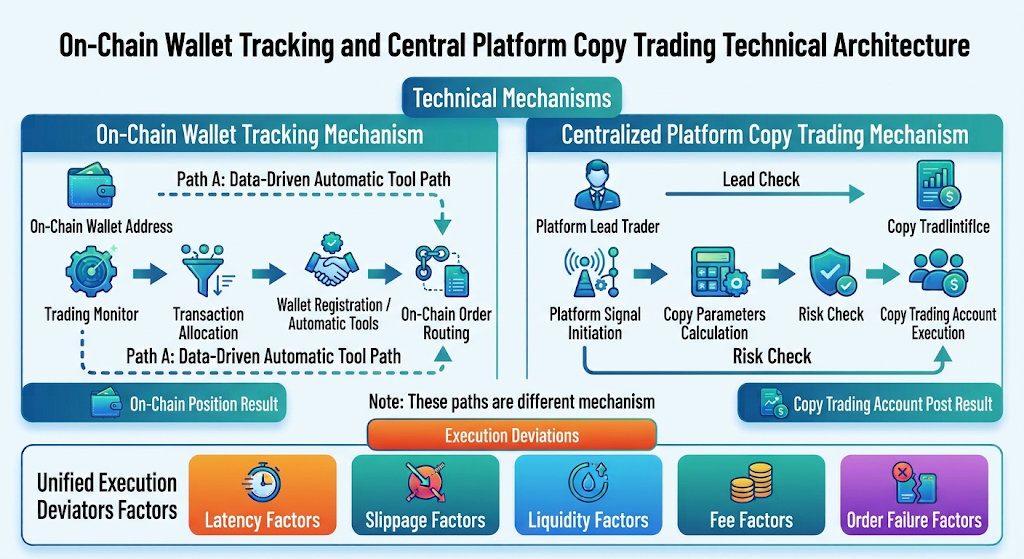
Why Might the Copy Trading Price Differ From the Original Trader's Price?
Discrepancies in copy trading results are usually caused by the combined effects of signal timing, order size, and market liquidity rather than by a single factor.
Time Delays and Price Changes
Suppose the original trader buys a meme coin at a certain price. By the time the system identifies the signal and submits an order for the copy trading account, the price may already have changed, even if the delay is brief. This difference is more pronounced in active markets with rapid price fluctuations.
Order Size and Market Depth
If the original trader places a small order while multiple copy trading accounts copy the trade at the same time, the combined order size may exceed the liquidity that the market can currently absorb. The larger the order, the more likely it is to affect the execution price.
Slippage and Trading Costs
Slippage means that the actual execution price differs from the expected price. On-chain trades may be affected by liquidity pool depth, transaction routing, and fee settings. Centralized platforms may be affected by order book depth, order type, and market volatility.
In addition, fees, funding rates, and other trading costs can affect the final return. The trading costs incurred by the original trader and the copy trader may not be the same.
Failed or Partially Filled Orders
Price changes, insufficient balances, trading limits, and system risk controls may prevent an order from being executed. A partial fill may also cause the copy trading account's actual position to differ from the original trader's position.
Therefore, copy trading tools should not be evaluated solely by the speed of signal identification. You should also consider the order execution success rate, execution discrepancies, and completeness of the trade records.
Tool Architecture and Key Capabilities for Meme Coin Copy Trading
From a technical perspective, the value of a copy trading tool lies not only in detecting trading activity but also in its ability to process trading information accurately and control execution risk.
A relatively complete tool typically needs the following capabilities:
-
Address or Trader Monitoring: Continuously identify trading activity from target wallets or platform traders.
-
Trade Classification: Distinguish between buys, sells, transfers, and other contract interactions.
-
Execution Parameter Management: Allow users to set the trade size, percentage, or other limits.
-
Risk Checks: Check the balance, liquidity, and trading conditions before submitting an order.
-
Order Status Feedback: Record order submission, execution, failure, and cancellation statuses.
-
Permission and Security Management: For on-chain tools in particular, clearly define the scope of wallet approvals and asset control permissions.
Keep in mind that more features do not necessarily mean lower risk. Greater automation may reduce some manual operations, but if signals are misclassified or trading parameters are set improperly, automation may also amplify losses more quickly.
Gate Platform Copy Trading Mechanism as a Reference
Gate's Futures Copy Trading feature can serve as a reference example of a centralized platform copy trading mechanism. According to the product information on Gate's official copy trading page, users can select lead traders, set copy trading parameters, and synchronize the corresponding futures positions based on the traders' actions.
Gate's help documentation also lists common reasons why the returns of copy traders and lead traders may differ, including users closing positions manually, differences in futures costs, changes in margin, leverage differences, copy trading multipliers, slippage, and shared risk limits.
These factors reflect an important characteristic of platform copy trading: the system copies trading operations that comply with the applicable rules. It does not guarantee the same trading results.
In addition, Gate previously announced that PAID Perpetual Contracts would support copy trading and trading bot features. This example shows that some assets related to the Meme ecosystem may be available in platform futures copy trading scenarios. However, the actual scope of support remains subject to the specific trading page. Users should not interpret platform copy trading as an automatic tracking service for all on-chain meme coin wallets.
How to Determine Whether a Copy Trading Tool Is Reliable
Before choosing a copy trading tool, users can evaluate it in four areas:
First, confirm whether the signals are verifiable. On-chain wallet tools should provide the relevant addresses and transaction records, while platform copy trading tools should clearly disclose trader information and performance metrics.
Second, confirm whether the execution rules are transparent. This includes how order sizes are calculated, how slippage is handled, how failed trades are reported, and whether additional fees apply.
Third, review permission and fund security. For on-chain tools in particular, pay close attention to the scope of approvals, private key management, and third-party contract risks. For platform tools, understand the account permissions, copy trading fund management, and product risk rules.
Finally, review historical execution results. In addition to trader returns, you should consider the copy trading account's actual execution results, maximum drawdown, failed orders, and the impact of costs. Only then can you determine whether the tool is truly suitable for your trading needs.
FAQ
How does meme coin copy trading identify trading signals?
On-chain tools typically identify activity by monitoring wallet addresses and on-chain transaction records. Platform copy trading systems obtain signals from traders' orders or position changes within the platform.
Does on-chain wallet tracking mean automatic copy trading?
No. Wallet tracking may only provide trade notifications, or it may be combined with an automated tool to execute trades. Whether trades are executed automatically depends on the tool's specific features and the permissions granted by the user.
Why does the copy trader's execution price differ from the original trader's price?
Common reasons include signal delays, price fluctuations, order size, market depth, slippage, and trading costs.
Can a copy trading system guarantee that every trade will be successful?
No. Insufficient balances, changes in liquidity, trading limits, network congestion, and risk controls may all cause an order to fail or be partially filled.
Can centralized platform copy trading copy an on-chain wallet?
Generally, the two should not be treated as equivalent. Platform copy trading usually synchronizes the actions of traders within the platform, while on-chain wallet tracking requires independently monitoring a public address and executing trades through the relevant tools.
Does a higher level of automation mean lower copy trading risk?
Not necessarily. Automation may reduce some manual operations, but risks from inaccurate signals, incorrect parameters, and market liquidity still remain.