Finding traders to follow in the meme coin market is not difficult. Public wallets, trading communities, trading platforms, and various analytics tools may provide traders' historical records or performance data. However, readily available information does not make the selection process simple.
A trader may generate high returns over a short period while also experiencing substantial drawdowns. Another trader may have a high win rate, but a few losing trades could be enough to offset many previous small gains. Some traders may also rely heavily on a few popular meme coins. Once market attention shifts, their original strategies may no longer work.
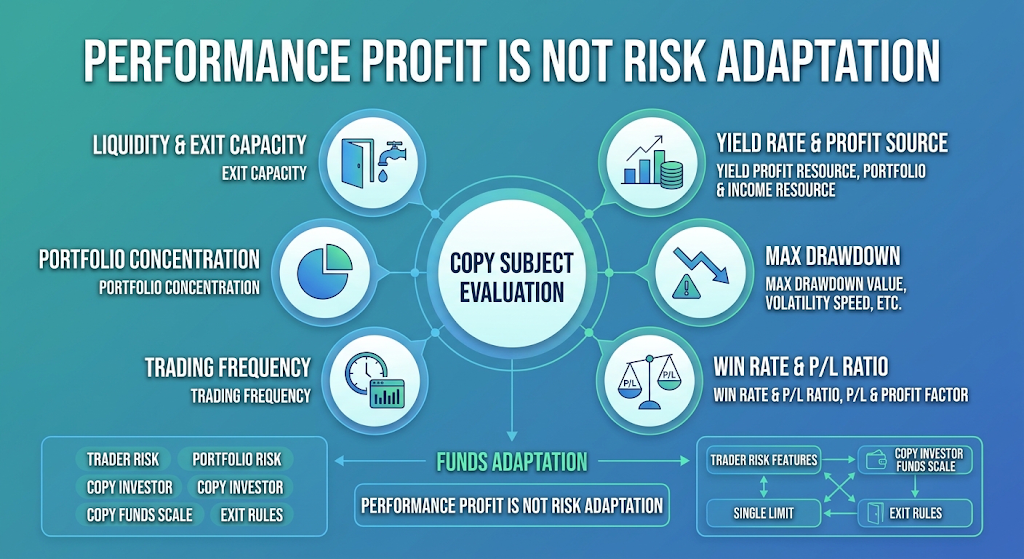
Therefore, returns alone cannot fully demonstrate a trader's abilities. Followers need to evaluate traders from multiple perspectives, including returns, risk, trading behavior, and execution conditions. For assets such as meme coins, whose liquidity and market sentiment can change rapidly, a trader's risk management capabilities are often more important than their return ranking during a particular period.
This article establishes a relatively comprehensive evaluation framework to help readers understand how to assess trader performance, identify strategy risks, and set copy trading position sizes based on their own financial situation. It is not a ranking of traders with high returns, but an analytical method for determining strategy suitability.
Why Can't You Choose a Trader to Follow Based Only on Returns?
Returns can reflect account performance over a period of time, but they cannot independently explain how much risk a trader took or guarantee that future performance will continue.
First, you need to distinguish between cumulative returns and returns over a specific period. Cumulative returns may be influenced by a small number of successful trades over a relatively long period, while recent returns may reflect how a strategy performed under the market conditions of a particular phase. Both should be understood in the context of the statistical period.
Next, consider how the capital behind the returns was used. A trader may increase returns by using high leverage, concentrated positions, or continuous position additions, but these behaviors can also amplify losses. Comparing return figures alone can easily overlook the risks taken by the strategy.
You should also consider whether the returns are sustainable. If most of a trader's returns came from one or two trades during extreme market movements, the strategy may be more opportunity-driven than a stable and repeatable trading method.
Therefore, evaluating a trader to follow should go beyond "how much they earned" and consider "how they generated those returns, what risks they took to do so, and whether this approach suits you."
Six Key Metrics for Evaluating Meme Coin Traders
1. Returns and Sources of Returns
Returns are a basic metric, but you should also examine absolute returns, capital size, and the sources of returns. A trader's high returns may come from the rapid appreciation of a few meme coins or from consistently executing a trading strategy.
You can review performance over different time periods to determine whether returns are overly concentrated in a particular period or a small number of trades. You should also confirm whether the return data accounts for trading fees, funding rates, and other related costs.
2. Maximum Drawdown
Maximum drawdown measures the largest decline in an account from a period high to a subsequent low. It can help you understand the degree of capital fluctuation a trader may have experienced under unfavorable market conditions.
For example, two traders may have similar cumulative returns, but one may have experienced a much larger account drawdown. For followers, this means that the two strategies may involve very different capital experiences and risk tolerance requirements.
Maximum drawdown cannot predict the upper limit of future losses, but it can help you identify extreme risks that have occurred historically.
3. Win Rate and Profit-to-Loss Ratio
Win rate is the proportion of profitable trades among all trades, but a high win rate does not necessarily mean that a strategy is better. A trader may maintain a high win rate through frequent small gains while taking substantial losses on a small number of trades.
Therefore, win rate should be evaluated together with average profit, average loss, and the profit-to-loss ratio. If the average loss is significantly greater than the average profit, long-term results may still be unfavorable even with a high win rate.
4. Trading Frequency and Holding Period
Trading frequency can reflect a strategy's style. High-frequency traders typically rely more on rapid execution, low trading costs, and sustained market liquidity. Low-frequency traders may focus more on trends and price movements over longer periods.
Followers need to determine whether their tools can match the trader's pace. If a trader frequently opens and closes positions while the copy trading system has significant delays or high costs, the original strategy's advantages may not be fully replicated.
5. Position Concentration and Asset Distribution
Whether a trader remains concentrated in a small number of meme coins is an important risk factor to monitor. Even if an account holds multiple tokens, these assets may all depend on the same market sentiment or liquidity conditions and therefore may not provide effective diversification.
You can review major holdings, the distribution of trading amounts, and whether returns rely excessively on a single asset. If you follow multiple traders, you should also check whether they hold highly overlapping tokens.
6. Liquidity and Exit Capability
Meme coin liquidity may change with market attention. A trader's ability to buy does not mean that followers can exit at the same price when needed.
During evaluation, you should consider the target asset's market depth, bid-ask spread, trading volume, and changes in liquidity. For on-chain assets, you should also understand the size of the relevant liquidity pools, trading routes, and potential price impact.
How Can You Identify Trading Behavior That Is Unsuitable to Follow?
In addition to quantitative metrics, a trader's behavior patterns can also provide important information.
Long-Term Reliance on a Single Popular Token
If a trader's returns mainly come from a popular meme coin and the trader has not demonstrated performance under different market conditions, the strategy may depend heavily on that single asset's market performance. You need to determine whether this reflects focused trading based on a clear rationale or a lack of risk diversification.
Continuously Adding to Losing Positions
Adding to a position does not necessarily mean that a strategy is unreasonable. However, if a trader continuously increases a position as the price declines without clear exit conditions, risk may gradually accumulate. Followers also need to consider whether their capital can withstand the same changes in position size.
Frequent Changes in Trading Style
A trader may shift from low-frequency swing trading to high-frequency trading over a short period, or from spot trading to high-leverage futures trading. Changes in strategy alter the original risk profile, so historical data may not represent the trader's current approach.
A Mismatch Between Returns and Actual Risk
If returns appear unusually strong but trading records show high concentration, extreme drawdowns, or unusual leverage usage, you should verify the data further. Do not judge whether a trader is reliable based only on promotional copy, rankings, or community discussions.
Lack of Clear Exit Rules
Meme coin prices can change rapidly. If a trader does not have clear stop-loss, position-reduction, or exit logic, followers may be unable to adjust their risk in time when the market reverses.
How Can You Set a Copy Trading Position Size Based on Your Own Capital?
After choosing a trader, the next step is not to immediately copy their entire position. Instead, determine the amount of capital risk you can tolerate.
Determine Your Total Risk Budget
First, define the maximum amount of capital you will allocate to copy trading and separate it from your overall personal assets. Meme coins are highly volatile assets. Copy trading capital should not be treated as capital with an expectation of stable returns.
Set a Capital Limit for Each Trader
If you follow multiple traders, avoid allocating all your capital to the single best-performing trader. Capital allocation should consider each trader's strategy style, historical drawdown, and overlap in underlying assets rather than simply distributing funds based on return rankings.
Set Limits for Individual Trades
The amount copied for each trade should be determined based on your capital size and potential loss range. For tokens with relatively low liquidity, you should also consider the impact of order size on the execution price to avoid additional slippage caused by oversized orders.
Define Exit and Suspension Conditions
Copy trading relationships should include a review mechanism. For example, you should reevaluate whether to continue following a trader when the trader's strategy changes significantly, the drawdown exceeds your predetermined range, copy trading execution consistently deviates from signals, or the target asset's liquidity declines significantly.
These rules cannot guarantee that losses will be avoided, but they can reduce the likelihood of continuously adding capital or delaying an exit due to emotional decision-making.
Does Following Multiple Traders Necessarily Diversify Risk?
Following multiple traders at the same time may appear to reduce reliance on a single trader, but this does not necessarily create genuine risk diversification.
For example, three traders may focus on different meme coins, but all of those tokens may depend on the same market trend. When market sentiment weakens, they may experience price declines and liquidity contraction at the same time. In this situation, multiple trading strategies may generate highly correlated losses.
Therefore, portfolio copy trading requires you to consider both the differences between traders' strategies and the correlation between their assets. You can focus on checking the following:
-
Whether the traders use similar entry and exit strategies;
-
Whether their major holdings are concentrated in the same meme coins;
-
Whether they all rely on short-term market trends;
-
Whether they frequently open positions during similar periods;
-
Whether they use similar leverage and risk management methods.
True risk diversification comes from differences between strategies and sources of risk, not simply from increasing the number of traders you follow.
Which Metrics Should You Monitor When Using Gate Copy Trading?
Gate's Futures Copy Trading Page provides trader selection and related performance information. You can refer to metrics such as returns, profit and loss, and Sharpe ratio to understand trading styles. The platform also provides corresponding copy trading parameter settings. The specific available options are subject to the actual page and product documentation.
These metrics should be used together. Returns can reflect performance over a period of time, profit and loss amounts can help you understand the scale of returns, and the Sharpe ratio provides additional insight from the perspective of risk-adjusted returns. However, no single metric can prove that a trader will maintain the same performance in the future.
In futures copy trading, you should also pay particular attention to leverage, margin, stop-loss settings, and shared risk limits. Differences in account capital conditions may cause your copy trading results to differ from those of the lead trader. For meme coin-related futures contracts, you should also confirm whether the specific contract supports copy trading rather than assuming that the general futures copy trading function is available for all Meme tokens.
A more reasonable approach is to use the trader data on Gate's pages as screening information and then make a decision based on your own risk budget and trading objectives, rather than treating platform recommendations or historical rankings as a guarantee of returns.
Establishing a Sustainable Copy Trading Review Mechanism
Meme Coin Copy Trading is not a one-time process of selecting a trader. Trading strategies change, market liquidity changes, and the execution conditions of copy trading tools may also change. Therefore, you need to review the traders you follow regularly.
You can conduct checks at three levels:
-
Review the trader: Observe whether their recent returns, drawdown, holdings, and trading style have changed.
-
Review copy trading execution: Compare the price difference between signals and actual executions, and check whether failed orders, slippage, and trading costs are continuously increasing.
-
Review your capital: Check whether your overall position exceeds your risk budget, whether there is asset concentration among multiple traders you follow, and whether the current strategy still meets your capital needs.
If a trader's historical advantages have disappeared or actual execution costs continue to erode returns, you should reevaluate the copy trading relationship rather than continuing to follow the trader solely because of strong past performance.
FAQ
Which Metric Should You Prioritize When Choosing a Meme Coin Trader to Follow?
You should not focus on just one metric. Returns, maximum drawdown, win rate, profit-to-loss ratio, trading frequency, and position concentration should be evaluated together.
Is a Trader With a High Win Rate Necessarily More Suitable to Follow?
Not necessarily. A high win rate may be accompanied by large losses on individual trades. You need to consider average profit, average loss, and maximum drawdown to assess the strategy's overall risk.
Is a Lower Maximum Drawdown Always Better?
When other conditions are similar, a lower historical maximum drawdown may indicate smaller historical capital fluctuations. However, you also need to consider the return level, statistical period, and differences between trading strategies. Historical drawdown does not represent the maximum loss that may occur in the future.
How Many Meme Coin Traders Should You Follow at the Same Time?
There is no fixed number that applies to everyone. More importantly, you should analyze whether the trading strategies and underlying assets are truly diversified and whether your overall position is consistent with your risk budget.
Should Copy Trading Capital Maintain the Same Proportion as the Lead Trader's Capital?
You should not copy the proportion mechanically. Followers should set capital limits independently based on their own capital size, risk tolerance, and tool parameters.
When Should You Stop Copy Trading?
When the trading strategy changes significantly, the drawdown exceeds the predetermined range, execution deviations continue to increase, or the asset's liquidity and risk conditions deteriorate significantly, you should reevaluate whether to continue following the trader.