Tokenized leveraged ETFs provide a way for traditional financial products to access the digital asset market, but they do not simply involve writing a stock ticker onto a blockchain. A complete tokenization arrangement typically involves the issuer, the underlying assets or related economic interests, custody mechanisms, token issuance and transfer rules, and the market infrastructure of the trading platform. Blockchain can record token transfers and support digital asset trading, but it does not automatically resolve issues such as the legal rights to the underlying assets, pricing when the market is closed, insufficient liquidity, or redemption restrictions. Using KORU, a 3x leveraged ETF tracking the South Korean stock market, and related tokenized products as examples makes it easier to understand how traditional financial exposure enters the crypto market and why on-chain trading prices may differ from traditional market quotes.
Key Takeaways
-
Bringing tokenized leveraged ETFs into the crypto market requires connecting traditional financial products with token issuance, custody, and legal rights arrangements
-
Blockchain can record token transfers, but cannot independently prove that the underlying assets continue to exist in sufficient amounts or replace legal and custody systems
-
24/7 trading does not follow the trading hours of the underlying securities market. During market closures, price discovery may rely more heavily on expectations, liquidity, and other available information
-
Token prices may diverge from the quoted prices of underlying ETFs due to trading hours, market supply and demand, transaction costs, and conversion restrictions
-
Investors need to evaluate the underlying financial product, the tokenized structure, and the trading platform together rather than assessing risk based solely on the token price
What Steps Are Required to Bring Tokenized Leveraged ETFs Into the Crypto Market?
Traditional ETFs are typically traded through securities exchanges and brokerage services, while tokenized leveraged ETFs attempt to bring the economic exposure associated with traditional financial products into a digital asset trading environment. For crypto market users, this structure may be attractive because exposure to certain markets that would otherwise require a traditional securities account may be presented in the form of digital tokens and connected to the trading, account, and asset management infrastructure of digital asset platforms. However, this does not mean that the underlying securities have become native cryptocurrencies, nor does it mean that blockchain has replaced all the rules of traditional securities markets.
The tokenization process first requires determining what the product itself represents. Some products may involve an issuer holding the corresponding traditional securities and then issuing related tokens to eligible users. Others may provide economic exposure to specific assets through contractual arrangements or other legal structures. Whether token holders have direct rights to the underlying securities, contractual claims against the issuer, or another form of right must be determined from the product documentation. Different issuance structures may involve different asset protection, transfer restrictions, and redemption arrangements. They should not be assumed to be identical based solely on the name "tokenized leveraged ETF."
After the issuance and legal structure have been established, a verifiable connection must also be created between the underlying asset holdings, custody arrangements, and token supply. The issuer needs to manage token creation, circulation, and destruction according to the product rules, and explain how the underlying assets are held, recorded, and verified. The custodian, issuer, and trading platform may have different responsibilities: the custodian holds the assets within the agreed scope, the issuer manages the product structure and related obligations, and the trading platform provides order matching or other trading services according to its own rules. The specific allocation of responsibilities depends on the product arrangement. The fact that a platform provides trading services does not mean that it also provides custody of the underlying assets or assumes all of the issuer's obligations.
Finally, the tokens need to enter an actual trading environment. A platform may match buy and sell orders through an order book or other trading mechanism, while wallets and blockchain networks may be involved in storing and transferring the tokens. However, not all tokenized products support user withdrawals, cross-chain transfers, or direct redemption for the underlying securities. Some products may only be traded on designated platforms or within specific account systems. Determining whether a product truly offers on-chain composability requires checking the networks it supports, its smart contract functions, transfer rules, and legal restrictions. "Tokenized" should not be treated as synonymous with "freely available for use across all DeFi protocols."
Token Issuance and Asset Custody: What Is Behind an On-Chain Token?
In the crypto market, a token contract can record the supply, holder addresses, and transfer transactions. However, these on-chain data points cannot independently answer whether the underlying assets actually exist, who holds them, or whether holders can obtain the corresponding assets under specific conditions. For tokenized products related to traditional securities, the on-chain ledger and off-chain asset records need to be connected through clear legal relationships and operating procedures. If an issuer claims that each token corresponds to a certain amount of underlying securities, investors also need to understand how that relationship is established and verified, and how changes in the asset quantity are handled.
Asset custody plays an important role in this process. Traditional securities may be held by regulated broker-dealers, custodians, or other entities that meet the product requirements. A tokenized product then connects these underlying assets with the rights held by token holders through its offering documents and operating arrangements. Custody is not limited to storing assets in an account. It also involves account records, asset segregation, permission management, reconciliation procedures, and the handling of disputes or financial problems involving the issuer. Asset segregation, bankruptcy remoteness, and holder rights may be governed differently across jurisdictions. Therefore, investors should not assume that all risks have been eliminated simply because a product is "held in third-party custody."
Token issuance and destruction mechanisms also require attention. For products using an asset-backed model, the issuance process generally needs to correspond to the holding or subscription of the relevant assets. During redemption or conversion, the token supply may need to be reduced according to the product rules, while the underlying assets or corresponding rights are handled at the same time. Specific minting, burning, and conversion procedures vary by product and may also be subject to investor eligibility, market hours, minimum subscription or redemption amounts, or the scope of platform support. Whether the token supply can remain consistently aligned with the underlying asset records is an important factor when evaluating this type of product structure.
The advantage of blockchain in this system is that it can provide verifiable records for token transfers that comply with its technical design and make some trading activity easier to track. However, blockchain cannot automatically verify all off-chain assets or independently guarantee that the issuer will fulfill its contractual obligations. Even if the token contract operates normally, problems with the issuer's operations, deficiencies in the custody arrangements, uncertainty surrounding legal rights, or interruptions to redemption channels may still affect the protection holders actually receive. On-chain transparency and off-chain governance need to work together rather than replace each other.
On-Chain Transfers Do Not Mean Free Circulation: Token Transferability and Usage Limits
Crypto users are generally accustomed to transferring tokens across supported networks and connecting assets to wallets, decentralized exchanges, or other on-chain protocols. However, tokenized products related to traditional securities may be subject to additional eligibility and transfer restrictions. Some tokens may be transferable on designated networks, while others may require holders to trade through designated platforms or maintain their holdings within specific account systems. These restrictions may arise from legal and compliance requirements, offering documents, technical design, or the issuer's operating arrangements. The use of blockchain technology alone does not mean that a token can circulate freely like an ordinary cryptocurrency.
Even if a token is technically transferable, the recipient may not automatically receive the same trading, redemption, or conversion eligibility as the sender. Product rules may impose conditions based on the holder's identity, location, transfer recipient, or trading channel. If a token is transferred to an unsupported wallet or platform, the holder may be unable to use the original trading or redemption services and may even need to complete additional procedures to restore normal operations. Therefore, on-chain transfer capability, trading platform support, and legal transferability are three separate issues that must be verified individually.
A token's on-chain composability should not automatically be treated as a product feature. Ordinary crypto assets may be used in decentralized lending, liquidity pools, or other DeFi protocols. Whether a security-related token can connect to these protocols requires consideration of smart contract compatibility, issuer rules, custody and collateral mechanisms, and applicable legal restrictions. Even if a protocol technically accepts the token, this does not mean that the use complies with the offering terms or that the token will receive the expected treatment in the event of liquidation, a dispute, or a protocol failure.
For investors, the key is to distinguish between "existing on-chain," "technically transferable," and "legally transferable with the ability to exercise the related rights." These three layers may be related, but they are not equivalent. Understanding the specific transfer scope and usage restrictions of a token can help prevent investors from mistaking the economic exposure of a traditional security for liquidity and composability identical to those of a native cryptocurrency.
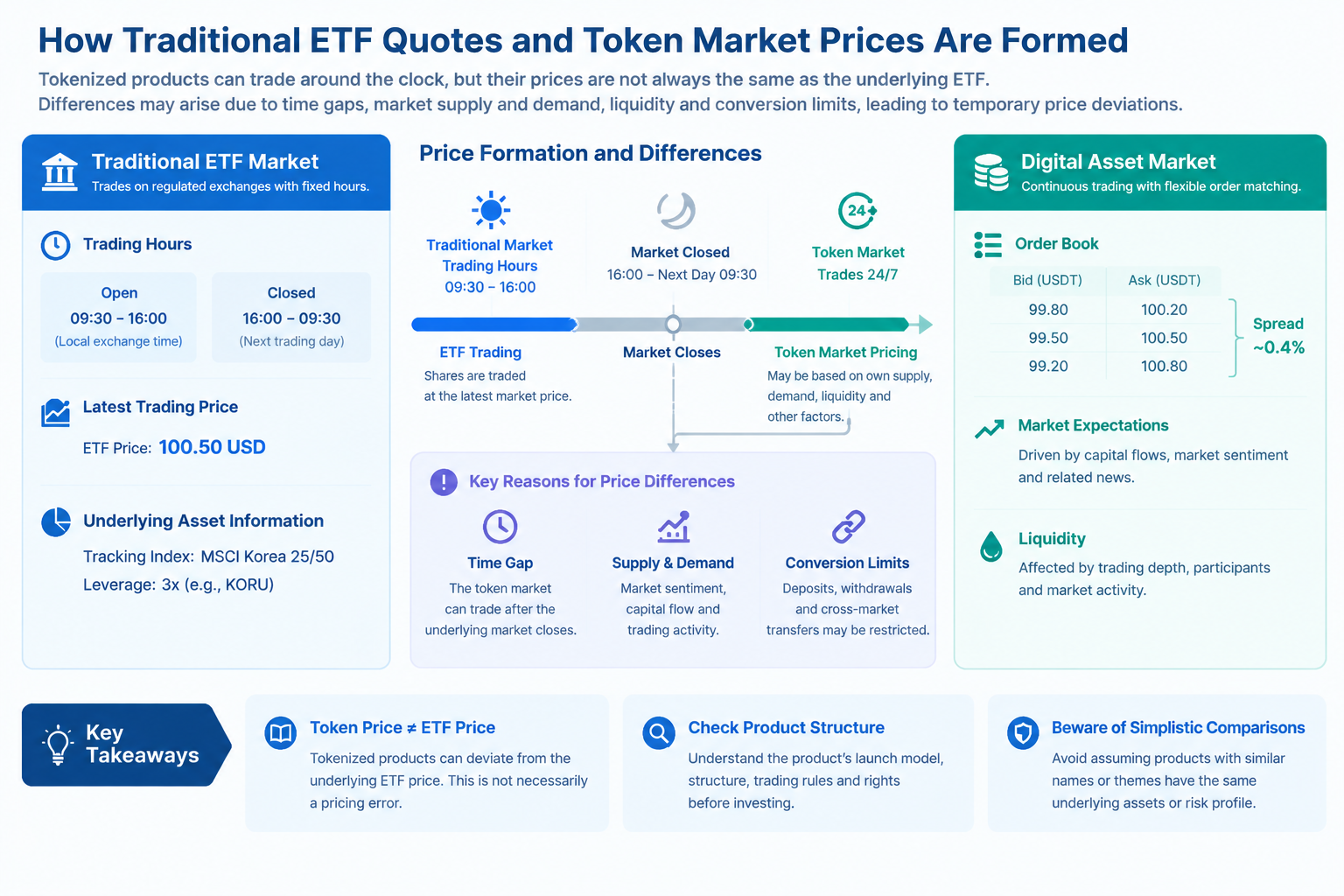
The market price of a traditional ETF is typically restricted by the trading hours of its listing exchange, while digital asset platforms may offer longer trading hours. Some products may even continue trading while the traditional market is closed. The different schedules create a unique issue for tokenized leveraged ETFs: when the underlying securities have no latest transaction price, the digital market may still generate new bid and ask quotes and transaction prices. These prices are not necessarily incorrect, but the process by which they are formed is not exactly the same as when the underlying market is open.
When the underlying market is closed, investors may trade based on the latest known ETF quote, related index futures, overseas market movements, macroeconomic news, exchange rate changes, or expectations for the next trading session. If significant news affecting the underlying assets emerges after the traditional market closes, digital market participants may adjust their quotes in advance. In this situation, the token price reflects participants' views of future market performance rather than a real-time transaction in the underlying ETF. Different participants may have different information, risk preferences, and trading needs, which can result in a new price range.
Liquidity further affects price discovery during market closures. If the order book is thin, a small number of large buy or sell orders may cause the transaction price to change significantly. If the bid-ask spread is wide, the price at which an investor actually trades may also deviate from the midpoint quote. A product that is relatively active during normal market hours may not maintain the same trading depth while the underlying market is closed. Therefore, 24/7 trading provides more hours in which trading is possible, but does not ensure the same level of liquidity around the clock or execution prices close to the underlying market's closing price.
It is also important to note that token prices and reference prices for traditional ETFs may use different data sources and update times. The latest transaction price of an underlying ETF, its net asset value, an index reference value, and the token market's transaction price are not the same metric. If investors overlook timestamps, trading venues, and data definitions when comparing prices, they may incorrectly assess whether the product has deviated abnormally. An effective price comparison must ensure that the references represent the same or an explainable economic exposure and account for the time difference between the two markets.
Why Might the Token Price Diverge From the Underlying ETF Quote?
The token price may first diverge from the underlying ETF quote because the trading hours differ. When the traditional market is closed, the underlying ETF has no new regular transaction price, while the token market may continue trading. The token price then reflects the current market participants' estimate of the asset's value, while the displayed price of the underlying ETF may still reflect the previous trading session. A difference between the two does not necessarily mean that the token mechanism has failed. It is necessary to further assess whether the difference is consistent with information updates, market expectations, and trading hours.
Second, supply and demand in the digital market affect the price. Even if a token is designed to track the economic exposure of an underlying security, the token market's own buy and sell orders, trading depth, capital inflows, and trader preferences may cause the execution price to temporarily diverge from the reference price. If arbitrage or conversion channels are restricted, market participants may not be able to take advantage of the price difference quickly, allowing the divergence to persist for longer. Whether arbitrage can function depends on the product rules, transaction costs, available capital, market hours, and whether holders are eligible to convert the related assets.
Third, the product structure itself may affect the price relationship. There may be an issuance, redemption, or conversion process between the token and the underlying ETF, and these processes may not be completed instantly or be available in all jurisdictions or during all market hours. If conversion must be conducted through a specific institution, follow a subscription or redemption schedule, or satisfy eligibility requirements, a price divergence may not be quickly eliminated through a simple purchase-and-redemption transaction. Investors should confirm whether the product provides a direct conversion mechanism and whether that mechanism is actually available to them.
Finally, it is necessary to distinguish changes in the price of the underlying financial instrument from trading deviations specific to the tokenized product. Taking KORU as an example, its daily 3x leverage objective means that the underlying fund's price is itself affected by the daily return path and the effects of compounding. The related tokenized product may also be affected by digital market liquidity, trading hours, and conversion conditions. Investors should not attribute every price movement to the token market, nor should they conclude that the product must be mispriced simply because the token price temporarily differs from the traditional market quote. They should first verify the timing and definition of the reference prices and then analyze the underlying fund's performance and supply and demand in the token market.
How to Evaluate the Trading and Structural Risks of Tokenized Leveraged ETFs
The first step is to confirm exactly what the product represents. Investors should identify the underlying ETF, the token issuer, the related assets or economic interests, and the rights actually held by token holders. Similar names and tickers do not mean that products have the same structure. The same traditional financial product may also correspond to different tokenization arrangements. For KORU and related tokenized products, the traditional ETF's investment objective and the legal rights of token holders should be studied separately rather than treated as the same thing.
The second step is to verify the asset backing and custody arrangements. Investors need to understand whether the underlying securities are held by the issuer or a related institution, how custody responsibilities are allocated, how asset records are verified, and what legal arrangements apply if the issuer experiences financial difficulties. For products that claim to have sufficient asset backing, investors should also review the relevant proof, asset segregation methods, and procedures for handling unusual circumstances. Supply records on the blockchain can provide some information, but cannot replace verification of off-chain assets and legal relationships.
The third step is to understand the trading and conversion rules. Whether tokens can be withdrawn, transferred to a personal wallet, or transferred at all; whether transfer restrictions apply; what conditions must be met for redemption; and whether conversion must wait until the traditional market opens will all affect the actual trading experience. At the same time, investors should review the trading platform's market depth, bid-ask spread, and quote times rather than treating the displayed price as the directly executable price. For users who need to trade within a short period, liquidity and order execution conditions may be just as important as the product's theoretical price.
The fourth step is to assess the underlying risks and token market risks separately. For leveraged ETFs, investors must understand the target reset period, the impact of volatility on long-term returns, and potential losses. For the tokenized structure, they need to analyze issuance, custody, legal rights, price discovery during market closures, and conversion restrictions. These two categories of risk may compound rather than offset each other. Establishing a clear evaluation framework is more useful for understanding the product's actual characteristics than simply observing short-term price movements.
Gate and Tokenized Leveraged ETFs: How Traditional Financial Exposure Enters the Digital Asset Market
Tokenized leveraged ETFs connect the market exposure associated with traditional leveraged ETFs with a digital asset trading format. However, how a specific product creates this connection must be determined based on its issuance structure and product terms. Traditional leveraged ETFs generally target the daily leveraged performance of a specific index. In addition to the underlying assets or exposure itself, a tokenized leveraged ETF may have its own issuance arrangements, pricing mechanism, trading rules, and holder rights. Therefore, understanding these products requires more than looking at the underlying index or leverage multiple. Investors also need to confirm what the token represents, how its price is formed, and what rights holders have.
Users who want to research related digital asset trading products can visit Gate's KORUG/USDT trading page to review the market quotes displayed for the trading pair and related trading information. However, KORUG/USDT is a specific trading pair, while KORU is a traditional 3x leveraged ETF on the South Korean stock market launched by Direxion. The two should not be considered the same asset solely because their names are similar. KORU seeks to deliver 300% of the daily performance of the MSCI Korea 25/50 Index, before fees and expenses. This daily leverage objective cannot be directly applied to price movements in KORUG/USDT. Investors should first verify Gate's official product description for KORUG, confirm its actual underlying asset or exposure, product structure, pricing mechanism, and risk terms, and then assess its relationship with the traditional leveraged ETF.
Gate's gStocks product introduction provides a reference for understanding the tokenization of traditional financial assets. It is important to note that tokenized products, traditional leveraged ETFs, and tokenized leveraged ETFs are not interchangeable concepts. The information about gStocks can help readers understand Gate's tokenized product services, but it cannot be used to infer that KORUG/USDT belongs to gStocks or that it uses the same asset backing or legal arrangements as a particular traditional ETF. The nature of a specific product should still be determined based on its applicable official documentation.
After a tokenized product enters a digital asset trading environment, its price may also be affected by market supply and demand, liquidity, trading hours, and investor expectations. When the underlying traditional market is closed, the digital market may still generate new quotes, but those quotes may not be equivalent to the real-time net asset value or fair value of the underlying ETF. For tokenized products related to leveraged ETFs, investors need to examine both the underlying leverage mechanism and the way the token's price is formed. They should avoid treating index movements, traditional ETF returns, and price movements in the digital trading pair as the same thing.
Therefore, when researching related trading products on Gate, investors should use the trading page as a starting point for reviewing quotes and trading information, then further verify the product structure, the underlying asset or exposure arrangement, holder rights, trading and transfer rules, and any applicable redemption conditions. Only by clearly identifying the product being traded can investors assess the extent of its relationship with a traditional leveraged ETF and evaluate price divergence, liquidity, and exit risks more appropriately.
FAQ
Does a Tokenized Leveraged ETF Directly Put a Traditional ETF on the Blockchain?
Not necessarily. A tokenized product may provide related economic exposure by holding the underlying securities, using contractual arrangements, or relying on other legal structures. The specific rights attached to the token depend on the issuer, product documentation, and applicable rules, not solely on the token contract on the blockchain.
Can a Tokenized Leveraged ETF Always Be Freely Transferred On-Chain?
Not necessarily. Some products may support transfers on designated networks, while others may only allow trading on designated platforms or within specific account systems. Technical transferability is not the same as legal transferability or eligibility for redemption.
Why Does the Token Price Continue to Change After the Traditional Market Closes?
The digital asset market may remain open, allowing participants to adjust quotes based on the latest news, movements in related markets, expectations, and order flow. However, liquidity and price references during the market closure may differ from those during traditional market hours.
Does a Token Price Divergence From the Underlying ETF Quote Mean That There Is a Problem With the Product?
No conclusion can be drawn from the price difference alone. The divergence may result from time differences between markets, liquidity, changes in supply and demand, data update times, or conversion restrictions. Investors should first confirm that they are comparing the same economic exposure using data from similar times, and then analyze the cause of the divergence.
Can Blockchain Transparency Guarantee the Safety of the Underlying Assets?
Not on its own. Blockchain can record token supply and transfers, but the existence and custody of the underlying assets and the legal rights held by investors still need to be confirmed through product documentation, custody arrangements, and appropriate verification mechanisms.