Tokenized leveraged ETFs combine the market exposure of traditional exchange-traded funds with digital asset trading methods, offering investors a product format that spans traditional finance and crypto markets. Direxion Daily MSCI South Korea Bull 3X Shares (KORU), for example, includes leveraged exposure to the South Korean equity market as well as multiple mechanisms involving daily return resets, underlying asset custody, token issuance, and trading platform liquidity. Understanding tokenized leveraged ETFs requires more than focusing on token prices or trading convenience. Investors also need to distinguish between the underlying fund and the tokenized product and recognize that leverage, market volatility, and legal structures may all affect investment outcomes.
Key Takeaways
-
Tokenized ETFs bring the economic exposure of traditional financial products into digital asset trading environments, but tokens do not necessarily represent direct ownership of the underlying securities
-
KORU seeks to achieve 300% of the daily performance of the MSCI Korea 25/50 Index, rather than three times its cumulative gains over any holding period
-
Tokenization changes how assets are accessed, traded, and settled. It does not automatically eliminate underlying leverage, liquidity, or market risks
-
When evaluating these products, investors should consider the underlying fund's mechanisms, token issuance and custody arrangements, trading rules, and redemption terms
Why Traditional ETFs and Digital Asset Markets Are Beginning to Converge
Exchange-traded funds (ETFs) are common investment tools in traditional financial markets. They typically provide investors with exposure to an index, industry, asset class, or specific investment strategy by holding securities, using derivatives, or applying other investment strategies. Compared with directly purchasing a basket of stocks, ETFs package related portfolios or strategies into fund shares that can be traded on exchanges, allowing investors to participate in markets through a relatively standardized approach.
As blockchain infrastructure and digital asset trading markets develop, more connections have emerged between traditional financial products and digital asset markets. Tokenized financial products seek to represent the economic interests associated with specific securities or financial instruments through digital tokens and corresponding legal arrangements. Tokens may trade on digital asset markets that support the product, and some products may also allow on-chain transfers or conversion requests under applicable conditions. This structure provides new access channels for traditional financial assets, but the specific rights involved still depend on the issuer, legal documentation, custody arrangements, and applicable rules.
Tokenized leveraged ETFs are a notable product category within this trend because they involve two distinct mechanisms. On one hand, the underlying fund uses a leveraged strategy to pursue amplified returns over a specified period relative to a benchmark index. On the other hand, the tokenized structure changes how the related product is held and traded in digital asset markets. Investors therefore need to understand two levels: how the underlying financial product generates returns and how the tokenized format carries or reflects those returns. Examining only one level is not sufficient to fully understand the product's risks.
What Is a 3x Leveraged ETF for the South Korean Stock Market?
Direxion Daily MSCI South Korea Bull 3X Shares is a leveraged ETF listed in the U.S. market under the ticker KORU. Before fees and expenses, its investment objective is to achieve 300% of the daily performance of the MSCI Korea 25/50 Index. The index reflects the performance of relevant listed companies in the South Korean equity market that meet the index rules, while KORU provides amplified daily market exposure through financial instruments and corresponding investment strategies. The fund does not guarantee that it will achieve its investment objective, and actual results may also be affected by fees, trading costs, and market conditions.
When understanding KORU, the most important distinction is between "daily 3x" and "long-term 3x." If the benchmark index rises 1% on a trading day, a fund targeting 3x daily returns may rise approximately 3%, assuming a simplified scenario that excludes fees and other deviations. If the index falls 1% that day, the corresponding target return may be approximately negative 3%. This objective applies to the performance of a single trading day. It does not mean that holding the fund for a week, month, or longer will generate three times the index's cumulative return over the same period.
A daily leverage objective means that the fund needs to adjust its exposure as market conditions change. As gains and losses accumulate each day, compounding effects can affect the final outcome. In particular, during repeatedly volatile markets, a leveraged fund may incur material losses due to the path of daily returns even if the index ultimately returns close to its starting level. Therefore, when evaluating this type of product, investors should not only assess their directional view of the South Korean equity market but also understand the degree of volatility during the holding period, the holding period itself, and the daily reset mechanism.
The South Korean stock market also has industry and market structure characteristics of its own. Index performance may be jointly affected by large listed companies, technology industry cycles, export demand, global capital flows, exchange rate movements, and macroeconomic policies. Leveraged ETFs amplify the daily gains and losses of their benchmark indexes rather than eliminating the uncertainty arising from these factors. Investors should first understand the sources of risk in the underlying index before determining whether a leveraged strategy suits their risk tolerance.
From KORU to Tokenized Leveraged ETFs: Two Levels of Market Exposure
Traditional leveraged ETFs and tokenized leveraged ETFs are not simply interchangeable ticker codes. KORU is a traditional 3x leveraged ETF offered by Direxion that seeks, before fees and expenses, to achieve 300% of the daily performance of the MSCI Korea 25/50 Index. This objective applies to daily returns rather than cumulative returns over longer periods. Daily resets, market volatility, and compounding paths can all affect long-term performance. Therefore, to understand tokenized leveraged ETFs, investors must first clarify the investment objective and return calculation mechanism of the underlying financial instrument rather than relying solely on the leverage multiple in the product name to assess its long-term performance.
Tokenized leveraged ETFs add a tokenized structure beyond the underlying financial exposure. Their issuers may provide token holders with economic exposure related to a specific financial instrument through holdings of underlying securities, custody arrangements, or other contractual mechanisms. The legal structure, asset backing method, redemption terms, and holder rights of specific products may differ. A product's connection to a traditional ETF alone does not mean that the two provide exactly the same asset ownership or legal rights.
The tokenized structure also involves token issuance and burning, asset custody, trading records, and potentially applicable conversion processes. At the same time, token market prices may be affected by supply and demand, liquidity, trading rules, and investor expectations. Even if a product is designed to reflect the economic performance of an underlying financial instrument, its trading price may deviate from the latest available quotation of the underlying ETF during certain periods. In particular, when the underlying market is closed while the token market remains tradable, new market expectations may first be reflected in token quotations. However, this does not mean that those quotations necessarily equal the real-time fair value of the underlying assets.
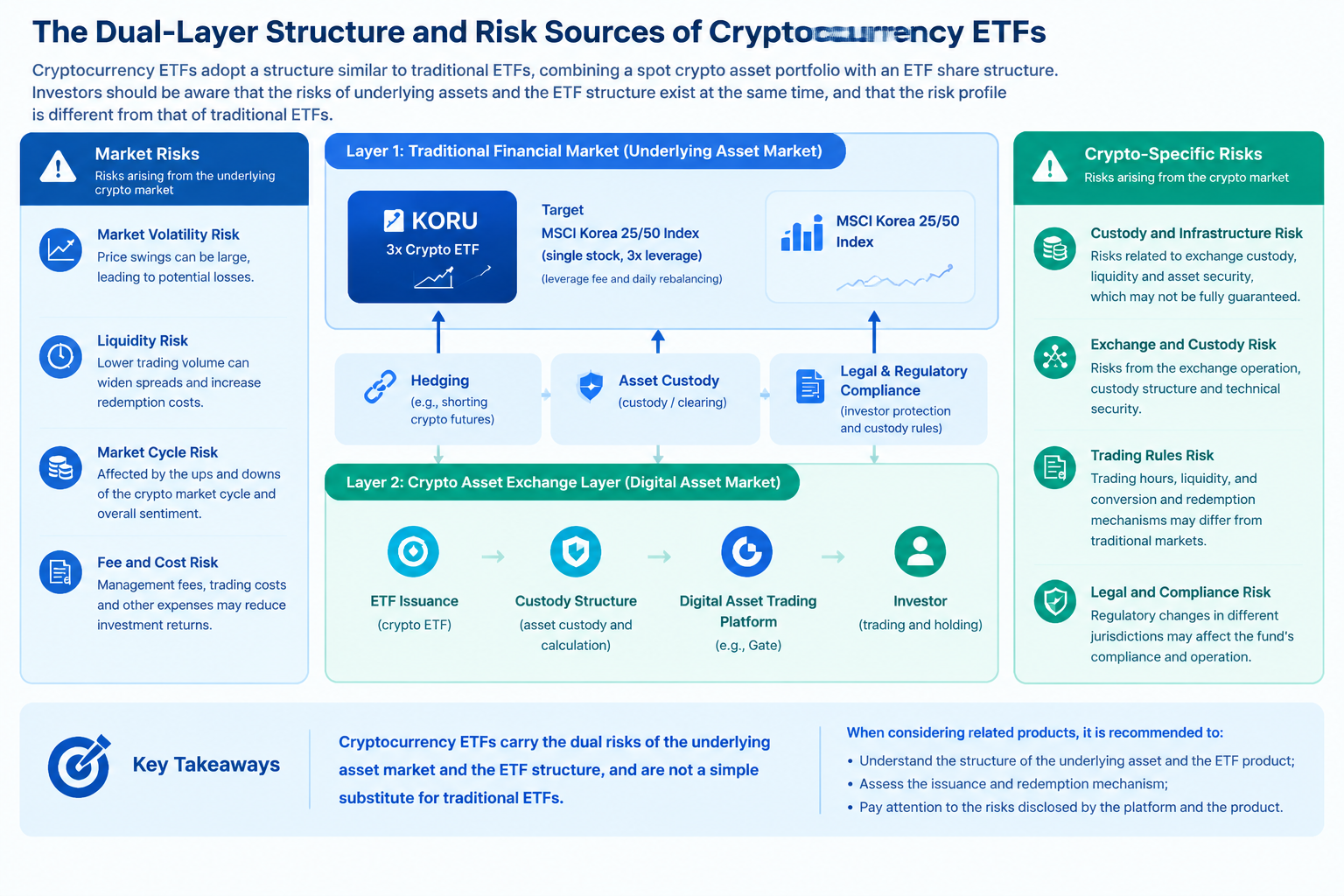
Therefore, when analyzing tokenized leveraged ETFs, investors should separately assess the underlying investment mechanism and the tokenized structure. The former determines the market volatility, daily leverage reset, and compounding risks faced by the product. The latter determines how the relevant economic exposure is issued, held, and traded, as well as the rights holders have and the rules that apply to them. These two layers of risk may exist at the same time and do not automatically disappear simply because the trading format becomes digital. Investors should assess the product's actual risks and appropriate use cases based on official product documentation, asset backing arrangements, pricing mechanisms, and exit terms.
What Changes Does Tokenization Bring?
The most direct change introduced by tokenized financial products is that the way investors access financial products may change. In traditional markets, investors typically need eligible securities accounts and related brokerage services to buy and sell ETFs. Tokenized products may instead offer trading access through digital asset platforms that support the product and may support digital wallet holdings or on-chain transfers under certain conditions. This arrangement may expand distribution channels for financial products, but actual availability remains subject to jurisdiction, investor eligibility, issuance terms, and the scope of platform support.
Another change involves trading hours and price discovery mechanisms. Traditional ETF trading is typically subject to the opening hours of listed exchanges, holiday schedules, and trading systems, while digital asset platforms may offer longer trading hours or even around-the-clock trading. This does not mean that the underlying securities markets are open at all times, nor does it mean that tokens can be traded with the same liquidity during every period. When traditional markets are closed, token trading prices may reflect supply and demand changes, new information, and trader expectations in digital markets to a greater extent.
In addition, blockchain technology can provide verifiable transfer records and compatibility with digital asset wallets and other on-chain infrastructure. However, the existence of on-chain records does not mean that all underlying asset information has been automatically verified, nor does it mean that token holders are directly registered as shareholders of the underlying securities. Asset backing, custody, and redemption still need to be supported by the relevant legal documentation, operational processes, and institutional arrangements.
Tokenization is therefore better understood as another method of access and distribution for financial products rather than a complete replacement for traditional financial systems. It may improve trading convenience and digital integration, but a product's actual risks still depend on the underlying assets, leverage strategy, issuance structure, market liquidity, and the rights that holders can actually exercise.
Key Risks Investors Need to Understand
The first category of risk comes from the underlying leveraged ETF. A daily 3x objective amplifies daily fluctuations in the benchmark index, while the compounding of daily returns may cause long-term performance to deviate from three times the index's cumulative return. Severe market volatility, frequent reversals in direction, or longer holding periods may all change the final outcome. Investors should not assume that a leveraged ETF will necessarily produce desirable returns solely based on their view of the long-term direction of the South Korean stock market.
The second category of risk comes from the tokenized structure. Token holders need to understand who the issuer is, who holds the underlying securities, what responsibilities the custodian assumes, how asset backing is verified, and under what conditions redemption or conversion can be requested. If legal documentation defines a token as a specific contractual right or security certificate, the holder's rights should be understood according to that definition rather than by directly applying all rights of traditional ETF holders.
The third category is trading and liquidity risk. Quotes, order book depth, and execution prices on digital asset platforms may differ from those on traditional exchanges. When the underlying market is closed, tokens may continue trading, but the latest available reference price for the underlying asset may already be outdated. During rapid market movements, insufficient trading depth, or platform operational restrictions, investors may face wider bid-ask spreads, price deviations, or an inability to execute trades at expected prices.
The fourth category of risk arises from rules, technology, and operations. Token issuance and custody arrangements may be affected by jurisdiction, investor eligibility, transfer restrictions, cybersecurity, and platform policies. Even if a product has underlying asset backing, this does not mean that redemption will be immediately available in all circumstances or that every trading platform can provide the same trading and conversion services. Investors should read the applicable terms and confirm the product's availability and the specific limits of their rights.
How to Build a More Complete Evaluation Framework
When analyzing tokenized leveraged ETFs, investors can begin with the underlying financial product. They should confirm the index tracked by the fund, leverage multiple, target reset period, fee structure, and primary investment risks. For daily 3x leveraged ETFs such as KORU, investors should specifically understand that the objective applies to daily performance and examine how volatility and compounding affect outcomes across different holding periods.
Next, investors should independently assess the legal and operational structure of the tokenized product. They need to confirm the issuer, method of underlying asset backing, custody arrangements, token transfer rules, redemption terms, and any potentially applicable eligibility restrictions. Different tokenization arrangements for the same underlying financial product may use different issuance structures. Therefore, investors should not assume that their rights and risks are identical simply because product names or ticker codes are similar.
The third step is to examine the actual trading environment. Whether the trading platform provides sufficient liquidity, how trading hours are arranged, what data is used for price references, how quotations are formed when markets are closed, and what restrictions apply during unusual market conditions can all affect the actual trading experience. Investors should also confirm whether they are trading spot tokens, traditional securities, or contracts that use margin or derivative structures, as the profit and loss mechanisms of these products differ.
Finally, product risks should be considered alongside individual investment objectives. Leveraged instruments may suit certain trading strategies for investors with relevant knowledge and the ability to tolerate substantial volatility. However, they should not be viewed as broadly suitable long-term investment options simply because they experience significant gains in short-term markets. A complete assessment should consider the underlying market view, holding period, capital management, liquidity requirements, and maximum potential loss.
Gate and Tokenized Leveraged ETFs: Traditional Market Exposure and Digital Asset Trading
Tokenized leveraged ETFs connect traditional financial market exposure with digital asset trading formats, but their specific structures depend on issuance arrangements, underlying assets or economic exposure, pricing mechanisms, and holder rights. Researching these products requires an understanding of both the return mechanisms of traditional leveraged ETFs and the differences in trading, liquidity, and legal structures that tokenized formats may introduce. Gate's related product and trading pages provide users with entry points for further research into these markets, but the relationship between different products should still be determined according to their respective official descriptions.
Users interested in the South Korean stock market can view Gate's KORUG/USDT trading page to review the market quotations and related trading information displayed for this trading pair. At the same time, KORU is a traditional 3x leveraged ETF offered by Direxion that seeks, before fees and expenses, to achieve 300% of the daily performance of the MSCI Korea 25/50 Index. This objective applies to daily returns and does not mean that holding it for a week, month, or year will generate three times the index's cumulative return over the same period. Daily resets, market volatility, and compounding paths may all affect long-term outcomes. Therefore, when analyzing related trading products, investors should consider the performance of the underlying market and verify the structure of the actual asset being traded. They should not assume that KORU and KORUG are the same asset or have the same return mechanism merely because their names are similar.
Tokenized products may also create price discovery issues independent of underlying index performance. Traditional ETFs are generally subject to trading-hour constraints, while digital asset market trading arrangements may differ. When the underlying market is closed, digital markets may still form new quotations based on supply and demand, liquidity, and investor expectations. Therefore, the market price of a tokenized product may not always match the reference price of the underlying ETF. For tokenized leveraged ETFs, investors need to separately evaluate the underlying leverage mechanism and the token's own pricing and trading structure. Index movements, the return performance of traditional ETFs, and price changes in digital trading pairs should not be treated as the same thing.
Gate's gStocks product introduction can serve as a reference for learning about the tokenization of traditional financial assets. Users can also review the Gate ETF product introduction to learn about information and risk disclosures related to the platform's ETF products. However, gStocks tokenized products, traditional leveraged ETFs, tokenized leveraged ETFs, and the leveraged token products offered by Gate should not be considered to have the same structure solely because their names include "securities" or "ETF." Whether a specific product is a tokenized leveraged ETF should still be verified based on its official product documentation, including its underlying connection, leverage mechanism, asset backing arrangements, and holder rights.
Overall, relevant products should be assessed at three levels. First, analyze the underlying market and the return objectives and compounding risks of traditional leveraged ETFs. Second, verify the issuance structure, pricing mechanism, trading rules, and related rights of tokenized products. Finally, confirm Gate's rules and disclosures for the specific trading product and assess liquidity, price deviations, and exit conditions. Separately analyzing market views, product structures, and trading environments can help investors understand the characteristics of tokenized leveraged ETFs more accurately and avoid mistaking similar market themes for identical investment risks.
FAQ
Are Tokenized Leveraged ETFs and Traditional Leveraged ETFs the Same Product?
Not necessarily. Traditional leveraged ETFs are exchange-traded funds managed by fund issuers, while tokenized products may provide economic exposure related to those ETFs through a different issuer and legal structure. Their holding formats, legal rights, trading venues, and redemption mechanisms may differ.
Does KORU's 3x Leverage Apply to Long-Term Returns?
KORU seeks to achieve 300% of the benchmark index's daily performance rather than three times its long-term cumulative performance. The compounding of daily returns affects long-term outcomes, and actual returns may differ significantly from a simple calculation of three times cumulative returns.
Can Tokenized ETFs Trade Around the Clock?
Some tokenized products may continue trading on supporting digital asset platforms while traditional markets are closed. However, trading hours, liquidity, and price formation mechanisms depend on the specific product and platform rules. Around-the-clock trading does not mean the same level of liquidity is available at all times.
Does a Tokenized ETF Mean That Holders Directly Own the Underlying Securities?
Not in all cases. The rights held by investors depend on the product's legal structure and issuance terms. Some tokenized products provide economic exposure related to underlying securities rather than direct ownership of those securities.
What Is Most Important When Evaluating These Products?
Investors should assess the underlying leverage mechanism, issuance and custody arrangements, asset backing, redemption terms, trading platform liquidity, and applicable legal rules. Looking only at token prices or short-term gains cannot fully reflect a product's risks.