For beginners who want a verifiable first purchase, the primary route is spot ONE/USDT—fund the quote asset, then use the order book—without mixing quick-buy steps into spot. Account security, funding, and order checks usually matter more than the last traded price alone; see spot trading basics and buying crypto and risk basics on Gate.
Spot trading settles digital assets into your spot balance at market prices—you own the asset after a fill, unlike leveraged contracts. On Gate, that means selecting ONE/USDT, sizing carefully, and confirming the fill in Assets. The steps below cover Harmony ONE crypto on spot ONE/USDT only—not unrelated products that share the words “gate” or “Harmony.”
Key Takeaways
- Harmony is a public blockchain aimed at scalable decentralized apps; ONE is its native token, mainly used for network fees and related ecosystem incentives.
- Primary path: prepare USDT (or usable funds) → open spot ONE/USDT → place a buy → verify the spot ONE balance.
- Before submitting, confirm the pair name, buy side, market vs limit type, and quantity units; for withdrawals, match network and address—start with a small test.
- Spot settles into ownership of ONE; futures or margin add leverage and different risk paths and sit outside these spot-only steps.
What is Harmony (ONE)?
Harmony is a public blockchain built for scalable decentralized applications, with sharding and cross-shard communication designed to improve throughput and keep fees efficient. If you want to know how to buy ONE on Gate, fund your account with USDT or another supported asset, open the ONE/USDT spot market, place a market or limit buy, then confirm the ONE balance in your spot wallet. See the Harmony website and Harmony ONE and scalable apps.
In plain terms, Harmony is a Layer-1 network and ONE is its native token. What is Harmony One Crypto for retail traders: a network plus a token you can trade on Gate spot after funding, with attention to platform security and operational checks—not price promises.
How Harmony Works
How Harmony works at a high level: the network splits state and work across shards so many transactions can process in parallel, a design intended to increase throughput and produce blocks in seconds, while cross-shard messaging keeps apps and assets able to move between shards. Finality can land in seconds for many transfers; always read live docs for timing claims. The project team publishes information people can use to learn how shards, staking, and bridges work—prefer those sources over random videos or deleted forum posts.
Why is Harmony Unique
Why is Harmony unique in many explainers? That sharding-and-messaging layout is often contrasted with single-chain queues that process every transaction serially. Official docs and project disclosures also discuss bridges to other chains so assets and messages can move across ecosystems—always verify current docs before relying on a specific bridge. Harmony community channels (official site, docs, and published social accounts) are the place to confirm network status—not random “support” DMs. Those sources let you compare Harmony’s stated design goals with other chains without treating marketing pages as guarantees.
What is Harmony (ONE) Token
What is Harmony (ONE) Token in practice? ONE is the native Harmony (ONE) token used mainly to pay network fees, support related ecosystem incentives, and serve various purposes within the ecosystem. After a spot fill on Gate, ONE first sits in your exchange spot account; withdrawing to a Harmony-capable wallet or using on-chain features is a later step. Separating network, token, and trading entry helps avoid confusing a spot pair with an on-chain account. For the project team and any technical claims, check official sources and project disclosures only. Buying software licenses, older desktop versions, or unrelated products that share the “Harmony” name is out of scope here.
| Dimension |
Detail |
| Network |
Harmony public blockchain; scalability and sharding-related design (per public disclosures) |
| Native token |
ONE for network fees and related ecosystem incentives across various purposes |
| Common capability areas |
dApps, asset transfers, cross-chain/cross-shard interoperability (per public disclosures) |
| Gate trading entry |
Spot pairs such as ONE/USDT (per the live trading page) |
The table maps the project to the buy path; it is not an investment rating. Buying still follows the account prep and spot order steps below; rules and parameters follow the live trading page.
What do you need before buying ONE on Gate?
Buying ONE on Gate spot usually requires a signed-in account, KYC where required, and 2FA. Identity verification is mandatory before trading, depositing, or withdrawing on exchanges in many regions; some payment methods may be unavailable until identity verification is complete. Payment methods and limits vary by region and account status—follow the live page. Before funding, finish a strong password, 2FA, an anti-phishing code if available, and a withdrawal allowlist if you plan to send assets out. The steps below cover the spot buy path only, not price or return claims.
| Prep item |
What it covers |
Common miss |
| Account & KYC |
Higher limits and more funding options |
Trying fiat rails before verification |
| Security settings |
2FA and anti-phishing controls |
Password-only login |
| Quote asset |
Usually USDT before buying ONE |
Balance in the wrong account type |
| Trading entry |
Confirm spot ONE/USDT |
Opening futures or another pair |
The table is a pre-trade checklist, not investment advice. If any row is incomplete, finish it before using the ONE/USDT order panel.
Step 1: How do you prepare fiat currency funds for the buy?
On spot, USDT is a common quote asset for ONE. Funds can enter Gate through several channels, including supported fiat currency routes where available, then be used on ONE/USDT. Fees, settlement time, and complexity differ—follow the live page.
| Funding path |
Better when… |
Extra checks |
| Card / quick buy |
You want crypto balance quickly |
Quote, fees, limits, credited asset |
| P2P (C2C) |
You prefer local payment methods |
Ad terms, payment window, own verified account |
| On-chain deposit |
You already hold USDT or ONE in another wallet or on another exchange |
Network and address must match |
| Existing balance |
You already hold USDT on Gate |
Spot account availability / transfers |
For peer-to-peer fiat rails, follow the P2P buy flow on Gate to obtain a stablecoin, then buy ONE on spot. On-chain deposits require a matching network; a mismatch can block credit. After funding, confirm in Assets that USDT (or your quote asset) is available for spot, and after a completed purchase, ONE appears in your wallet balance/Assets view.
Step 2: How do you open the ONE/USDT spot page?
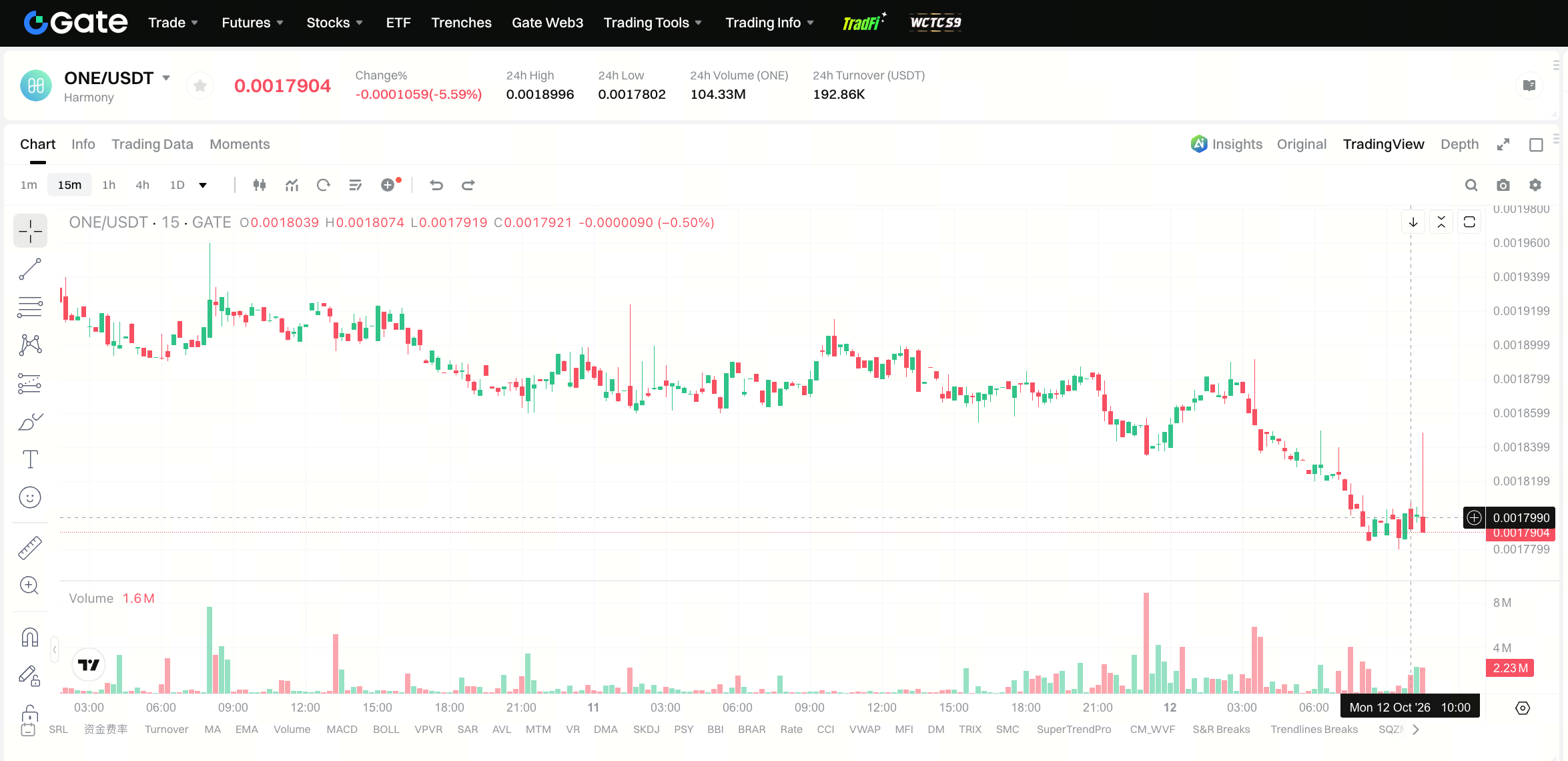
After login, open Spot Trading, search ONE, select ONE/USDT, and load the Gate ONE/USDT spot page. Confirm the pair label is ONE/USDT before reading the order book and order panel—avoid other quote currencies or products. A typical spot page includes the order book, ticker/chart area, and order form; use the Buy side and stay on spot rather than futures. Minimum size and fees follow pair parameters and the order preview.
Step 3: How do you buy ONE with a market or limit order?
Buy instructions for ONE on Gate stay on spot ONE/USDT: confirm the pair, choose market or limit, submit, then verify the spot balance. Read the instructions on the order preview before you confirm.
What is spot trading in crypto and how does it work?
After confirming the pair and Buy side, choose an order type, enter size or amount, review estimated proceeds and fees, then submit. This is the core of how spot trading works in crypto on an exchange order book: traders use the order book to trade against resting liquidity at displayed prices, and a successful fill credits ONE (and debits USDT) into your spot account. Traders who want ownership rather than leveraged exposure usually start here; many traders also trade smaller sizes first to learn the panel.
Market buy: Market orders execute instantly at the current market price when liquidity is available; the average may differ from the last trade depending on depth—read on-screen estimates and fees first. Larger size against thin books can move the average higher than the last print; check size carefully before confirm.
Limit buy: Limit orders execute only when the market reaches your specified price (or better). Limits can stay open; view or cancel them in open orders. If the market stays higher than your limit, the order may not fill—adjust, switch to market, or cancel. Review transaction details, including fees, before confirming.
| Order type |
Outcome pattern |
Typical use |
| Market buy |
Usually fills faster; average follows the book |
Prioritize completion |
| Limit buy |
May fill partially or not at all |
Control the fill price |
Understanding Spot Trading in Crypto
Understanding spot trading in crypto starts with one question—what is spot trading and how does it work?—and the short answer is: trade the asset itself at market or limit prices, settle into spot balances, and skip leverage unless you later choose a different product. It is important to stay updated on market information when making spot decisions; that does not mean chasing every chart.
How Spot Trading Works in Crypto
How spot trading works in crypto on Gate for ONE: fund USDT, open ONE/USDT, submit buy instructions as market or limit, then verify. Follow the on-screen instructions; do not accept off-platform “support” that asks you to change a withdrawal address. Fills can complete in seconds when liquidity is available, but thin books may take longer.
Pros and Cons of Crypto Spot Trading
Pros and cons of crypto spot trading (education only): spot is straightforward—you own the asset after settlement, with no futures liquidation path—but you still face price moves, fees, and operational mistakes. Spot is often favored by beginners for its simplicity, yet it can be risky due to cryptocurrency price volatility; staying updated on market information is useful, without treating trends as advice. Spot makes custody and position tracking clearer; losses come from price and mistakes, not forced liquidations.
Spot Trading vs. Other Trading Strategies
Spot trading vs. other trading strategies: futures or margin can amplify returns and losses with leverage; spot participants may seek to generate returns, but outcomes still depend on price and execution. In-depth trading ideas and chart patterns belong elsewhere; the operational goal here is a clean first buy on spot ONE/USDT only.
Making the Most of Spot Trading in Crypto
Making the most of spot trading in crypto means sizing carefully, verifying fills, and keeping account security ahead of speed. Where can I buy Harmony One / Harmony One Coin for a first purchase on Gate? Use the spot ONE/USDT page after funding—not random apps or off-platform escrow. Is USDT also a dollar? USDT is a stablecoin designed to track the U.S. dollar; it is not the same as cash in a bank account, and conversion rules follow the venue.
After submit, check order status. Once the purchase completes, ONE appears in your wallet or spot available balance. Set a habit to re-read fill details before you send assets home to an external wallet.
How do you verify the order and spot balance after buying?
Submitting an order is not the same as fully converting funds to ONE. Check at least three points: whether the order filled, whether size and average match expectations, and whether spot ONE available balance increased. Review order/trade history first, then Assets → Spot and search ONE. Open limit orders may not yet show the full target size; trust fill details for partial fills. Only after this check should you hold, sell, or withdraw.
What common mistakes happen when buying ONE for various purposes—and how do you avoid them?
Most errors cluster around the pair, order type, and withdrawal network. Use the table below as a self-check.
| Mistake |
Typical cause |
Fix |
| Wrong pair |
Quote currency or product not confirmed |
Confirm spot ONE/USDT |
| Market fill surprises |
Ignoring depth and estimates |
Read estimated proceeds and fees first |
| Limit never fills |
Limit far from the market |
Adjust price, switch to market, or cancel |
| Balance unchanged |
Unfilled order or wrong account type |
Check order status and account type |
| Withdrawal stuck / missing |
Wrong network/address |
Match network and address; test small |
Withdrawals need a Harmony-capable wallet and a matching network/address on Gate’s page; when unsure, test small first. Fake support or off-platform “change address” requests are not a normal flow.
Is buying and holding ONE on Gate safe? What risks should you know first?
Buying ONE via Gate spot in a supported region is a standard spot path; safety depends on account hygiene, operational checks, and risk awareness—not on the buy action being risk-free. Enable 2FA, avoid phishing sites, and verify withdrawal addresses. Trading involves price moves, slippage, and unfilled limits; exchange custody follows platform rules, while self-custody shifts key responsibility to the user. Wrong network or address on withdrawal can make recovery impossible. This is general education, not investment advice; rules follow Gate pages, and network details are on the Harmony website.
Summary
To buy ONE on Gate: clarify what Harmony (ONE) is and how the project is positioned, finish account prep, fund USDT via card, P2P, or on-chain deposit, open spot ONE/USDT, place a market or limit buy, and verify balances. Understanding spot trading in crypto—how spot trading works, and spot vs other strategies—keeps the path educational and operational. What matters is pair, order-type, and withdrawal-network checks. Risks come from market moves, operational mistakes, and weak account security. A checklist before confirm usually beats rushing submit.
FAQ
What is Harmony (ONE)?
Harmony is a public blockchain aimed at scalable decentralized applications; ONE is its native Harmony (ONE) token, used for network fees, staking, governance, and related ecosystem incentives. How Harmony works in brief: sharding and cross-shard design aim to increase throughput, can produce blocks in seconds, and use the property of eventual atomicity to keep cross-shard transactions consistent. See the Harmony website for more detail—do not confuse the blockchain with unrelated “Harmony” software install guides.
How do I buy ONE on Gate?
After account and identity checks, prepare USDT, other funds, or fiat currency where supported, open spot ONE/USDT, place a market or limit buy, then confirm the spot ONE balance; Gate may send deposit or transfer details by email when relevant to your funding method. Use the live spot trading page as the entry. That path is spot trading in crypto on Gate—not a driveway-gate quote, contractor install, or third-party store download flow. Where can I buy Harmony One on Gate specifically? Open ONE/USDT spot after funding, then follow the buy instructions above.
Can I buy ONE with USDT?
Yes. A common Gate spot path uses USDT on ONE/USDT. Confirm enough available USDT, the Buy side, and the order type before submitting. Understanding spot trading in crypto here means your USDT settles into ONE at the fill—check Assets after the trade.
Should I use a market or limit order to buy ONE?
Market orders usually fill faster, with the average following the book; limit orders set a price but may not fully fill. Prefer market for completion, limit for price control; read on-screen estimates first. Spot trading vs other trading strategies: stick to spot for a first buy unless you already understand leverage products.
How do I withdraw ONE safely after buying?
In Assets → Withdraw, select ONE, confirm the Harmony network and external address, and add any required memo/tag. Send a small test first; wrong address or network selection can prevent credit. Community channels and support claims off-platform are not a substitute for matching the network displayed on Gate’s withdrawal page.