The price of a crypto asset is not determined solely by the project name or market narrative. Even if two tokens both belong to the Meme category, they may differ significantly in terms of supply, holder distribution, liquidity, trading venues, and market participant structure. For Meme coins that lack a traditional cash-flow valuation anchor, these market structure factors often directly affect price discovery and risk exposure.
ni hao cat (MIHAO) is a suitable case for analysis from this perspective. CoinGecko lists it as a cat-themed Meme coin in the Ethereum ecosystem and provides information such as token supply, market trading activity, and the contract address. Compared with short-term price movements, examining how supply is distributed, whether trading pools can absorb orders, whether market participants are concentrated, and whether prices differ across trading channels provides greater insight into the market mechanics of this type of asset.
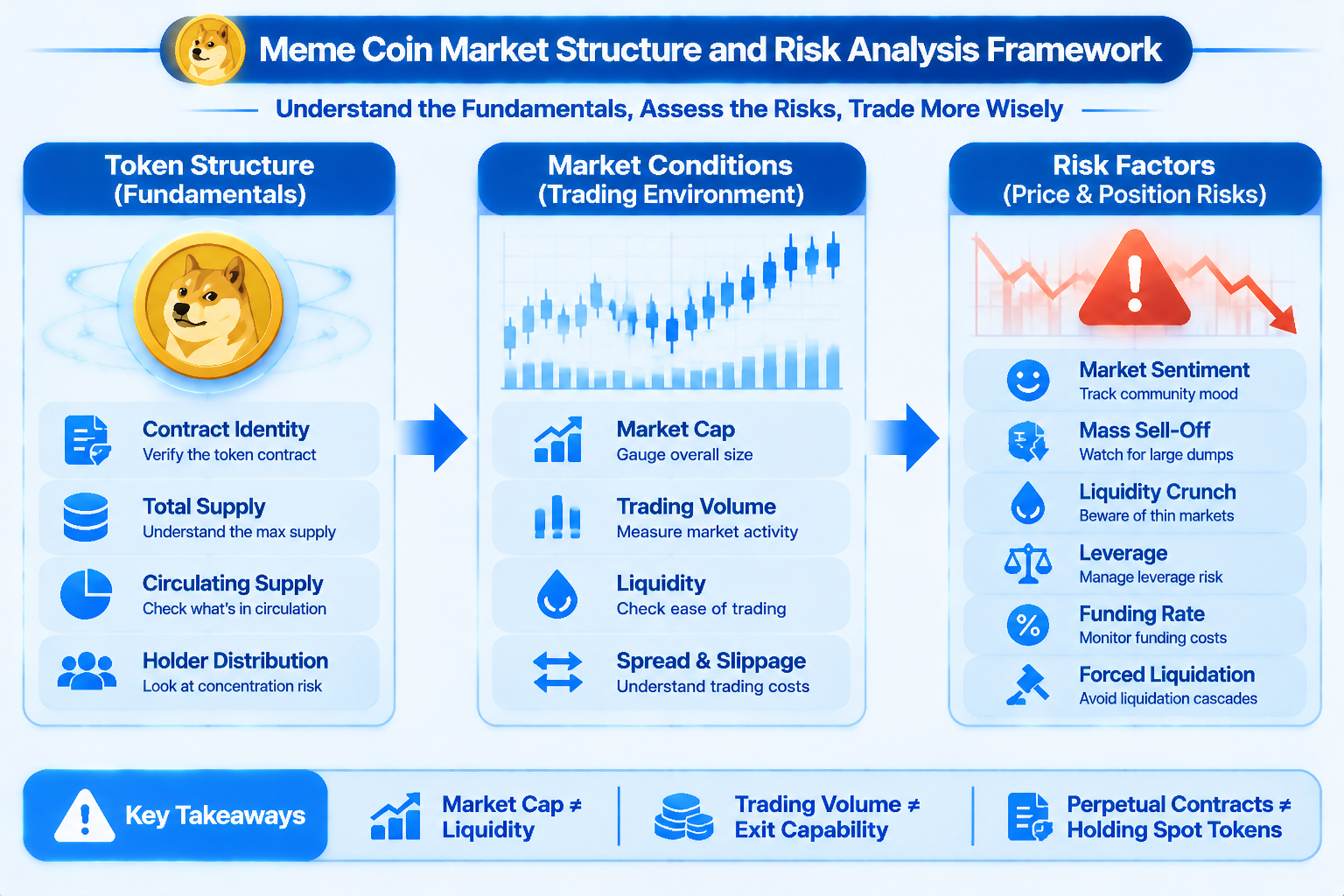
This article does not treat the price, trading volume, or market capitalization at any particular point in time as a long-term conclusion. Instead, it establishes a relatively stable analytical framework. By examining token identification, supply and demand structure, liquidity, price discovery, and derivatives risk, it explains how investors should research Meme coins such as MIHAO and why active trading does not necessarily mean lower risk.
Key Takeaways
-
MIHAO must be identified using the Ethereum network and its complete contract address to avoid confusion with tokens of the same name on other chains
-
Total supply and circulating supply are only the starting points for supply analysis. Holder concentration and the behavior of major addresses are also important
-
Market capitalization, trading volume, and liquidity represent different market metrics and cannot replace one another
-
The price of a Meme coin may depend heavily on market sentiment and changes in marginal capital. When liquidity is insufficient, price impacts can be amplified
-
Gate provides access to both the Ethereum-based MIHAO Meme coin and the MIHAO_USDT perpetual contract. Participants must separately assess on-chain liquidity as well as contract leverage, funding rates, and liquidation risks
How Can You Confirm MIHAO's Token Identity and Basic Information?
The first step in researching any crypto asset is confirming which token you are analyzing. A token name and ticker are not unique identifiers on a blockchain. Different networks and even different projects may use the same or similar names. In the Meme coin sector in particular, copied names, similar icons, and tokens with the same name are common. If the network and contract address are not confirmed first, subsequent analysis of supply, holders, liquidity, and trading markets may apply to the wrong asset.
The ni hao cat (MIHAO) listed on CoinGecko belongs to the Ethereum ecosystem, and its contract address is 0xb3a6add33f777ac6ea0ec88bdf533573c8bbbc03. CoinGecko's page lists both the maximum supply and total supply as 1 billion tokens, and also shows a circulating supply of 1 billion tokens. Note that these figures reflect the methodology used by a third-party data platform at a specific point in time. Researchers should still verify the contract, token decimals, total supply, and on-chain transfer records using an Ethereum block explorer.
When identifying a token, you should also check whether the contract matches the project's official channels, whether multiple similar trading pools exist, and whether the main trading markets are genuine. For assets traded on decentralized exchanges, the trading pool address and base trading pair should also be verified. Acting solely on a token name in search results or a promotional link on social media can easily lead to counterfeit assets or the wrong trading pool.
The scope of MIHAO analysis should always be limited to the Ethereum contract mentioned above. Even if tokens with the same name, ticker, or similar branding exist on other networks, they should not automatically be treated as the same asset. This identification step may appear basic, but it is the foundation for all subsequent market analysis.
How Should You Analyze the Supply Structure of a Meme Coin?
Token supply structure determines the basic amount of an asset available for trading in the market. However, total supply alone cannot indicate whether a token is scarce or directly show the extent of selling pressure faced by holders. Supply analysis should at least distinguish between maximum supply, total supply, circulating supply, and the amount actually available for trading. Different data platforms may use different methods to calculate circulating supply. Therefore, you should focus on the data definition and update time rather than simply recording a single figure.
The CoinGecko page currently shows MIHAO's maximum supply, total supply, and circulating supply as 1 billion tokens each. This means that under the platform's current methodology, the circulating supply is already close to its displayed maximum supply. However, reaching the maximum supply does not mean that selling pressure has disappeared. Circulating tokens may still be concentrated among a small number of addresses. Early holders, project-related addresses, or liquidity providers may also hold large amounts of tokens.
Supply analysis should therefore extend to the holder structure. Researchers can examine the percentage held by the top 10 addresses, whether major addresses are connected, the proportion held by exchange or liquidity pool addresses, and whether large transfers occur frequently. For Meme coins, if a small number of addresses control a high proportion of the circulating supply, the market may be more sensitive to concentrated transfers and large sell orders.
You should also distinguish between token supply and market demand. A fixed supply does not mean that demand is stable. Even if no new tokens are issued, declining attention, selling by holders, or the withdrawal of liquidity may put downward pressure on the price. For assets such as MIHAO, the supply cap is only the starting point. Other factors that affect market trading conditions include token distribution, trading pool reserves, and holder behavior.
Why Should Market Capitalization, Trading Volume, and Liquidity Not Be Treated as the Same Thing?
Market capitalization is generally calculated by multiplying the token price by the circulating supply. It is a commonly used measure of the scale at which the market values an asset. However, market capitalization does not mean that an equivalent amount of capital exists in the market, nor does it mean that all holders can sell at the current quoted price. If a token has a large circulating supply but limited trading pool depth, relatively small amounts of buying or selling can significantly affect its price.
Trading volume reflects the scale of transactions that occur within a given period and can help indicate the level of market participation. However, high trading volume does not necessarily mean that the market has sufficient liquidity. High-frequency trading, short-term speculation, and rapid turnover among different traders can all increase trading volume. If buy and sell orders are concentrated within a narrow price range or trading pool reserves are insufficient, large orders may still cause significant slippage.
Liquidity is more directly related to whether traders can complete transactions at prices close to their expectations. For decentralized trading pools, you can examine the reserve levels of the two assets in the pool, trading depth, and price impact. For centralized trading venues, you can examine the bids and asks in the order book, the spread, and whether orders of different sizes can be filled. Liquidity cannot necessarily be transferred between trading venues. Therefore, simply adding the trading volumes of multiple markets does not mean that the asset has an equivalent ability to support exits.
When researching MIHAO, market capitalization, trading volume, and liquidity should be recorded separately and compared using the same time windows whenever possible. If trading volume rises rapidly while trading pool depth does not improve at the same pace, the market may face a higher risk of price impact. If market capitalization is high but major holders are highly concentrated, you should also remain alert to the potential impact of concentrated selling on the price.
What Factors Affect Price Discovery for Meme Coins?
Price discovery is the process through which buyers and sellers continuously establish a market price through trading. For assets with deeper liquidity and broader participation, prices can generally incorporate more market information. For Meme coins with limited trading depth and relatively concentrated market participants, a small number of large orders may have a more pronounced impact on short-term prices. Therefore, when observing price changes, you should consider not only the percentage change but also the transaction size, order depth, and trading pool reserves.
The price of a Meme coin may also be affected by social media distribution and community sentiment. When an image or topic attracts significant attention, new traders may enter the market, changing buying and selling demand. However, the source of attention is not always the same. Some attention comes from genuine community participation, some from short-term promotion, and some from speculators pursuing price volatility. Different types of attention last for different periods, so social media popularity should not be treated simply as stable demand.
Price differences across markets are another important aspect of price discovery. If the same token is quoted at different prices in different trading pools or on different trading platforms, the difference may be related to liquidity, trading fees, network congestion, arbitrage costs, and the structure of market participants. For MIHAO on Ethereum, researchers should verify the relevant trading pools and pairs to avoid including price data for tokens with the same name on other chains.
Price discovery may also be affected by the behavior of large holders. If a major address suddenly transfers a large amount of tokens to a trading pool or trading platform, the market may interpret it as potential selling pressure. Conversely, if a large amount of tokens flows out of trading venues, this may change the market's assessment of the supply available for trading. However, an on-chain transfer does not necessarily represent a buy or sell transaction. It must be analyzed together with the address attributes, subsequent transactions, and fund flows.
How Should the Market Risks of Meme Coins Be Broken Down?
The first type of risk is liquidity risk. Even if a token has high trading volume during a particular period, this does not mean that the market can consistently absorb large orders. When market interest declines, trading pools may experience reduced reserves, wider spreads, and higher slippage. For participants with large positions, exit costs may be significantly higher than expected. They should therefore focus on the actual execution prices for different trade sizes rather than only the latest quoted price.
The second type of risk is holder concentration risk. If a large amount of a token is concentrated among a small number of addresses, transfers and trades by major holders may affect market expectations. Researchers should observe the percentage held by the top 10 addresses, the historical behavior of major addresses, and large fund flows. They should also distinguish between trading pool, trading platform, and contract addresses, which are not personal holding addresses, to avoid interpreting every large address as a single investor.
The third type of risk is information and contract risk. Meme coin projects may provide limited public information, and their team backgrounds, governance arrangements, token utility, and contract permissions may not be easy to verify. Even if a third-party platform displays a contract address, this does not mean that the contract has undergone a security audit. Participants should check the contract's source-code verification status, permission settings, trading restrictions, and any special mechanisms that may affect transfers. They should also remain alert to counterfeit websites and phishing links.
The fourth type of risk comes from changes in market sentiment and narratives. Attention toward a Meme coin may change rapidly with social media topics, community activity, and overall market conditions. Once attention shifts elsewhere, demand may weaken within a short period. For assets without stable cash flows or a clear valuation anchor, market prices may be more easily affected by changes in marginal capital and expectations.
How Do On-Chain Spot Trading and Perpetual Contracts Change MIHAO's Trading Risks?
Spot trading and perpetual contract trading have different risk structures. Spot trading involves directly buying and holding tokens. Users must consider factors such as the token price, on-chain transfers, wallet security, and trading pool liquidity. Perpetual contracts are derivatives. Traders establish contract positions linked to the underlying price and do not automatically own the corresponding quantity of on-chain tokens by holding a contract.
Gate provides two different ways to trade MIHAO. One is the Ethereum-based MIHAO Meme coin trading page on Gate Web3. It uses the token contract address to identify the Ethereum version of MIHAO discussed in this article, and traders can connect a wallet to participate in on-chain token trading. The other is the MIHAO_USDT perpetual contract page, which corresponds to a USDT-settled perpetual contract and provides derivatives exposure linked to the price of MIHAO. The two trading methods differ in their relationship to asset ownership, trading mechanisms, and sources of risk.
For on-chain trading, users need to pay attention to the Ethereum network, the token contract address, trading pool liquidity, bid-ask spreads, and slippage. They should also remain aware of on-chain transaction fees and wallet authorization risks. For perpetual contracts, traders can establish long or short positions based on their market views. The funding rate mechanism helps align the contract price with the market index price. Leverage amplifies the impact of price movements on account equity. When margin is insufficient to meet the maintenance margin requirement, a position may also be forcibly liquidated. Therefore, underlying price volatility, funding rate changes, and margin levels are all factors that require ongoing attention when trading contracts.
Traders should also distinguish between the meaning of data from on-chain and derivatives markets. The liquidity, trading activity, and holder distribution of on-chain trading pools help indicate the condition of the MIHAO token market. Contract trading volume, open interest, and funding rates reflect participation in the derivatives market. The latter cannot directly represent the number of MIHAO holders on Ethereum or the size of its community. These two markets should be observed separately to avoid combining different market metrics into a single conclusion.
Establishing a Long-Term Observation Framework for MIHAO
Long-term observation of MIHAO can focus on five areas. The first is asset identity, including the network, contract address, token decimals, and contract permissions. The second is supply structure, including total supply, circulating supply, holder concentration, and changes in major addresses. The third is market liquidity, including trading pool reserves, order depth, spreads, and slippage. The fourth is community and distribution, including original content, genuine participation, and the continuity of public information. The fifth is the derivatives market, including open interest, funding rates, mark price, and liquidation risk.
These dimensions are connected but cannot replace one another. For example, increased community attention may bring more trading activity, but if liquidity does not improve at the same time, price volatility and exit costs may remain high. A fixed supply can reduce uncertainty related to new issuance, but it cannot eliminate the risks of holder concentration and declining demand. Increased perpetual contract open interest may indicate greater trader participation, but it may also mean that leverage risk is accumulating.
When evaluating these indicators, you also need to consider the market risks commonly associated with Meme coins. Social media popularity and speculative sentiment may drive rapid price changes, while insufficient liquidity, concentrated holdings, and market manipulation may amplify price declines and trading losses. Investopedia provides additional background through its analysis of the main risks of Meme coins, helping explain the challenges these assets face in speculative trading and volatile markets.
Observers should therefore maintain ongoing records rather than draw conclusions from a single day's data. They can regularly record changes in major addresses, trading pool reserves, trading volume across different time windows, and market depth, and compare major project announcements with on-chain activity. For highly volatile Meme coins, the data timestamp and calculation methodology are particularly important. Historical snapshots should not be mistaken for current market conditions.
Ultimately, MIHAO's market analysis should return to its characteristics as a Meme coin. Its price may be jointly affected by cultural distribution, community sentiment, and market liquidity, and the persistence of these factors is uncertain. The value of an analytical framework is not to predict a specific price, but to help participants identify information gaps, measure trading costs, and understand the differences in risk created by different trading methods.
FAQ
What Is MIHAO's Total Supply?
CoinGecko currently shows MIHAO's total supply, maximum supply, and circulating supply as 1 billion tokens each. Supply data may be updated due to changes in the platform's methodology or on-chain conditions. Researchers should verify the information against the contract and a block explorer.
Does MIHAO's Market Capitalization Represent an Equivalent Amount of Capital in the Market?
No. Market capitalization is generally calculated by multiplying the token price by the circulating supply. It does not mean that an equivalent amount of capital exists in the market, nor does it mean that all holders can sell at the current quoted price. Actual exit capacity also depends on trading pool depth, the order book, and market liquidity.
Why Can a Meme Coin Have High Trading Volume but Still Experience Significant Slippage?
Trading volume measures the scale of transactions over a period of time, while slippage depends on the impact of a specific order on the order book or trading pool reserves. If liquidity is concentrated, depth is insufficient, or there are many large orders, significant slippage may occur even when trading volume is high.
How Can You Determine Whether MIHAO Has Holder Concentration Risk?
You can use an Ethereum block explorer to examine major holder addresses and token distribution, while distinguishing between trading pool, contract, and trading platform addresses. You should also continuously track transfers by large addresses. However, a single transfer alone is not enough to determine whether a holder intends to sell.
What Is the Difference Between MIHAO Perpetual Contracts and On-Chain Spot Tokens?
On-chain spot trading involves directly holding MIHAO tokens on the Ethereum network. A perpetual contract is a derivatives position. Traders obtain price exposure and do not automatically own on-chain tokens as a result. Perpetual contracts also involve additional risks, including leverage, funding rates, margin requirements, and forced liquidation.
Which Metrics Require the Most Attention When Researching Meme Coins?
You can evaluate contract identity, supply, holder concentration, trading pool depth, trading volume, spreads, slippage, and community participation together. If you trade perpetual contracts, you should also pay attention to open interest, funding rates, mark price, and maintenance margin requirements.