As the blockchain industry gradually transitions into a multi-chain era, applications are no longer confined to a single blockchain. More and more DeFi protocols, games, and infrastructure are being deployed across multiple networks—yet these chains naturally lack communication capabilities. Enabling smart contracts to collaborate across chain boundaries has become a key driver of cross-chain infrastructure development.
Synapse Protocol stands out as a major player in the cross-chain interoperability space. Beyond providing bridge services, Synapse has built a cross-chain messaging system that allows smart contracts to send instructions, synchronize state, and execute complex business logic across chains. This capability forms the foundational infrastructure for chain abstraction and omnichain application development.
What Is Cross-Chain Messaging?
Cross-chain messaging refers to the process by which a smart contract on one blockchain sends information to a smart contract on another blockchain and triggers execution.
Traditional cross-chain bridges mainly handle asset transfers. For instance, when a user moves ETH from Ethereum to Arbitrum, the core goal is asset mobility. Cross-chain messaging, however, focuses on transmitting information and instructions—like notifying the target chain to perform an action, update state, or call a specific contract function.
In short, cross-chain bridges solve asset liquidity, while cross-chain messaging solves application interoperability.
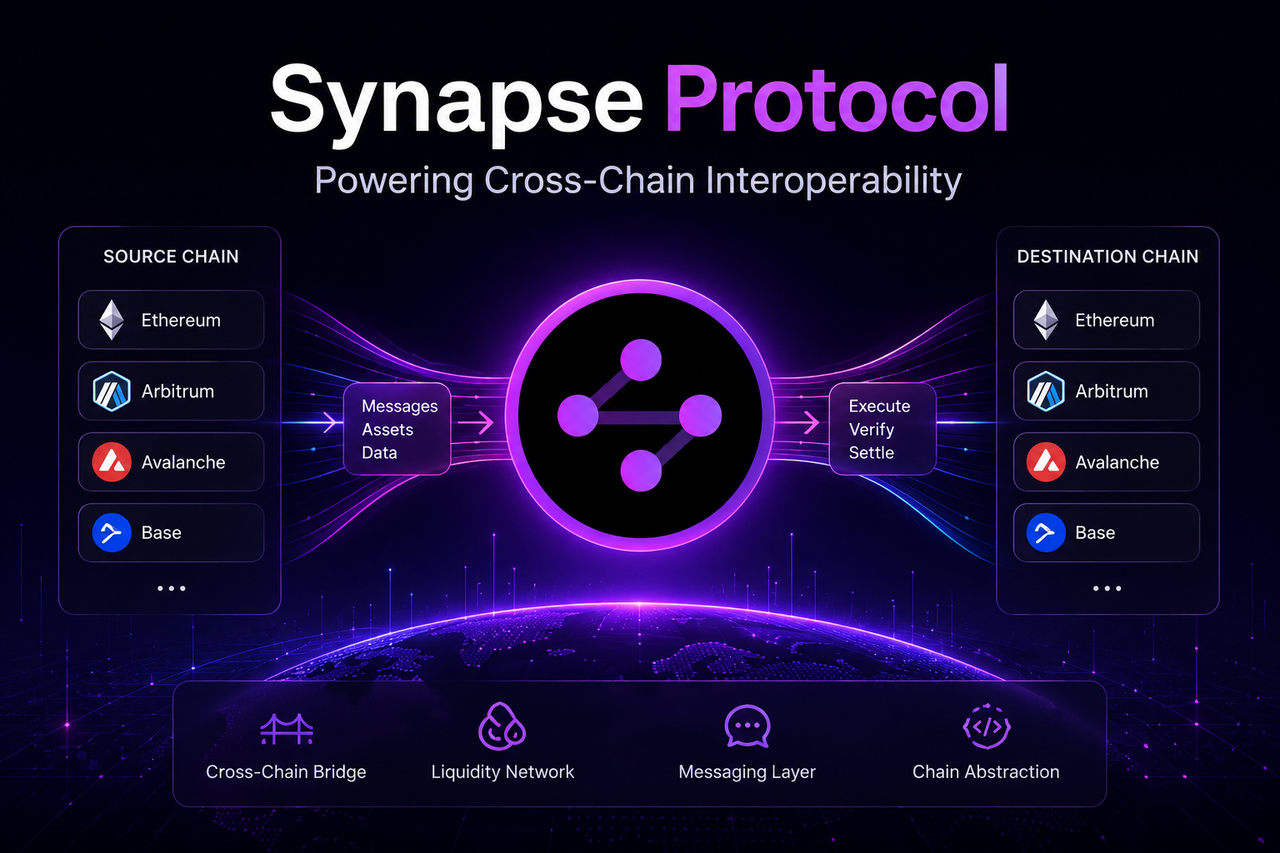
Core Architecture of Synapse Cross-Chain Messaging
Synapse's messaging system consists of several core modules.
First, the source chain contract layer. When a user initiates an action, the application calls Synapse's message interface to generate a cross-chain request.
Second, the message verification and transmission layer. This layer confirms the authenticity of the message source and securely forwards it to the target chain.
Finally, the target chain execution layer. Once the message arrives, the target contract receives and executes the corresponding logic.
From an architectural standpoint, Synapse Messaging connects different blockchains into a unified communication network, allowing cross-chain applications to operate as seamlessly as single-chain apps.
How Is a Cross-Chain Message Generated?
The lifecycle of a cross-chain message begins with a user action.
Imagine a user initiates a cross-chain lending request on a DeFi application on Ethereum. The application first gathers relevant parameters—target chain, receiving address, and the specific operation to be executed.
The source chain smart contract then encodes this data into a standardized message format and submits it to the Synapse network.
At this stage, the message hasn't yet executed the cross-chain operation; it enters the verification and forwarding phase.
How Does Synapse Verify Cross-Chain Messages?
Message verification is a core component of cross-chain security.
After generation, the Synapse network must confirm that the message originates from a legitimate contract and that the transaction is confirmed on the source chain.
Verification typically includes transaction status confirmation, signature verification, and duplicate execution prevention.
Only verified messages are broadcast to the target chain. This mechanism prevents forged messages or malicious tampering.
For cross-chain infrastructure, the message verification mechanism is just as critical as fund security in asset bridging.
How Are Messages Sent to the Target Chain?
After verification, the message enters the cross-chain transmission phase.
The Synapse network routes the message to the target blockchain. The message typically includes the function to call, execution parameters, and the target contract address.
Unlike asset bridging, message transmission does not necessarily involve fund movement. Some scenarios only require state sync or business logic triggering.
When the message reaches the target chain, it is submitted to the Synapse contract for further processing.
How Does the Smart Contract on the Target Chain Execute the Operation?
Once the message arrives, execution begins.
The Synapse contract on the target chain parses the message content and verifies its source.
After verification, the target contract calls the specified function—whether for asset swaps, position updates, governance votes, or on-chain game logic.
The entire process is typically transparent to the user. The user sees a single action, but behind the scenes, cross-chain communication and execution have already taken place.
A Complete Example of a Cross-Chain Smart Contract Call
Suppose a user wants to deposit assets on the Base network and automatically join a yield strategy on Arbitrum.
Step 1: The user sends a transaction request to the app on Base.
Step 2: The app generates a cross-chain message and sends it through the Synapse network to Arbitrum.
Step 3: Synapse verifies the message and completes cross-chain forwarding.
Step 4: The target contract on Arbitrum receives the message.
Step 5: The target contract automatically executes deposit, swap, or yield strategy operations based on the message content.
The user doesn't need to manually switch networks or interact with multiple apps individually.
This is the essence of omnichain applications and chain abstraction.
What Is the Difference Between Synapse Messaging and Cross-Chain Bridges?
Cross-chain bridges and cross-chain messaging are often conflated, but they solve different problems.
Bridges primarily transfer assets; messaging primarily transmits instructions and executes logic.
For example, moving USDC from Ethereum to Avalanche is a bridge scenario. Notifying an Avalanche smart contract to execute a lending operation is a messaging scenario.
| Dimension |
Synapse Messaging |
Cross-Chain Bridge |
| Core Object |
Messages and Instructions |
Digital Assets |
| Main Use |
Contract Communication |
Asset Transfer |
| State Sync |
Supported |
Limited Support |
| Application Interoperability |
Supported |
Not Supported |
| Omnichain Application Support |
Strong |
Limited |
Many modern cross-chain protocols combine both bridging and messaging to support more complex cross-chain scenarios.
Why Is Cross-Chain Messaging Crucial for Chain Abstraction?
Chain abstraction aims to hide underlying blockchain differences, allowing users to operate without network awareness.
Asset bridging alone is insufficient. Applications need to exchange information, synchronize state, and automatically execute logic across chains.
Cross-chain messaging is the core infrastructure enabling this capability.
New applications—unified accounts, cross-chain wallets, omnichain DeFi, and AI agents—all depend on the messaging layer for cross-chain coordination and communication.
As the industry moves toward omnichain applications, cross-chain messaging is becoming increasingly vital.
Summary
Synapse Cross-Chain Messaging is a key component of Synapse Protocol’s cross-chain interoperability ecosystem. Unlike traditional bridges that focus on asset transfers, the messaging system transmits information and executes instructions across different blockchains, enabling cross-chain collaboration between smart contracts.
A complete cross-chain message execution typically involves four stages: message generation, verification, transmission, and target chain execution. This mechanism empowers developers to build omnichain applications spanning multiple blockchains, giving users a more unified and seamless experience.
With the advancement of chain abstraction, intent-based execution, and omnichain applications, cross-chain messaging is becoming a cornerstone of next-generation blockchain infrastructure—and Synapse Protocol is a key pioneer in this space.
FAQs
What Is Synapse Cross-Chain Messaging?
Synapse Cross-Chain Messaging is a cross-chain communication system from Synapse Protocol that lets smart contracts send messages, synchronize state, and execute cross-chain operations across different blockchains.
What Is the Difference Between Synapse Messaging and Synapse Bridge?
Synapse Bridge handles cross-chain asset transfers, while Synapse Messaging handles cross-chain information transmission and smart contract calls. Together, they form Synapse’s cross-chain interoperability infrastructure.
What Steps Are Involved in Executing a Cross-Chain Message?
A complete process typically includes four stages: message generation, verification, transmission, and target chain execution. Upon arrival, the target smart contract executes the predefined logic.
Does Cross-Chain Messaging Always Involve Asset Transfers?
Not necessarily. Many cross-chain messages are used solely for state synchronization, governance voting, game logic execution, or application communication—with no asset movement involved.
Why Do Omnichain Applications Need Cross-Chain Messaging?
Omnichain applications must share state and execute logic across multiple blockchains. A cross-chain messaging layer is essential for inter-chain communication; asset bridging alone cannot support complex application interoperability.
How Does Synapse Messaging Support Chain Abstraction?
Synapse Messaging enables applications to handle cross-chain communication and execution automatically. Users don’t need to understand the underlying blockchain structure, delivering a chain abstraction experience that feels closer to Web2.







