DeFi is commonly described as a financial system powered by smart contracts and blockchain networks. Compared with traditional financial services, on-chain transactions are publicly verifiable, assets are composable, and execution can be automated by programs. However, these characteristics do not mean that risks exist only within smart contracts. User accounts, API keys, automated trading systems, wallet signing permissions, and cross-protocol fund flows can all become entry points for security risks.
When market participants use multiple trading platforms, on-chain protocols, and automated tools, their funds and permissions are often distributed across different systems. A compromised account key may lead to abnormal transactions or asset transfers. The resulting fund movements may prompt institutions to reassess their positions, reduce their risk exposure, or withdraw liquidity. These effects may extend beyond the account where the initial security incident occurred.
The Lighter API key incident in November 2026 and the subsequent market reaction provide a case study for observing this type of risk transmission. The incident itself involved the leakage of a trading account's API key, followed by on-chain fund transfers and institutional position adjustments. When analyzing this case, it is important to distinguish between the initial security incident, verifiable on-chain fund flows, risk management actions taken by market participants, and the indirect effects these actions may have on other markets.
Key Takeaways
-
DeFi risks do not come only from smart contracts. Account keys, API permissions, and automated systems can also become attack vectors.
-
Account risks and protocol risks must be distinguished. A protocol operating normally does not mean that account keys cannot be misused.
-
On-chain fund flows can provide investigative leads, but on-chain transfers alone cannot fully establish the identity or intent of the person operating the addresses.
-
Institutional position adjustments may amplify market effects. Large-scale position closures, margin transfers, and redemption requests can change the distribution of funds, but do not necessarily indicate a systemic market failure.
-
Risk management requires a cross-layer approach. Accounts, wallets, trading systems, smart contracts, and liquidity management should form a continuous line of defense.
Why Can't DeFi Security Risks Be Evaluated Based Only on Smart Contracts?
Smart contracts are central to how DeFi protocols execute their rules, but multiple interaction layers still exist between users and protocols. Users may sign transactions through wallets, connect automated programs through APIs, access protocols through third-party interfaces, or deposit assets into other contracts for lending and liquidity management. Each interaction point can introduce different types of risk.
Smart contract vulnerabilities may cause assets to be transferred incorrectly or permissions to be bypassed. Wallet signing risks may cause users to authorize malicious transactions. API key leaks may allow attackers to use the permissions already assigned to an account. Problems with third-party front ends or dependency services may also affect user access and transaction security. These risks involve different technical mechanisms and should not all be broadly categorized as "smart contract hacks."
Therefore, DeFi security assessments need to cover the complete user-operation chain. In addition to reviewing contract code and audit reports, users should understand how authorization is granted, how keys are stored, how transactions are signed, how assets enter protocols, and whether abnormal operations can be detected and stopped promptly.
How Can an API Key Leak Become the Starting Point for Risk Transmission?
API keys connect trading accounts with automated systems. They allow programs to perform tasks such as retrieving market data, submitting orders, and managing positions, making them an important part of account permission management. If a key is leaked, an attacker may perform unauthorized operations within the scope of the permissions granted to that key.
On November 16, 2026, Lighter released a security incident statement indicating that the incident involved the leakage of a trading user's API key and stating that the protocol and smart contracts were not affected. Bitquery subsequently tracked the on-chain fund flows and recorded approximately 10.39 million USDC transferred out of the relevant contracts. A report by CoinDesk also stated that Lighter attributed the incident to a trading account API key leak rather than a protocol or smart contract vulnerability.
The importance of this type of incident lies in how it demonstrates the difference between account key security and protocol security. An attacker does not necessarily need to modify contract code or breach blockchain consensus. Obtaining a valid key and using the account's existing permissions may be enough to cause actual asset losses. For trading institutions, the storage, permission allocation, and usage environment of API keys therefore deserve the same level of attention as wallet private key management.
What Can On-Chain Fund Tracking Show, and What Can't It Show?
The public nature of blockchain ledgers allows researchers to track asset transfers between specific addresses and analyze whether funds passed through trading protocols, cross-chain bridges, or other on-chain services. Using transaction hashes, token contracts, and chronological data, investigators can reconstruct part of the fund flow and provide verifiable evidence for a security incident.
However, on-chain data does not automatically reveal the real identities behind addresses. If an address receives funds, this only shows that a corresponding on-chain transfer occurred. By itself, it cannot confirm the identity of the controller, the motivation behind the transaction, or the legal relationship between the address and a particular institution. Attribution can become even more complex after funds pass through multiple addresses and protocols.
In the Lighter incident, Bitquery's investigation recorded USDC transferred from the relevant contracts, followed by conversions and dispersed transfers. The research report also clearly distinguished directly observed on-chain data from account loss estimates obtained from social media. This distinction is important for readers: verifiable on-chain amounts, potential losses reported by the media, and market participants' speculation should be labeled separately and should not be combined into a single definitive figure.
Why Can a Security Incident Trigger Large-Scale Position Adjustments?
Large trading institutions typically manage assets, margin, and risk exposure across multiple markets and protocols. After a security incident, an institution may reassess account permissions, fund security, and counterparty risk, and may close positions, transfer margin, redeem staked assets, or suspend certain strategies.
In November 2026, on-chain activity associated with Abraxas Capital attracted market attention. According to on-chain monitoring and media reports, the institution closed approximately $200 million in related positions after the API key incident, transferred approximately 109 million USDC in margin to other platforms, and submitted a request to redeem approximately 219,000 HYPE. These figures describe position size, margin transfers, and redemption requests, respectively, and do not represent the direct losses caused by the initial security incident. A redemption request also does not mean that the assets have already been received.
Institutional risk management actions may affect market liquidity and trading expectations. Large position closures may change the long-short structure of derivatives markets. Fund transfers may affect the distribution of margin across platforms. Staking redemptions may change the circulating and staked supply of the relevant token. However, these actions may also simply reflect an institution's decision to reduce risk. Position changes alone cannot establish that a protocol has a new vulnerability or that the market is about to experience a cascading collapse.
Why Can DeFi Composability Amplify Risk?
DeFi protocols can connect with one another through tokens, collateral, liquidity pools, and lending markets. Users may deposit one asset into a lending protocol and then use the borrowed assets for trading or liquidity provision. They may also use liquid staking tokens as collateral for additional financial strategies. This composability improves capital efficiency but also creates dependencies between risks across different protocols.
When the price of an underlying asset falls rapidly or liquidity suddenly declines, lending protocols that depend on that asset may face lower collateral ratios and increased liquidation pressure. If multiple protocols use the same asset as collateral, risk may spread across different applications. Cross-chain bridges and external oracles may also become additional points of dependency, where a single failure can affect multiple downstream protocols.
Therefore, DeFi risk assessments should map fund and asset dependencies rather than simply examine the TVL of an individual protocol. It is important to understand where assets come from, which protocols accept them as collateral, how their prices are determined, and whether users can redeem or exit smoothly under market stress.
How Can a Cross-Layer DeFi Security Framework Be Established?
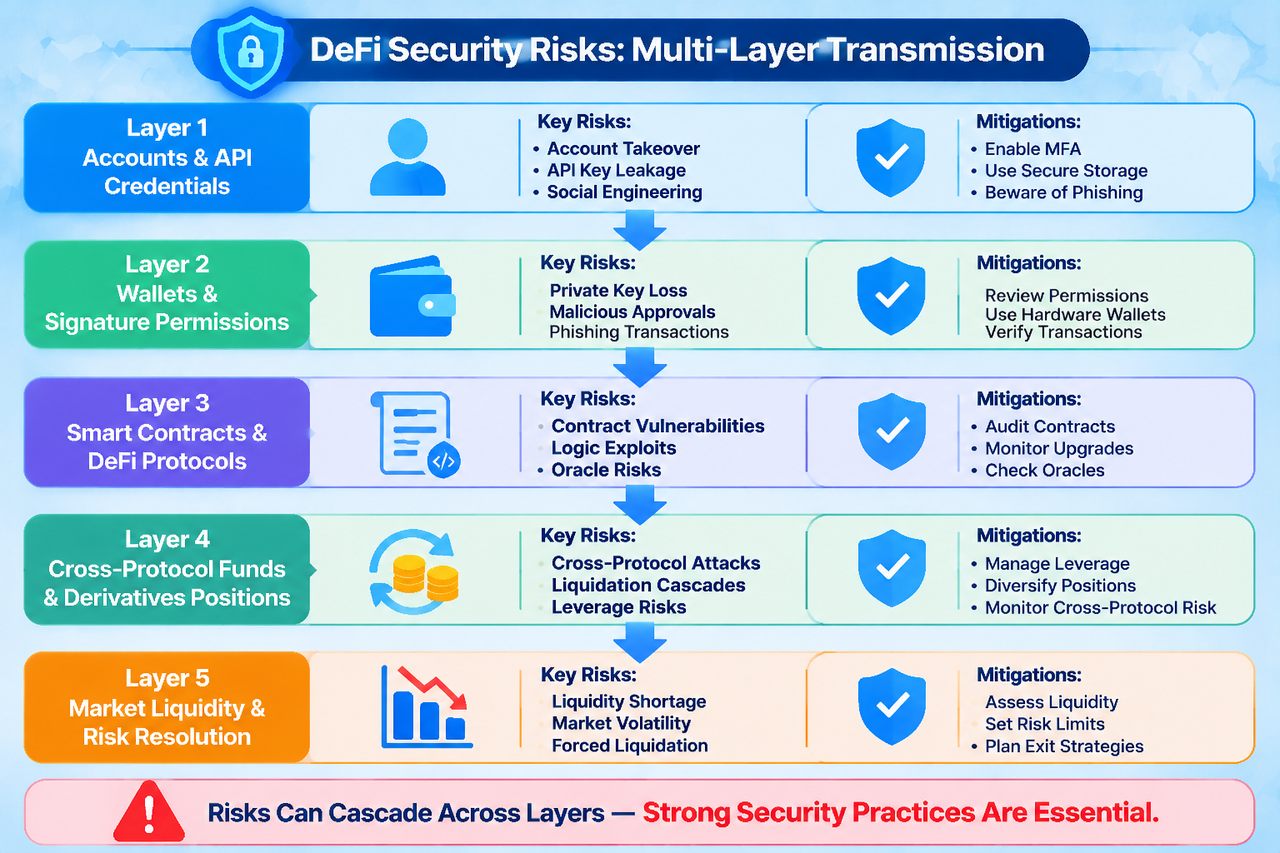
The first layer is account and key security. Users and institutions should follow the principle of least privilege, limit the scope of API key operations, use IP allowlists and separate subaccounts, and rotate keys regularly. For high-risk operations, they can add manual approval and transaction limits to prevent a single key from directly controlling all funds.
The second layer is wallet and signing security. Users should verify transaction details, contract addresses, and authorization scopes, and avoid granting unlimited allowances to unknown contracts. Institutional accounts can use multisignature and tiered approval mechanisms to separate transaction initiation, review, and execution, reducing the impact of a single point of failure.
The third layer is protocol and asset dependency risk. Users need to understand whether a protocol has undergone an audit, how administrator permissions are configured, whether its upgrade mechanism is transparent, and whether its collateral and oracle systems have concentrated dependencies. Cross-protocol strategies also require an assessment of redemption liquidity and liquidation conditions. Users should not mistake multi-layer yield strategies for risk diversification.
The fourth layer is monitoring and incident response. Institutions should continuously monitor abnormal logins, API request sources, transaction sizes, on-chain fund transfers, and position changes. They should also establish procedures for key revocation, account freezes, risk exposure reduction, and incident disclosure. Security capability depends not only on whether an attack can be prevented, but also on whether losses can be contained quickly after an incident occurs.
How Can Gate Users Monitor Trading Platform and DeFi Risks?
For users of trading platforms such as Gate, security analysis should consider platform accounts, API tools, and on-chain wallets at the same time. Centralized trading platform accounts and self-custodial wallets are controlled differently, and an API key is not the same as an on-chain private key. Users should configure permissions based on their actual use cases and should not grant trading bots unnecessary account permissions.
Gate provides trading services such as spot and futures trading. Spot trading primarily involves buying and selling tokens and holding assets. Futures trading involves margin, leverage, funding rates, and liquidation mechanisms. When using APIs for automated trading, users should also consider whether their programs have adequate permission controls, emergency stop mechanisms, and risk limits. Users can refer to the official Gate API documentation for API details and related instructions.
Users who want to combine centralized trading with on-chain DeFi should pay particular attention to the location of asset custody, the scope of account authorizations, and the path of fund transfers. Trading platform account security, on-chain wallet signing security, and DeFi protocol contract security belong to different layers. Protection at any one layer cannot replace protection at the others.
Conclusion
DeFi security risks often do not occur in isolation. Account keys, API permissions, wallet signing, smart contracts, and cross-protocol fund flows collectively form the digital asset usage chain. A problem at any point may affect fund management and market behavior at other points.
Understanding a security incident requires distinguishing direct losses, on-chain fund flows, and subsequent risk management actions. It also requires avoiding the assumption that an incident involving an individual account necessarily represents a systemic problem with an entire protocol or industry. For users and institutions, establishing a cross-layer security management framework is more important than relying on a single audit or security feature.
FAQ
Do DeFi Security Risks Mainly Come From Smart Contract Vulnerabilities?
No. Risks may also come from API key leaks, wallet signing authorizations, third-party front ends, cross-chain bridges, oracles, and user actions. Smart contract security is only one part of the overall security framework.
Why Can an API Key Leak Affect On-Chain Funds?
If an API key can control a trading account, an attacker may use the account's permissions to execute trades or other operations, potentially causing fund transfers and changes in risk exposure. The specific impact depends on the key's permissions and the account configuration.
Can On-Chain Fund Tracking Confirm an Attacker's Identity?
Usually not. On-chain records can verify asset transfers between addresses, but other evidence is needed to establish the real controller behind an address and the motivation for a transaction.
Does a Large Position Closure Mean That the Relevant Protocol Has a Security Vulnerability?
Not necessarily. An institution may close positions because of risk management, liquidity needs, or strategy adjustments. The security incident itself, the institution's risk management actions, and the protocol's operating status must be distinguished.
How Can Cross-Protocol DeFi Risks Be Reduced?
Users should understand collateral relationships, oracle sources, redemption mechanisms, contract permissions, and liquidity dependencies. They should also avoid layering multiple forms of leverage or complex strategies without understanding how risks may be transmitted.