The demand that large language models place on GPUs, network bandwidth, and data center resources has already far exceeded what traditional enterprise server systems can handle. AI model training requires not only massive computing power, but also high speed data exchange and the ability to schedule stable cloud resources continuously.
MSFT’s applications in AI and data centers mainly cover Azure AI infrastructure, GPU cluster management, enterprise AI services, high performance computing, and AI inference platforms. The core of Microsoft’s AI ecosystem is also gradually expanding from software platforms into the data center and cloud infrastructure layer.
What Is MSFT’s Role in the AI Market
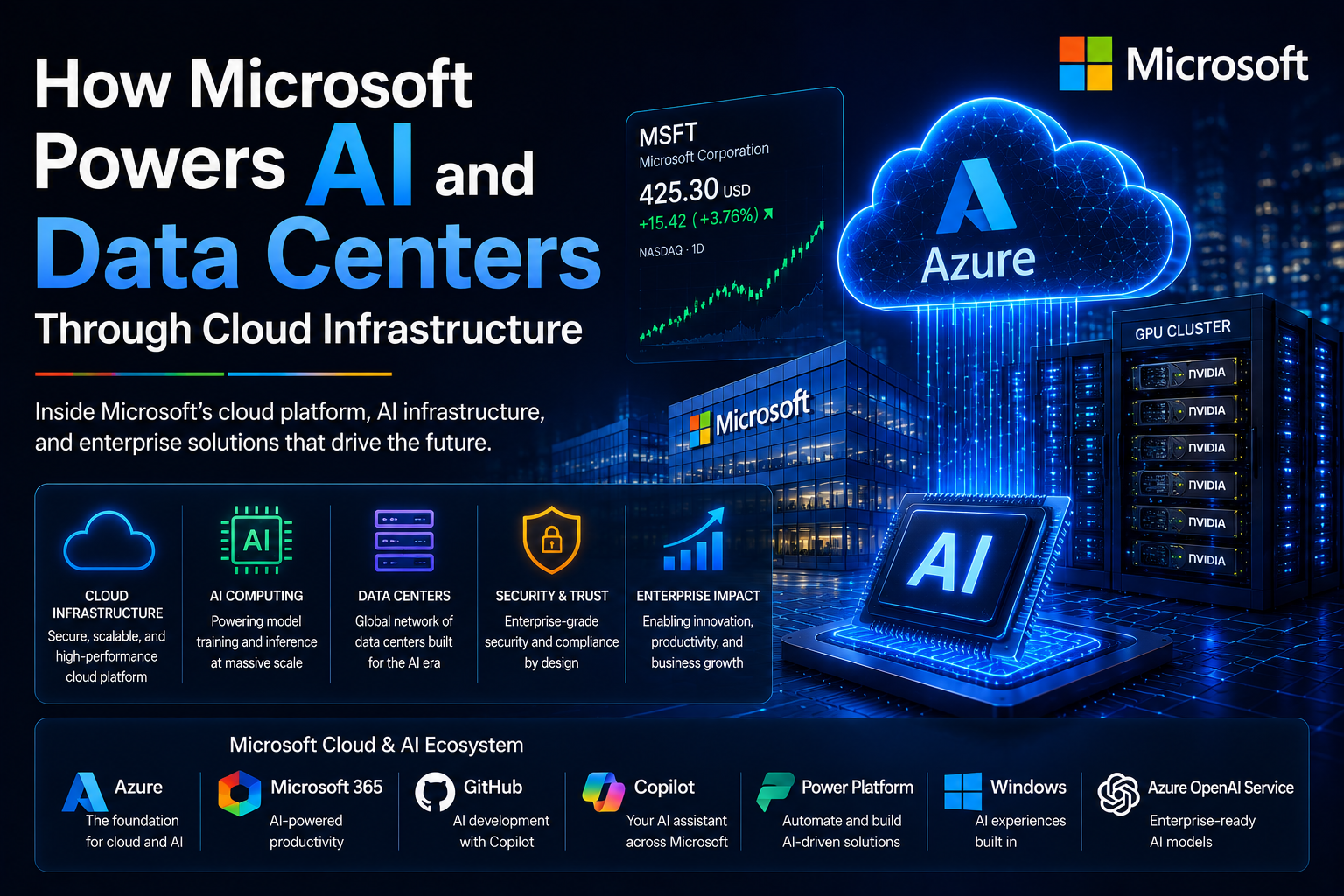
MSFT’s core role in the AI market is essentially that of an enterprise grade AI infrastructure provider. Microsoft not only provides AI model capabilities, but also supports the data centers, cloud computing systems, and enterprise software environment needed to run AI models.
Azure has become an important foundation of Microsoft’s AI strategy. Enterprises can use Azure to access GPU computing power, AI model interfaces, and data management resources without building large AI clusters themselves.
Microsoft’s partnership with OpenAI has further strengthened Azure’s position in the AI ecosystem. GPT model training, inference, and enterprise grade deployment now rely heavily on Microsoft’s cloud computing system.
Unlike a traditional software company, MSFT’s current AI strategy is closer to an “AI operating system platform.” Windows, Microsoft 365, GitHub, and Azure have formed a unified enterprise AI ecosystem.
How Microsoft Supports AI Data Center Operations
The core of Microsoft’s AI data centers lies in distributed GPU clusters and a global cloud computing network. Azure data centers not only support enterprise cloud services, but also handle AI model training and inference tasks.
Structurally, Azure AI data centers are usually made up of GPU clusters, high speed networks, storage systems, and resource scheduling platforms. During large scale AI model training, GPU nodes need to exchange data at high speed on a continuous basis.
Microsoft integrates GPU, network, and storage resources into a unified scheduling system. Azure can dynamically allocate computing resources and automatically adjust GPU workloads based on AI training tasks.
Below are the main components of Microsoft’s AI data centers:
| Module |
Core Role |
Main Function |
| Azure data centers |
Cloud infrastructure |
Provides computing resources |
| GPU clusters |
AI training |
Supports model computing |
| High speed networks |
Data exchange |
Reduces training latency |
| Azure AI services |
Model deployment |
Provides enterprise AI capabilities |
This structure means Azure is not just a traditional cloud platform, but an operating environment for AI infrastructure. The larger an AI model becomes, the higher the requirement for coordination between GPU and network resources.
How Azure Supports AI Model Training
The Azure AI platform essentially relies on distributed training and GPU virtualization systems. Large language model training usually requires thousands of GPUs running at the same time, making traditional single machine servers unsuitable for such tasks.
After enterprises upload training data to Azure, Azure automatically allocates GPU, storage, and network resources. Distributed training systems can coordinate multiple GPU nodes at the same time to complete model parameter calculations.
During AI model training, data throughput directly affects training efficiency. The coordination between Azure’s high speed networks and GPU clusters can reduce data latency between nodes.
Compared with local AI deployment, Azure places more emphasis on elastic resource scheduling. Enterprises can dynamically expand the number of GPUs based on model size without having to maintain their own AI data centers over the long term.
The importance of Azure AI services also lies in the ability for enterprises to deploy AI models quickly. Once training is complete, AI systems can connect directly to Azure OpenAI and enterprise business platforms.
What Are the Applications of Microsoft AI Chips and GPUs
The core application scenarios for Microsoft AI chips and GPUs are mainly concentrated in AI model training, inference services, and cloud AI infrastructure. GPUs have become a key computing resource in the generative AI system.
The Azure AI platform currently uses large numbers of NVIDIA GPUs to support AI model training. Large language models usually require high density GPU clusters, so GPU supply capacity directly affects how quickly Azure AI services can expand.
Microsoft is also advancing its own AI chip system. Microsoft Maia and Cobalt chips are mainly designed to optimize AI inference efficiency and cloud computing performance.
From a business logic perspective, in-house AI chips can reduce long term infrastructure costs. Microsoft aims to reduce its single source dependence on external GPU supply chains and improve the efficiency of Azure AI services.
Microsoft AI chips and GPUs are currently mainly used for:
-
AI model training
-
AI inference services
-
Copilot systems
-
Enterprise AI automation
The importance of the AI chip system is not only about performance competition; it is also closely tied to the long term operating costs of the Azure AI platform.
How MSFT Influences Enterprise AI Services
MSFT’s influence on enterprise AI services mainly comes from the deep integration of Microsoft 365, Azure AI, and Copilot. Microsoft has gradually embedded AI features into enterprise office and collaboration systems.
Microsoft 365 Copilot can help enterprises generate documents, summarize meetings, and analyze data. AI models are gradually entering everyday enterprise workflows.
Azure OpenAI Service provides enterprise grade AI interfaces. Enterprises can use Azure to build AI customer service, automated search, and knowledge base systems without training large models separately.
Teams, Outlook, and GitHub Copilot further expand Microsoft’s AI ecosystem. The focus of Microsoft’s AI platform is not a single AI product, but enterprise workflow automation.
Unlike consumer AI products, Microsoft places more emphasis on enterprise grade AI collaboration capabilities. AI services connect directly with enterprise data, permission systems, and cloud-based business workflows.
Microsoft’s high performance computing system now covers AI supercomputing, scientific computing, and enterprise data analytics. High performance computing platforms usually require GPU clusters, low latency networks, and large scale data synchronization capabilities.
The Azure HPC platform can provide high performance computing resources to enterprises and research institutions. Drug development, financial computing, and climate simulation usually require high density GPU computing support.
The relationship between AI and high performance computing is also growing stronger. Training large AI models is essentially an extremely large scale parallel computing task.
Microsoft connects GPU nodes through high speed networks and uses Azure scheduling systems to manage computing resources. In HPC systems, GPU, CPU, and storage resources need to maintain low latency coordination at all times.
Structurally, Azure HPC is closer to a “cloud based supercomputing platform.” Enterprises can access AI supercomputing resources directly through Azure without building their own HPC clusters.
What Challenges Does Microsoft AI Infrastructure Face
The core challenges currently facing Microsoft AI infrastructure mainly come from GPU supply, energy consumption, and global AI cloud platform competition.
AI model training requires large numbers of GPUs, and NVIDIA GPU supply capacity directly affects the pace of Azure AI service expansion. Tight GPU resources also increase the cost of building AI data centers.
Energy pressure on AI data centers is also continuing to rise. Large GPU clusters usually require high power cooling systems, so the operating costs of Azure AI infrastructure are clearly higher than those of traditional cloud platforms.
Google, Amazon, and Meta are also strengthening competition in AI cloud platforms. Global technology companies have already begun competing over AI models, GPUs, and data center resources.
Microsoft also needs to continue balancing AI commercialization with capital expenditure efficiency. Although AI data centers can drive Azure growth, they also mean higher long term operating investment.
AI infrastructure competition has gradually shifted from software competition to a broader contest across “GPUs + data centers + cloud platforms.”
Conclusion
MSFT has become an important infrastructure platform for the global AI and data center industries. Azure cloud computing, GPU clusters, and enterprise AI services together form important parts of Microsoft’s AI ecosystem.
Growth in AI model training, enterprise AI automation, and high performance computing demand has further strengthened Microsoft’s strategic position in the global AI market. Azure and the OpenAI ecosystem are helping Microsoft build a complete AI business system.
At the same time, Microsoft also faces pressure from GPU supply, data center costs, and AI platform competition. Global AI infrastructure competition has gradually become a core direction for Microsoft’s long term development.
FAQs
What Is MSFT’s Core Role in the AI Market?
MSFT mainly provides infrastructure support for AI model training and enterprise AI deployment through the Azure cloud platform, the OpenAI partnership ecosystem, and enterprise AI services.
Why Is Azure Suitable for AI Model Training?
Azure can provide GPU clusters, distributed computing, and high speed network resources, allowing large AI models to complete training and inference through Azure.
Why Is Microsoft Developing AI Chips?
Microsoft is developing AI chips mainly to improve the efficiency of Azure AI services and reduce the long term operating costs of AI data centers.
What Do Microsoft AI Data Centers Do?
Microsoft AI data centers are mainly used for AI model training, Copilot services, enterprise AI inference, and cloud resource scheduling.
What Applications Does MSFT Have in Enterprise AI Services?
MSFT has integrated AI features into Microsoft 365, Teams, GitHub Copilot, and Azure OpenAI Service for office automation and enterprise AI collaboration.