As large AI models continue to improve, the market’s focus is shifting from “Can AI generate content?” to “Can AI complete tasks on its own?” AI Agent has therefore become an important direction in the AI industry. Compared with traditional chatbots, AI Agents place greater emphasis on autonomous decision-making, long-term memory, and tool-calling capabilities. Their goal is to allow AI to keep executing complex tasks, rather than simply answer one question at a time.
In the Web3 industry, this trend has further created demand for on-chain AI Agents. Traditional AI systems usually run on centralized servers, where users cannot verify their execution logic or results. In a blockchain environment, however, many tasks involve assets, contracts, and on-chain data, so the AI execution process requires higher transparency and trustworthiness. DeAgentAI emerged against this backdrop, with the goal of providing AI Agents with on-chain identity, a memory system, and a verifiable execution framework.
What Is the DeAgent Framework
The DeAgent Framework is DeAgentAI’s core operating framework. It is used to manage an AI Agent’s behavioral logic, tool calls, and task execution process.
In traditional AI models, once a user enters a question, the model usually generates a one-time answer. In DeAgentAI, by contrast, the Agent first analyzes the task objective, then decides whether to call external tools, read historical states, or perform on-chain operations.
For example, when a user asks an AI Agent to analyze the risk of a DeFi protocol, the system may first call an on-chain data interface, then read historical market states, and finally generate a risk assessment. The entire process does not depend only on the large model itself, but instead combines multiple modules working together.
This architecture makes AI Agents closer to “autonomous executors” than simple chatbots.
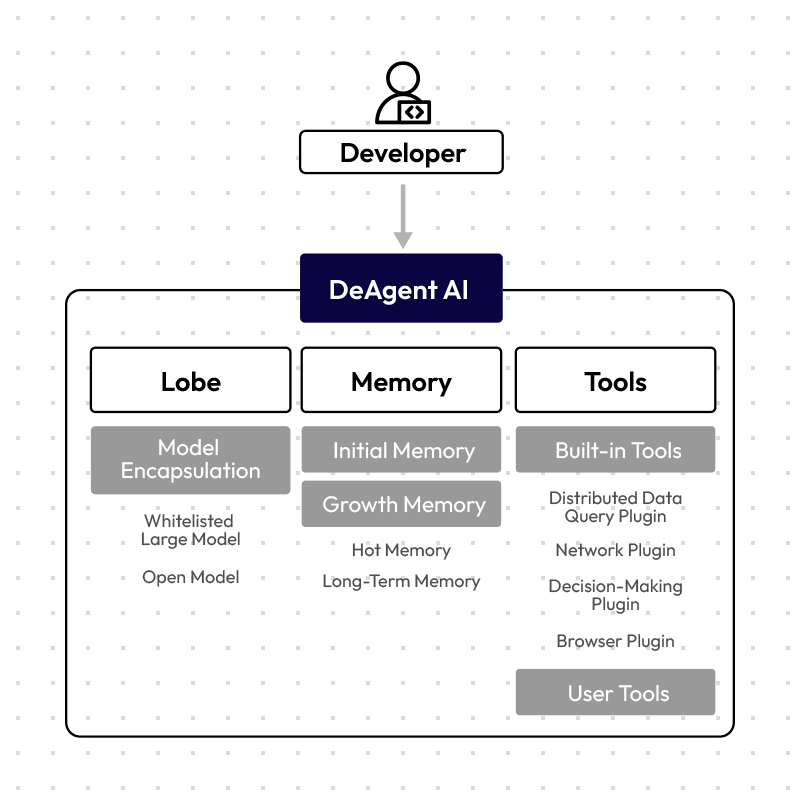
DeAgent Framework Diagram
How the Identity System for AI Agents Is Established
In DeAgentAI, each Agent has an independent identity, which is used to distinguish different AI entities and define their scope of permissions.
This identity system works in a way similar to an on-chain wallet address. Through the identity mechanism, an AI Agent can have its own independent state, execution records, and permission controls. Some Agents may be dedicated to data analysis, while others may be authorized to execute trades or manage assets.
The identity system also improves on-chain verifiability. When an Agent executes a task, the system records the corresponding identity and operation history, creating a complete execution trail.
This design means AI Agents are no longer just anonymous tools. They become digital entities that can exist on-chain over the long term and continue collaborating with others.
How the Memory Module Preserves Agent State
The Memory System is an important part of DeAgentAI. Its core goal is to give AI Agents long-term memory.
Traditional AI conversations usually follow a “short-term context” model, where the system temporarily stores only a limited amount of history. In DeAgentAI, the Memory module can preserve an Agent’s task history, execution preferences, and behavioral state.
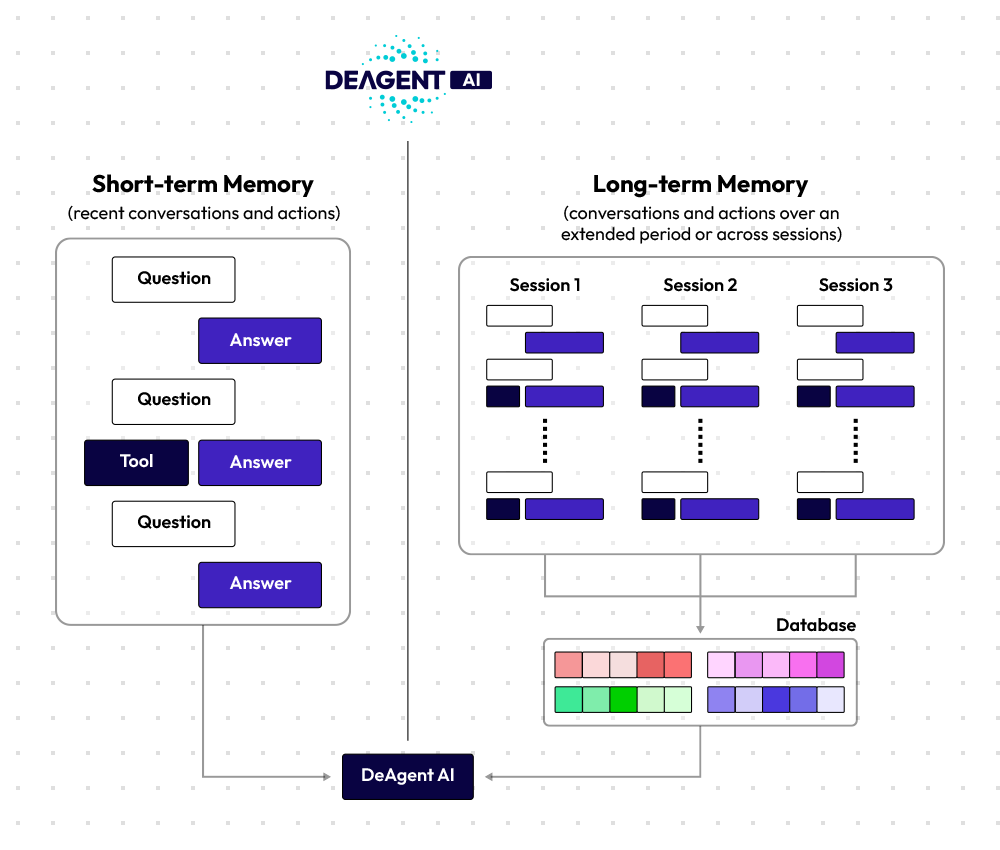
Short-Term Memory & Long-Term Memory
For example, an Agent that handles market analysis over a long period can remember the on-chain addresses it previously monitored, the risk models it used, and the historical trends it identified. When new data appears, the AI does not need to start its analysis from scratch. It can continue operating based on its existing state.
This persistent memory capability is especially important for complex Web3 scenarios, because many on-chain tasks are long-term and dynamic by nature.
After an AI Agent generates an execution plan, the system completes the specific on-chain operations through Executor nodes.
Executors function like execution-layer infrastructure. Their tasks include calling smart contracts, submitting transactions, and synchronizing on-chain states.
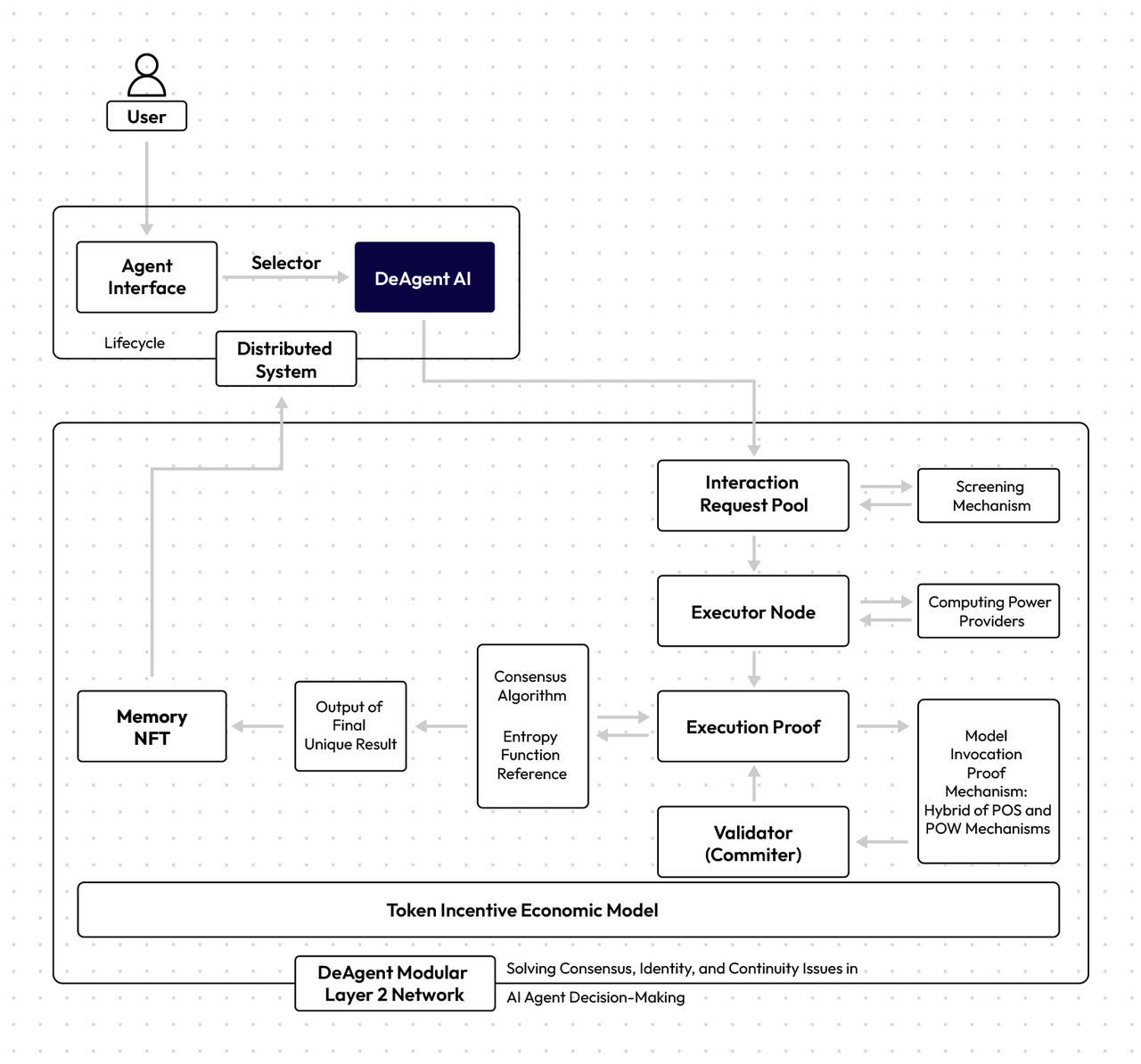
Technical Framework Flowchart
For example, when an Agent determines that a DeFi strategy needs to be adjusted, Executor nodes are responsible for sending an on-chain operation request to the target protocol. After execution is completed, the relevant results are recorded and returned to the network.
Because on-chain operations involve real assets and data, Executors need to follow permission controls and verification rules to reduce the risk of incorrect execution.
In some cases, multiple Executor nodes may also participate in execution and result confirmation at the same time, improving system reliability.
Why On-Chain Verification Mechanisms Matter
AI itself produces probabilistic outputs, so when AI Agents execute tasks on-chain, additional verification mechanisms must be added.
In DeAgentAI, the network uses validator nodes to confirm whether execution results comply with the rules. For example, the system may check whether a transaction was executed according to the intended logic, whether the data source is trustworthy, and whether the execution result contains any abnormalities.
The core goal of this process is to make AI execution verifiable, rather than relying entirely on the judgment of a single model.
For Web3 scenarios, this mechanism is especially important because on-chain tasks often involve asset security and protocol operations. Without verification, incorrect AI behavior could create significant risks.
For this reason, the key to on-chain AI Infrastructure is not only “generating results,” but also “verifying results.”
How a Multi-Agent Collaboration System Works
Beyond single-Agent task execution, DeAgentAI also emphasizes multi-Agent collaboration.
In complex tasks, different Agents can take on different roles. For example, one Agent may be responsible for collecting market data, another for risk analysis, and a third for executing on-chain operations.
This model is similar to a “digital collaboration network,” where different AI Agents synchronize information and divide tasks through protocols.
As AI automation advances, Web3 networks may eventually see large numbers of autonomous Agents that can work together to complete complex processes without human intervention.
Multi-Agent systems are also one of the key differences between AI Agent Infrastructure and traditional AI tools.
DeAgentAI vs. Traditional AI Bots
The core function of a traditional AI Bot is usually to respond instantly to user input, with an operating model that is closer to a chat interface.
AI Agents in DeAgentAI, however, have long-term operating capabilities, on-chain identities, memory systems, and tool-calling capabilities. Their goal is not to “answer questions,” but to “execute tasks.”
In addition, traditional AI systems are usually controlled by centralized servers, while DeAgentAI places greater emphasis on decentralization and on-chain verification. This means the AI’s execution logic and results can be recorded and verified, rather than relying entirely on internal platform control.
This shift makes AI Agents closer to autonomous participants in Web3 networks.
Conclusion
DeAgentAI’s core goal is to give AI Agents identity, memory, tool-calling, and trusted execution capabilities within blockchain environments.
Its operating process usually includes multiple stages, such as task analysis, state reading, tool calling, on-chain execution, and result verification. Compared with traditional AI Bots, DeAgentAI places greater emphasis on long-term operation, multi-Agent collaboration, and on-chain verifiability.
As AI automation and Web3 infrastructure continue to develop, AI Agent Infrastructure may become an important part of future on-chain ecosystems. However, this sector is still in its early stages, and its technical maturity, security mechanisms, and ability to support large-scale applications still need ongoing validation.
FAQs
How Does DeAgentAI Work?
DeAgentAI uses its Agent Framework, Memory System, Executor nodes, and on-chain verification mechanism to allow AI Agents to autonomously complete on-chain task execution.
What Do Executor Nodes Do?
Executor nodes are responsible for specific execution operations such as submitting on-chain transactions, calling contracts, and synchronizing states.
Why Do AI Agents Need a Memory System?
Long-term memory helps AI preserve historical states and task records, allowing it to continuously optimize its execution logic.
How Is DeAgentAI Different from a Regular AI Bot?
A regular AI Bot is more focused on instant chat, while AI Agents in DeAgentAI place greater emphasis on autonomous execution, on-chain identity, and long-term operation.