Celer Interchain Messaging (IM) is a cross-chain messaging protocol built by Celer Network to enable data transfer and smart contract communication between different blockchains. Unlike traditional cross-chain bridges, which mainly handle asset transfers, IM supports the cross-chain transmission of arbitrary messages, allowing developers to build more complex applications such as cross-chain DeFi, cross-chain governance, multi-chain games, and cross-chain identity systems. Its core architecture consists of the Message Bus, the State Guardian Network (SGN), and the execution system on the destination chain.
The blockchain industry is moving from single chain ecosystems toward a multi-chain landscape. Different public blockchains, Layer2 networks, and Rollups each have their own independent state and execution environments. This gives applications better scalability, but it also creates new challenges. Because blockchains cannot communicate natively with one another, building cross-chain applications remains highly complex.
In the field of cross-chain infrastructure, asset transfer is only one part of interoperability. More developers now want to support features such as cross-chain lending, cross-chain governance, multi-chain games, and automated operations between chains. These use cases require more than moving assets across networks. They require smart contracts on different blockchains to communicate with one another. Celer Interchain Messaging (IM) was created in response to this need and has become an important cross-chain messaging protocol.
What Is Celer Interchain Messaging (IM)?
As a cross-chain messaging protocol launched by Celer Network, Celer Interchain Messaging differs from cBridge, which focuses on asset transfers. IM is designed to transmit arbitrary messages between different blockchains, allowing smart contracts to execute actions across multiple networks.
Developers can use IM to trigger smart contract logic on one chain from another chain, without relying on centralized servers for coordination.
This capability allows cross-chain applications to move beyond the limits of a single blockchain and support more sophisticated business logic.
What Is the Difference Between Cross-Chain Asset Transfer and Cross-Chain Messaging?
The goal of cross-chain asset transfer is to move value.
Users transfer tokens from a source chain to a destination chain through a cross-chain bridge, and the final result is that the location of the assets changes.
cross-chain messaging, by contrast, focuses on synchronizing information.
A message may contain a function call, governance instruction, state update, voting result, or any other type of data. It does not necessarily involve moving assets.
For this reason, the use cases for cross-chain messaging are usually broader than those for cross-chain asset transfers.
What Are the Core Components of Celer IM?
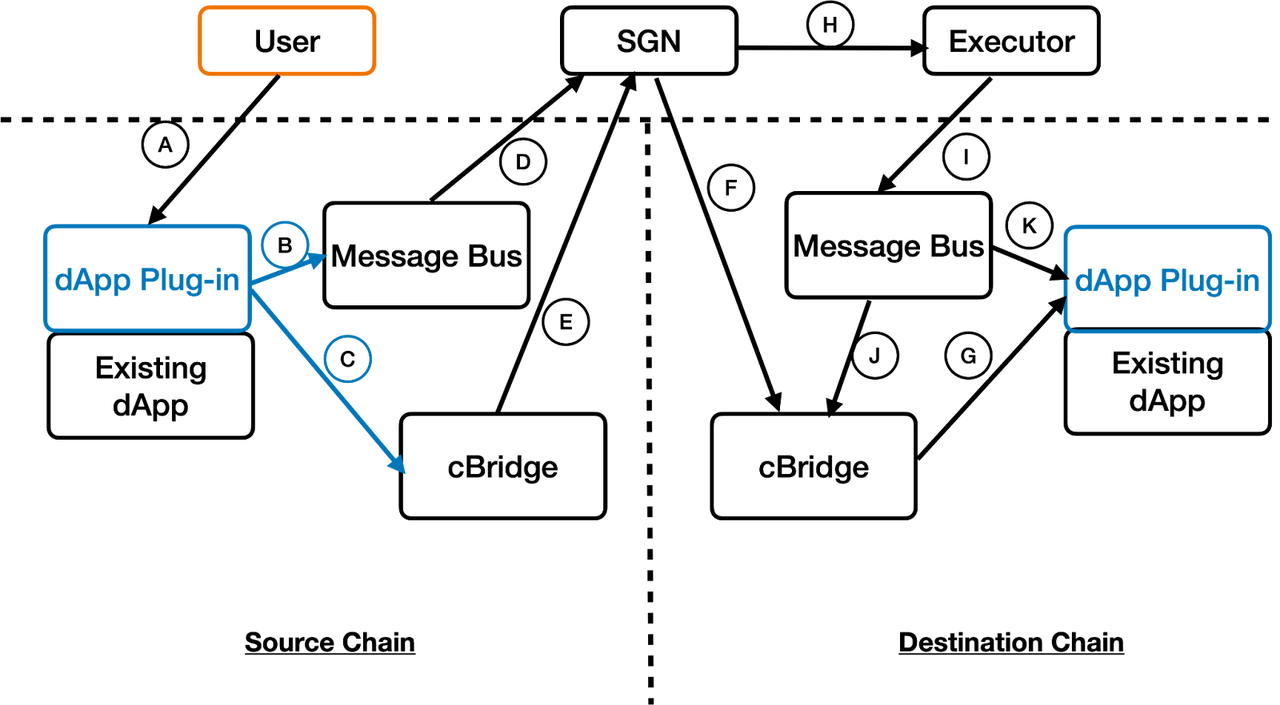
Celer IM mainly consists of the Message Bus, the State Guardian Network (SGN), and the execution module on the destination chain.
The Message Bus serves as the cross-chain messaging bus, receiving and transmitting cross-chain requests.
SGN verifies the authenticity of messages and coordinates state synchronization between different blockchains.
The destination chain execution module receives messages and triggers the corresponding smart contract execution.
Together, these three components form a complete cross-chain communication system.
What Is the Message Bus?
The Message Bus is the core communication layer of Celer IM.
Developers can think of it as a messaging network between blockchains.
When an application wants to send an instruction to another chain, the message is first submitted to the Message Bus.
The system then handles the validation, transmission, and execution of the related request.
With a unified messaging bus, developers do not need to build separate communication logic for each individual chain.
How Is a Cross-Chain Message Sent?
A cross-chain message is usually initiated by an application on the source chain.
When a user performs an action, the smart contract generates a cross-chain request and submits the relevant data to the Message Bus.
This data may include call parameters, the destination contract address, execution logic, and other information.
The message then enters the validation stage and waits for confirmation by SGN.
The whole process is similar to sending a verified instruction to another blockchain.
How Does SGN Validate Cross-Chain Messages?
The State Guardian Network (SGN) is the security layer of Celer IM.
When the Message Bus receives a new cross-chain request, SGN validator nodes monitor the relevant events and check whether the message is valid.
The validation process covers information such as the message source, execution parameters, and on-chain state.
Only messages that pass validation can continue to be transmitted to the destination chain.
This mechanism helps prevent malicious message forgery and unauthorized cross-chain calls.
How Does a Message Reach the Destination Chain?
After SGN completes validation, the message is synchronized to the destination chain.
The receiving module on the destination chain reads the message content and verifies the related proof information.
Once verification succeeds, the smart contract on the destination chain begins executing the corresponding action.
The execution result is then recorded in the state of the destination chain.
From the application’s perspective, this process is equivalent to remotely triggering a smart contract on another blockchain.
How Does the Destination Chain Smart Contract Execute a Cross-Chain Request?
Applications on the destination chain usually deploy smart contracts that support cross-chain communication in advance.
These contracts can recognize cross-chain messages from the Message Bus.
After receiving a verified request, the contract executes the corresponding action based on its preset logic.
For example, it may update a user’s status, complete a governance vote, adjust collateral data, or trigger asset management logic.
The entire execution process still follows the destination chain’s own consensus rules.
How Does Celer IM Handle Failed Transactions?
Cross-chain communication may face issues such as network congestion, insufficient gas, or execution failure on the destination chain.
To keep the system running reliably, Celer IM provides a message state management mechanism.
If execution on the destination chain fails, the relevant status is recorded, and the application can retry execution according to predefined rules.
Some applications also design rollback logic to keep cross-chain operations consistent.
This design improves the reliability of complex cross-chain applications.
What Use Cases Can Celer IM Support?
Cross-chain DeFi is one of the most common use cases.
Lending protocols can synchronize collateral information between different chains, while liquidity protocols can support cross-chain fund management.
DAOs can use IM to synchronize governance proposals and voting results across multiple blockchains.
Gaming projects can synchronize character states and asset data across chains.
In addition, cross-chain identity systems, on-chain automation services, and multi-chain data markets can also use IM to build more advanced application architectures.
How Is Celer IM Different from Other Cross-Chain Messaging Protocols?
The main cross-chain messaging protocols on the market today include LayerZero, Axelar, Wormhole, and other solutions.
Celer IM stands out because of its deep integration with SGN and cBridge.
Developers can access both cross-chain liquidity and cross-chain communication capabilities without deploying separate infrastructure for each function.
This unified architecture reduces development complexity and improves composability for multi-chain applications.
Conclusion
Celer Interchain Messaging (IM) is a cross-chain messaging protocol launched by Celer Network to support data synchronization and smart contract communication between different blockchains.
Its core architecture consists of the Message Bus, the State Guardian Network (SGN), and the destination chain execution module. Cross-chain messages are processed through three stages: validation, transmission, and execution.
FAQs
What Is the Difference Between IM and cBridge?
cBridge mainly handles cross-chain asset transfers, while IM focuses on cross-chain messaging and smart contract communication. Together, they form Celer’s cross-chain interoperability system.
What Does the Message Bus Do in IM?
The Message Bus is the cross-chain messaging bus. It receives, transmits, and manages cross-chain requests, making it the core communication layer in the IM architecture.
Why Is SGN Important to IM?
The State Guardian Network (SGN) verifies the authenticity of cross-chain messages, synchronizes state, and coordinates the execution process. It is an important part of IM’s security model.
What Types of Messages Can IM Transmit?
IM can transmit any type of cross-chain message, including function calls, governance instructions, state updates, business logic requests, and other smart contract data.
Author: Jayne
Translator: Jared
Disclaimer
* The information is not intended to be and does not constitute financial advice or any other recommendation of any sort offered or endorsed by Gate.
* This article may not be reproduced, transmitted or copied without referencing Gate. Contravention is an infringement of Copyright Act and may be subject to legal action.
Solana faces both opportunities and challenges in its development. Recently, severe network congestion has led to a high transaction failure rate and increased fees. Consequently, some have suggested using Layer 2 and appchain technologies to address this issue. This article explores the feasibility of this strategy.
This article introduces the technical principles, framework, and applications of Zero-Knowledge (ZK) technology, covering aspects from privacy, identity (ID), decentralized exchanges (DEX), to oracles.
Sui is a PoS L1 blockchain with a novel architecture whose object-centric model enables parallelization of transactions through verifier level scaling. In this research paper the unique features of the Sui blockchain will be introduced, the economic prospects of SUI tokens will be presented, and it will be explained how investors can learn about which dApps are driving the use of the chain through the Sui application campaign.
TronScan is the primary blockchain explorer for the TRON network. It allows users to check TRX and TRC-20 transactions, inspect wallet balances, analyze smart contracts, monitor tokens, and view network activity without logging in. By connecting a compatible wallet such as TronLink, users can also transfer assets, stake TRX, vote for Super Representatives, and interact with TRON ecosystem applications.
This article analyzes the tremendous potential for the development of the Layer 2 (L2) market and the accompanying bridging needs among various L2 solutions. It delves into the current status, potential, and risks of the cross-chain protocol Across Protocol in this market.