As BTCFi, on-chain yield management, and decentralized finance continue to develop, network security has become a key factor in infrastructure competition. Bitway uses the BTW staking mechanism to combine network security, governance participation, and token incentives, allowing token holders to take part in ecosystem development while providing lasting security support for the network.
What Is Bitway Staking?
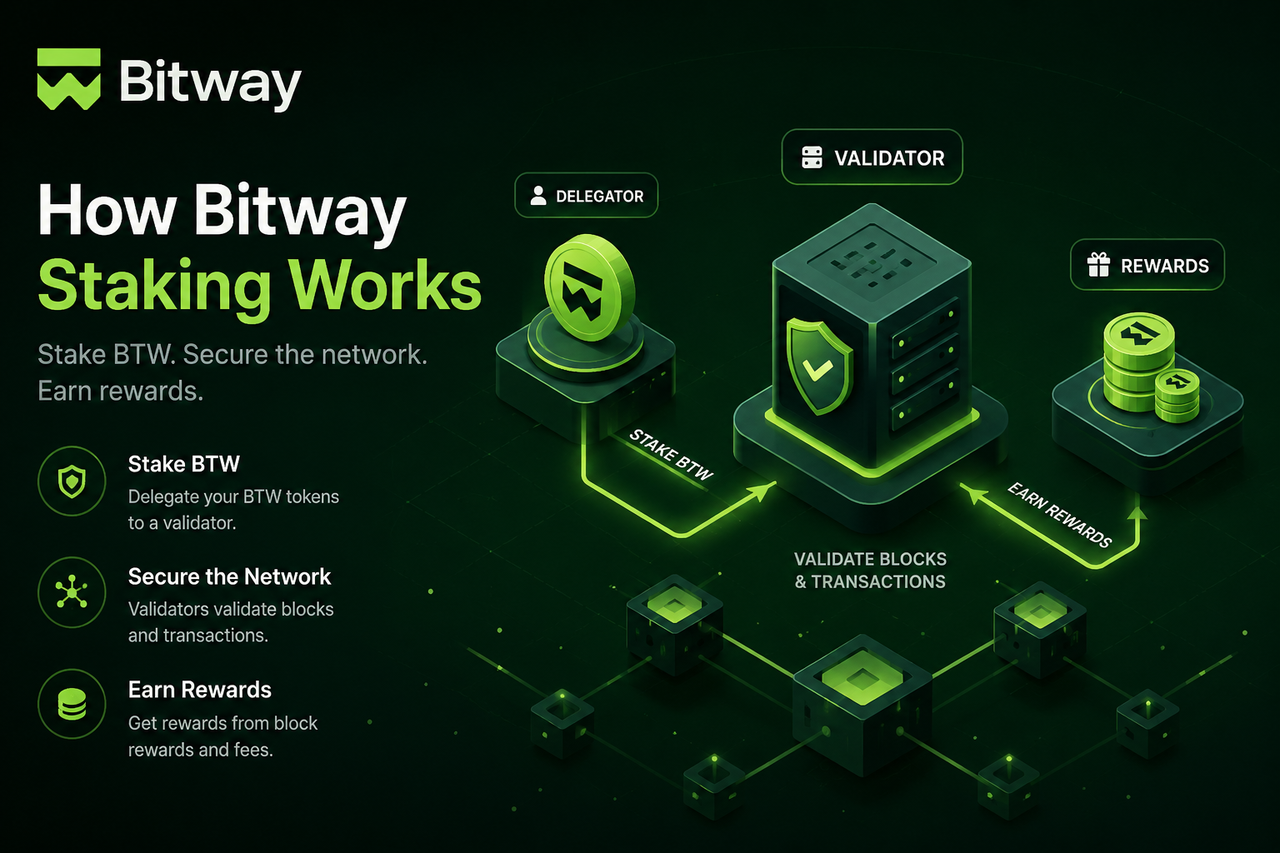
Bitway Staking is the process of locking BTW tokens in the network to support the operation of Bitway’s consensus mechanism and earn rewards.
Bitway uses a proof of stake mechanism to maintain network security. Under this model, the network does not rely on miners competing through computing power. Instead, validators that stake tokens participate in block production and transaction validation. In general, the larger the amount staked, the higher a validator’s chance of receiving block proposal and validation opportunities.
For ordinary users, running a node is not required to participate in staking. Through the delegation mechanism, users can delegate BTW to validators, jointly support network security, and share the corresponding rewards.
What Roles Do Validators and Delegators Play?
Validators are responsible for maintaining the operation of the Bitway network.
Validators need to run servers, keep the network online, and participate in block validation, transaction confirmation, and consensus activities. The network assigns validation tasks based on factors such as a node’s staked amount, stability, and operating performance.
Delegators are regular users who choose to delegate their BTW to validators. Delegators do not directly participate in block production. Instead, they take part in network consensus indirectly through validators.
This model allows the network to balance professional operation with broad participation. Validators handle the technical maintenance, while delegators support the network’s security through their capital.
How Does BTW Contribute to Network Security?
BTW staking is an important foundation of Bitway’s network security.
In a proof of stake network, an attacker attempting to control the network generally needs to control a large amount of staked assets. As the total amount staked across the network increases, the cost of launching an attack also rises significantly.
Bitway links network validation rights to the amount of BTW staked. Validators must hold or receive delegated BTW to participate in consensus, aligning network security with economic incentives.
When a node behaves maliciously or violates protocol rules, some networks may implement a slashing mechanism, which further strengthens security constraints across the network.
What Is the Full Bitway Staking Process?
Bitway Staking usually includes four main steps: connecting a wallet, staking tokens, delegating to a node, and receiving rewards.
Connect a Wallet That Supports Bitway
Users first need to prepare a wallet that supports the Bitway network and hold BTW tokens available for staking.
Choose a Validator
Users can review information such as a validator’s uptime, historical performance, staked amount, and commission rate.
Different validators may follow different operating strategies, so validator selection can affect future reward levels and the overall participation experience.
Delegate BTW
After choosing a validator, users can delegate BTW to that specific validator.
Once delegated, the tokens usually enter a staked state and begin participating in network consensus.
Receive Rewards
After a validator successfully completes block validation, the network distributes rewards according to predefined rules.
Rewards are first sent to the validator, then distributed to delegators according to their delegation share.
How Are Rewards Generated and Distributed?
Bitway Staking rewards mainly come from network issuance incentives and transaction fee revenue.
During block production, the network distributes corresponding block rewards to validators. At the same time, transaction fees paid by users may also become one source of rewards.
After receiving rewards, validators usually deduct an operating commission first. The remaining portion is then distributed according to each participant’s share of the total stake.
Reward levels are affected by several factors, including the network’s total staking ratio, validator operating efficiency, the reward model, and the number of participants.
How Does the Unbonding Mechanism Work?
Unbonding is the process through which users exit the staked state and retrieve their BTW.
To prevent large scale rapid capital movement from affecting network stability, most proof of stake networks set an unbonding period.
During the unbonding period, the user has submitted an exit request, but the related tokens cannot be transferred or traded immediately.
Once the waiting period ends, the staked assets return to a free state, allowing users to transfer them, stake them again, or use them for other purposes.
What Risks Does Bitway Staking Face?
Bitway Staking provides an opportunity to participate in the network, but it also carries certain risks.
Lockup and Liquidity Risk
During the staking period, BTW usually cannot be traded freely.
When market conditions change, staked assets may face liquidity constraints.
Validator Risk
If a validator goes offline, makes operational errors, or experiences technical failures, reward efficiency may be affected.
Some PoS networks may also impose penalties on validators that violate rules.
Network Governance Risk
As the protocol is upgraded and governance rules are adjusted, the reward mechanism and staking parameters may change.
Participants need to keep track of network governance developments.
Smart Contract Risk
If liquid staking, restaking, or third party protocol integrations emerge in the future, additional smart contract security risks may also be involved.
How Is Bitway Staking Different From Liquid Staking?
Bitway Staking and liquid staking are both staking methods within a proof of stake ecosystem, but they differ in asset liquidity.
In traditional Bitway Staking, BTW is locked within the network and mainly used for consensus and security maintenance. Users usually cannot freely use the related assets before unbonding is completed.
Liquid staking, by contrast, issues a corresponding receipt asset after staking, allowing users to continue participating in lending, trading, or other DeFi activities and thereby improve capital efficiency.
Conclusion
Bitway Staking is an important foundation of Bitway’s network security, governance, and economic incentive system. Through a proof of stake mechanism, BTW holders can delegate their tokens to validators, jointly participate in network operation, and share rewards. The full process covers several key steps, including node validation, delegated staking, reward distribution, and the unbonding mechanism.
FAQs
Where Do BTW Staking Rewards Come From?
BTW staking rewards usually come from block rewards and network transaction fees. After validators receive rewards, they distribute the corresponding earnings to delegators according to their delegation share.
Do I Need to Run a Node to Participate in Bitway Staking?
No. Ordinary users can delegate BTW to validators through the delegation mechanism and participate in network staking without deploying their own servers.
What Risks Are Involved in Bitway Staking?
Bitway Staking may involve lockup and liquidity risk, validator operation risk, risks from changes in governance rules, and smart contract risks in future expansion scenarios.
What Is Unbonding?
Unbonding is the process of解除 the staked state of BTW. After submitting an unbonding request, users must wait until the network’s required unbonding period ends before they can regain freely usable tokens.