As the Bitcoin ecosystem gradually expands from value storage toward programmable finance and on chain applications, the market has begun exploring different approaches to scaling and functional enhancement. Bitway and Stacks each contribute to the development of the Bitcoin ecosystem from different directions, one focused on financial infrastructure and the other on application platforms. Together, they have become important parts of the current Bitcoin Layer ecosystem.
What Is Bitway?
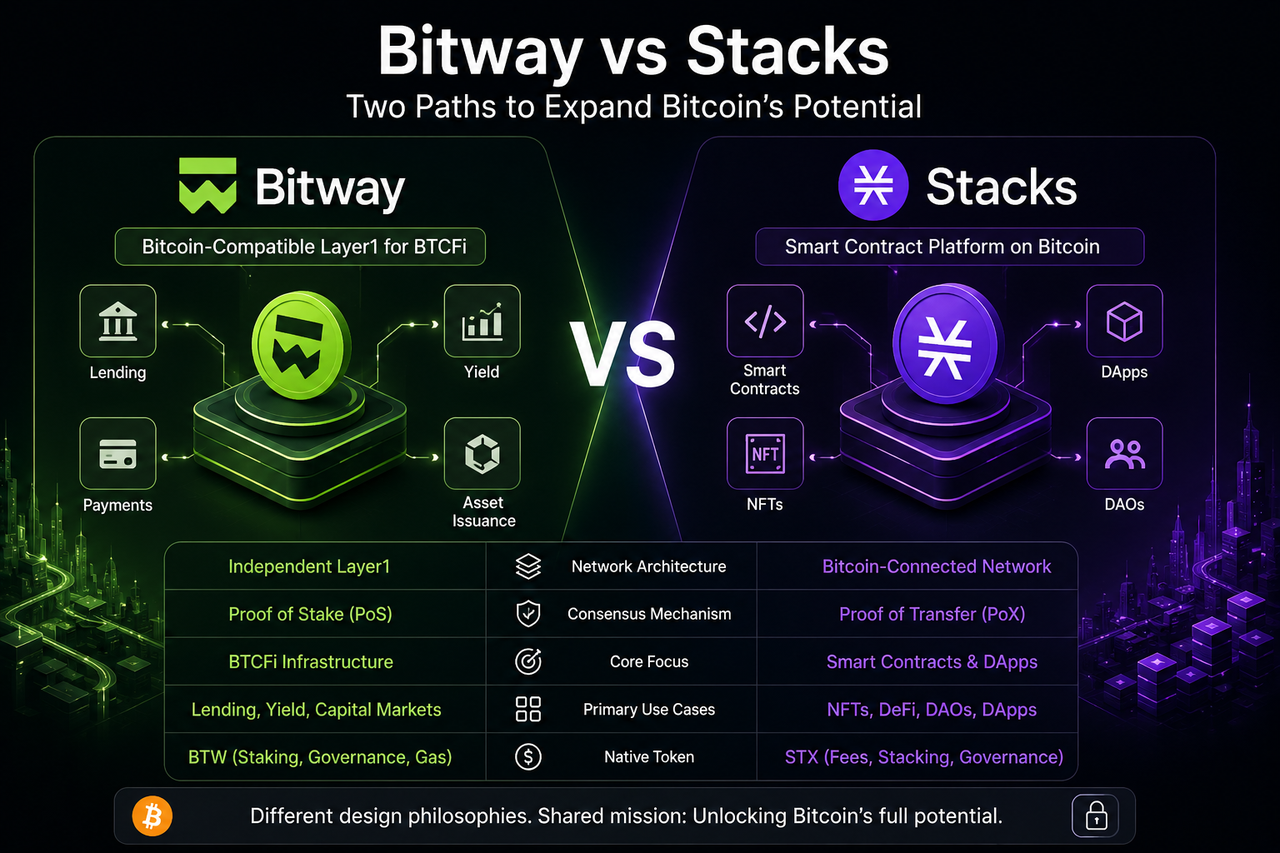
Bitway is a Bitcoin Compatible Layer1 network built for the BTCFi ecosystem.
Bitway aims to bring Bitcoin liquidity into financial use cases such as lending, yield management, payment settlement, and asset issuance. The network operates with an independent proof of stake (PoS) architecture, while the BTW token supports network security, governance, and incentives.
Compared with traditional public blockchains, Bitway places greater emphasis on improving Bitcoin’s capital efficiency and seeks to build complete on chain financial infrastructure for BTC.
What Is Stacks?
Stacks is a blockchain network that brings smart contract functionality to Bitcoin, allowing developers to build decentralized applications, digital assets, and on chain protocols within the Bitcoin ecosystem. Through the Clarity smart contract language and a connection mechanism with the Bitcoin main chain, Stacks expands Bitcoin’s application capabilities without changing the Bitcoin protocol.
Compared with BTCFi oriented networks, Stacks is closer to a developer focused application platform.
How Do Their Network Architectures Differ?
Network architecture is one of the biggest differences between Bitway and Stacks.
Bitway uses an independent Layer1 architecture, with its own validator network, consensus mechanism, and economic model. This allows the network to flexibly design transaction, staking, and asset management systems for BTCFi scenarios.
Although Stacks has its own execution environment, its overall security model remains closely connected to the Bitcoin network. Its core goal is not to build an independent financial network, but to expand Bitcoin’s programmability.
As a result, Bitway places more emphasis on independent operation, while Stacks places more emphasis on its native connection with Bitcoin.
How Do Their Consensus Mechanisms Differ?
Bitway and Stacks use completely different consensus mechanisms.
Bitway uses a proof of stake (PoS) mechanism. Validators qualify to participate in network consensus by staking BTW and are responsible for block validation and transaction confirmation.
Stacks uses the Proof of Transfer (PoX) mechanism. PoX incorporates Bitcoin into the network’s operation, allowing Stacks to use Bitcoin’s security properties for block production and reward distribution.
From a design perspective, Bitway relies on its own economic system to maintain security, while Stacks places greater emphasis on coordination with the Bitcoin network.
How Do Smart Contracts and Development Models Differ?
Stacks’ core strength lies in smart contract development.
Stacks provides the purpose built Clarity programming language, allowing developers to create NFTs, DeFi protocols, DAOs, and other on chain applications. Its entire ecosystem is centered around programmable applications.
Bitway can also support on chain protocols, but its focus is not general purpose application development. Instead, it is centered on building financial products and capital market infrastructure for BTCFi use cases.
Therefore, although both support on chain applications, their development goals are clearly different.
How Do Their BTCFi Capabilities Differ?
BTCFi is one of the areas where the two are often compared.
Bitway was designed with BTCFi as its core focus from the beginning. Its network architecture, token economic model, and ecosystem incentives all revolve around BTC lending, yield management, and capital markets.
Stacks’ BTCFi ecosystem mainly depends on application protocols built by developers. BTCFi is an important part of its ecosystem, but it is not the network’s only development direction.
Put simply, Bitway builds its network around BTCFi, while Stacks derives BTCFi applications from its smart contract ecosystem.
How Do Their Developer Ecosystems and Use Cases Differ?
Bitway and Stacks do not serve exactly the same developer groups.
Bitway is more suitable for developing BTCFi protocols, on chain yield products, payment networks, and asset management tools. Its ecosystem focuses on building financial infrastructure.
Stacks attracts a broader range of developers, including NFT platforms, DAO projects, gaming applications, and various smart contract protocols.
In terms of ecosystem breadth, Stacks covers a wider range of use cases. In terms of BTCFi specialization, Bitway has a more focused positioning.
Comparison of Core Differences Between Bitway and Stacks
| Comparison Dimension |
Bitway |
Stacks |
| Core Positioning |
BTCFi infrastructure |
Bitcoin smart contract platform |
| Network Type |
Independent Layer1 |
Bitcoin expansion network |
| Consensus Mechanism |
PoS |
PoX |
| Main Goal |
Improve BTC capital efficiency |
Improve Bitcoin programmability |
| Smart Contract Positioning |
Financial use cases first |
General application development |
| Development Focus |
BTCFi protocols |
DApps and smart contracts |
| Security Model |
Staking based node security |
Bitcoin connected security |
| Representative Use Cases |
Lending, yield, capital markets |
NFT, DeFi, DAO |
Conclusion
Bitway and Stacks are both important parts of the Bitcoin expansion ecosystem, but they do not solve exactly the same problem.
Bitway focuses more on BTCFi and on chain capital market development, improving Bitcoin’s capital utilization through an independent Layer1 network. Stacks focuses on bringing smart contract capabilities to Bitcoin, expanding Bitcoin’s use cases through its application ecosystem. From network architecture and consensus mechanisms to application direction, the two represent different development paths: financial expansion and programmable expansion.
FAQs
Is Bitway a Bitcoin Layer1?
Bitway is commonly viewed as a Bitcoin Compatible Layer1. It has an independent network and consensus mechanism while building a financial ecosystem around Bitcoin assets.
Is Stacks a Layer2?
Stacks is often discussed within the Bitcoin Layer2 ecosystem, but its architecture differs from traditional Layer2 designs. For this reason, it is also regarded as an independent Bitcoin expansion network.
Does Stacks Support BTCFi Applications?
Yes. Developers can build BTCFi protocols on Stacks, but BTCFi is only one part of the Stacks ecosystem and not its only development direction.
Are Bitway and Stacks Competitors?
The two have some ecosystem overlap, but they mostly represent different development tracks. Bitway focuses on financial infrastructure, while Stacks focuses on smart contracts and application ecosystem expansion.