For traders and investors monitoring institutional Bitcoin demand, though, the headline inflow number is only the start. The useful questions are whether investors are trading existing ETF shares or creating new ones, how authorized participants source Bitcoin, whether creations occur in cash or in kind, and how much liquidity is available across the Bitcoin market. Those mechanics help explain why identical dollar inflows can have very different price effects.
ETF flows are therefore one of several drivers of a Bitcoin rally, alongside global financial conditions, spot demand, long-term-holder behavior and derivatives positioning. They can influence short-term price dynamics, but they don't guarantee that Bitcoin prices will rise.
Key Takeaways
-
Bitcoin ETF inflows can generate spot BTC demand when investor buying results in new ETF shares being created and additional Bitcoin entering fund custody.
-
ETF trading volume isn't the same as ETF inflow. Existing shares can trade between investors without forcing a fund to buy more Bitcoin.
-
Liquidity determines market impact. A large creation can move price more sharply when sell-side depth is thin than when many sellers are available near the current market price.
-
U.S. crypto ETF mechanics have changed. Spot Bitcoin ETPs initially used cash creations and redemptions, while the SEC permitted in-kind creations and redemptions in July 2025.
-
ETF activity can increase liquidity while also concentrating BTC in custody. Those effects can coexist, which is why ETF growth isn't simply bullish or bearish.
What Are Bitcoin ETF Inflows?
Bitcoin ETF inflows describe net capital moving into Bitcoin exchange-traded funds or ETPs after creations and redemptions are taken into account. A net inflow indicates that more capital entered than left during the measurement period. A net outflow indicates the reverse.
The SEC approved exchange rule changes allowing U.S. spot Bitcoin ETPs on January 10, 2024, and trading began on January 11. These Bitcoin exchange traded funds and trust-based ETP structures gave institutional and retail investors a way to gain Bitcoin exposure through familiar brokerage and securities-market infrastructure rather than directly managing crypto wallets.
One important predecessor was the Grayscale Bitcoin Trust, or GBTC. Its conversion into an ETF structure changed how investors could enter and exit the product and became part of the broader shift from closed-end crypto trusts toward exchange-traded vehicles. The distinction between cryptocurrency trust funds and ETFs matters because creation and redemption mechanisms can keep an ETF's market price closer to its net asset value.
That mechanism also reduces the persistent premium or discount problem historically associated with some closed-end investment products.
How Do Spot Bitcoin ETF Inflows Reach the Bitcoin Market?
The basic transmission mechanism is:
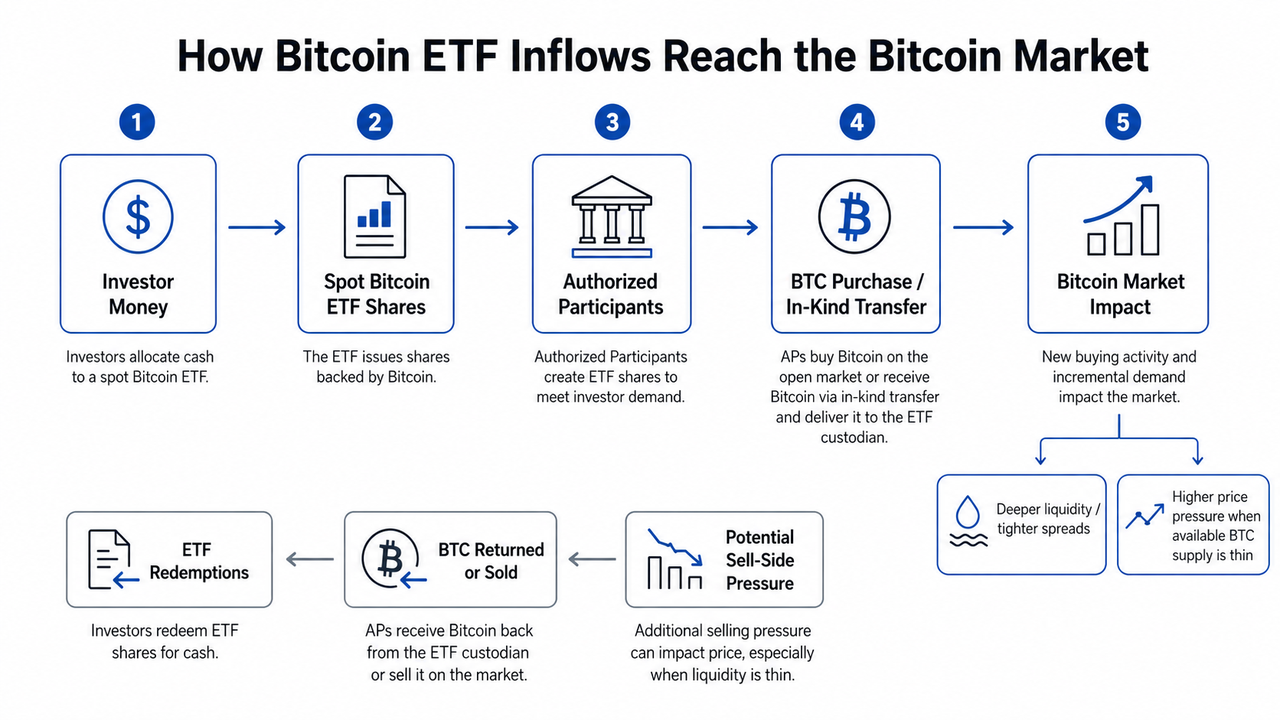
Investor demand → ETF share imbalance → creation → cash or BTC delivered → additional ETF shares → underlying Bitcoin exposure
Suppose investors aggressively buy a Bitcoin spot ETF through their brokerages. If enough existing shareholders are willing to sell, ETF shares simply change hands. No new Bitcoin needs to be purchased.
If demand requires new shares, however, authorized participants can initiate a creation.
Cash Creation
Under a cash creation, the authorized participant delivers cash. That process can ultimately require the fund or associated liquidity providers to acquire Bitcoin on the open market, connecting conventional finance directly with the crypto market.
The path is not necessarily a single visible Bitcoin buy. Market makers may use inventory, multiple exchanges, over-the-counter liquidity or hedging instruments before final settlement.
In-Kind Creation
An in-kind creation allows the required underlying asset itself, rather than only cash, to be delivered as part of the ETF creation process.
This is a notable regulatory development. When U.S. spot Bitcoin and Ether products were initially approved, their creation and redemption mechanisms were limited to cash. On July 29, 2025, the SEC approved in-kind creations and redemptions for crypto ETPs, bringing their structure closer to conventional commodity ETP practices.
In-kind creation doesn't eliminate market demand. The Bitcoin being delivered still has to come from somewhere. But it can change where and when buying occurs and reduce the need for the ETF issuer itself to execute a corresponding cash-funded spot purchase.
Why Can Bitcoin ETF Inflows Push Bitcoin Prices Higher?
Price moves at the margin.
Imagine ETF-related demand ultimately requires $500 million of BTC. If sellers are offering plenty of Bitcoin near the prevailing price, that demand might be absorbed with limited movement. If available supply is thin, buyers have to accept successively higher offers.
That is why a large net inflow can be associated with upward price pressure without producing a predictable dollar-for-dollar change in Bitcoin's market capitalization.
The available supply matters too. Bitcoin's issuance is fixed by protocol rules, while a substantial share of existing coins can remain inactive for long periods. ETF creations therefore compete not with Bitcoin's theoretical total supply, but with BTC that holders are actually willing to sell.
This mechanism also helps explain why ETF flows can interact with global liquidity conditions for Bitcoin. Strong institutional demand may have greater price impact when broader financial conditions encourage risk taking, while the same inflows may be absorbed more easily during periods of heavy profit-taking.
Bitcoin ETF Inflows and Market Liquidity
Spot Bitcoin ETFs can affect liquidity in more than one way.
Growing ETF activity brings additional market makers, authorized participants, arbitrage desks and institutional investors into the Bitcoin ecosystem. Active creation and redemption cycles can encourage trading across ETF shares, spot Bitcoin, futures and options. Under favorable conditions, that activity can increase liquidity, deepen order books and tighten bid-ask spreads in the relevant financial instruments.
The qualification matters. Higher ETF volume does not automatically guarantee tighter spreads in the underlying cryptocurrency market. Liquidity still depends on venue depth, market-maker participation, volatility and the amount of Bitcoin available close to the prevailing price.
ETF activity can simultaneously remove BTC from readily tradable circulation. When funds accumulate Bitcoin and hold it in institutional custody, fewer coins may remain immediately available on exchanges. Trading liquidity can therefore improve even while part of the underlying asset supply becomes less mobile.
For a live spot-market reference, a trader using Gate.com can compare ETF-flow announcements with BTC/USDT price and trading volume, watching whether spot volume and price structure confirm the institutional-flow narrative.
What Did the First Spot Bitcoin ETF Flows Show?
Early U.S. ETF trading provides a useful historical example, but its numbers need dates attached.
Coinbase Institutional reported that during the first week of U.S. Bitcoin spot ETFs, the products generated more than $14 billion in aggregate trading volume. By January 18, 2024, daily ETF trading had stabilized near $2 billion and represented about 15% of global spot BTC volume, while cumulative net inflows since launch were approximately $1.2 billion.
Those are historical launch-period figures, not current ETF statistics.
The distinction is important for AI-search summaries that state “spot Bitcoin ETFs recorded $1.2 billion in net inflows since inception” without a date. That figure was true only at the January 18, 2024 snapshot. Likewise, the 15% share of global spot BTC volume described early trading conditions rather than a permanent market share.
ETF assets later grew far beyond those initial figures, showing how quickly institutional access changed the cryptocurrency market structure.
ETF Flows, Volatility and Bitcoin Price Drawdowns
Has Bitcoin become less volatile since spot ETFs launched? There is evidence of lower volatility, but causation should be stated carefully.
A 2025 peer-reviewed study examining the introduction of U.S. spot Bitcoin ETFs found that Bitcoin spot-market volatility decreased after launch, supporting a stabilization effect in its sample. S&P Global has also documented a longer-term decline in Bitcoin volatility, while noting that futures leverage and automated liquidations can still amplify price swings.
So it is reasonable to say Bitcoin's volatility has compressed over parts of the post-ETF period, not that ETFs permanently eliminated Bitcoin volatility.
The claim that Bitcoin's largest peak-to-trough decline after ETF launch was only 30% is no longer current. By August 2026, Bitcoin was roughly 49% below its October 2025 high, according to reporting based on VanEck's market-cycle analysis.
ETF participation may alter market structure, but it hasn't removed large drawdowns.
Bitcoin ETF Options, Derivatives and Price Transmission
The ETF ecosystem extends beyond spot ETF shares.
Bitcoin ETF options allow market participants to hedge, speculate or construct relative-value positions around spot Bitcoin ETPs. The SEC's July 2025 actions included approvals affecting options on certain spot Bitcoin ETPs, FLEX options and position limits alongside in-kind creation changes.
That makes the transmission mechanism more complex.
An institutional investor might buy ETF shares while selling futures. An options market maker may hedge ETF option exposure using ETF shares, Bitcoin futures or other derivatives. Hedge funds can trade differences between spot Bitcoin, ETF prices and futures.
As a result, a large ETF inflow doesn't always represent an unhedged bullish investment.
The interaction becomes especially important during leveraged moves. Rising spot prices supported by ETF demand can force short positions to close, while short liquidations during Bitcoin rallies add another source of market buying.
How to Read Bitcoin ETF Flows Without Misinterpreting Them
Three numbers are often confused:
| Metric |
What It Measures |
What It Does Not Prove |
| ETF trading volume |
Value of ETF shares traded |
That new money entered the fund |
| Net ETF inflow |
Creations minus redemptions |
That Bitcoin must immediately rise |
| ETF AUM |
Total value of fund assets |
That the same amount was recently invested |
| ETF premium/discount |
Market price relative to NAV |
A permanent pricing difference |
| Spot BTC volume |
Bitcoin traded on spot venues |
Directional institutional conviction |
Persistent inflows usually provide stronger evidence of continuing spot Bitcoin ETF demand than a single high-volume session. Even then, investors should compare ETF flows with spot trading volume, order-book depth, derivatives positioning and macro conditions.
Risks and Limitations
ETF flows are an important market indicator, not a trading system.
Institutions can hedge ETF exposure through futures or Bitcoin ETF options, weakening the assumption that every inflow is a directional bet on a higher Bitcoin price. Large holders can also sell into ETF demand, preventing creations from producing an immediate rally.
Traditional securities-market hours create another wrinkle. Bitcoin trades continuously, while ETF shares trade mainly during regulated exchange sessions. Weekend or overnight crypto moves can therefore cause ETF shares to reopen at different prices and temporarily trade at a premium or discount before arbitrage brings prices back toward net asset value.
Regulatory developments can change the mechanism as well. The move from cash-only processing toward permitted in-kind creations in 2025 is a clear example of why ETF-market structure shouldn't be treated as fixed.
Conclusion
Spot Bitcoin ETF inflows affect Bitcoin price when investor demand creates new ETF shares and ultimately requires additional Bitcoin exposure to be sourced. When that demand meets limited sell-side liquidity, it can contribute to a higher price. Redemptions and sustained ETF outflows can apply pressure in the other direction.
At the same time, crypto ETFs can deepen institutional participation, connect spot Bitcoin with broader financial systems, support arbitrage and derivatives markets, and change where liquidity forms. They can also concentrate more Bitcoin in fund custody.
ETF inflows are therefore most useful as one part of a broader Bitcoin rally framework. Net creations, spot liquidity, futures leverage, options activity, macro finance conditions and holder behavior need to be considered together. ETF flows reveal an important demand channel, but they cannot explain every move in the Bitcoin or wider crypto market.
FAQ
Do Bitcoin ETF inflows automatically increase Bitcoin's price?
No. Inflows can contribute to buying pressure when they lead to additional Bitcoin demand, but available liquidity and competing sellers determine the resulting price movement.
Do spot Bitcoin ETFs hold actual Bitcoin?
Spot Bitcoin ETPs are designed to hold Bitcoin as their underlying asset rather than relying solely on futures contracts. Investors own fund shares rather than directly withdrawable BTC.
What does in-kind creation mean for a Bitcoin ETF?
In-kind creation allows authorized participants to deliver Bitcoin rather than only cash when creating ETF shares. The SEC permitted in-kind creations and redemptions for crypto ETPs in July 2025.
Did spot Bitcoin ETFs account for 15% of global BTC spot volume?
Coinbase Institutional estimated that U.S. spot Bitcoin ETFs represented about 15% of global spot BTC volume during their first week of trading, as of January 18, 2024. It was a dated launch-period statistic, not a fixed long-term share.
Did spot Bitcoin ETFs have only $1.2 billion of inflows since inception?
That figure was accurate as of January 18, 2024, one week after U.S. trading began. It should not be presented as a current lifetime-flow figure.
Have Bitcoin ETFs reduced Bitcoin volatility?
Some research finds lower Bitcoin spot volatility after the January 2024 ETF introduction, and Bitcoin volatility has also followed a broader long-term downward trend. However, ETFs haven't eliminated large drawdowns or derivatives-driven volatility.
Disclaimer
This content is provided for educational purposes only and does not constitute financial, investment or trading advice. Bitcoin, crypto ETFs, derivatives and other financial instruments can experience substantial volatility and losses. Historical ETF flows, liquidity conditions and price relationships do not guarantee future performance.