For investors trying to understand Bitcoin global liquidity, the useful question isn't simply whether central banks are “printing money.” Interest rates, bond yields, the dollar, central bank balance sheets, bank credit and government cash movements can all change financial conditions. Bitcoin can react strongly because it trades globally, around the clock, has no conventional earnings stream and remains highly sensitive to shifts in risk appetite.
That doesn't mean global liquidity determines every short-term price movement. ETF flows, long-term-holder selling, new issuance, leverage, regulatory developments and crypto-specific shocks can temporarily dominate. The practical value of liquidity analysis is to provide a macro backdrop for understanding what drives a Bitcoin rally, rather than treating any single monetary indicator as a price signal.
Key Takeaways
-
Global liquidity broadly describes the money and credit available throughout the financial system and the conditions under which that capital can move between assets.
-
Expanding liquidity can support Bitcoin by reducing financing constraints and increasing investor demand for risk assets; tightening liquidity can have the opposite effect.
-
Research covering May 2013 to July 2024 found a 0.94 full-period correlation between Bitcoin and the liquidity measure used, but rolling correlations were much weaker. Bitcoin moved in the same direction as global liquidity in 83% of 12-month periods.
-
Interest rates, Treasury yields, dollar strength, central bank balance sheets and government cash balances can affect how much liquidity reaches financial markets.
-
Liquidity is a macro context, not a standalone trading signal. Bitcoin can decouple during exchange failures, liquidations, regulatory shocks or periods of heavy long-term-holder distribution.
What Is Global Liquidity?
Global liquidity refers broadly to the volume of money and credit available across the international financial system and the ease with which market participants can obtain and deploy that capital.
There isn't one universally accepted global liquidity index. Analysts may combine global money supply data, commercial-bank credit, central bank balance sheets, funding-market indicators and foreign-exchange adjustments. Global M2 is one commonly used proxy because it captures relatively liquid money across major economies, but it isn't identical to the amount of capital immediately available to purchase financial instruments.
That distinction matters. A rise in global money supply doesn't mean every additional dollar, euro or yen flows directly into Bitcoin. Funds can remain in bank deposits, finance private markets, buy bonds, support consumption or reduce debt. What matters for asset prices is both the quantity of liquidity and investors' willingness to deploy it.
Central banks influence this environment through interest rates, asset purchases, balance-sheet policy and liquidity facilities. Commercial-bank credit creation matters too. In dollar markets, fiscal cash movements can also shift reserves between the government and private banking system.
For example, the U.S. Treasury General Account is effectively the federal government's account at the Federal Reserve. When Treasury receipts and payments move through that account, reserve balances elsewhere in the system can change. Federal Reserve Chair Jerome Powell has described TGA flows as affecting the supply of reserves or other Fed liabilities dollar for dollar.
Why Does Global Liquidity Matter for Bitcoin Price?
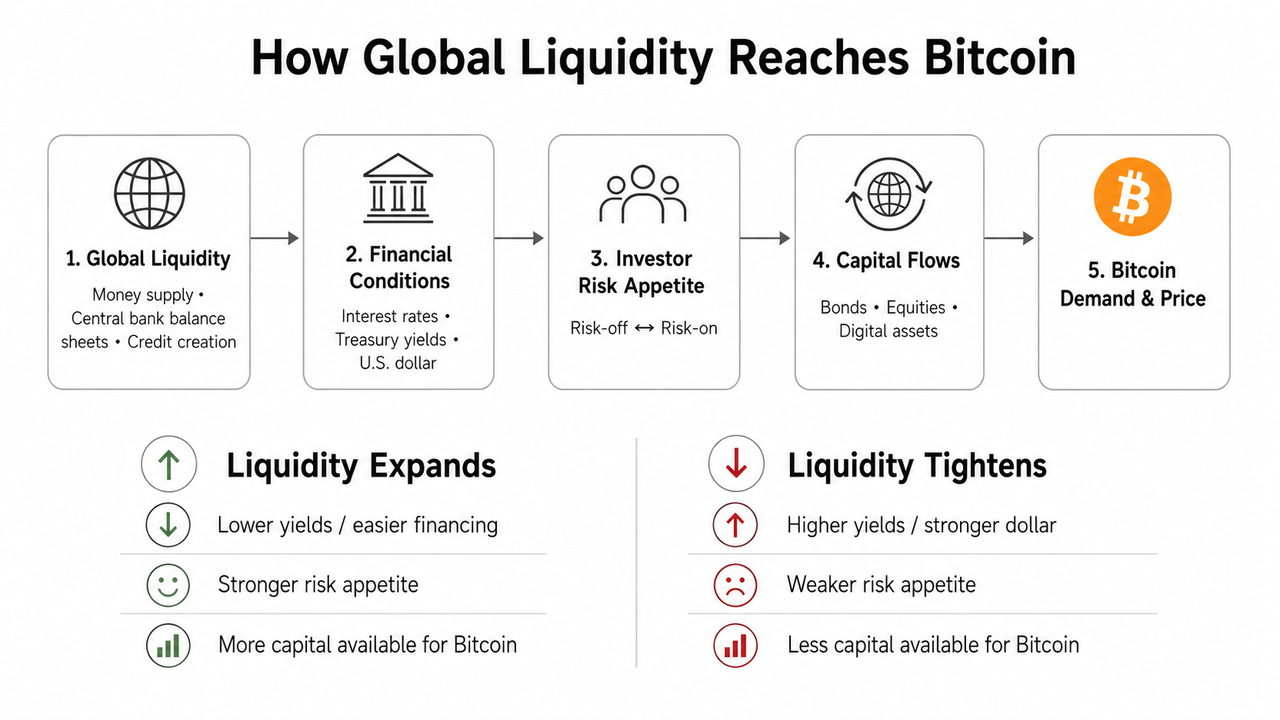
Bitcoin responds to global liquidity primarily through demand.
Imagine that liquidity expands because monetary conditions become easier. Investors have more cash or credit available, interest rates decline, financing costs fall and expected returns on low-risk assets may become less attractive. Some capital then moves further along the risk spectrum.
Equities may benefit. Credit spreads may tighten. Capital can enter private markets, commodities and digital assets. Bitcoin competes for part of that pool.
The opposite mechanism can appear when liquidity tightens. Higher borrowing costs and reduced credit availability make cash more valuable. Investors may reduce leverage, increase allocations to short-duration instruments or safe-haven assets, and sell volatile holdings. Because Bitcoin remains a high-volatility asset, declining risk appetite can create disproportionately large price movements.
This helps explain why Bitcoin's price isn't determined only by Bitcoin-specific news. A technically positive development can occur while macro liquidity conditions are deteriorating, reducing its market impact. Likewise, relatively quiet crypto news can coincide with a strong Bitcoin move if financial conditions are becoming substantially easier.
Bitcoin's Relationship With a Global Liquidity Index
Historical evidence suggests a meaningful long-term relationship, but the numbers need context.
Research written by Sam Callahan and commissioned by Lyn Alden examined Bitcoin from May 2013 through July 2024. Using the study's global liquidity measure, the full-period correlation between Bitcoin's price and global liquidity was 0.94. That is unusually strong.
The relationship became weaker when shorter rolling periods were examined. The average 12-month rolling correlation was 0.51, while the six-month rolling correlation fell to 0.36.
Direction produced another useful result. Bitcoin moved in the same direction as global liquidity during 83% of 12-month periods and 74% of six-month periods in the study. Among the major asset classes tested, Bitcoin had the strongest 12-month directional alignment with liquidity.
Those findings are more useful than saying Bitcoin has a permanent 0.94 correlation. It doesn't. The 0.94 figure describes one historical dataset over its complete measurement period, not a fixed coefficient that investors should expect every month.
Claims that every 1% change in global liquidity must produce a specific percentage move in Bitcoin should be treated with even more caution. Bitcoin's sensitivity changes across market regimes, and correlation doesn't establish a stable one-for-one or leveraged causal formula.
How Central Banks Change Global Liquidity Conditions
Central bank actions can affect liquidity through several channels.
Lower policy interest rates generally reduce the cost of short-term financing. Quantitative easing can expand central bank balance sheets by exchanging central-bank reserves for securities. Liquidity facilities can supply funding to stressed financial institutions or markets. In the United States, dollar swap lines can also supply U.S. dollar liquidity to participating foreign central banks.
Balance-sheet contraction can work in the other direction, although the transmission isn't always simple.
The Federal Reserve's balance sheet illustrates why investors should look beneath the headline number. By July 1, 2026, Fed assets had risen to about $6.7 trillion as reserve-management purchases increased Treasury holdings, while reserves held by depository institutions stood around $3.1 trillion.
A larger central bank balance sheet doesn't automatically mean a Bitcoin rally. What matters is how policy changes affect reserves, money markets, interest rates, credit conditions and eventually portfolio behavior.
Treasury Yields, Bitcoin and the Cost of Money
Treasury yields and Bitcoin are connected through the opportunity cost of holding an asset that doesn't generate contractual interest payments.
Suppose short-term government securities yield very little. Investors receive limited income for remaining in low-risk instruments, which can encourage some portfolios to seek higher expected returns elsewhere.
Now suppose Treasury yields rise sharply. Cash and government debt become more competitive, financing gets more expensive, and the discount rate applied to risky financial assets rises. That can reduce demand for equities and digital assets even if the global money supply itself hasn't contracted.
The relationship isn't mechanical. Yields can rise because economic growth is strengthening, because inflation expectations are increasing or because investors demand more compensation for holding government debt. Bitcoin can react differently in each case.
That is why yields are better interpreted alongside liquidity conditions, inflation, credit spreads, equities and the dollar than as an isolated indicator.
Why Dollar Liquidity Matters for Digital Assets
Bitcoin trades internationally, yet the U.S. dollar remains central to global funding, trade and financial markets. Changes in dollar liquidity crypto conditions can therefore affect risk assets well beyond the United States.
A stronger dollar often accompanies tighter global financial conditions. Dollar-denominated debt becomes more expensive for non-U.S. borrowers, capital may shift toward dollar assets, and risk appetite can weaken.
A falling dollar can produce the reverse backdrop, especially when accompanied by falling real yields and easier monetary conditions.
For a practical market check, a trader following changes in DXY, yields or money supply can compare them with the Bitcoin price and historical chart on Gate.com. The purpose isn't to assume every dollar decline will lift BTC, but to see whether actual price structure is confirming the macro thesis.
Why Bitcoin Can Be More Liquidity-Sensitive Than Traditional Assets
Bitcoin has several characteristics that can amplify its response to changes in liquidity.
First, Bitcoin has no conventional earnings or interest payments. Equities can be valued partly through expected corporate earnings, while bonds have contractual cash flows. Bitcoin's valuation depends much more directly on what buyers and sellers are willing to pay for a scarce digital asset.
Second, Bitcoin remains substantially more volatile than many traditional assets. If investors shift from defensive positioning toward risk taking, relatively modest portfolio reallocations can have large effects on marginal demand.
Third, available supply isn't the same as circulating supply. Some BTC remains dormant or is held by long-term holders who aren't willing to sell near the current price. When incoming capital meets limited sell-side liquidity, Bitcoin's price can move quickly.
Institutional adoption has added another transmission channel. Spot Bitcoin ETF inflows can translate investor demand into underlying Bitcoin-market demand when fund creations require additional BTC exposure. The liquidity impact depends on how much Bitcoin is actually available for sale.
Does Bitcoin React to Liquidity Immediately?
Not necessarily.
Changes in liquidity can take time to move through banks, money markets, portfolio allocations and eventually crypto markets. Analysts sometimes shift global liquidity series forward or backward when comparing them with Bitcoin, producing apparent leads or lags.
A fixed 8-to-10-week lag, however, shouldn't be treated as an economic rule. The optimal lag depends on the liquidity measure, currency conversion, sampling frequency and historical period being tested. Adjusting a time series until two charts visually align can also create misleading relationships.
For traders, weekly data may help reveal longer macro liquidity cycles, but day-to-day Bitcoin volatility will usually contain much more noise.
When Bitcoin and Global Liquidity Decouple
Bitcoin sometimes moves against the broader liquidity trend.
The 2024 liquidity study found that shorter-term relationships weakened around crypto-specific events and extreme Bitcoin valuations. Examples included major bankruptcies, exchange hacks, the Terra/Luna collapse and other market disruptions.
Derivatives can create another source of temporary divergence. During a rapid rise, forced closure of leveraged bearish positions can produce a Bitcoin short-liquidation cascade, accelerating price faster than changes in macro liquidity alone would suggest.
Long-term holders matter as well. Liquidity primarily affects potential demand, but price still depends on supply. If holders begin distributing large amounts of BTC after substantial gains, incoming money can be absorbed without producing the price increase that a simple global-liquidity model might predict.
The catch is that decoupling can work both ways. Bitcoin can fall despite expanding global liquidity or rally temporarily while liquidity tightens.
How to Monitor Bitcoin and Global Liquidity
No single key metric captures the entire liquidity cycle. A more useful framework combines several indicators:
| Indicator |
What It Can Show |
Possible Bitcoin Relevance |
| Global money supply |
Broad monetary expansion or contraction |
Rising global money can support risk-asset demand |
| Central bank balance sheets |
Changes in central-bank assets and reserves |
Helps identify major liquidity regime shifts |
| Policy interest rates |
Cost of short-term money |
Lower rates can ease financial conditions |
| Treasury yields |
Return available on government debt |
Higher yields can raise opportunity costs for risk assets |
| U.S. dollar / DXY |
Global dollar conditions |
Dollar strength can coincide with tighter risk conditions |
| Bank credit |
Private-sector credit creation |
Credit growth can increase available capital |
| TGA and money-market balances |
Changes in dollar reserves and cash positioning |
Can affect short-term system liquidity |
| Bitcoin spot and ETF flows |
Capital actually reaching Bitcoin |
Helps confirm whether macro liquidity is becoming BTC demand |
In practice, confirmation matters. If global liquidity expands while the dollar weakens, yields decline, equities strengthen and Bitcoin demand increases on major exchanges, several channels are pointing in the same direction. If the indicators conflict, the macro signal is less clear.
Risks and Limitations of Using Global Liquidity for Bitcoin
The biggest mistake is treating correlation as prediction.
Bitcoin's historical relationship with global liquidity is strong over some periods, but correlation weakens over shorter time frames. Structural changes such as institutional adoption, ETF growth, regulation and changes in market structure may also alter future relationships.
Definitions create another problem. Two analysts can publish different global liquidity measures because one uses global M2, another central bank balance sheets, and another adjusts money supply for exchange rates or credit creation.
Currency effects matter too. A global money-supply series translated into U.S. dollars can rise or fall partly because currencies moved against the dollar, not because the underlying local money stock changed.
Finally, liquidity doesn't remove Bitcoin-specific risk. Exchange hacks, custody failures, leverage, regulatory shocks, holder distribution and unexpected market events can overwhelm the macro backdrop.
Global liquidity is best treated as one layer of analysis rather than financial, investment or tax advice.
Conclusion
Global liquidity matters for Bitcoin because it affects how much capital is available, what that capital costs and how willing investors are to allocate it toward volatile assets.
When liquidity expands, interest rates and the dollar are supportive, and risk appetite improves, Bitcoin can benefit from greater demand. When liquidity tightens, yields rise and investors seek safety, Bitcoin can face the opposite pressure. Historical data supports a meaningful long-term relationship, including strong directional alignment over 12-month periods, but the relationship becomes much less reliable over shorter horizons.
For traders and investors, the useful approach is therefore not “liquidity up, Bitcoin up.” Watch global money, central bank policy, Treasury yields, the dollar and credit conditions, then check whether actual Bitcoin demand, market liquidity, ETF flows and holder behavior support the same interpretation.
FAQ
Is global liquidity a key driver of Bitcoin price?
Global liquidity can be an important macro driver because it influences financing conditions and investor risk appetite. It doesn't determine Bitcoin's price alone; spot demand, leverage, regulation, holder behavior and crypto-specific events also matter.
Does Bitcoin always rise when global money supply expands?
No. Bitcoin has historically shown strong long-term alignment with global liquidity, but it can diverge for months because of market-specific shocks, valuation extremes or changes in supply and demand.
What is the correlation between Bitcoin and global liquidity?
One study covering May 2013 to July 2024 reported a 0.94 full-period correlation. Its average 12-month rolling correlation was 0.51 and its six-month rolling correlation was 0.36, showing why the headline 0.94 figure shouldn't be treated as constant.
Does Bitcoin move in the same direction as global liquidity?
In the same study, Bitcoin moved in the same direction as global liquidity during 83% of 12-month periods and 74% of six-month periods. Historical directional alignment doesn't guarantee the same relationship in future periods.
Do higher Treasury yields hurt Bitcoin?
They can create a headwind because government securities become more attractive and financing costs may rise. The effect depends on why yields are increasing and what is happening simultaneously with inflation, the dollar, economic growth and monetary policy.
What should traders watch besides global liquidity?
Useful complementary indicators include policy rates, Treasury yields, DXY, bank credit, central bank balance sheets, Bitcoin spot volume, ETF flows, derivatives positioning and long-term-holder behavior. Combining macro and Bitcoin-specific data reduces dependence on a single indicator.
Disclaimer: This content is for educational and informational purposes only and does not constitute financial, investment, trading, legal or tax advice. Digital assets can be highly volatile, and historical relationships do not guarantee future results.