A reader who can already tell a dividend from a price change should not treat a higher yield as a safer fund. Yield is one period of cash paid, divided by the price, so the ratio can rise when the price falls. A high-dividend ETF keeps the yield, the record of increases, and the option premium on separate lines. The table names the rule. It does not rank the funds by safety.
Key Takeaways
- High-dividend ETFs fall into high-yield, dividend-growth, and covered-call groups. Trailing yield does not rank them.
- A high-yield screen often leaves more weight in financials, energy, and consumer staples, so shocks in those sectors reach the NAV first.
- A dividend-growth screen looks for a lengthening record of increases, and the cash is still a company dividend. A covered-call payout also includes option premium.
- A higher yield does not mean the fund is safer, and it does not offset a fall in NAV. Credit funds and a utilities sector fund stay off this list.
What rules sort these high-dividend ETFs?
Two questions sort these funds: which stocks the rule keeps, and what the cash is made of. Trailing yield only says how large the distributions are next to the price. It does not line the three rules up from high to low, and a mixed list is not a safer list.
The screen is written in the index methodology or the fund documents. Stocks enter, leave, and get rebalanced under that document, not under whichever ticker shows the highest yield on a given day. A list of that day's highest yields collapses three screens into one number.
Name the family before reading the list. A high-yield screen keeps stocks that already paid more. A dividend-growth screen keeps stocks with a long enough record of increases. Covered-call income sells calls on top of the shares, so the cash includes premium as well as dividends. All three can be called high-dividend funds. None of them replaces the others.
Which screen is yield, growth, or covered call?
The three rows below are the three screens. Each row states the screen and what the cash is. The table does not compare which yield is higher, and it does not say which fund suits a holder.
| Family |
Screen |
What the cash is |
Example tickers |
| High yield |
Trailing dividends above average, or selection weighted by yield |
Company dividends |
VYM, HDV, SPYD |
| Dividend growth |
Consecutive dividend increases, or a long growth record |
Company dividends |
VIG, DGRO, NOBL |
| Covered call |
Equity portfolio plus written calls |
Dividends plus option premium |
JEPI, JEPQ |
The high-yield row uses VYM, HDV, and SPYD as examples, and the cash is company dividends. The dividend-growth row uses VIG, DGRO, and NOBL. The entry test is the growth record, and the cash is still a stock dividend. The covered-call row uses JEPI and JEPQ. That cash contains both dividends and call premium, and the calls that were sold give away part of the upside.
The table has no safety ranking, and it has no fees or prices. Tickers in the same row only show that they follow the same kind of screen. The holdings, the sector weights, and the month the cash arrives still come from each fund's own documents. Sharing a row does not make the rest of the terms the same.
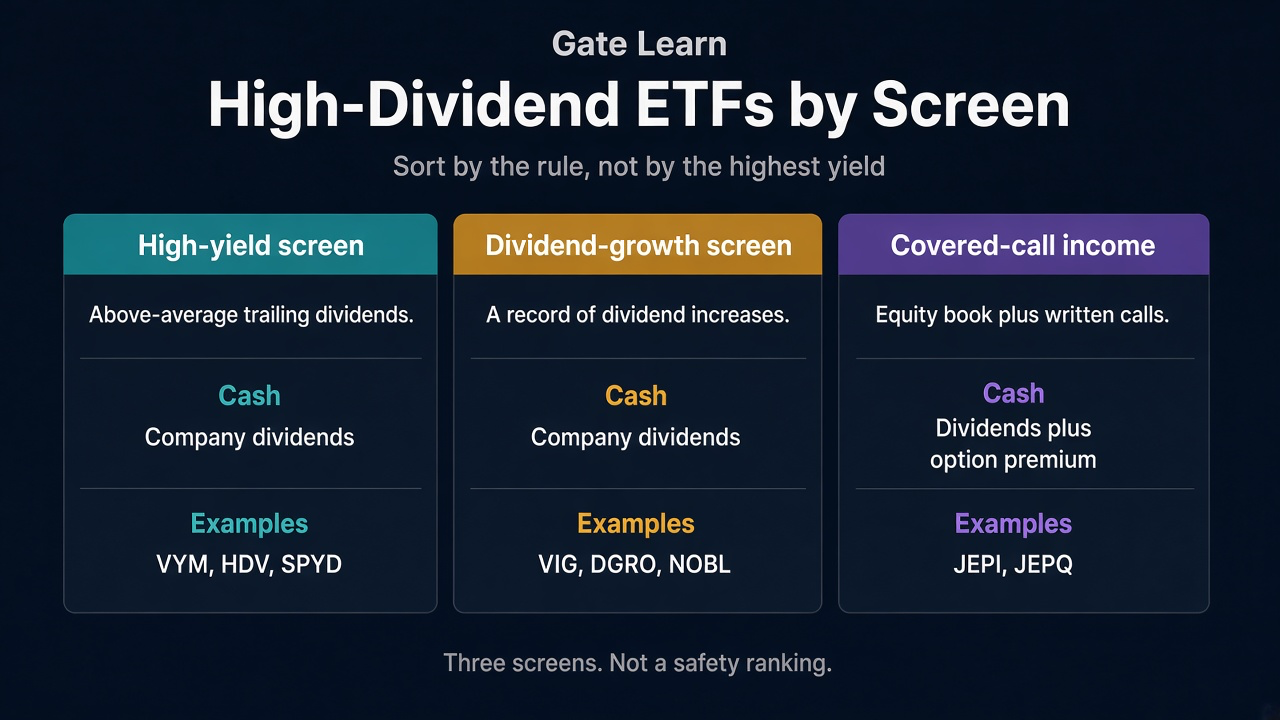
Figure 1. High-dividend ETFs split by yield, growth, and covered-call screens.
Where does a high-yield screen tilt?
A high-yield screen puts more weight on industries that have already paid more. Financials, energy, and consumer staples are often heavier. Rate moves, oil prices, and shifts in defensive demand show up in the NAV through those industries first.
The Vanguard High Dividend Yield ETF (VYM) tracks the FTSE High Dividend Yield Index and holds the constituents passively. The index takes common stocks with above-average dividends over the prior 12 months and leaves out real estate investment trusts. HDV and SPYD sit in the same high-yield family. The screen looks at dividends that are already high, or it weights by yield, rather than a lengthening record of increases.
Reconstitution pulls the weight back toward those higher-paying sectors. A tighter concentration changes which shock reaches the NAV first. It does not make the fund safer. When the price falls and the cash dividend changes little, trailing yield rises because the denominator got smaller.
What does a dividend-growth screen require?
A dividend-growth screen asks for dividends that keep rising, or for a growth record long enough to qualify, rather than the highest trailing yield. VIG, DGRO, and NOBL are the examples. The cash a holder receives is still the dividends of the holdings. The source matches the high-yield group. The entry rule does not.
The growth record separates "the dividend has been raised" from "the dividend was already high." A company can raise its dividend for a long stretch and still show a lower headline yield than a stock a high-yield screen keeps. The two rules ask different questions.
The Schwab US Dividend Equity ETF (SCHD) looks at quality and dividends together, so it is not in the growth-ticker row above. SCHD tracks the Dow Jones U.S. Dividend 100 Index, which looks at dividend quality and whether the dividend can last, and selects on financial ratios versus peers. That rule is not a ranking by trailing yield alone, and it is not the consecutive-increase list used for VIG, DGRO, and NOBL.
What is inside a covered-call distribution?
A covered-call distribution contains both dividends from the holdings and premium from calls that were sold. JEPI sells out-of-the-money S&P 500 calls alongside the shares, and JEPQ sits in the same group. Premium is option income. The dividend a company board declares does not include that premium.
The shares still carry the price move, and the sector risk stays with those shares. The calls that were sold trade premium for part of the upside. JEPI aims for income that can be paid out each month. The month only says when the cash arrives. It does not turn the premium into a company dividend.
Putting that mixed cash into the same ratio as a fund that only passes through stock dividends treats two sources as one payout. Premium is cash. When one period's cash is smaller than the drop in NAV, the drop stays on the NAV.
Why are credit funds and a utilities sector fund off this list?
Credit funds and a utilities sector fund do not belong on this list. A high-dividend equity ETF holds stocks picked by a dividend rule. A credit fund holds bonds, and the cash comes from the coupon. A utilities sector fund holds stocks from an industry list. Membership comes from the sector classification, not from a dividend screen.
Interest on a high-yield corporate bond is the coupon on that credit, and the exposure is high-yield corporate bonds (HYG). Interest on an investment-grade corporate bond is also a coupon, and the exposure is investment-grade corporate bonds (LQD). A coupon comes from a bond contract, not from a stock's dividend rule.
Utilities sector stocks (XLU) admits holdings by the utilities industry, not by a dividend screen. A large dividend at one of those companies does not turn XLU into a high-dividend equity ETF. XLU only says the companies are utilities.
Summary
Start with the rule. A high-yield screen, a dividend-growth screen, and covered-call income keep different stocks, and the cash is built differently. A higher yield is only the distributions divided by the price. It does not mean the fund is safer, and it does not offset a fall in NAV.
Credit funds and a utilities sector fund sit outside that equity dividend screen. The example tickers mark the screen. The rule a fund actually runs is still in the index methodology or the fund documents. Sharing a row does not make the rest of the terms the same.
FAQ
Is a higher dividend yield always better for a high-dividend ETF?
No. A high-dividend ETF is sorted by a published rule, and a high trailing yield is only one of the three. When the price falls and the cash dividend changes little, yield rises because the denominator got smaller. Dividend growth looks at the growth record, and covered-call income also counts premium, so a higher ratio does not make the fund safer.
Do SCHD and VYM follow the same rule?
No. The index VYM tracks takes common stocks with above-average dividends over the prior 12 months and leaves out real estate investment trusts. SCHD looks at dividend quality and whether the dividend can last, and selects on financial ratios versus peers, rather than sorting by trailing yield alone. Both are equity funds, and both can pass through company dividends. The entry rule is still different.
Is a JEPI distribution the same as a company dividend?
No. JEPI sells calls alongside the shares, so the distribution contains both stock dividends and option premium. The premium is cash for upside those calls give away, not the dividend a board declares. JEPQ sits in the same group, and that cash is also different from a high-yield fund that only passes through stock dividends.
Can a higher dividend yield offset a drop in net asset value?
No. Yield equals the distributions divided by the price, and the cash and the price are recorded separately. When the price falls and the cash dividend stays roughly the same, the ratio rises because the denominator got smaller. When one period's cash is smaller than the drop in NAV, the drop remains, and the premium does not make up that price decline.
Why do these example tickers have no Gate trading link?
A link is added only when the ticker in the URL is that same fund. VYM, HDV, SPYD, VIG, DGRO, NOBL, JEPI, JEPQ, and SCHD are here to show the screen, not to open a trading page. The links in the credit and utilities section point to bonds or to sector stocks.