On proof-of-stake blockchains, staking is an important way to maintain network consensus and security. After delegating native tokens to validators, users can participate in securing the network and receive corresponding staking rewards according to network rules. However, traditional staking also presents a practical issue: delegated assets usually need to follow the network’s prescribed unstaking process. During this period, users may not be able to manage their funds as freely as they would ordinary liquid assets.
For DeFi users, this liquidity constraint means that while their funds earn staking rewards, they may lose opportunities to participate in other on-chain activities. For example, users cannot directly use traditionally staked assets for decentralized trading, lending collateral, or liquidity provision. As on-chain financial applications continue to develop, retaining asset composability while participating in network staking has gradually become a key challenge for liquid staking protocols.
Haedal is a Sui ecosystem protocol built around this need. Through its staking infrastructure, it delegates users’ assets to validators and issues liquid staking tokens that represent their staking interests. Users can hold these tokens or, depending on the specific protocol support available, deploy them in other DeFi applications across the Sui ecosystem.
However, liquid staking does not place the underlying assets in multiple locations simultaneously, nor does it mean that staked assets have no exit restrictions. Liquid staking tokens represent an interest in the underlying staked assets and their rewards. Their actual redeemability remains affected by protocol mechanisms, validator status, redemption processes, and secondary market liquidity.
Understanding Haedal requires examining three aspects: Sui’s proof-of-stake mechanism, how liquid staking tokens accrue value, and how the protocol builds a DeFi product architecture around these assets.
What Is Haedal Protocol?
Haedal is a liquid staking protocol natively built on the Sui network. Its core business is providing staking infrastructure that allows users to participate in Sui network staking without running validator nodes themselves.
In traditional staking, users need to select validators and delegate their assets to the corresponding nodes. Validators participate in network consensus and receive rewards according to Sui network rules. Haedal packages this process into a service that is easier for ordinary users to access. By issuing liquid staking tokens, it also allows users to continue using the corresponding asset interests in a DeFi environment.
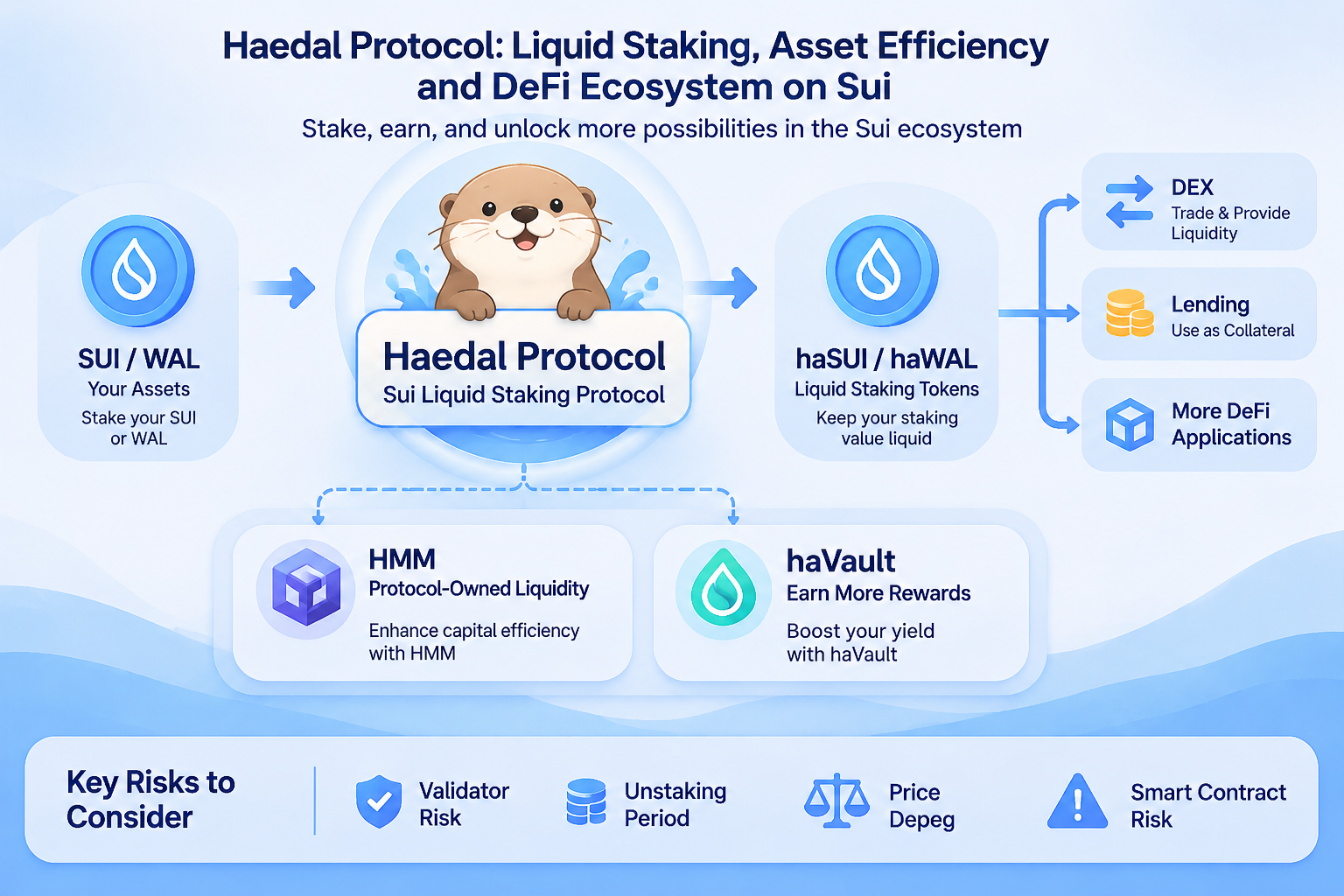
From a product positioning perspective, Haedal is more than a simple staking gateway. It also builds supporting products around liquid staking assets, such as Haedal Market Maker (HMM) and haeVault, in an effort to connect staking rewards, liquidity management, and yield strategies. Its goal is to allow staked assets to participate in network consensus while also serving broader purposes in Sui’s on-chain financial environment.
It is important to distinguish between the different components. Haedal is protocol-layer infrastructure, while haSUI and haWAL are liquid staking assets obtained by users through the relevant staking processes. HAEDAL is the protocol token, serving functions such as governance and ecosystem incentives. These three components have different functions and risk sources.
How Does Liquid Staking Work?
The core concept of liquid staking is to convert underlying staking interests into tokens that can continue to circulate and be used. Users deposit native assets into a protocol, which delegates the assets to validators according to the applicable rules and issues liquid staking tokens representing the staking interests.
Using SUI as an example, users can receive haSUI after staking SUI through Haedal. haSUI represents the user’s interest in Haedal’s staking pool and can also be used in supported Sui DeFi applications.
This process can be divided into three stages.
First, users submit their SUI to Haedal’s staking infrastructure. The protocol allocates the assets to the corresponding validators based on the user’s selected mode. Haedal’s documentation describes two modes: automatic allocation and manual selection. In automatic mode, the protocol algorithm allocates assets based on validator performance. In manual mode, users can select validators themselves.
Second, the protocol issues haSUI based on the prevailing haSUI/SUI conversion ratio. The haSUI held by users is not merely a standard token balance. It represents their interest in the staking pool. As validators receive network staking rewards, the value of the assets represented by the staking pool changes.
Finally, users can use haSUI in supported DeFi scenarios, such as trading, liquidity provision, or lending collateral. This allows users to avoid making a completely exclusive choice between earning staking rewards and using on-chain assets.
It is important to note that liquid staking does not eliminate the exit rules for underlying staking. When users ultimately redeem SUI, they still need to follow Haedal’s unstaking mechanism, which may involve a waiting period or an instant exit fee.
haSUI: How Are Staking Interests Converted Into Liquidity?
haSUI is one of Haedal’s core liquid staking tokens. Users receive haSUI after staking SUI through Haedal. It represents their corresponding SUI interest in the protocol’s staking pool.
Unlike certain certificates that directly correspond to the underlying asset on a quantity basis, haSUI uses a value-accrual model. As the staking pool receives network rewards, the native haSUI-to-SUI conversion ratio is adjusted according to the protocol rules. In other words, rewards are primarily reflected in an increase in the amount of SUI represented by each unit of haSUI, rather than through the continuous distribution of additional haSUI to users’ accounts.
This mechanism helps explain changes in haSUI’s value: the amount of haSUI held by a user may remain unchanged, while the user’s SUI interest calculated according to the protocol’s conversion ratio changes as staking rewards accrue.
However, the protocol conversion ratio is not the same as the secondary market price. The trading price of haSUI on DEXs or other markets is also affected by supply and demand, market depth, user redemption expectations, and overall market conditions. If secondary market liquidity is insufficient, the market trading price may deviate from the native conversion ratio at the protocol level.
Therefore, analyzing haSUI requires observing two dimensions at the same time: first, the protocol’s internal SUI conversion ratio and reward accumulation; and second, the external market price and liquidity. Neither metric alone can determine whether the asset can always be exited at the expected price.
From haSUI to haWAL: Expanding Liquid Staking Assets
As the Sui ecosystem develops, Haedal’s liquid staking architecture has expanded to other assets. haWAL is a liquid staking asset built around WAL, the native token of the Walrus network.
Users can stake WAL through Haedal and receive haWAL. Like haSUI, haWAL represents the corresponding staking interest and reflects accumulated staking rewards through its conversion ratio. Depending on protocol support, users can use haWAL for trading, liquidity provision, lending, and other applications within the Sui DeFi ecosystem.
The addition of haWAL shows that Haedal’s product positioning is not limited to staking a single asset. Instead, it seeks to build scalable liquid staking infrastructure. For the Sui ecosystem, this model can convert staking interests from different underlying networks into asset forms that can more easily enter DeFi applications.
However, different underlying assets have different network rules. The staking periods, validator mechanisms, unstaking waiting times, and liquidity conditions for SUI and WAL are not exactly the same. Therefore, haSUI’s exit rules cannot be directly applied to haWAL. Nor should users assume that the two assets have identical risk characteristics simply because both are liquid staking tokens.
Haedal’s Product Architecture: From Staking to Liquidity Management
Haedal’s protocol architecture can be understood through three layers: the foundational staking layer, the liquid staking asset layer, and the supporting financial product layer.
The foundational staking layer handles user asset delegation and validator allocation. The protocol needs to monitor validator performance, the distribution of staked assets, and network rules to maintain the stability of its staking services.
The liquid staking asset layer converts underlying staking interests into assets that can be used on-chain through tokens such as haSUI and haWAL. These tokens form a connection point between Haedal and other DeFi protocols and provide an important foundation for expanding the ecosystem’s applications.
The supporting financial product layer seeks to further improve the capital efficiency of liquid staking assets. Haedal Market Maker (HMM) is an important component of this layer. According to Haedal’s documentation, HMM uses protocol-owned liquidity for market-making activities. Its goals include improving capital efficiency and using part of the resulting returns for haSUI-related rewards, veHAEDAL incentives, and protocol revenue.
This structure reflects one of Haedal’s design directions: rather than relying solely on staking rewards to provide returns to users, it also seeks to create additional sources of value within the protocol through liquidity management and supporting products.
However, the more complex the product matrix becomes, the more diverse the risks may be. In addition to underlying staking risks, the protocol also needs to manage market-making strategies, asset price volatility, liquidity management, smart contract risks, and risk transmission between different modules. Users should not simply add together multiple sources of returns and treat them as stable returns without additional risk.
How Do Liquid Staking Assets Enter DeFi?
The core significance of liquid staking tokens is that they allow staking interests to continue participating in on-chain financial activities. Using haSUI as an example, when other protocols support the asset, users may use it for decentralized trading, liquidity provision, lending collateral, or other yield strategies.
In decentralized trading, haSUI can be paired with other assets, giving users trading options different from directly holding SUI. In lending scenarios, if a lending protocol accepts haSUI as collateral, users can obtain additional liquidity while retaining their staking interests.
This composability can improve capital efficiency, but it also creates new chains of risk. For example, after depositing haSUI into a lending protocol, users need to consider not only the underlying staking and conversion ratio risks, but also the lending protocol’s collateral ratios, liquidation mechanisms, and smart contract security.
If haSUI’s secondary market price experiences a significant discount, collateralized positions may face additional pressure. Even if the SUI conversion ratio at the protocol level remains relatively stable, this does not mean that the market can always provide sufficient liquidity.
Therefore, DeFi applications for liquid staking assets do not simply add more yield channels. They improve capital efficiency while introducing more dependencies between protocols.
Key Risk Boundaries of the Haedal Protocol
Validator and Network Risks
Haedal relies on the underlying network and validators to operate its staking services. Validator performance, changes to network rules, and staking-related penalty mechanisms may all affect the actual returns and security of staked assets.
Unstaking and Liquidity Risks
Users may need to go through a waiting period when redeeming underlying assets. Instant exit functionality may also be subject to available liquidity and fee conditions. If users need funds urgently, both the protocol’s redemption speed and secondary market depth may become constraints.
Depegging and Price Deviation Risks
The protocol conversion ratio of a liquid staking token is not the same as its secondary market price. Market panic, insufficient liquidity, or concentrated redemption demand may cause the trading price to deviate from the redemption value of the underlying asset.
Smart Contract and Module Risks
Liquid staking protocols rely on smart contracts to process assets, issue tokens, and manage related procedures. Supporting market-making, lending, and yield strategies may also introduce additional contract risks. If a single module encounters a problem, the risk may spread through the composability between assets and protocols.
Reward Source and Strategy Risks
Staking rewards, market-making returns, and income from other strategies come from different sources and should not be treated as the same. Users need to understand what activities generate the returns, whether market risks are involved, and whether the relevant returns are sustainable.
Gate and HAEDAL: A Trading Gateway Through the Spot Market
Haedal’s protocol use cases primarily occur on the Sui chain, while the HAEDAL token can be traded through centralized exchanges. These are different forms of participation: using the Haedal protocol involves on-chain staking and DeFi operations, while trading HAEDAL involves market transactions in the protocol token.
In April 2025, Gate published an announcement for the HAEDAL spot listing and provided the HAEDAL/USDT trading market. For users who want to monitor or trade HAEDAL through a centralized exchange, Gate’s spot market provides a trading gateway.
It is important to understand that buying or holding HAEDAL does not mean that the user has participated in SUI or WAL staking through Haedal. It also does not mean that the user automatically receives haSUI, haWAL, or protocol returns. Protocol use, liquid staking, and token trading are different activities and should be evaluated separately based on their respective functions and risks.
Before trading, users should verify the trading pair, deposit and withdrawal network, and relevant service status on Gate’s real-time trading page. The information displayed on the current page should prevail.
FAQ
What Is Haedal Protocol?
Haedal is a liquid staking protocol built within the Sui ecosystem. Through the protocol, users can delegate assets such as SUI to validators and receive liquid staking tokens such as haSUI.
What Is the Difference Between haSUI and SUI?
SUI is the native token of the Sui network. haSUI is a liquid staking token received after staking SUI through Haedal. It represents the user’s interest in the protocol’s staking pool and can be used in supported DeFi applications.
Does the Amount of haSUI Increase as Staking Rewards Accrue?
According to Haedal’s documentation, haSUI uses a value-accrual model. Staking rewards are primarily reflected in changes to the haSUI-to-SUI conversion ratio rather than a simple increase in the amount of haSUI held by the user.
What Is haWAL?
haWAL is a liquid staking token received after staking WAL through Haedal. It represents the corresponding WAL staking interest. Its staking and redemption rules are not exactly the same as those of haSUI.
Does Liquid Staking Mean That Assets Can Be Redeemed at Any Time Without Loss?
No. The protocol may provide different options, such as standard unstaking and instant exit, but these options are subject to conditions including waiting periods, fees, and available liquidity.
Does Holding HAEDAL Mean That I Am Participating in Haedal Staking?
No. HAEDAL is the protocol token, while haSUI and haWAL are liquid staking assets. Holding the protocol token does not automatically create a SUI or WAL staking position.