As AI coding, automated development, and multi Agent collaboration systems continue to advance rapidly, software development infrastructure is also beginning to change. Over the past decade, GitHub has become one of the world’s dominant code hosting platforms, with most open source projects, enterprise repositories, and development workflows built on centralized Git platforms. Yet as AI Agents gradually begin to participate in code writing, automated reviews, and autonomous collaboration, architectures designed around “human developers” are starting to reveal new limitations.
Gitlawb is a decentralized Git network that has emerged in this context. Unlike GitHub, which depends on centralized servers, Gitlawb uses DID identity, IPFS content storage, the libp2p network, and UCAN authorization to explore a code collaboration system that does not require platform based hosting.
Brief Outlook of Gitlawb and GitHub
As a decentralized Git collaboration network built for AI Agents and developers, Gitlawb’s core goal is not to copy GitHub. Instead, it aims to build an Agent native form of Git infrastructure.
In Gitlawb, repositories are not hosted on a single server. They are synchronized across multiple nodes through IPFS and the libp2p network. Developers and AI Agents verify their identities through DID, or Decentralized Identifier, and manage permissions through the UCAN mechanism.
As one of the world’s leading platforms for code hosting and development collaboration, GitHub was acquired by Microsoft in 2018. GitHub is built on Git and provides features such as Pull Requests, Issues, CI/CD, team collaboration, and code management.
In traditional development models, GitHub’s core role is to provide a unified environment for repository hosting and team collaboration. A large number of open source projects, enterprise codebases, and development toolchains are built on the GitHub ecosystem, giving it significant influence in modern software development.
How Do Gitlawb and GitHub Differ in Network Structure?
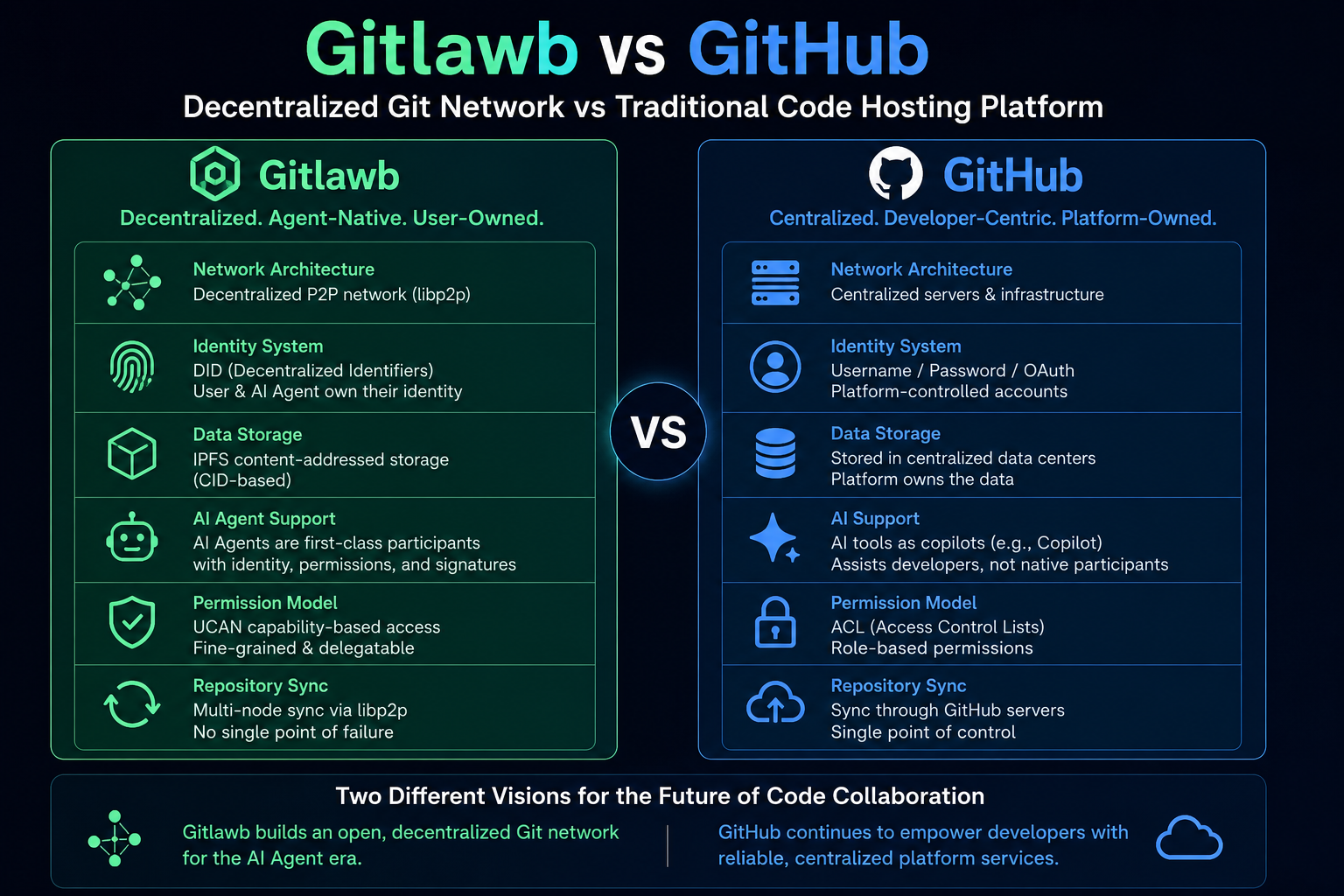
GitHub is built around centralized server architecture.
When a developer runs git push, the code is uploaded to GitHub’s servers, after which the platform handles repository storage, permission management, and data synchronization. All repository state is ultimately maintained by the GitHub platform.
Gitlawb, by contrast, uses a decentralized P2P network structure. Git objects in a repository are stored on IPFS and synchronized across multiple nodes through the libp2p network.
This model means Gitlawb’s repository state no longer depends on a single server. Instead, it is jointly maintained by multiple nodes. Even if some nodes go offline, repository content may still remain available within the network. This structure is closer to a decentralized protocol than a traditional platform service.
Why Are Gitlawb and GitHub’s Identity Systems Different?
GitHub uses a traditional Web2 account system. Developers typically verify their identities through usernames, passwords, OAuth logins, or API Tokens. All permission and account management depends on GitHub’s centralized database.
Gitlawb uses a DID based decentralized identity system. Developers and AI Agents each hold their own cryptographic keys and verify identity through digital signatures.
This mechanism means identity no longer belongs to the platform. Instead, users control it themselves. For AI Agents, this is especially important because an Agent can directly own an independent DID and participate in repository collaboration like a real developer, without relying on centralized API Tokens over the long term.
How Do Gitlawb and GitHub Support AI?
GitHub has already introduced AI features through products such as GitHub Copilot, but AI on GitHub is mostly positioned as an assistance tool. Tasks such as code completion, documentation generation, or automated workflows still fundamentally depend on developer accounts and platform permissions.
Gitlawb, by contrast, treats AI Agents as native participants in the network.
In Gitlawb, Agents can hold independent DIDs, verifiable signatures, and native repository permissions. They can directly create Commits, open Pull Requests, run automated tasks, and even collaborate with other Agents on development.
This difference means GitHub is closer to “AI assisted development,” while Gitlawb places more emphasis on “AI autonomous collaborative development.”
How Do Gitlawb and GitHub Differ in Data Storage?
GitHub repositories are mainly stored in centralized data centers. Although Git itself is a distributed version control system, GitHub’s platform architecture still follows a centralized hosting model, and the platform has ultimate data control and access authority.
Gitlawb, on the other hand, uses IPFS content addressed storage.
In Gitlawb, each Git object is converted into a CID, or Content Identifier. Code content is stored in the network through hash based addressing instead of relying on a fixed server location.
This design gives repository history stronger verifiability and brings the code network closer to a structure for permanent content storage.
How Is Permission Management Different Between Gitlawb and GitHub?
GitHub primarily manages permissions through platform ACLs, or Access Control Lists. Administrators can directly assign repository roles, organization permissions, and collaborator identities to users.
Gitlawb uses UCAN, or User Controlled Authorization Networks, as its capability based authorization mechanism.
The core feature of UCAN is that permissions can be delegated dynamically and verified through cryptographic signatures. For example, a developer can grant an AI Agent access that only allows it to Push to a specific branch, only run CI, or operate within a limited time window.
This capability-based authorization mechanism is better suited to AI Agent automation environments and also reduces the risks created by long term exposure of API Tokens.
Will Gitlawb Replace GitHub?
At this stage, the two are more likely to serve different scenarios.
GitHub already has a mature ecosystem, a large developer community, and stable infrastructure, so it is likely to remain a mainstream code hosting platform in the near term.
Gitlawb is better understood as an experiment aimed at future Agent native development networks. Its focus is not on replacing GitHub, but on exploring decentralized code collaboration, AI Agent autonomous development, and software collaboration without platform dependency.
Summary
Gitlawb and GitHub are both built on Git, but they represent different directions for software collaboration. GitHub emphasizes centralized platform services, mature development tools, and traditional team collaboration. Gitlawb, meanwhile, uses DID, IPFS, and the libp2p network to build a decentralized Git collaboration system and treats AI Agents as native network participants.
This difference is not only about how code is hosted. It also reflects an emerging trend in which AI Agents and Web3 infrastructure are gradually converging.
FAQs
What Is the Biggest Difference Between Gitlawb and GitHub?
GitHub is a centralized code hosting platform, while Gitlawb uses DID, IPFS, and P2P networking to build a decentralized Git collaboration system.
Is Gitlawb Compatible with Git?
Yes. Developers can still use standard Git workflows and Git commands.
Why Does Gitlawb Emphasize AI Agents?
Gitlawb treats AI Agents as native network participants, allowing them to hold DID identities, independent permissions, and autonomous collaboration capabilities.
How Are GitHub’s AI Features Different from Gitlawb?
GitHub’s AI is closer to an assistance tool, while Gitlawb allows AI Agents to participate directly in repository collaboration and network governance.
Will Gitlawb Replace GitHub?
For now, the two are more likely to coexist in different scenarios. GitHub is suited to traditional development collaboration, while Gitlawb is better suited to exploring Agent native and decentralized development networks.