For someone making a first trade, this distinction matters because fractional share trading can make expensive securities more accessible, while the advertised zero-fee benefit covers only a specific part of the transaction cost. Understanding the account structure, order types, third-party fees, ownership mechanics, and remaining risks helps users decide whether the service suits their investment strategy. It explains how fractional orders, USDT settlement, remaining third-party fees, dividends, order types, and key investment risks work under the zero-fee model.
TL;DR
-
Gate waives its platform Trading Fee on eligible buy and sell orders for U.S. stocks and ETFs, including supported fractional orders.
-
Fractional trading begins at 0.01 share, allowing investors to choose a smaller dollar amount instead of purchasing one full share.
-
There is no minimum Trading Fee, Account Opening Fee, or Account Maintenance Fee under the announced zero-fee structure.
-
Settlement fees, SEC and TAF charges on qualifying sell orders, CAT fees, ADR custody fees, spreads, and ETF expenses may still apply.
-
Fractional shares improve position-sizing flexibility, but they do not guarantee lower investment risk or positive future results.
What Does Gate Zero-Fee Mode Mean for Fractional Shares?
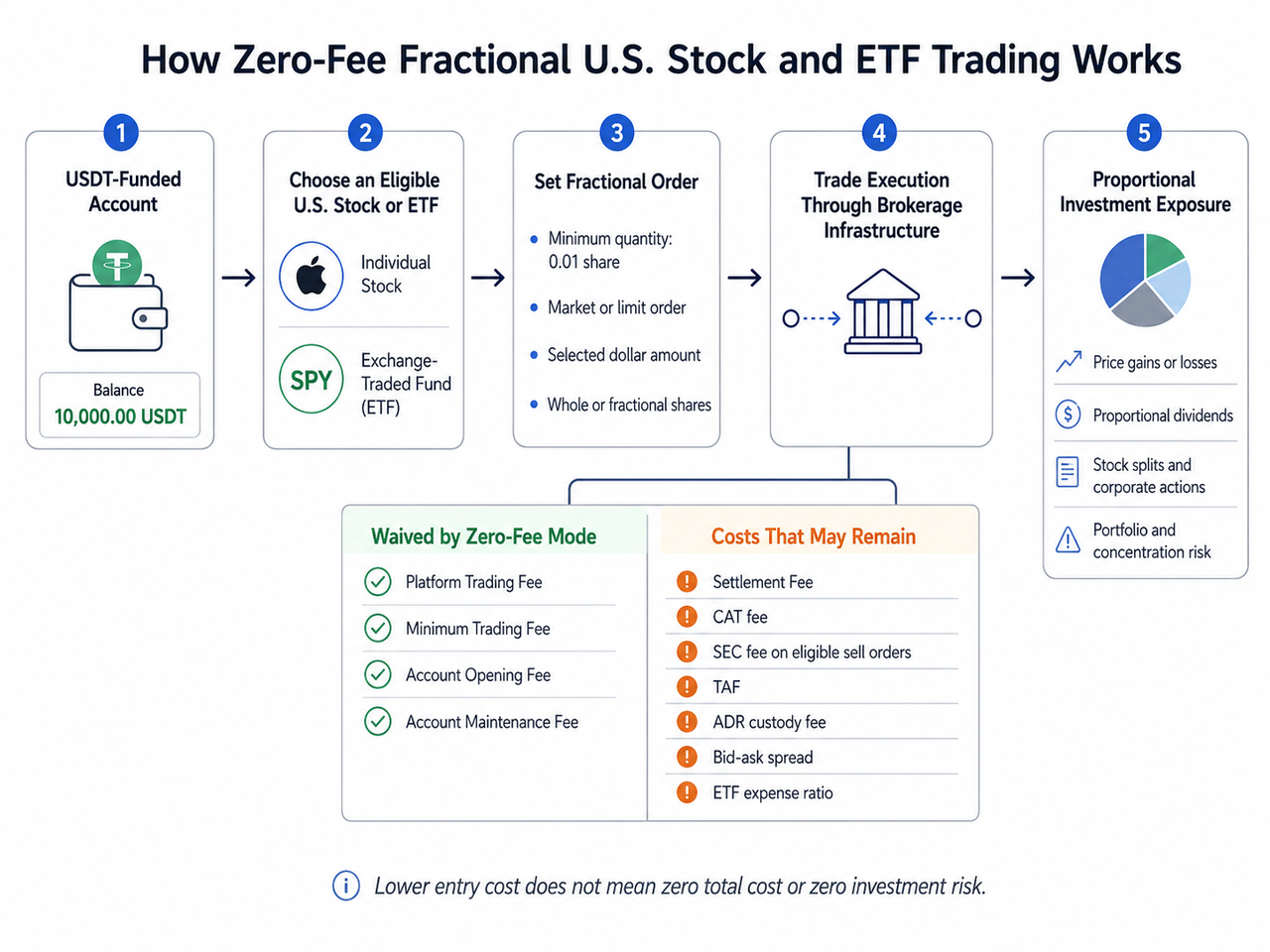
Gate describes its July 31, 2026 upgrade as the first zero-fee mode in its industry for eligible U.S. stocks and ETFs. Under this structure, Gate sets its own platform Trading Fee at $0 for eligible purchases and sales. Customers are also not assessed a minimum Trading Fee, Account Opening Fee, or Account Maintenance Fee.
Zero-fee mode therefore applies to both full-share and supported fractional-share trading. A user buying 0.10 share of a company’s stock does not enter a separate commission category simply because the order contains a fraction. The platform Trading Fee can still be waived, provided the security, account, region, and order are eligible.
The broader meaning of zero-fee mode for U.S. stocks and ETFs is narrower than completely free trading. Gate controls the fee charged by its own service, but it does not control every charge imposed by regulators, clearing organizations, fund managers, or custodian banks.
This distinction is the central point behind how Gate zero-fee works for fractional U.S. stocks and ETFs: the fractional quantity changes how much of the security is purchased, while zero-fee mode changes the platform commission applied to an eligible trade. Neither feature changes the investment’s market value, business fundamentals, or risk.
How Fractional Share Trading Works
A fractional share represents less than one whole share of a company or exchange-traded fund. Instead of saving enough money to buy a full share, investors can trade fractional shares by selecting a smaller quantity, beginning at 0.01 share for supported Gate stock products.
For example, suppose a company’s stock trades at $400. Buying 0.05 share creates approximately $20 of exposure before fees and price movement. If the stock rises or falls by 10%, the fraction generally experiences the same percentage change as a full share, although the dollar gain or loss is smaller.
Fractional trading can help investors:
-
Allocate a fixed dollar amount across several securities.
-
Gain exposure to favorite companies with high share prices.
-
Build a portfolio gradually instead of waiting to purchase whole shares.
-
Combine individual stocks with diversified ETFs.
-
Rebalance investments using smaller increments.
The ability to purchase fractions does not guarantee diversification. Buying small pieces of several companies in the same industry can still create a concentrated portfolio. Similarly, an ETF trade may provide broad exposure, but some funds focus on one sector, country, factor, or narrow market theme.
How Orders, Funding, and Settlement Work
Gate Stocks uses USDT as the funding entry point for U.S. stock and ETF trades. Users can manage digital assets and securities investments within the same platform environment rather than transferring U.S. dollars into a separate traditional brokerage account. The service connects orders to existing securities-market and brokerage infrastructure; it does not create a separate stock market or rely on synthetic stock tokens for this access model.
The basic process is:
-
Complete identity verification and confirm regional eligibility.
-
Activate the relevant stock account or service.
-
Hold sufficient USDT for the intended purchase.
-
Choose an eligible stock or ETF.
-
Enter a quantity of at least 0.01 share.
-
Select an available market or limit order.
-
Review the estimated value and applicable fees.
-
Submit the order and verify the execution details.
The process for trading U.S. stocks and ETFs under zero-fee mode should be followed with attention to the quoted price, quantity, order type, trading session, and estimated cost.
A market order prioritizes execution, but the final price may differ from the latest quote when the market moves or liquidity is limited. A limit order gives the investor greater price control, but execution is not guaranteed. The available order types and fractional-order rules may differ by security or trading session.
Gate states that its global stock ecosystem supports 24/7 trading coverage across the U.S., Hong Kong, and South Korean equity markets. The wider platform includes more than 10,000 U.S. stocks and ETFs, over 1,500 Hong Kong-listed stocks, and more than 1,000 Korean stocks, producing access to more than 12,500 stocks and ETFs worldwide. This broader 24/7 ecosystem should not be interpreted as meaning every U.S. security trades continuously; individual market sessions, products, and order availability remain subject to applicable rules.
What Happens to Dividends and Corporate Actions?
Fractional holdings provide economic exposure in proportion to the number of shares held. Gate states that both fractional and whole-share positions receive stock-dividend entitlements and that the service supports corporate actions such as stock splits and reverse stock splits.
If an investor holds 0.25 share of a dividend-paying company, the dividend allocation is generally proportional to that fraction. The final amount can still be affected by withholding tax, rounding, record-date eligibility, and the rules governing the security.
Corporate actions may also produce fractional adjustments. A stock split can increase the number of shares while reducing the price per share, whereas a reverse split can reduce the quantity held. Investors should review account records after any corporate action rather than assuming that the displayed position will remain unchanged.
Which Fees Can Still Apply?
Zero commissions do not mean that every cost becomes zero. Under the fee structure announced on July 31, 2026, the platform Trading Fee is waived, but the following third-party fees may still be assessed:
| Cost |
When it may apply |
Announced rate or treatment |
| Platform Trading Fee |
Eligible buy and sell orders |
Waived |
| Settlement Fee |
Buy and sell orders |
$0.003 per share, capped at 0.05% of transaction value |
| CAT Fee |
Buy and sell orders |
$0.000003 per share |
| SEC Regulatory Fee |
Sell orders |
$20.60 per $1 million; trades of $500 or less exempt |
| TAF |
Sell orders |
$0.000195 per share; 50 shares or fewer exempt; $9.79 cap per execution |
| ADR Custody Fee |
Applicable ADR holdings |
Typically $0.01–$0.03 per share |
These charges come from relevant regulators, clearing organizations, or custodian banks rather than the waived platform commission. The settlement, SEC, TAF, CAT, and ADR custody fee structure shows why the total cost of a trade can remain above zero.
For illustrative purposes, consider a user purchasing 0.20 share of a $250 stock. The order represents a $50 investment before market movement. The platform Trading Fee may be $0, but the settlement and CAT fees can still apply. If the user later sells the fraction, sell-side regulatory exemptions may be relevant, depending on the value and number of shares.
Additionally, U.S. stock trading volume no longer counts toward the total volume used for Gate VIP-tier calculations after the zero-fee upgrade. Users should not assume that frequent stock trades will raise their VIP level.
The comparison of U.S. stock trading fee structures is therefore most useful when it includes platform commissions, account fees, settlement costs, currency conversion, spreads, withdrawals, custody, and regulatory charges instead of focusing only on zero commissions.
Fractional Stocks Versus Fractional ETFs
A fractional stock provides proportional exposure to one company’s stock. A fractional ETF provides proportional exposure to a fund that may hold dozens or hundreds of securities.
| Feature |
Fractional stock |
Fractional ETF |
| Underlying exposure |
One company |
A portfolio or index strategy |
| Main return driver |
Company performance |
Combined fund holdings |
| Concentration risk |
Usually higher |
Depends on the ETF |
| Ongoing fund expense |
No ETF expense ratio |
Expense ratio usually applies |
| Dividend treatment |
Proportional when declared |
Proportional fund distributions |
| Minimum quantity |
From 0.01 share when eligible |
From 0.01 share when eligible |
Exchange-traded funds can make portfolio construction more accessible, but an ETF is not automatically low risk. Its return can be affected by tracking difference, concentration, underlying liquidity, premiums or discounts to net asset value, and management expenses.
A lower-cost fractional order does not eliminate those fund-level costs. The zero-fee model applies to the eligible trade, not to the ETF’s internal operating expenses.
Risks and Limitations
Fractional share trading reduces the dollar amount required to start investing, but it does not remove the risks attached to stocks, ETFs, USDT funding, or brokerage infrastructure.
Market risk: The value of securities can fall. Past performance does not guarantee future results.
Concentration risk: Several fractions can still represent one sector, theme, or economic factor.
Liquidity risk: Thinly traded stocks and ETFs may have wider spreads or less favorable execution.
Tracking risk: An ETF may not perfectly match its benchmark after expenses, trading costs, and portfolio adjustments.
Currency and funding risk: USDT settlement reduces the need for users to perform a traditional dollar conversion themselves, but stablecoin liquidity, conversion value, transfer costs, and regulatory conditions remain relevant.
Behavioral risk: Small fractions and zero commissions can make repeated trading feel inexpensive. Frequent purchases and sales can still accumulate spreads, third-party fees, tax complexity, and timing mistakes.
Account and regional risk: U.S. stock trading is subject to identity verification, account types, product eligibility, and regional restrictions. Gate notes that services may be restricted or prohibited in specific jurisdictions.
Transfer and ownership limitations: The treatment of fractions, voting, transfers, and corporate actions may differ from that of whole shares. Customers should verify current product rules before moving or selling a position.
Conclusion
Gate zero-fee mode works with fractional U.S. stocks and ETFs by removing the platform Trading Fee from eligible purchases and sell orders while allowing positions from 0.01 share. The combination can lower the initial cost of accessing high-priced securities and make precise portfolio allocation possible.
Its strongest benefit is flexibility: investors can choose a dollar amount, divide money among stocks and funds, and manage crypto and U.S. equity exposure through one account environment. However, lower entry limits and zero platform commissions do not make an investment free or safe.
Settlement fees, regulatory charges, ADR custody fees, spreads, ETF expenses, liquidity conditions, USDT-related risks, and market losses remain. Fractional access is a portfolio tool, not a guarantee of diversification, lower risk, or profitable future results.
FAQ
How does Gate zero-fee mode work for fractional U.S. stocks and ETFs?
Gate waives its platform Trading Fee for eligible fractional and whole-share buy and sell orders. Users can start from 0.01 share, while settlement, regulatory, ADR custody, spread, and ETF-level costs may remain.
Can users trade fractional shares starting from 0.01 share?
Yes. Supported U.S. stocks and ETFs can be purchased from 0.01 share, subject to security availability, account eligibility, identity verification, regional restrictions, and current product rules.
Are there account opening or maintenance fees?
Under the announced zero-fee structure, users are not charged a minimum Trading Fee, Account Opening Fee, or Account Maintenance Fee for the eligible service. Other transaction, funding, transfer, or third-party costs may still apply.
Does zero-fee mode mean every trade is completely free?
No. The platform Trading Fee is waived, but settlement fees and CAT fees can apply to purchases and sales. SEC and TAF charges may apply to qualifying sell orders, while ADR custody fees and ETF expenses may also remain.
Are fractional shares real securities or synthetic tokens?
The U.S. stock access model connects users to existing securities-market and regulated brokerage infrastructure. It is different from buying a tokenized or synthetic asset that merely references a stock price.
Can users manage cryptocurrency and U.S. stocks in one account?
Users can manage digital assets and stock investments within the same platform ecosystem, with USDT acting as the funding entry point for stock trades. The stock account may still involve separate activation, identity verification, compliance review, and eligibility requirements.
Can every U.S. stock be traded 24 hours a day?
Not necessarily. Gate describes a 24/7 global stock ecosystem across three major equity markets, but individual U.S. stocks remain subject to supported sessions, available order types, liquidity, market rules, and product eligibility. Availability should be checked before placing an order.
Do fractional shareholders receive dividends?
Gate states that dividend entitlements apply to fractional and whole-share holdings. The amount is generally proportional to the position but may be affected by withholding tax, rounding, record dates, and security-specific rules.
This content is for educational and illustrative purposes only and does not constitute financial, investment, legal, or tax advice. Stocks, fractional shares, ETFs, and USDT-funded investments involve risk. Past performance does not guarantee future results, and zero platform fees do not eliminate market losses, spreads, third-party charges, settlement costs, or product restrictions.