Zero-Fee Mode for U.S. stocks and ETFs means Gate does not charge platform trading fees on eligible U.S. stock and ETF buys and sells, and does not set a minimum trading fee, account opening fee, or account maintenance fee (per Gate’s 2026-07-31 announcement). Settlement fees, SEC fees, TAF, CAT, and ADR custody fees may still arise under third-party market rules. In plain terms, commission-free trading waives brokerage commissions on stock and ETF fills—it does not make every market cost disappear.
What Is Zero-Fee Mode for U.S. Stocks and ETFs? Which Fees Are Waived?
Zero-Fee Mode for U.S. stocks and ETFs means Gate.com waives its own platform trading fees on eligible U.S. stock and ETF buys and sells, so “zero fee US stocks” on Gate.com refers to commission-free platform execution rather than a blanket removal of every trade-related charge. Per Gate’s 2026-07-31 announcement, Gate also does not set a minimum trading fee, account opening fee, or account maintenance fee, which can reduce platform-side fixed costs when accessing U.S. equity and ETF markets.
In industry usage, “zero fee” or “commission-free” usually means the venue does not charge its own brokerage commissions. It does not automatically cancel settlement, regulatory, clearing, or custody pass-through charges. Gate frames Zero-Fee Mode as a platform-fee waiver; third-party fees still follow rules set by regulators, clearing firms, and custodian banks, so separating waived platform commissions from remaining pass-through rows helps estimate actual fill costs accurately. Because “commission-free” labels vary by venue, a U.S. stocks trading fees across platforms comparison helps confirm whether a line item is a platform commission or a pass-through fee.
Which Other Fees Can Still Apply Under Zero-Fee Mode?
Under Zero-Fee Mode, settlement, regulatory, and ADR custody pass-through fees can still apply even when platform trading fees are not charged. Per Gate’s 2026-07-31 announcement: settlement fees apply on both buys and sells at $0.003 per share, capped at 0.05% of trade value; SEC fees and TAF apply on sells only; CAT applies on both buys and sells; ADR names may also incur custody fees.
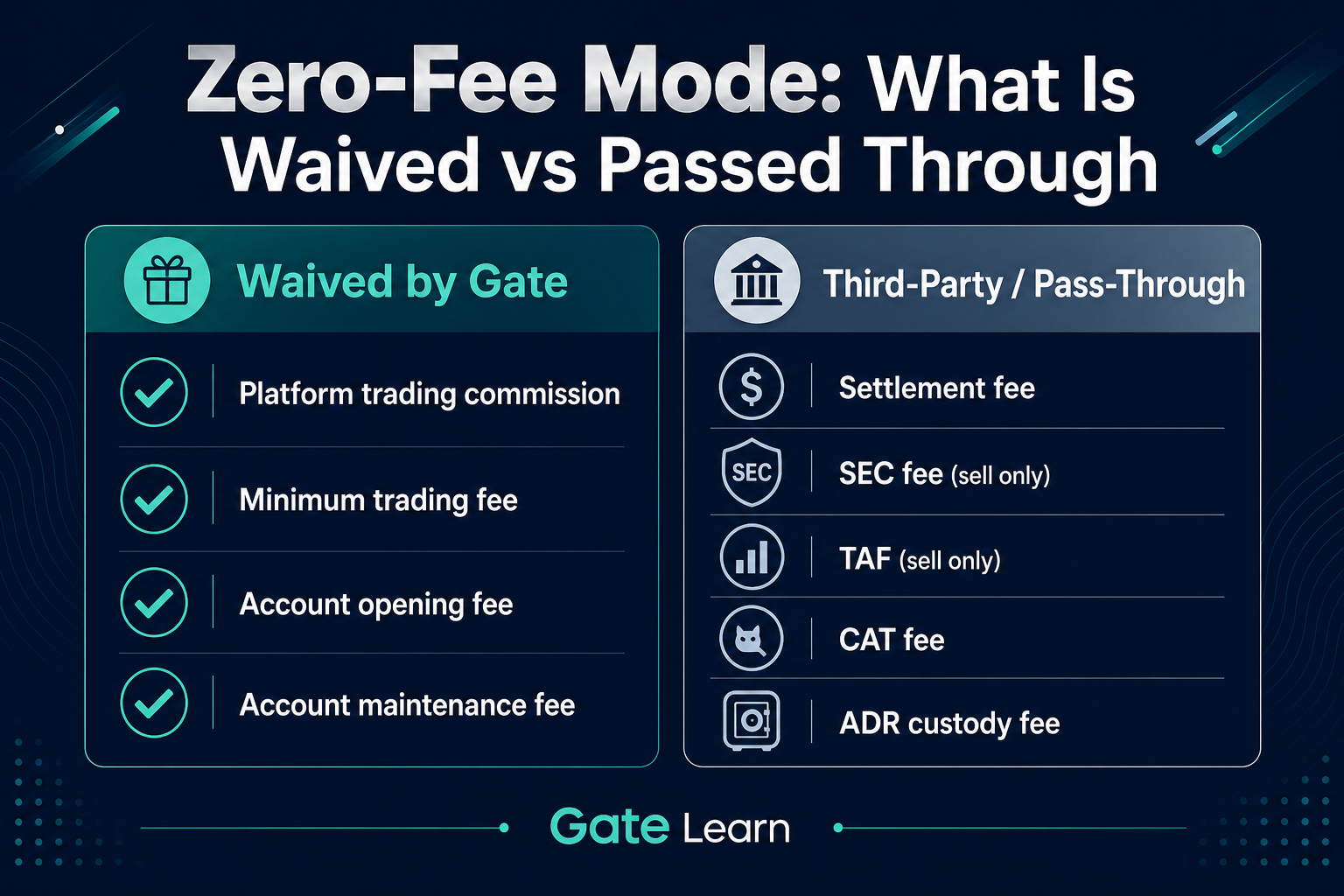
Figure 1. Zero-Fee Mode fee layers: Gate platform trading fees and related items waived, versus settlement, SEC, TAF, CAT, and ADR third-party pass-through charges.
| Fee item |
Side charged |
Rate (per Gate 2026-07-31 announcement) |
| Gate platform trading fee |
Buy / sell |
Eligible U.S. stocks and ETFs: not charged |
| Minimum / Opening / Maintenance fee |
— |
Not set |
| Settlement fee |
Buy / sell |
$0.003 per share (max 0.05% of trade value) |
| SEC fee |
Sell only |
$20.60 per million ($1,000,000) of sell principal; waived if a single sell is ≤ $500 |
| TAF (Trading Activity Fee) |
Sell only |
$0.000195 per share; waived if sell ≤ 50 shares; max $9.79 per execution |
| CAT |
Buy / sell |
$0.000003 per share |
| ADR custody fee |
Depends on symbol |
Typically about $0.01–$0.03 per share; follow the symbol’s rules |
The table separates “platform waived” from “pass-through charged”: the former is canceled or not set by Gate; the latter scales with share count or sell principal. Small sells may hit SEC or TAF waiver thresholds, while settlement and CAT can still appear. Customers comparing brokers should still check how each venue labels commissions versus pass-through rows. Line-item detail is covered in settlement, SEC, TAF, CAT, and ADR fees explained.
How Do Platform Trading Fees Differ from Third-Party Pass-Through Fees?
Platform trading fees are Gate’s own charges for matching and trade services; under Zero-Fee Mode, eligible U.S. stock and ETF buys and sells no longer incur them, so platform commissions on those fills are not billed. Third-party pass-through fees come from U.S. market settlement, regulatory, and custody chains and are passed through at amounts that actually occur under those rules—not as Gate’s own commission schedule.
Billing bases also differ: settlement, TAF, and CAT are often share-based; SEC fees scale with sell principal; ADR custody ties to depositary rules. When reading fills, separate “is the platform fee zero?” from whether settlement, regulatory, or custody rows appear, so a pass-through line is not misread as Zero-Fee Mode failing. Some industry education materials also discuss payment for order flow as one revenue model some brokers may use when they offer zero commissions, and brokers such as charles schwab are often cited as established U.S. firms offering commission-free trading under us sec oversight; Robinhood pioneered commission free trading in the U.S. market, and reports noted it made $271.2 million from payment for order flow in Q2 2020, even though that model can lead to poorer trade execution over time. Low interest rates in 2020 also reduced how profitable idle-cash interest income could be for brokers. Brokers may also make money from margin lending and interest on uninvested cash, so Gate’s Zero-Fee Mode documentation centers on which platform fees are waived and which pass-through fees remain, rather than assuming any single industry revenue model. Live detail sits on the Gate Fee Schedule; symbol pages such as NVDA confirm tradability and fee notices online.
After the Zero-Fee Upgrade, How Do U.S. Stock Trades Count Toward VIP Volume?
Per Gate’s 2026-07-31 announcement, after the Zero-Fee upgrade, U.S. stock trades no longer count toward VIP total volume. VIP tiers usually map fee levels to cumulative volume and related rules; once U.S. equity fills leave that metric, those buys and sells no longer raise that cumulative counter.
The change affects how volume feeds the tier system. It does not reverse the platform trading-fee waiver under Zero-Fee Mode or restore platform trading fees on eligible U.S. stock and ETF orders. Users who also trade spot, derivatives, or other product lines should still read each product’s current VIP rules separately, including any options product volume rules that are based on those markets rather than stock-ETF Zero-Fee Mode.
Which Markets Does Gate Stocks Cover? What Is in Scope for Zero-Fee Mode?
Gate Stocks covers U.S., Hong Kong, and Korean equities and can offer 24/7 trading service for customers using the online Stocks product. Per Gate’s 2026-07-31 announcement, support includes more than 10,000 U.S. stocks and ETFs, 1,500+ Hong Kong stocks, and 1,000+ Korean stocks—over 12,500 stocks and ETFs in total—and while many zero-commission brokers let investors buy fractional shares, Gate offers them starting from 0.01 share.
| Market |
Coverage scale (per Gate 2026-07-31 announcement) |
Relation to Zero-Fee Mode |
| U.S. stocks and ETFs |
More than 10,000 |
Zero-Fee Mode waives platform fees on eligible U.S. stocks and ETFs |
| Hong Kong stocks |
1,500+ |
In product coverage; fees follow the fee page and symbol rules |
| Korean stocks |
1,000+ |
In product coverage; fees follow the fee page and symbol rules |
| Total |
Over 12,500 stocks and ETFs |
Product breadth; Zero-Fee scope follows the U.S./ETF announcement |
Product coverage and Zero-Fee eligibility are not the same: the three markets describe tradable breadth, while the platform-fee waiver targets eligible U.S. stocks and ETFs. Hong Kong and Korean fee lines must be checked separately on the fee page and may still list commissions or different minimums. Gate Stocks product features include dividend entitlements, cross-broker transfer for U.S. and Hong Kong stocks, and corporate actions such as splits and consolidations. A position transfer does not by itself change whether future U.S. stock or ETF orders qualify for Zero-Fee Mode; eligibility remains based on the announcement scope. Among the largest U.S. equity venues, fee labels still vary, so eligibility should be read from the live schedule. Equity options are not covered by this stock-and-ETF Zero-Fee Mode description—related fees, if any, follow the options fee schedule instead.
How to Verify Zero-Fee and Pass-Through Costs Before Trading U.S. Stocks or ETFs on Gate?
Before trading, check the fee page and symbol-page fee notices online, estimate which pass-through fees a buy or sell may trigger, then review estimated costs on the order screen before submit. Confirm available balance and any transfer timing if funding just landed, then select size carefully so estimated pass-through rows match the intended orders. How to trade U.S. stocks and ETFs with zero fee on Gate walks through account prep, symbol search, order placement, and fee review.
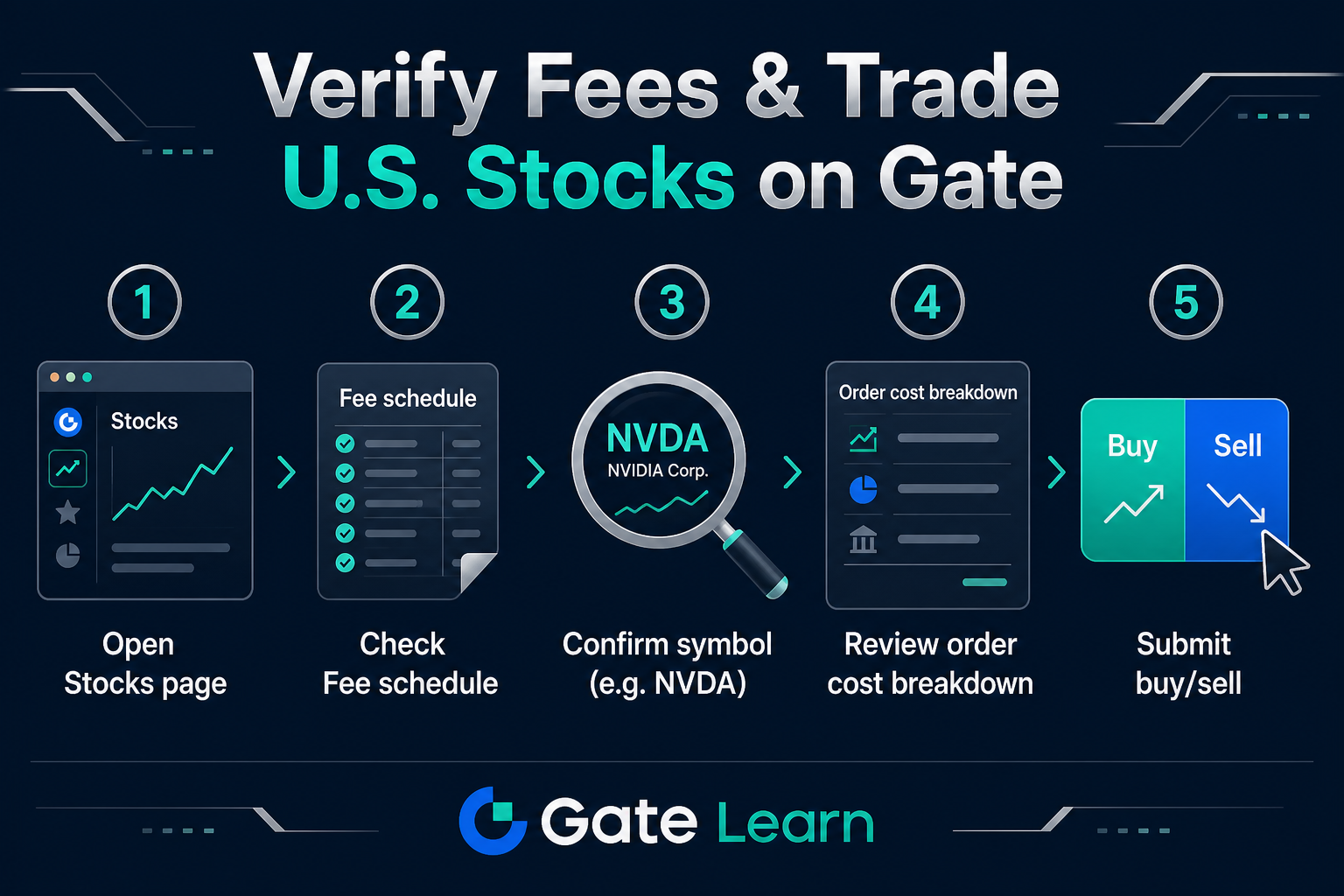
Figure 2. Five-step path to verify Zero-Fee Mode and third-party fees, then complete a U.S. stock or ETF trade on Gate.
-
Open the Gate Fee Schedule and confirm U.S. stock/ETF platform and third-party fee rows, including that platform trading fees are not charged on eligible names.
-
Open a symbol page (for example NVDA) and confirm ticker, tradability, and order entry.
-
Choose buy or sell: watch SEC and TAF on sells; watch settlement and CAT on both sides.
-
For ADRs, confirm whether custody fees may apply (typically about $0.01–$0.03 per share; follow the symbol’s rules).
-
On the order confirmation page, review fee lines and quantity (including fractional shares from 0.01), then submit.
The sequence stresses “fee page first, symbol page next, order screen last,” so a Zero-Fee label is not read in isolation from pass-through rows or VIP volume treatment. Making that checklist a habit helps keep platform fees, minimums, and pass-through lines from being conflated when comparing estimated costs across orders. Venues that offer clear fee breakdowns make that review easier.
What Are the Advantages, Limits, and Risks of Trading U.S. Stocks Under Zero-Fee Mode?
The main advantage is removing platform trading fees on eligible U.S. stocks and ETFs, plus no minimum trading fee, account opening fee, or account maintenance fee—so platform commissions and those account minimums are not part of the billed stack for eligible fills. That can clarify platform-side cost for small and fractional trades and can offer lower friction for customers sizing smaller notional balances. Related Stocks features such as fractional size from 0.01 share and multi-market coverage exceeding 10,000 U.S. stocks/ETFs plus Hong Kong and Korean listings let smaller notional sizes adjust exposure without needing the largest order tickets.
Limits include: Zero-Fee Mode does not cover settlement, regulatory, or ADR custody pass-through fees; U.S. stock fills no longer add to VIP total volume; Hong Kong and Korean fees must not be assumed identical to U.S. Zero-Fee Mode. Large orders can still accumulate meaningful settlement and regulatory costs even when brokerage commissions are waived. Drawbacks of commission-free stock trading more broadly include mistaking a waived platform fee for “all-in free,” since the bid-ask spread still applies and a zero-commission order can still carry a transaction fee elsewhere in the flow, underestimating pass-through fees on frequent orders, and treating industry payment-for-order-flow discussions as a substitute for reading the venue’s own fee schedule. Broker economics are not limited to commissions: firms may make profits from margin lending, interest on uninvested cash, and routing or service revenue, which can keep zero-fee offers profitable over time. Some also use securities in margin accounts to borrow money from a bank, and rehypothecation can expose clients to added risk. Investors may not pay a commission on an eligible trade, but other fees can still appear, and some brokers later change pricing after an initial no-cost offer, so use the live fee page and check execution quality against what was expected. Note that making cost checks balance-sheet aware—available balance, pending transfer credits, and projected pass-through totals—keeps estimates grounded and can surface lower all-in costs when share count stays small.
On risk, stock and ETF price moves, liquidity, session hours, and corporate actions all affect positions; ADRs also follow custody rules. Fee schedules and tradability can change with market and compliance needs; use live fee-page and symbol-page displays online before each order. Equity options risk and that product’s fee schedule remain separate from this Zero-Fee Mode guide. This section explains fee mechanics only and is not investment advice or a solicitation to trade.
Summary
Zero-Fee Mode for U.S. stocks and ETFs centers on Gate waiving platform trading fees on eligible U.S. stock and ETF buys and sells, and not setting a minimum trading fee, account opening fee, or account maintenance fee (Gate 2026-07-31 announcement)—so platform commissions and those minimums are not charged on eligible fills. Settlement, SEC, TAF, CAT, and ADR custody pass-through fees may still apply; after the upgrade, U.S. stock trades no longer count toward VIP total volume. Gate Stocks covers U.S./ETF, Hong Kong, and Korean listings totaling over 12,500 symbols, with fractional shares from 0.01, and can offer online access across those markets. Equity options remain out of scope for this stock-and-ETF mode. Fee pages that offer side-by-side platform versus pass-through rows make verification clearer. Separating platform waivers from pass-through fees, then verifying the fee page and symbol page before order submit, is the practical checkpoint for using this mode.
FAQ
What is zero-fee / commission free trading in U.S. stocks?
Zero-fee (commission-free) U.S. stock trading usually means a platform or broker does not charge its own trading commissions on U.S. equity buys and sells. On Gate, it means eligible U.S. stocks and ETFs incur no platform trading fee on buys or sells, and Gate does not set a minimum trading fee, account opening fee, or account maintenance fee (per Gate’s 2026-07-31 announcement). That is what “commission-free” means for the platform fee line; it does not mean every third-party fee is zero. Commission free trading can still be profitable for brokers through margin lending and interest on uninvested cash, and does not cancel settlement or regulatory charges that still apply.
Is zero-fee U.S. stock trading completely free of all charges?
No. Zero-Fee Mode waives Gate platform trading fees and related platform-side items; settlement fees, SEC fees, TAF, CAT, and ADR custody fees may still arise under trade rules. Buys and sells can both involve settlement and CAT; SEC and TAF mainly appear on the sell side. Customers should still compare pass-through totals when making frequent orders, because lower platform commissions do not erase share-based settlement or sell-side regulatory lines.
How is the SEC fee calculated on a U.S. stock sell?
Per Gate’s 2026-07-31 announcement, the SEC fee applies on sells only, at $20.60 per million of sell principal; a single sell of ≤$500 is waived. Buy orders do not incur the SEC fee. The calculation is based on sell principal, not on whether a platform commission was charged.
What is the FINRA Trading Activity Fee (TAF)?
TAF is a pass-through fee tied to FINRA trading activity. Per Gate’s 2026-07-31 announcement, it is charged on sells only at 0.000195 dollar per share; sells of ≤50 shares are waived, with a maximum of $9.79 per execution. Like other pass-through rows, it can appear even when the venue does not offer platform commissions on the fill.
Does Zero-Fee Mode cover U.S. ETFs?
Yes. Per Gate’s 2026-07-31 announcement, Zero-Fee Mode covers eligible U.S. stocks and ETFs: Gate charges no platform trading fee on either side. ETFs, like individual stocks, may still incur settlement and regulatory pass-through fees per the fee page and symbol rules. Broker-exclusive mutual-fund or zero-expense-ratio index-fund menus sit outside Gate Stocks Zero-Fee Mode and need their own schedule review. Equity options fees also sit on a separate product schedule.
How should stock trading fees be checked before placing an order?
Before submitting, open the Gate Fee Schedule for U.S. stock/ETF fee rows, open the symbol page (for example NVDA) to confirm tradability and available balance, and on the order confirmation screen verify that platform commissions show as zero while reviewing settlement, SEC, TAF, CAT, or ADR line items before submit.