Multi-platform “zero commission” U.S. stock trading usually means the platform commission layer is 0; settlement fees and U.S. Securities and Exchange Commission (SEC) fees, FINRA Trading Activity Fees (TAF), Consolidated Audit Trail (CAT) fees, and similar pass-throughs may still apply. Compare costs with one aperture—“platform fee + pass-through”—instead of only checking whether commission reads “0.” That split matches U.S. stocks and ETF zero-fee mode, which separates platform waivers from third-party pass-throughs. Public fee pages from Charles Schwab, Fidelity, Robinhood, and Interactive Brokers (IBKR) offer the same two-layer reading when you compare Schwab-style $0 online equity claims to Gate Stocks zero-fee mode.
| Platform (public-page aperture) |
Platform commission / trading-fee layer |
Pass-throughs often disclosed separately? |
Public structure highlights |
| Gate Stocks |
Eligible U.S. stocks/ETFs: no platform trading fee (zero-fee mode) |
Yes (settlement, SEC, TAF, CAT, ADR) |
No minimum trading fee / account opening fee / account maintenance fee (Gate 2026-07-31 announcement) |
| Robinhood |
U.S. stocks, ETFs: $0 commission |
Yes (SEC, TAF, CAT, ADR, etc.) |
Public pages note regulatory pass-throughs under industry rules |
| Fidelity |
Online U.S. stocks, ETFs: $0 online equity |
Yes (sell-side activity assessment, etc.) |
Fee pages stress $0 commission; sells may still carry regulatory assessments |
| IBKR Pro |
Fixed / Tiered per-share commissions |
Yes (regulatory, exchange, clearing by schedule) |
Fixed about 0.005/share (order min about $1); Tiered about 0.0035–0.0005/share (order min about 0.35) |
The table compares structure from public fee pages and announcements—including how Charles Schwab and peers disclose commission-free equity alongside pass-throughs. It is not a “best platform” ranking and is not an invitation to open accounts or trade. Live fee figures and waiver thresholds follow each platform’s current fee page. Public pages also offer disclosure notes on regulatory lines. When making a Schwab-to-Fidelity or Schwab-to-Robinhood reading, keep costs on the same aperture before judging which brokerage services fit a workflow.
What Fee Layers Do U.S. Stock Trades Usually Include?
U.S. stock trading fees usually split into a platform trading-fee / commission layer and a third-party pass-through layer. Brokers set or waive the first; settlement, regulatory, and custody chains generate the second across U.S. equity markets.
Platform-layer items often include stock/ETF commissions, minimum trading fees, account opening fees, and account maintenance fees. Pass-through items often include settlement/clearing fees, SEC fees (often on sells), TAF (often on sells), CAT, and ADR custody fees. Mixing the two layers turns “zero commission” into a false reading of “the whole fill is free.” Charles Schwab fee education and similar broker services pages stress that commission-free labels do not erase every market charge; making that distinction—and making pass-through names explicit—keeps Schwab, Fidelity, Robinhood, and Gate Stocks comparisons honest about remaining costs. Fee pages offer the same two-layer map even when marketing stresses $0 commission.
What Do “Zero Commission” and “Zero-Fee Mode” Usually Mean?
In traditional brokerage language, “zero commission” usually means no proprietary commission on eligible online U.S. stock or ETF trades. Charles Schwab, Robinhood, and Fidelity public pages describe that layer as $0 commission / 0 online equity and offer commission-free stock trading on those products. Commission-free stock trading still has a catch on many markets: platform fees can be free while SEC, TAF, CAT, settlement, or ADR lines remain. Equity and options product schedules may list separate options contract fees even when stock commission is free—so options lines belong in a full costs review, not as a reason to ignore stock pass-throughs.
On Gate Stocks, “zero-fee mode” means eligible U.S. stocks and ETFs incur no platform trading fee on buy and sell sides, with no minimum trading fee, account opening fee, or account maintenance fee (per Gate 2026-07-31 announcement). That waiver sits in the same family as Schwab-style “zero commission” and does not automatically cancel settlement fees or SEC/TAF/CAT/ADR pass-throughs. Is there any catch to a 0% commission brokerage? Usually the catch is pass-throughs and product conditions—not a secret second platform commission—when Schwab, Fidelity, Robinhood, or Gate pages are read carefully.
How Should You Compare Multi-Platform U.S. Stock Fees on One Aperture?
The core formula is: comparable total cost ≈ platform fee + pass-through (same buy/sell side, similar share count and notional). List each layer first, then check waiver floors and caps, then review non-fee conditions. Compare Schwab to other brokers the same way you compare Gate Stocks to Robinhood, Fidelity, or IBKR: identical markets aperture, identical buy-side and sell-side direction, and the same share-count band before ranking costs.
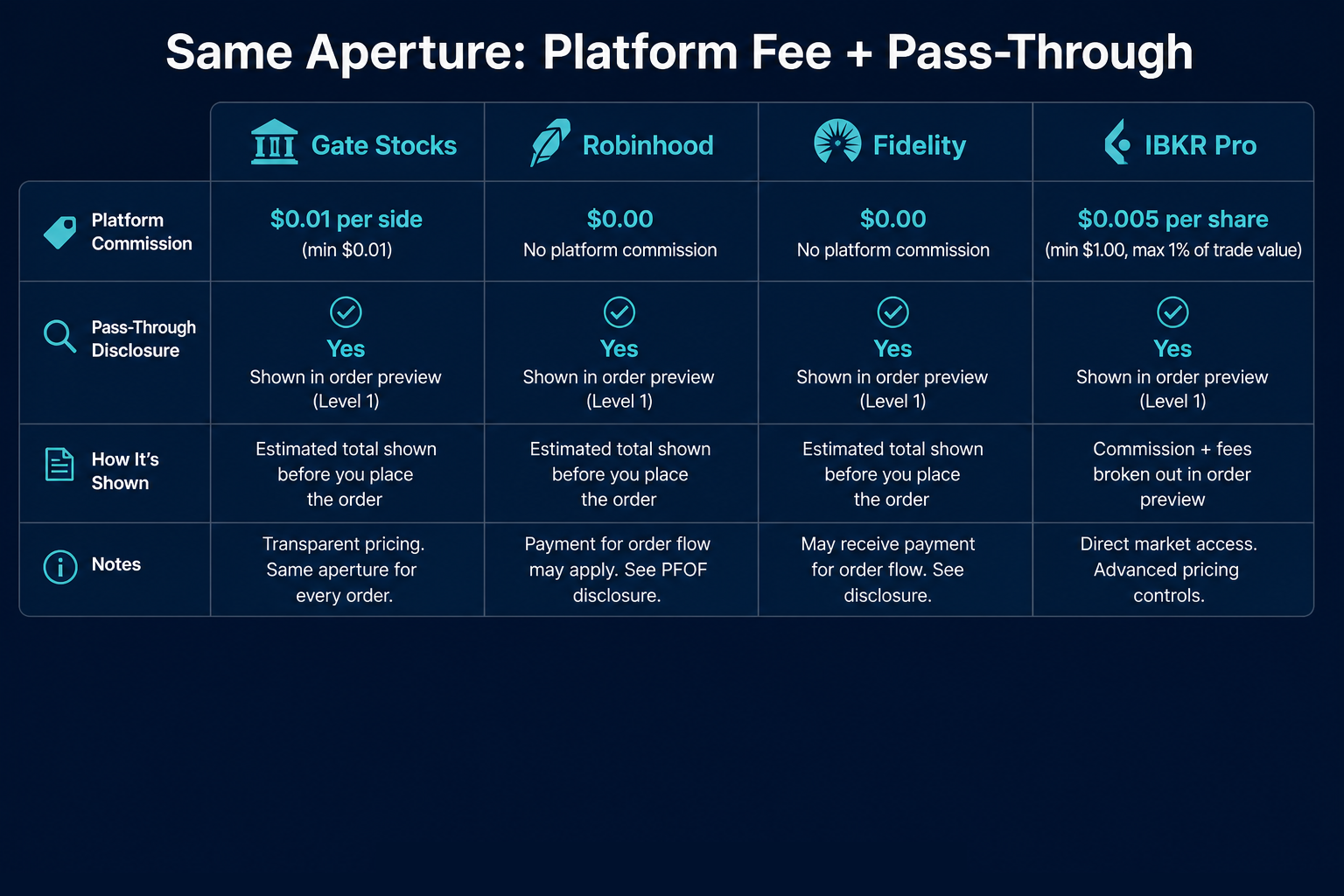
Figure 1. Same-aperture comparison: platform commission layer vs pass-through layer (Gate / Robinhood / Fidelity / IBKR Pro public structures; Charles Schwab follows the same $0 online equity family).
- List whether platform commission (or a “zero commission / zero-fee” claim) covers buy-side and sell-side fills—Schwab and peer pages often offer $0 on online U.S. equities.
- List settlement, SEC, TAF, CAT, ADR, and other pass-through lines, plus direction (buy/sell), including how Schwab and Fidelity label activity assessments.
- Recalculate on a similar order size so a “minimum commission” pro schedule is not mixed with a “0 platform commission” schedule as if they shared one unit—making IBKR Pro minimums comparable to Schwab $0 units requires that normalization.
- Check VIP volume treatment, fractional shares, market coverage, and whether brokerage services extend to options or other products without changing the stock-fee aperture.
Operating steps: How to trade U.S. stocks under zero-fee mode on Gate. Pass-through line items: U.S. stock settlement and regulatory pass-through fees.
How Do Platform Commission Layers Differ?
Platform-layer differences concentrate on three points: whether the rate is 0, whether a minimum commission applies, and whether pricing is tiered per share. Charles Schwab and Fidelity typically offer $0 online U.S. stock commissions in the same structural family as Robinhood; IBKR Pro offers Fixed/Tiered per-share schedules instead.
Under zero-fee mode, Gate Stocks waives platform trading fees on eligible U.S. stocks and ETFs and does not set a minimum trading fee, account opening fee, or account maintenance fee (Gate 2026-07-31 announcement). Robinhood, Fidelity, and Charles Schwab public pages describe eligible online U.S. stocks/ETFs as 0 commission / commission-free online equity. IBKR Pro publishes Fixed (about 0.005/share, order minimum about 1) and Tiered (about 0.0035–$0.0005/share, order minimum about 0.35) schedules and passes exchange/clearing charges under tier rules. Making Schwab vs IBKR Pro comparisons without splitting those units inflates small-order costs on the pro side.
| Dimension |
Zero-commission / zero-fee style (Gate, Robinhood, Fidelity, Schwab public aperture) |
Pro commission schedule (IBKR Pro public aperture) |
| Platform commission |
Eligible U.S. stocks/ETFs often $0; Schwab online equity often free of platform commission |
Fixed / Tiered per share, with order minimums |
| Minimum platform commission |
Gate announcement states no minimum trading fee; Schwab / Fidelity $0 pages emphasize $0 |
Tiered min about $0.35 / Fixed min about $1 (public pages) |
| Pass-through presentation |
Often listed on fee or support services pages (SEC/TAF, etc.); Schwab discloses regulatory lines separately |
Tiered usually passes exchange and clearing fees more fully |
“$0 commission” and “per-share commission + minimum” are different units: on small orders, a minimum can raise nominal cost on a pro schedule; on large flow across U.S. markets, tier rates and pass-through transparency must be modeled together. Brokerage services that bundle research or options tools still leave stock pass-through costs intact when the stock commission line is free.
Which Pass-Through Fees Still Appear Across Platforms?
Regulatory and settlement-chain pass-throughs often still appear across platforms—not a single broker’s “hidden commission.” SEC fees and TAF show up most often on sells; CAT and settlement-style fees may appear on both sides; ADR custody fees follow depositary-receipt rules. Trading Activity Fee frequently asked questions on FINRA-related education and Schwab / Fidelity fee pages explain why TAF can apply even when commission is free.
Per Gate 2026-07-31 announcement, Gate Stocks education figures include: settlement fee 0.003 per share (capped at 0.05% of trade value); SEC fee of 20.6 per million of sell proceeds (waived when a single sell is ≤500); TAF 0.000195 per share (waived when sell ≤50 shares; max $9.79 per execution); CAT 0.000003 per share; ADR custody typically about 0.01–0.03 per share. Robinhood, Fidelity, Charles Schwab, and IBKR public fee pages also disclose SEC/TAF or equivalent assessments and CAT-style lines; live rates follow each page’s current text. Those remaining costs are the practical “catch” when markets offer commission-free equity but still bill regulatory pass-throughs.
Gate Stocks and traditional brokers—including Schwab—often share the same U.S. markets rules on whether pass-throughs can occur. Differences sit more in platform-layer waivers, how lines are named, and product conditions such as coverage. Making a side-by-side of Schwab services versus Gate Stocks therefore starts with naming each pass-through, not with assuming a free fill equals zero total costs on every buy or sell.
What Non-Fee Items Should a Fee Comparison Still Check?
After fees align on one aperture, three non-fee conditions still matter: VIP/tier volume treatment for U.S. stocks, fractional-share support, and market coverage beyond U.S. stocks/ETFs. Charles Schwab and peer brokerage services also publish fractionals, eligibility, and product-scope limits that change which markets and share sizes a $0 commission claim covers.
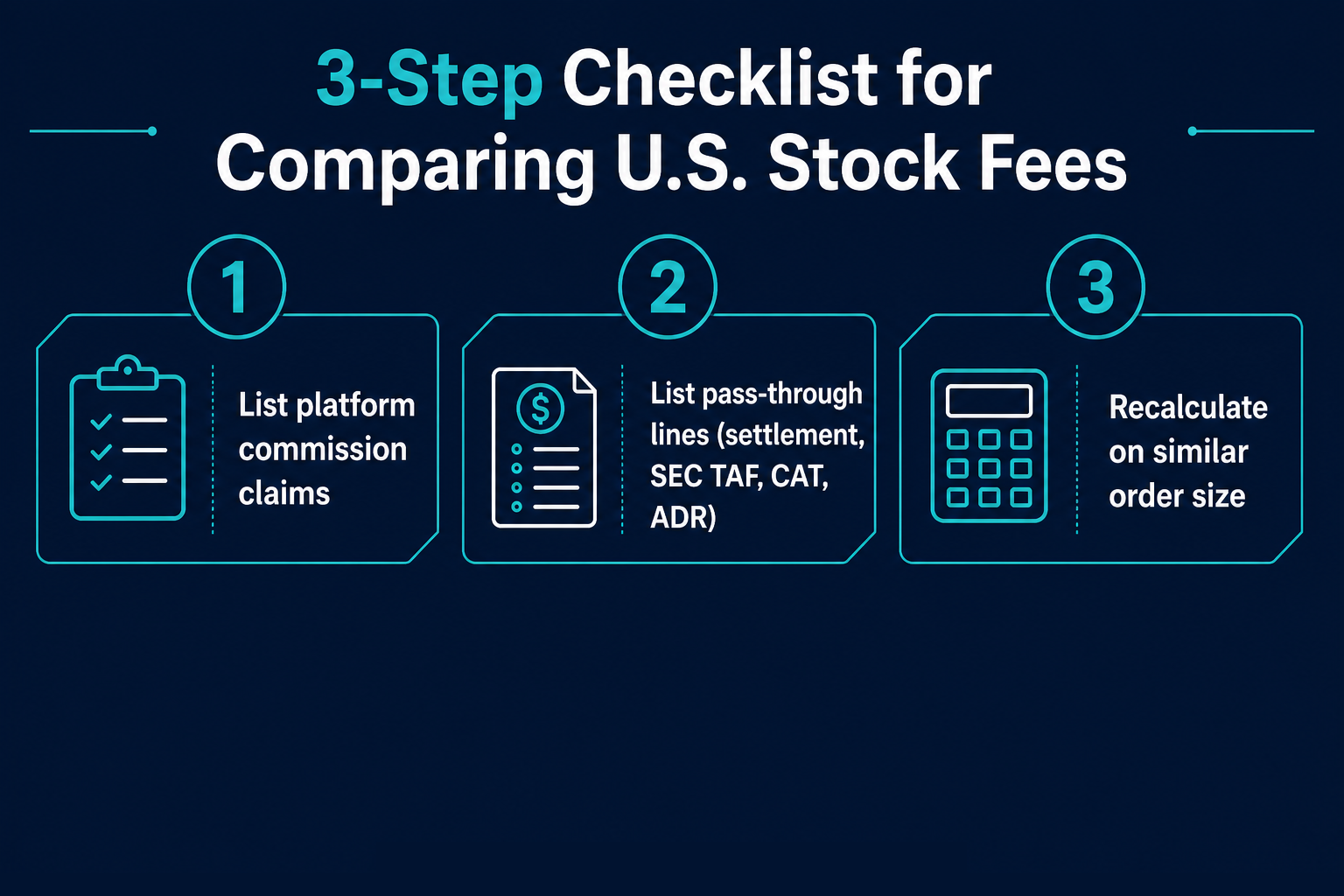
Figure 2. Three-step checklist for comparing U.S. stock fees: list fee layers, unify “platform fee + pass-through,” then check non-fee items (same aperture for Schwab-style $0 brokers and Gate Stocks).
Per Gate 2026-07-31 announcement, after the zero-fee upgrade U.S. stock trades no longer count toward VIP total volume; fractional shares can start from 0.01 share; equity coverage includes U.S. stocks/ETFs, Hong Kong stocks, and Korean stocks totaling more than 12,500 tickers, with zero-fee mode limited to eligible U.S. stocks and ETFs. Traditional zero-commission brokers—Charles Schwab, Fidelity, Robinhood—and IBKR publish separate limits on fractionals, eligibility, Lite/Pro lines, and whether options or other markets sit outside the stock commission-free claim. Those conditions can still change the tradable set even when fee apertures match. When making coverage checks, confirm that “free” applies to the same product class before equating Schwab online equity to Gate Stocks U.S. ETF eligibility.
How Should Comparison Results Be Used?
Use comparison results to match needs to fee structure, not to declare a single “best platform.” Fee schedules offer structure maps, not rankings. How much are fees costing you on a sample notional? Answer with platform fee + pass-through on that notional—Schwab, Fidelity, Robinhood, Gate Stocks, or IBKR Pro—rather than with marketing slogans about commission-free investing.
Choose A (platform-layer 0 + clear pass-through lines) if: the goal is to verify 0 platform commission and inspect settlement/SEC/TAF/CAT/ADR lines; small or fractional orders should avoid a minimum platform commission. Gate Stocks zero-fee mode and Robinhood / Fidelity / Charles Schwab public $0 apertures fall in this structure family; those brokers offer commission-free stock trading on eligible online U.S. equities while still disclosing pass-through costs.
Choose B (per-share commission tiers + detailed pass-through) if: Fixed/Tiered schedules, exchange/clearing transparency, and volume-based rate steps matter, and order minimum commissions are acceptable. IBKR Pro’s public structure falls in this family and is the usual contrast when comparing Schwab-style free online equity to a pro schedule.
The framework matches fee structures only—not buy/sell advice, account-opening prompts, or allocation guidance. Before any order, rely on each platform’s fee page, ticker page, and order confirmation UI—those surfaces offer the live pass-through lines that marketing pages may omit. Brokerage services pages for Schwab, Fidelity, and peers remain the live source for whether markets still assess TAF or SEC lines after a commission-free fill.
Summary
A usable US stock trading fees comparison restores “zero commission / zero-fee” to a platform-layer waiver, then compares Gate Stocks, Robinhood, Fidelity, Charles Schwab, and IBKR Pro on one “platform fee + pass-through” aperture across U.S. equity markets. Settlement, SEC, TAF, CAT, and ADR often still appear even when stock commission is free; VIP treatment, fractionals, options product scope, and coverage are non-fee checks. Making Choose A / Choose B decisions matches needs to structure—Schwab-style free online equity versus IBKR Pro tiers—without ranking a “best platform” or treating commission-free labels as zero total costs.
FAQ
Do zero-commission U.S. stocks still charge other fees?
Yes. Zero commission usually covers only the broker’s own commission; settlement fees, SEC fees, TAF, CAT, and ADR custody fees may still arise under fill rules across U.S. markets. Charles Schwab, Fidelity, Robinhood, and Gate Stocks fee pages offer the same warning: commission-free does not mean every line is free. Buy/sell direction and waiver floors differ by line item and must be read on each platform’s fee page; options contract fees, when present, are a separate product schedule.
How do you compare U.S. stock trading fees across platforms?
Unify the aperture first: separate platform commission from pass-throughs, estimate “platform fee + pass-through” on similar share counts and notionals, then check VIP volume, fractionals, and market coverage. Compare Schwab to other brokers with the same buy-side and sell-side sample before equating Schwab services to Gate Stocks or IBKR Pro. Do not compare only whether commission says “$0,” and keep making costs apples-to-apples when one schedule is free of platform commission and another is not.
Do all brokers charge SEC and TAF?
SEC fees and TAF are U.S. market regulatory-related pass-throughs; most public fee pages—including Charles Schwab and Fidelity—disclose or pass them on the sell side. Line-item display, waiver floors, and exact rates follow each platform’s live text—do not assume identical numbers everywhere when markets and brokerage services use different labels for the same assessments.
Where do crypto-platform and traditional-broker U.S. stock fees mainly differ?
Differences concentrate on the platform layer: Gate Stocks can waive platform trading fees under zero-fee mode; traditional brokers such as Charles Schwab, Fidelity, and Robinhood often label the same idea “$0 commission” or commission-free online equity. Pass-through layers often still follow the same U.S. settlement and regulatory rules, so comparisons should stay two-layer when making a Schwab-versus-Gate Stocks reading of remaining costs on a buy or sell.
Which fee layer does Gate zero-fee mode waive?
Per Gate 2026-07-31 announcement, zero-fee mode waives platform trading fees on eligible U.S. stocks and ETFs and removes minimum trading fees, account opening fees, and account maintenance fees; settlement, SEC, TAF, CAT, ADR, and other third-party pass-throughs may still occur. That is the same structural family as Schwab-style free online equity: the platform layer can be free while markets still assess pass-through costs.