Gate's US stock price difference usually means the Gate quote or execution price is not identical to the NYSE price, public market quote, or reference price a user is checking at the same time. The difference does not always mean an error. It can reflect how stock prices are quoted, how orders are executed, which trading session is active, how much liquidity is available, and how USDT settlement is calculated inside the trading flow.
Gate US Stocks lets eligible users access supported U.S. stocks and ETFs through a digital asset account, with USDT used as the funding and settlement asset. However, a stock quote is not a single fixed number everywhere. A public NYSE price, a last traded price, a bid price, an ask price, and an executable price on a trading platform can all be slightly different. That difference matters because the final cost of a buy order or the final proceeds of a sell order depend on the price available when the order is filled, not only on the number a user first sees.
Gate's US stock price difference refers to the gap between the price displayed or executed for a supported U.S. stock on Gate and the NYSE, exchange, or public market price used as a comparison reference.
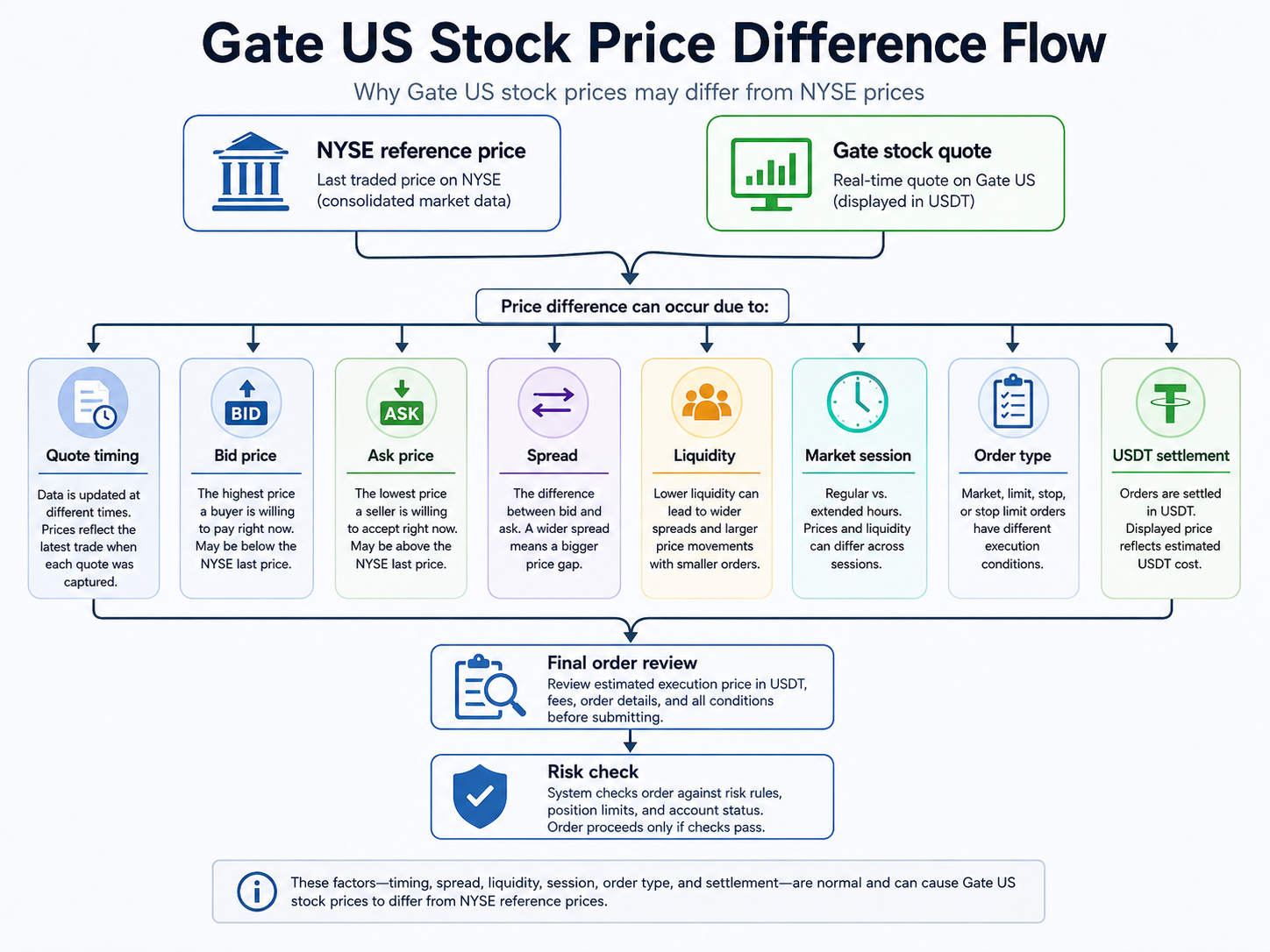
What Does Gate's US Stock Price Difference Mean?
Gate's US stock price difference means that the price a user sees on Gate may not be exactly the same as the price shown on NYSE, a financial news site, a broker app, or another market data screen.
The key point is that “the stock price” can mean several different things:
| Price Type |
What It Means |
Why It May Differ |
| Last traded price |
The price of the most recent completed trade |
It may be stale during fast markets or quiet sessions |
| Bid price |
The highest price buyers are currently willing to pay |
It is usually lower than the ask price |
| Ask price |
The lowest price sellers are currently willing to accept |
It is usually higher than the bid price |
| Mid price |
The midpoint between bid and ask |
It may not be executable |
| Order execution price |
The actual filled price of the order |
It depends on liquidity, size, timing, and order type |
| USDT estimated cost |
The estimated stock order value shown in USDT |
It may include settlement calculation and platform rules |
This table matters because many users compare a Gate price with a single number from another screen. If that other number is a last price, while Gate is showing an executable ask price for a buy order, the two numbers can naturally differ. A more useful comparison is to check what each screen is actually showing.
For a broader product-level view, the process of buying U.S. stocks with USDT on Gate explains why users need to review the trading flow, settlement asset, order details, and supported market conditions before placing an order.
Why Can Gate's US Stock Price Difference Happen?
Gate's US stock price difference can happen because stocks trade through a live market structure rather than a single universal price board.
The most common reasons include quote timing, bid-ask spread, liquidity, market session, order type, and reference-price mismatch. A public quote may show the last trade. A buy order may interact with the ask side. A sell order may interact with the bid side. During fast movement, these numbers can change before the user finishes reviewing the order.
A simple analogy helps: comparing stock prices across platforms is like checking the temperature on two thermometers placed in different parts of the same room. They are measuring the same environment, but one may update faster, one may be closer to a window, and one may round the number differently. The room is the same market, but the displayed readings may not match perfectly.
Price difference may become more visible when:
-
The stock is moving quickly after news;
-
The order is placed in pre-market or after-hours trading;
-
The stock has thin liquidity;
-
The order size is large compared with available quote depth;
-
The reference quote is delayed;
-
The user compares a last traded price with a buy-side ask price;
-
Fees, estimated costs, or USDT settlement details are included in the displayed amount.
Users comparing crypto-platform access with a conventional stock account may also benefit from understanding how USDT stock trading without a brokerage account changes the funding path while still exposing the user to stock market price movement and execution risk.
How Does USDT Settlement Affect Gate's US Stock Price Difference?
USDT settlement can affect the displayed cost because the user is funding the stock order with USDT rather than depositing U.S. dollars through a traditional bank and securities account.
In a standard U.S. brokerage account, a user often thinks in USD cash. On Gate, the stock trading flow is connected to a digital asset account and the order value is presented through USDT-based funding or settlement. Since USDT is designed to track the U.S. dollar but still trades as a digital asset, users should check the displayed USDT amount, estimated order value, and any visible cost details before confirming.
USDT settlement does not mean the stock itself becomes a crypto token, and it does not remove normal stock market execution rules. It mainly changes the funding layer. The stock market price, quote availability, order execution, liquidity, and session rules still matter.
A practical way to think about this is:
| Factor |
Stock Market Layer |
USDT Settlement Layer |
| Stock price movement |
Driven by market supply and demand |
Reflected in estimated USDT value |
| Bid-ask spread |
Comes from available buyers and sellers |
Affects final USDT cost or proceeds |
| Trading session |
Regular or extended-hours availability |
Determines when orders may be submitted or filled |
| Order review |
Shows asset, quantity, price, and cost |
Shows the USDT amount involved |
| Final result |
Filled, partially filled, or not filled |
Settled according to platform rules |
The table shows that USDT is the funding and settlement unit, but it does not erase price movement, spread, or execution risk. Users still need to review the order as a stock order, not only as a USDT balance movement.
Why Do NYSE Prices, Live Quotes, and Gate Displayed Prices Not Always Match?
NYSE prices, live quotes, and Gate displayed prices may not always match because they can represent different market data points at different moments.
A user may say “NYSE price” when they actually mean one of several references: the official exchange quote, a broker quote, a delayed finance website quote, a last trade, or a closing price. These are not always the same. During the regular U.S. market session, prices can update quickly. During pre-market and after-hours sessions, fewer participants may be active, which can widen spreads and make displayed prices less stable.
Trading session matters. U.S. stocks have regular market hours, and some platforms may support extended-hours access depending on product rules. During the main session, liquidity is usually deeper for large and actively traded stocks. Outside the main session, spreads can widen and execution may become less predictable.
That is why a user studying Gate US Stocks extended-hours trading should pay attention to the active session, the available order types, and whether the quote reflects enough liquidity for the intended order size.
This is also where spread and slippage matter. The article on Gate US stock liquidity and spread is especially relevant because price deviation is often not only about the reference price. It is also about whether enough shares or fractional quantity are available near that price.
What Is an Example of USDT Buying US Stock Price Deviation?
USDT buying US stock price deviation can appear when a user compares a public NYSE reference price with the executable price shown on Gate before placing a buy order.
Example: A user holds USDT in a Gate account and wants to buy a supported U.S. stock. A public finance website shows the stock at 100.00 based on the last traded price. On Gate, the user opens the stock page and sees an estimated buy price of 100.18. The user may think there is a price error, but the difference may come from the ask price, current spread, quote update timing, and available liquidity.
If the user places a market-style order, the final fill may differ again if the stock moves or if available liquidity changes before the order is executed. If the user places a limit order, the order may only execute at the chosen limit price or better, but it may also remain unfilled if the market does not reach that price.
This example shows why the order confirmation screen matters more than a screenshot of an external quote. The user should compare the asset name, ticker, session, bid, ask, order type, estimated USDT cost, and visible fees before confirming.
What Should Users Check Before Confirming an Order?
Before confirming an order, users should check whether the displayed price is a quote, an estimated price, or a likely execution price.
A practical checklist includes:
| User Check |
Why It Matters |
| Confirm the ticker |
Similar company names or ETFs can cause confusion |
| Check the trading session |
Extended-hours prices may differ from regular session prices |
| Compare bid and ask |
The ask affects buying, while the bid affects selling |
| Review spread |
A wider spread can increase the visible price difference |
| Check order size |
Larger orders may move through multiple price levels |
| Review order type |
Market and limit orders behave differently |
| Check estimated USDT cost |
The final displayed cost may include settlement details |
| Review fees and platform rules |
Costs can change the final amount paid or received |
| Confirm regional eligibility |
Product access may depend on the user’s location and account status |
The checklist matters because price deviation is often a combination of small details rather than one single cause. A user who checks only the last price may miss the spread. A user who checks only the spread may miss the trading session. A user who checks only the ticker may miss the order type.
The distinction between stock products also matters. Users comparing spot-style stock access with derivative exposure may review US stock spot vs futures on Gate, because futures, leveraged contracts, and stock access can have different pricing logic, risk, and settlement mechanics. For users studying contracts specifically, Gate US stock contract leverage has a different risk profile from simple stock buying and should not be treated as the same product.
Users who compare Gate with bank-funded brokers should also understand the structural difference between traditional brokers and crypto platforms for U.S. stocks. The market exposure may relate to the same underlying stock universe, but the account system, funding path, settlement asset, and user experience are different.
Summary
Gate's US stock price difference should be read as a normal comparison issue between a platform quote, an exchange reference, and an executable order price.
The difference can come from:
-
the bid-ask spread;
-
delayed or differently timed market data;
-
last price versus executable price;
-
regular session versus extended-hours trading;
-
available liquidity;
-
order size and order type;
-
USDT settlement calculation;
-
fees and product rules.
The most important practical step is to review the live order details before submitting. A user should not assume that the NYSE price, a finance website quote, a broker quote, and the Gate order price are identical. They may all describe the same stock market, but they may not describe the same price point.
FAQs
What is Gate's US stock price difference?
Gate's US stock price difference is the gap between the price displayed or executed on Gate and the NYSE, exchange, broker, or public market price used for comparison. It can happen because the two prices may reflect different quote types, update timing, spreads, sessions, or settlement calculations.
Why does Gate's US stock price difference happen during buying?
Gate's US stock price difference can happen during buying because a buy order usually interacts with the ask price, not necessarily the last traded price shown on another platform. If the ask is higher than the last price, the estimated buy cost on Gate may look higher than the reference quote.
Can USDT buying US stock price deviation happen during selling too?
USDT buying US stock price deviation can also appear during selling because sell orders usually interact with the bid price. The bid may be lower than the last traded price, especially in extended hours or lower-liquidity conditions.
Does Gate's US stock price difference mean the NYSE price is wrong?
Gate's US stock price difference does not automatically mean the NYSE price or Gate price is wrong. It may simply mean that the user is comparing a last price, bid, ask, delayed quote, or estimated execution price from different sources.
How can users reduce the impact of Gate's US stock price difference?
Users can reduce the impact of Gate's US stock price difference by checking bid and ask prices, reviewing the spread, using suitable order types, avoiding rushed orders during volatile periods, and confirming the final USDT amount before submission. Limit orders may help users control the maximum buy price or minimum sell price, but they may not always fill.
Stock investing involves market risk, and prices may fluctuate significantly. Please make decisions carefully based on your own risk tolerance.