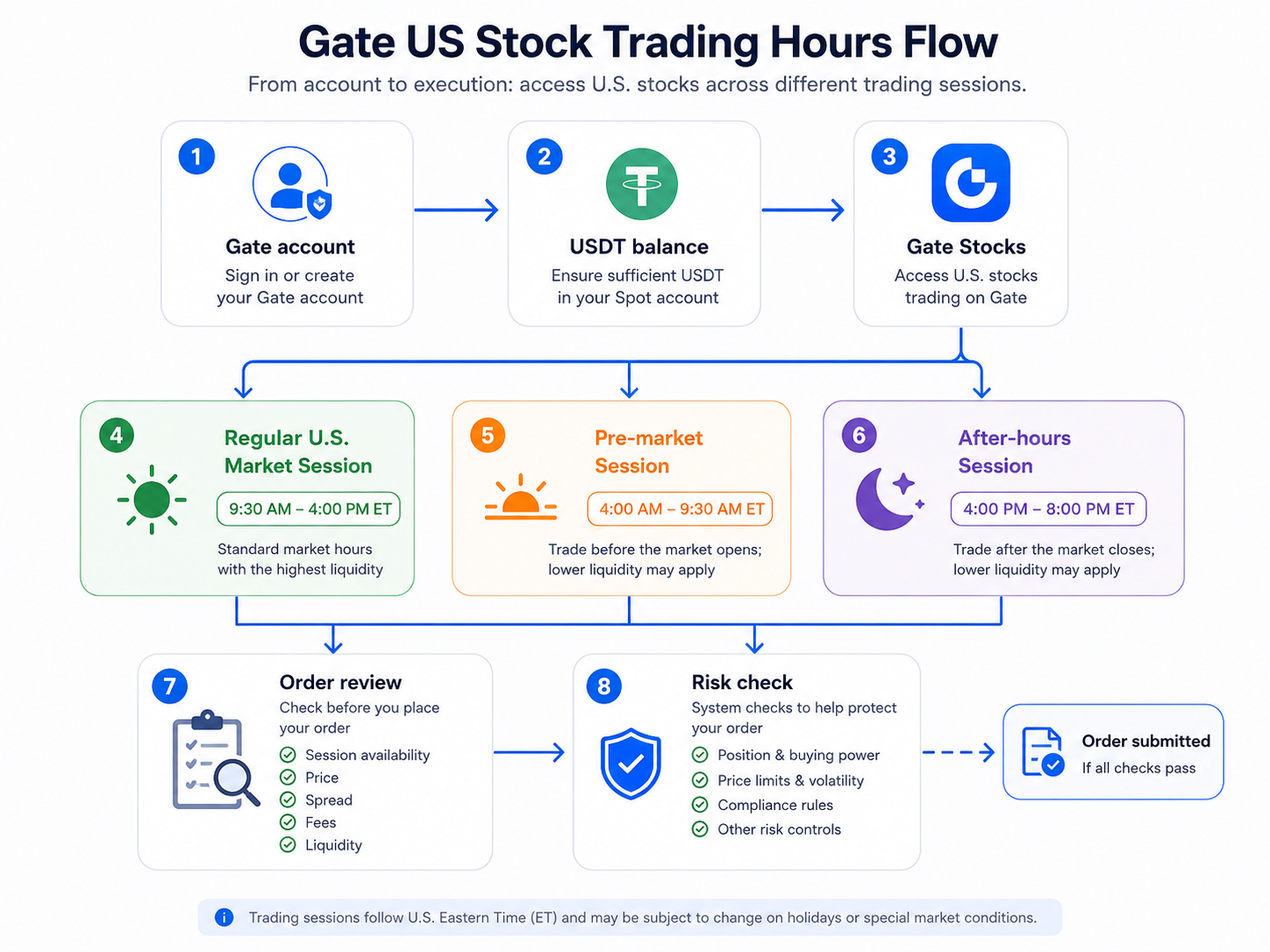
Gate US stocks are not available 24/7. Gate offers a 16×5 trading window that covers regular U.S. market hours, pre-market sessions, and after-hours sessions. Eligible users can trade supported U.S. stocks and ETFs through Gate Stocks using USDT, subject to app version, regional availability, liquidity, and applicable product rules.
Gate US stocks are not available 24/7. Gate offers a 16×5 trading window that covers regular U.S. market hours, pre-market sessions, and after-hours sessions.
Gate US Stocks extended-hours trading lets you trade supported U.S. stocks and ETFs on Gate during regular market hours, as well as during pre-market and after-hours sessions. It uses USDT as the settlement asset.
The key point is simple. Extended-hours trading gives users more time, not unlimited access. It’s like shopping at a store before or after peak hours, when fewer customers are present. The store is open, but prices, availability, and speed may feel different from the busiest part of the day.
For Gate Stocks users, this means order checks matter. Before placing an order, users should review the active session, stock availability, displayed price, spread, fees, order type, and USDT balance.
Can You Trade Gate US Stocks 24/7?
Gate US stocks should not be described as full 24/7 trading. Gate’s extended-hours schedule expands the trading window from the regular U.S. stock session to a 16×5 weekday schedule that includes pre-market and after-hours access.
This distinction matters because “24/7 stock trading” can sound like crypto spot trading. Many crypto markets run continuously. U.S. stocks still depend on market sessions, liquidity venues, brokerage infrastructure, supported assets, and platform rules.
For users learning about U.S. stock trading with USDT, the practical answer is direct. Gate Stocks gives eligible users a longer weekday window for supported U.S. stocks and ETFs. It does not mean every stock is tradable every hour.
What Does Gate US Stocks Extended-Hours Trading Mean?
Gate US Stocks extended-hours trading means supported U.S. stocks and ETFs may trade outside the regular U.S. stock session. The 16×5 schedule includes regular hours, pre-market trading, and after-hours trading.
Pre-market trading happens before the regular U.S. market opens. After-hours trading happens after the regular market closes. These sessions can matter when companies release earnings, announcements, or important updates outside regular trading hours.
Session Type
What It Means
What Users Should Check
Regular market session
The main U.S. stock trading period on weekdays
Stock name, ticker, price, quantity, fee, and order type
Pre-market session
Trading before the regular market opens
Asset support, liquidity, price spread, and session label
After-hours session
Trading after the regular market closes
Order type, price movement, spread, and execution conditions
16×5 schedule
A longer weekday trading window
App version, account eligibility, region, and product access
24/7 direction
A future product direction, not the same as full live access
Verify official availability before assuming all-day trading
The table shows why session awareness matters. A stock may be available, but the order book may be thinner. The spread may also be wider than during the regular session.
How Do I Trade During Pre-Market and After-Hours on Gate?
Users can trade during pre-market and after-hours by entering Gate Stocks and checking the selected asset. The selected U.S. stock or ETF must be available in that session.
Extended-hours trading requires the latest Gate App version. Extended-hours trading requires a recent version of the Gate App. (When this article was published, version 8.21.5 or later was needed; always update to the latest version.) Users should keep the app updated.
A simple operating flow looks like this:
Open the Gate App.
Check that the app is updated.
Confirm that Gate Stocks is available for the account and region.
Make sure the account has enough USDT.
Enter Gate Stocks.
Search by stock name or ticker.
Check whether the asset is available in the active session.
Review price, spread, quantity, estimated USDT cost, and fee.
Select the available order type.
Confirm the order only after reviewing the session label.
Gate Stocks supports fractional share trading from 0.01 shares in the referenced product information. Fractional trading can make order sizing more flexible. It does not remove price risk, spread risk, or liquidity risk.
What Happens When an Order Is Placed After the Market Closes?
An order placed after the market closes may face different conditions from a regular-session order. Liquidity may be lower. The bid-ask spread may be wider. Fewer market participants may be active.
A market order focuses on execution. In a thin session, the final price may differ from the last visible quote. A limit order gives more price control. However, it may not execute if the market does not reach the chosen price.
After-hours trading is often linked to news. Earnings reports, company updates, analyst actions, economic data, and sector news may move prices. The extended window gives users more timing flexibility, but it also requires closer price checks.
Users should also separate stock trading from contract trading. U.S. stock spot and futures on Gate can involve different mechanics. Futures may include margin, leverage, funding costs, and liquidation risk.
What Is an Example of an Extended-Hours Stock Order?
A user holds USDT in a Gate account. The user wants to place an order for a supported U.S. stock before the regular market opens.
The user opens Gate Stocks and searches the ticker. The user then checks whether the stock is available in the pre-market session. Before confirming, the user reviews the displayed price, bid-ask spread, estimated USDT cost, and available order type.
If the user chooses a limit order, the order will only execute at the selected price or better. If the market does not reach that price, the order may stay unfilled.
This example shows the core idea. Extended-hours trading adds more time, but it does not remove session rules. Orders still depend on asset availability, liquidity, spread, and execution conditions.
How Is Gate Stocks Different from a Traditional Broker?
Gate Stocks and traditional brokers can both provide access to U.S. stocks. The account path is different.
Gate Stocks uses a Gate account and USDT settlement. Traditional brokers usually use fiat funding, bank transfers, securities accounts, and broker custody systems.
Comparison Area
Gate Stocks
Traditional Broker
Funding asset
USDT inside a Gate account
Fiat through bank or broker rails
Account setup
Gate account, identity checks, eligibility, and regional access
Brokerage account and local securities onboarding
Market access
Supported U.S. stocks and ETFs through Gate Stocks
U.S. stocks and ETFs through broker market access
Extended hours
16×5 schedule with regular, pre-market, and after-hours sessions
Depends on broker, account type, and region
Fractional shares
Supported from 0.01 shares in referenced product information
Depends on the broker
Main checks
USDT balance, app version, session, spread, fee, and product access
Cash balance, permissions, session rules, fees, and broker policies
This comparison helps users avoid a common mistake. Gate Stocks may feel familiar to crypto users, but stock trading still follows market-session logic. It is not the same as trading a crypto pair around the clock.
Users should check trading fees, spreads, estimated USDT cost, and any displayed account conditions before placing an order. The referenced Gate information states that Gate Stocks is integrated with the VIP tier system. It also states that eligible users may access stock trading fees as low as 0.023% under stated VIP conditions.
The displayed fee is only one part of cost. Extended-hours sessions may have wider spreads. A wider spread can affect the effective buy or sell price.
Before confirming an order, users should check:
displayed trading fee
bid-ask spread
estimated USDT cost
selected stock or ETF
fractional share quantity
active trading session
available order type
any notice shown in the order interface
Users researching advanced stock-related products should keep product types separate. Gate U.S. stock contract leverage involves margin and leverage mechanics. It should not be treated as the same flow as Gate Stocks trading.
What Are the Risks of Gate US Stocks Extended-Hours Trading?
Gate US Stocks extended-hours trading carries regular stock-market risk. It also adds session-specific risks.
Market risk comes from company performance, economic data, sector sentiment, interest rates, regulation, and broader financial conditions. A longer trading window does not reduce the chance of price declines.
Liquidity risk may be more visible before and after the regular session. Fewer active participants can make the order book thinner. This may lead to wider spreads, partial execution, or no execution at the intended price.
Execution risk also matters. A quote may change before the order is filled. A market order may execute at a different price from the last visible quote. A limit order can control price, but it cannot guarantee execution.
Regional and platform rules also apply. Gate may restrict or prohibit certain services in specific jurisdictions. Users should verify asset support, account eligibility, fees, trading hours, and order rules inside Gate before trading.
Summary
Gate US stocks are not full 24/7 trading. Gate Stocks offers a 16×5 trading window for supported U.S. stocks and ETFs. The window covers regular U.S. market hours, pre-market sessions, and after-hours sessions.
Here’s the simplest way to understand the product. Eligible users get a longer weekday window to trade supported U.S. stocks with USDT. They do not get unlimited trading for every stock at every hour.
Before placing an order, users should check app version, account eligibility, regional access, session status, asset support, price, spread, fee, and order type.
Extended-hours access can reduce the gap between new information and order placement. It can also involve lower liquidity, wider spreads, and different execution conditions.
Stock investing involves market risk, and prices may fluctuate significantly. Please make decisions carefully based on your own risk tolerance. This article does not constitute investment advice.
FAQs
Can you trade Gate US stocks 24/7?
Gate US stocks are not full 24/7 trading. Gate Stocks offers a 16×5 schedule that includes regular, pre-market, and after-hours sessions.
How to buy Gate US stocks 24/7 before and after the market closes?
How to buy Gate US stocks 24/7 before and after the market closes should be understood as using Gate Stocks during supported extended-hours sessions. Users should check asset availability, session status, price, spread, fee, and order type before confirming.
Does Gate Stocks support pre-market trading?
Gate Stocks supports pre-market trading for eligible users and supported assets. Users should confirm session availability inside Gate before placing an order.
Does Gate Stocks support after-hours trading?
Gate Stocks supports after-hours trading for eligible users and supported assets. After-hours trading may involve thinner liquidity, wider spreads, and different execution conditions.
What app version is needed for extended-hours trading?
Extended-hours trading requires the latest Gate App version. Extended-hours trading requires a recent version of the Gate App. (When this article was published, version 8.21.5 or later was needed; always update to the latest version.)
Are all U.S. stocks available during pre-market and after-hours sessions?
Users should not assume that every U.S. stock has the same extended-hours availability. Asset support, liquidity, order types, and trading rules may differ.
Author: Jared
Disclaimer
* The information is not intended to be and does not constitute financial advice or any other recommendation of any sort offered or endorsed by Gate.
* This article may not be reproduced, transmitted or copied without referencing Gate. Contravention is an infringement of Copyright Act and may be subject to legal action.
The report shows that in Q1 2026, the crypto market will reach a stage of structural maturity, with Derivative trading making up more than 90% of total trading volume, exceeding $20 trillion. As Spot demand weakens, liquidity will become even more concentrated in top exchanges, reflecting a more cautious market sentiment and a shift toward leveraged and institutional trading.
Stablecoins were originally designed as dollar substitutes within exchanges, primarily used for asset pricing and trade settlement. As on-chain financial ecosystems have matured, their role has expanded beyond simple payments to include collateral assets, cross-chain liquidity mediums, and unified settlement units. In particular, as AI systems and automated agents begin to participate directly in economic activity, demand has risen sharply for programmable value units capable of instant settlement. This shift is pushing stablecoins toward the role of foundational financial infrastructure.
In the competition for DeFi liquidity, high-inflation mining alone is no longer enough to build lasting advantages. Aerodrome applies the ve(3,3) economic model to redesign token emissions, voting mechanisms, and revenue distribution, creating a liquidity flywheel centered on governance and cash flow. This article examines AERO tokenomics, the veAERO locking mechanism, and protocol revenue models to explain how Aerodrome builds a sustainable DeFi economic system.
PAXG (Pax Gold) is a tokenized asset backed by physical gold, issued by the fintech company Paxos and traded on the Ethereum blockchain as an ERC-20 token. The core concept is to tokenize physical gold on-chain, with each PAXG token representing ownership of a certain amount of gold. This structure enables investors to hold and trade gold in the form of a digital asset.
PAXG (Pax Gold) is a tokenized asset backed by physical gold reserves, launched by fintech firm Paxos and issued as an ERC-20 token on the Ethereum blockchain. The core concept is to digitally represent real-world gold assets, allowing investors to hold and trade gold via the blockchain network. Because each PAXG token corresponds to a specific quantity of physical gold, its price is theoretically expected to closely track the global gold market.
AERO is the native token of Aerodrome Finance, a core decentralized exchange and liquidity protocol in the Base ecosystem. It is primarily used for liquidity incentives and ecosystem operations. veAERO is a governance NFT that users receive by locking AERO, representing both voting power and the right to share protocol revenue. Through a dual track structure of AERO as a utility token and veAERO as a governance credential, Aerodrome separates liquidity usage value from long term governance power, allowing participants to act as liquidity providers, governance decision makers, and revenue sharers within the same system.