Gate crypto options cover European exercise, T-quotes, and cash settlement. Comparing options, perpetuals, and event contracts in one payoff–margin–horizon frame—including the common Gate options vs futures split—is what the sections below do, without restating single-product rules.
Key Takeaways
- Options: Pay premium once; max loss is typically the premium on long Calls/Puts; European exercise at expiry; cash settlement—no delivery of the underlying coin.
- Perpetual futures: No expiry date; PnL tracks mark price; leverage and maintenance margin apply; funding rates periodically transfer value between long and short sides.
- Event contracts: Short windows; payoff often resembles a binary or capped outcome on direction or event result—not the same as multi-strike option chains.
- Margin logic differs: Options margin for sellers vs buyers is not the same as perp notional leverage; event contracts may use simpler stake-and-settle rules within their product sheet.
- Scenario fit: Defined-risk hedges and volatility structures → options; continuous delta exposure → perps; very short, outcome-focused views → event contracts—subject to eligibility, limits, and local rules.
What Are Gate Crypto Options and Options Trading?
Gate options and Gate futures solve different trading jobs: Gate options are European-style contracts with a fixed expiry, where you pay a premium for the right, but not the obligation, to trade at a strike price, while Gate futures here mainly means perpetual futures — leveraged contracts with no expiry that require margin and include recurring funding payments between longs and shorts. For most active traders deciding between the two, the biggest difference is risk structure: options define risk up front for buyers, while perpetual futures give continuous exposure but can magnify gains and losses through leverage.
Gate crypto options are European-style contracts, so the holder may exercise only at expiry, not before. In standard stock options, a call option gives the buyer the right to buy and a put gives the buyer the right to sell the underlying stock at the strike price before expiration, with one contract often controlling 100 shares; on Gate, the same call/put logic applies within options contracts, but the contract is tied to the underlying asset such as BTC or ETH rather than shares, and it gives the holder the right to buy or sell at a specific price by expiry — not the obligation. The buyer pays an upfront premium in cash (quoted in stablecoin or dollar terms on the platform).
Settlement is cash-based: per Gate Help, at expiration or exercise buyers and sellers do not physically deliver the underlying; P&L is settled in cash from the difference between market price and strike. OTM contracts expire worthless and the buyer loses the premium. By contrast, Gate perpetual futures stay open until you close them or are liquidated, use posted margin instead of an upfront premium, and suit traders who want directional exposure without waiting for a fixed expiry.
The sections below compare Gate crypto options, perpetual futures, and event contracts across payoff, margin, expiry, operating mechanics, scenario fit, and risk—so product choice follows structure rather than treating all derivatives as interchangeable. Platform steps and order types follow how to trade crypto options on Gate; spot overlay protection aligns with how to hedge BTC with Gate options.
What Are Gate Perpetual Futures and Futures Trading?
Perpetual futures (perps) are leveraged derivatives with no scheduled expiry and are a type of futures contracts used for futures trading. In the broader futures market, a contract normally obligates the buyer and seller to transact at a specific future date; perps remove that endpoint, while a standard contract can also have a delivery date if it is physically settled. Positions stay open until closed or liquidated. Traders post initial margin and must maintain maintenance margin; Gate-specific requirements follow the contract specification and selected leverage—do not substitute third-party percentage ranges. In traditional futures, contracts are marked to market daily for profit and loss, while crypto perps track PnL against the contract’s mark price continuously relative to entry. That collateral functions as a margin deposit, and losses can exceed the initial margin when market moves sharply. Depending on the contract spec, one futures contract may represent a fixed quantity of the underlying, and many traders value perps for deep liquidity without having to manage expiry rollover.
Because there is no expiry, perps use a funding mechanism: on a fixed schedule (e.g., every eight hours on many crypto venues), one side pays the other based on the funding rate, which reflects the gap between perp price and spot/index reference. Positive funding often means longs pay shorts; negative funding reverses the flow. Funding is a balance transfer, not a fee to the exchange in the same sense as spot trading fees. Unlike options, these contracts bind both the buyer and seller to the contract terms rather than granting a discretionary right at expiry. In a standard futures contract, that obligation applies at a future date, whether the position is cash settled or closed before settlement by market participants who do not want delivery.
Perps are commonly used for continuous directional exposure and basis-style strategies. They do not offer the same “pay premium once, ignore until expiry” structure as long options. That trade-off matters for traders who trade futures, since they stay exposed to ongoing price changes without the fixed-premium structure of long options. Traditional futures products can also trade beyond standard market hours, unlike the simpler equity-session assumption some readers bring in. Futures can reference far more than crypto, including commodities, indexes, and in some jurisdictions individual stocks; for example, if gold rises, gains on a gold futures position are typically credited through daily variation settlement.
What Are Gate Event Contracts?
Event contracts on Gate (where listed) let users take a view on short-horizon outcomes—for example, whether price finishes above or below a level by a window end, or whether a stated event resolves one way or another. Payoffs are typically simpler and more binary than a full options chain: stake size, window, and settlement rule are fixed in the product specification.
Horizons are much shorter than most monthly or weekly options listings. They are not perpetual futures: exposure ends when the window closes and the contract settles. They are also not standard Calls/Puts: there is no multi-strike volatility surface in the same form as listed crypto options.
Event contracts suit users comparing time-boxed prediction mechanics to continuous perps or expiry-dated options—not users seeking long-dated hedge with explicit strike grids.
Options vs Futures vs Event Contracts: Key Differences Explained, Structure, Margin, and Expiry
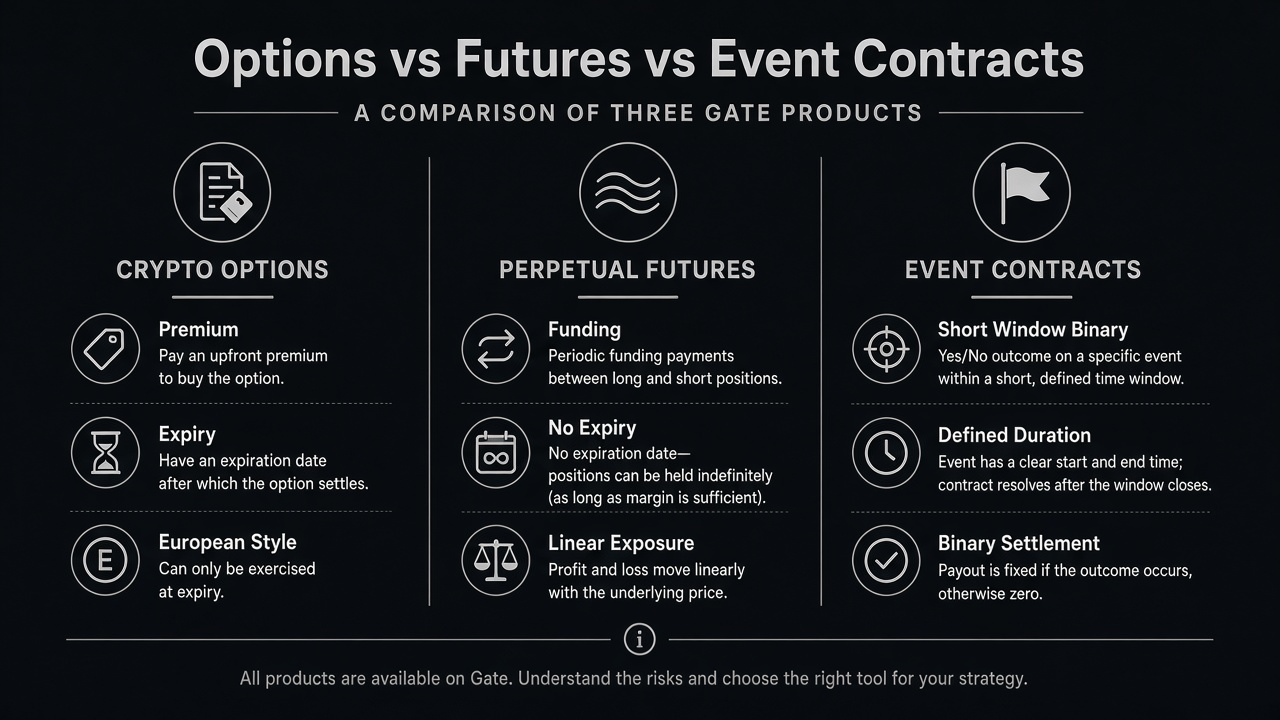
Figure 1. Structure comparison of Gate crypto options, perpetual futures, and event contracts.
| Dimension |
Gate crypto options |
Perpetual futures |
Event contracts |
| Expiry |
Fixed expiry date/time |
None (funding replaces roll; standard futures use a specific future date) |
Fixed short window |
| Payoff shape |
Non-linear (Call/Put) |
Linear in mark price (before fees/funding) |
Often binary or capped |
| Upfront cost |
Premium (long options) |
Margin against notional |
Stake per contract rules |
| Exercise |
European at expiry only |
N/A (close or liquidate) |
Auto-settle at window end |
| Settlement |
Cash |
Cash PnL + funding flows |
Cash per outcome rule |
| Typical risk frame |
Long: premium at risk |
Leverage + liquidation |
Stake at risk per rules |
These are the major differences between futures and options as financial derivatives on Gate: they can reference the same underlying market, but their payoff and margin mechanics are very different. Standard futures obligate both sides to transact at a future date, though many traders close or roll before the delivery date, while perps are the non-expiring version.
Margin: Long option buyers generally post premium, not full notional. Options buyers pay that cost upfront, while futures positions use margin and may need extra collateral if price moves go against the trade. In standard futures markets, that means a margin deposit rather than a one-time premium, and one contract stands for a defined contract size. Perp traders post collateral against leveraged notional, so small mark moves can trigger liquidation. Event contracts use product-specific stake and payout caps—compare each listing’s sheet rather than assuming perp margin tables apply.
Expiry: Options force a decision point at expiry (exercise, abandon, or cash settle). Options contracts have set expiration dates and grant a right, while futures create an obligation at a future date and keep tracking PnL rather than losing value through time decay in the same way. Perps require ongoing funding and margin management. Event contracts end automatically when the window closes.
Which Product Fits Which Scenario?
These are structural fits based on trading style and risk tolerance, not recommendations:
-
Defined-risk directional or hedge with a known end date: Long Calls or Puts (premium known upfront; European expiry aligns with a calendar event or risk window). These options strategies can hedge risk around a known event or time window, and more advanced approaches can also generate income through covered-call style setups, though that is more complex and different from simply buying options. Spot overlay protection matches the mechanics in how to hedge BTC with Gate options.
-
Continuous exposure to spot/index moves with leverage: Perps match “always on” delta without rolling dated futures; funding cost/receipt must be modeled over hold time. Some futures traders prefer that continuity, and some choose it for deep liquidity and nearly around-the-clock futures products, but it can involve more risk than defined-risk long options and adds leverage and liquidation risk.
-
Very short, outcome-focused view (up/down in a slot): Event contracts match fixed-window prediction; ill-suited when the need is multi-week strike selection or volatility trading across expiries.
-
Volatility or spread structures (strangles, calendars): Options chain granularity; perps and event products do not replicate full vol surfaces.
-
Capital efficiency vs path risk: Perps amplify path and liquidation risk; losses on leveraged futures can exceed the initial investment committed as margin, while long options cap cash loss at the premium and event contracts cap stake per contract but may offer no partial payoff. Expected market movements can also change option pricing through implied volatility, whereas perp risk comes more directly from leveraged price exposure.
Users often combine products (e.g., perp for core exposure, options for tail hedge). Gate’s own eligibility, contract specs, and fee schedules govern what is available in each jurisdiction.
What Limits Apply When Comparing These Products?
-
Product availability: Not every underlying or window is listed across options, perps, and events at the same time.
-
European exercise only on Gate crypto options—early exercise strategies from American-style markets do not apply.
-
Funding volatility on perps can dominate PnL over short holds; options theta and implied volatility matter on a different schedule.
-
Regulatory and KYC tiers may restrict access to derivatives or event products.
-
Liquidity differs by strike, expiry, and contract; differences between the options market and the futures market also vary by product, strike, expiry, and trading hours, so tight spreads on BTC perps do not guarantee the same on far out of the money options or niche event markets.
-
Tax and accounting treatment varies by region; this article does not provide tax guidance.
-
Speculation and leverage: options trading and futures trading are derivatives uses and may involve substantial risk depending on margin, liquidity, and position management. Protections and rules follow Gate’s product documentation and the terms applicable to the account’s region.
-
No price targets or signals—compare mechanics and risk frames only.
-
Educational only: This article is for education, not investment advice, and past performance does not guarantee future results. Customer positions and cash in those accounts are instead handled under segregation rules of the relevant clearing framework, and trading futures products is speculative and not suitable for all investors.
Always read Gate’s help center and contract specifications before placing orders; parameters change with listings and maintenance.
Summary
Gate crypto options offer European, cash-settled Call/Put rights with premium upfront and fixed expiry. Perpetual futures offer non-expiring leveraged exposure with funding between longs and shorts. Event contracts offer short-window, often binary-style outcomes. Choosing among them is a question of payoff shape, margin, time horizon, operational burden, and the underlying asset exposure being managed or targeted—not a universal ranking. European settlement and quote rules still follow Gate crypto options.
FAQ
Are Gate crypto options the same as perpetual futures?
No. Standard futures create an obligation to transact on a specific future date, while a call option or put grants the right, not the obligation, to buy or sell at a strike price by expiry for a prepaid premium; in stock options that right is usually tied to an underlying stock, while on Gate it is tied to the crypto asset. Options pricing depends on more than the underlying market price, whereas a perp tracks mark-price exposure more directly and uses funding instead of time decay in the option sense.
Can I hedge a perp position with Gate options?
In principle, long Puts or Put spreads can offset downside on an underlying correlated with the perp mark, with the options position sized against the perp exposure and hedge horizon. A futures options contract or standard options structure should match the same directional assumption and expiry window before you use it as a hedge; execution details are in how to hedge BTC with Gate options.
Do event contracts replace options for quick trades?
They serve different structures. Event contracts settle on short-window outcomes; options provide strike and expiry grids suited to volatility and multi-leg strategies. One does not substitute for the other without checking payoff math.
Why do perps have funding but options have theta?
Funding transfers value between perp longs and shorts to anchor price to index. Options theta reflects time decay of extrinsic value on premium—different mechanisms for different contract designs. Even with a relatively stable underlying market, options premiums can still shift as implied volatility and time remaining change, so short-term price movements do not map one-for-one to option value.
Is maximum loss always the option premium?
For long Calls and Puts, options buyers usually have loss limited to the premium plus fees—for example, with stock contracts a call commonly covers 100 shares and a put gives the right to sell 100 shares at the strike price—but if options expire worthless when held to expiry out of the money, that full premium is gone. Short option writers, or option sellers, and leveraged perps face substantial risk under product rules; on a naked call, upside loss has no clear upper limit, and trading options can also involve complex pricing and assignment risk beyond the premium-based maximum loss of long positions, even though owning the underlying can reduce that exposure.