In the crypto market, altcoins do not all derive their value from the same sources. Some tokens primarily serve payment, staking, or network resource usage functions, while others grant holders the right to participate in protocol decisions through governance mechanisms. The market valuation of governance tokens is typically influenced not only by trading supply and demand, but also by the protocol's development direction, level of governance participation, treasury management arrangements, and quality of community decision-making. Understanding these assets requires distinguishing between a token's function within a technical system and the rights that holders can actually exercise.
Ampleforth Governance Token (FORTH) is a representative example. It is the governance token of the Ampleforth ecosystem and has been used to participate in decisions such as protocol parameter adjustments, governance proposals, and DAO treasury management. Unlike AMPL in the ecosystem, AMPL primarily serves as an elastic-supply unit of account and financial primitive, while FORTH represents the governance participation mechanism. Although both belong to the same ecosystem, they serve different economic and institutional roles.
However, the value of governance tokens is not permanently fixed. In 2026, the Ampleforth community passed a proposal related to winding down Forth DAO and subsequently announced plans for DAO asset disposal and governance system adjustments. Changes to the governance rights structure mean that the market needs to reassess FORTH's functional boundaries: after the original DAO governance system exits, what rights do token holders still have, and how should the token's value be understood? This is not only a case specific to FORTH, but also reflects structural issues that governance altcoins may face at different stages of a protocol's lifecycle.
Key Takeaways
-
FORTH is a governance token, not AMPL's elastic-supply token: the two serve different roles in the Ampleforth ecosystem and should not be conflated
-
Governance rights have institutional boundaries: whether token holders can participate in decisions depends on the governance contracts, authorization relationships, and protocol arrangements that are actually in effect
-
A DAO exit changes the token's functional context: after Forth DAO ended its governance role, the original governance mechanisms and treasury management methods were adjusted, so past governance descriptions should not continue to be applied without qualification
-
Market price is not the same as governance value: trading prices are also affected by liquidity, holder distribution, market expectations, and risk appetite
-
Evaluating governance altcoins requires reviewing rights and execution mechanisms: key factors include voting scope, proposal execution authority, treasury arrangements, governance participation, and exit plans
FORTH's Positioning: How Does a Governance Token Differ From a Standard Functional Token?
FORTH is an ERC-20 token used by the Ampleforth protocol and its ecosystem governance system. Its core purpose is governance, rather than directly serving as AMPL's unit of account or adjusting users' wallet balances through an elastic-supply mechanism. Under the original governance structure, FORTH holders could participate in proposal voting or delegate their voting rights to other addresses for representation in governance.
The difference between governance tokens and standard functional tokens is that the primary rights represented by governance tokens are not simply eligibility to use a product. Functional tokens may be used to pay network fees, access services, or participate in in-app activities. Governance tokens, by contrast, are mainly connected to the protocol decision-making process, such as parameter changes, upgrade directions, treasury budgets, and ecosystem development plans. Whether governance rights have practical significance depends on whether proposals can affect the protocol's state and whether governance outcomes can be executed.
However, governance rights do not equal corporate equity, nor do they mean that holders automatically own protocol assets or have rights to revenue distributions. FORTH holders cannot infer solely from holding tokens that they own equity in the Ampleforth team, have fixed rights to protocol revenue distributions, or directly own ecosystem assets. The scope of governance rights should be based on governance contracts, protocol rules, and formal proposals.
This distinction is particularly important when analyzing altcoins. The market may sometimes describe governance tokens as representing "equity" in a protocol, but this can easily conflate voting rights, economic interests, and asset ownership. A more rigorous approach is to first confirm which decisions the token actually controls, then assess whether those decisions can affect the protocol's long-term usage demand and economic activity.
FORTH and AMPL: Two Token Models Within the Same Ecosystem
To understand FORTH, it is necessary to first understand its relationship with AMPL. One of Ampleforth's core designs is its elastic-supply mechanism: AMPL aims to track a 2019 US dollar purchasing power benchmark adjusted by the Consumer Price Index, and the protocol adjusts token supply based on deviations between the market price and the target. Changes in demand are primarily absorbed through changes in supply quantity, rather than entirely through price fluctuations around the fixed supply of an asset.
When AMPL's market price is above the target range, the protocol may expand supply. When the price is below the target range, the protocol may contract supply. Supply adjustments are reflected in users' wallet balances through the rebase mechanism. In principle, a holder's proportion of the network does not change solely because of proportional adjustments. This means that AMPL quantity fluctuations differ from those of standard fixed-supply tokens, and users cannot assess changes in portfolio value based only on the price of a single token.
FORTH, by contrast, serves a governance role. It has been used to make decisions regarding Ampleforth protocol parameters, governance proposals, and DAO treasury arrangements. In short, AMPL is primarily the protocol's elastic-supply asset, while FORTH is the voting tool within the governance system. Their sources of value and risk structures are different.
This dual-token design reflects a common DeFi architectural approach: separating a protocol's economic functions from its governance functions so that tokens serving as assets or financial applications do not also need to bear all governance decisions. However, functional separation does not mean risks are fully isolated. Governance decisions may affect AMPL parameters, ecosystem funding, and application direction, while AMPL adoption may in turn affect the ecosystem's continued development. Therefore, FORTH's governance value depends largely on whether the system it governs still has a clear product direction and real usage demand.
How Governance Rights Are Formed: From Community Discussion to On-Chain Execution
Under the original governance mechanism, Ampleforth's governance process did not simply allow token holders to initiate a vote directly and immediately change the protocol. Community members could first propose ideas through forums, communities, or other channels. Once discussions reached a certain level of consensus, relevant proposals could be organized into an Ampleforth Improvement Proposal (AIP) or Configuration Change Proposal (ACCP), then enter more formal discussion and decision-making stages.
Formal proposals generally need to clearly describe the proposed changes, technical impact, and execution methods. The community then conducts targeted discussions around the proposal and, where necessary, uses off-chain signaling votes to understand token holder preferences. Only after technical development, testing, and security reviews may a proposal enter the binding on-chain voting and deployment process. Holders can vote directly or delegate their voting rights.
This process shows that the role of a governance token is not merely to "vote." It also needs to connect with proposal formation, discussion, technical implementation, and on-chain execution. Voting has practical institutional significance only when governance outcomes can be implemented through contracts or clearly defined administrative authority.
However, governance processes also have limitations. Voter participation may be low, concentrated holdings may influence decision outcomes, and delegation mechanisms may also concentrate voting rights among a small number of representatives. Even if a proposal passes on-chain, this does not mean its technical implementation is necessarily risk-free. Code audits, upgrade permissions, and execution arrangements still require independent assessment.
For investors, understanding the governance process requires more than reviewing whether the project has held votes in the past. It is also necessary to confirm whether the current governance system is still operating, which contracts hold administrative authority, who executes proposals after they pass, and whether governance rights involve delegation or centralization issues. Governance systems can change as protocols develop, and historical rules do not automatically represent the current state.
Forth DAO Exit: How Do the Boundaries of Governance Token Rights Change?
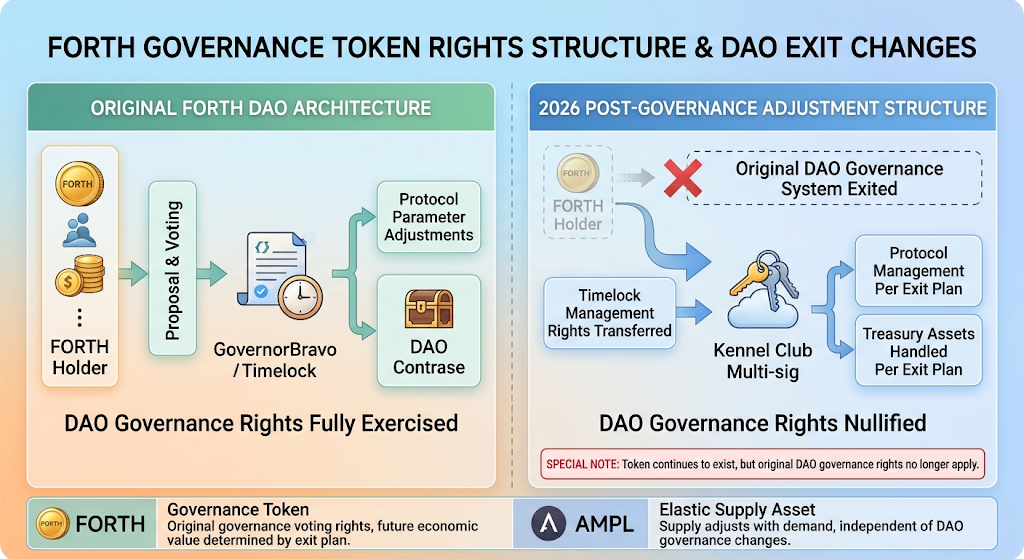
In 2026, Ampleforth's governance system underwent significant adjustments. According to an explanation published on the official governance forum on October 14, 2026, FORTH holders had previously passed a proposal to wind down Forth DAO. After the proposal was executed, ownership of the Timelock previously managed by GovernorBravo was transferred to the Kennel Club multisig, returning the protocol's management structure to an arrangement combining a multisig and Timelock.
The subsequently announced DAO exit plan involved treasury asset handling, liquidity arrangements, FORTH-related asset disposal, and the future management of systems including AMPL and SPOT. The official plan proposed distributing certain non-AMPL liquid assets to eligible FORTH holders according to the plan, while also establishing arrangements for DAO-held FORTH, liquidity positions, and other assets. It should be noted that these details are part of the exit plan and execution arrangements published on the official forum. Specific asset distributions and timelines should be subject to subsequent formal execution records.
For FORTH, the primary significance of this change is that the institutional basis of its original governance function has changed. In the past, holding FORTH enabled participation in the Forth DAO governance process. Once the DAO ceases operations and administrative authority is transferred, past governance rights can no longer simply be regarded as rights that remain effective today. A token continuing to exist and trade does not mean that the original governance system continues to operate in the same manner.
Second, the governance exit affects how the market assesses the token's future utility. If the token's primary value narrative was previously based on DAO governance, treasury management, and ecosystem resource allocation, the market needs to reassess the token's remaining functions, potential demand, and future development potential after these functions are adjusted. Asset disposal plans may become a short-term market focus, but a one-time treasury distribution arrangement does not equal ongoing revenue or a long-term source of value.
Finally, the DAO exit raises a broader question: can governance tokens retain a clear economic purpose after the governance system changes? Without ongoing governance rights, protocol usage demand, or other defined functions, a token's market valuation may be influenced more by trading expectations and liquidity than by sustained governance demand.
How Should the Value of Governance Altcoins Be Evaluated?
When evaluating governance altcoins such as FORTH, the first step is to confirm the token's actual rights rather than making judgments based only on the "governance token" label. Investors need to understand whether the token still corresponds to an effective voting mechanism, which parameters or treasury arrangements voting can influence, whether governance outcomes are binding, and whether a multisig, foundation, or other entity retains ultimate administrative authority.
The second dimension is the protocol's underlying usage demand. The significance of a governance token is generally related to the protocol it governs. If a protocol has stable users, ongoing on-chain activity, and clear product demand, governance decisions may have a real impact on system operations. Conversely, if protocol usage declines, products are discontinued, or the governance system exits, the token's original function may weaken accordingly. Therefore, evaluating FORTH requires not only studying the token itself, but also understanding AMPL's usage and the Ampleforth ecosystem's development direction.
The third dimension is supply and liquidity. Total supply, circulating supply, holder concentration, trading depth, and exchange coverage can all affect price formation. For assets with relatively limited market capitalization and trading depth, short-term buy and sell orders may cause significant price fluctuations. Even if trading volume increases rapidly during a given period, an increase in transaction value alone cannot be used to infer that long-term demand has formed.
The fourth dimension is governance and execution risk. Adjustments to governance mechanisms, treasury asset distributions, contract permission changes, and multisig management arrangements can all alter holder expectations for the token. Investors should pay attention to whether proposals have passed, whether on-chain execution has been completed, which matters remain under discussion, and whether relevant information comes from official governance records.
Finally, market price should be considered separately from fundamentals. Price increases may result from improved liquidity, market sentiment, changes in trading structure, or expectations surrounding specific events. They do not necessarily represent increased protocol adoption or stronger governance functions. For governance altcoins, price performance can serve only as one indicator for observing market behavior and cannot replace research into token rights and protocol status.
Gate and FORTH: From Token Information to Governance Mechanism Research
For market participants following FORTH, research should not focus solely on price movements and trading activity. It should also assess project mechanisms, governance status, and ecosystem changes. Gate's crypto asset information and research content can serve as a supplemental resource for understanding project background, token mechanisms, and market developments. Gate has also published educational content on elastic-supply tokens, including AMPL's rebase mechanism, which can help readers understand the functional differences between AMPL and FORTH in the Ampleforth ecosystem.
When using market information platforms such as Gate to research FORTH, users can combine trading data, including price, trading volume, and market depth, with Ampleforth's official documentation, governance forum, and on-chain execution records. The former can be used to observe how the market values the token, while the latter can be used to confirm token rights and protocol status. The two types of information complement each other but cannot replace one another.
It should be made clear that this discussion of FORTH is research into governance altcoins and protocol mechanisms and does not constitute an investment recommendation for the token. FORTH's governance structure has undergone significant adjustments. When assessing its current functions, users should refer to the latest official governance announcements, contract status, and applicable product descriptions. The availability of specific trading services, trading pairs, and rules should also be subject to Gate's real-time platform pages.
From a broader perspective, FORTH reminds market participants that the value of a governance token is not automatically guaranteed by the term "governance." What truly requires research is what rights holders have, how those rights are executed, and whether the protocol still needs this governance tool. When governance systems change, the token's value logic also needs to be reassessed accordingly.
FAQ
What Is FORTH?
FORTH is the governance token of the Ampleforth ecosystem. Historically, it has been used to participate in protocol proposals, parameter changes, and Forth DAO-related decisions. Unlike AMPL, which is responsible for the elastic-supply mechanism, FORTH primarily serves governance functions.
What Is the Difference Between FORTH and AMPL?
AMPL is Ampleforth's elastic-supply token, and its wallet balances are adjusted through rebase according to protocol rules. FORTH, by contrast, is a governance token that has historically been used to participate in protocol and DAO governance decisions. The two have different functions and should not be analyzed using the same valuation framework.
What Governance Rights Did FORTH Holders Have in the Past?
Under the original governance structure, FORTH holders could participate in proposal voting or delegate their voting rights. Relevant governance matters included protocol changes and DAO treasury management. The specific scope of rights depended on the governance rules and contracts in effect at the time.
Does FORTH Still Exist After Forth DAO Ended?
According to the plan published on Ampleforth's official governance forum, the FORTH token itself did not automatically cease to exist because of the DAO exit and can still trade as an ERC-20 token. However, after the DAO governance system ended, past governance rights should no longer be regarded as rights that are currently effective.
Where Does the Value of a Governance Token Mainly Come From?
The value of governance tokens is generally related to voting rights, protocol development, governance execution capabilities, and ecosystem usage demand. If the governance system exits or the protocol's purpose changes, the token's original value logic may also change.