In the crypto market, token prices are often influenced by protocol design, liquidity structure, changes in supply and demand, and market sentiment. Forest Protocol aims to connect token issuance, trading liquidity, and interactive applications, using FOREST to link ecosystem activity with token economics. Understanding this model requires distinguishing between the functions provided by the protocol, the economic mechanisms designed by the project, and demand that actually forms in the market. This article examines Forest Protocol's growth conditions through liquidity pathways, token supply, value capture, and market trading, as well as the key risks to consider when assessing its long-term potential.
Key Takeaways
-
Forest Protocol aims to integrate token issuance, AMM liquidity, and interactive applications within a single infrastructure
-
Potential demand for FOREST is closely tied to the number of ecosystem projects, actual trading activity, fee usage, and liquidity structure
-
Whether buyback, burn, and incentive mechanisms can remain effective depends on real revenue, execution rules, and market supply and demand—not merely how the mechanisms are described
-
A sharp one-day increase may be influenced by liquidity, trading concentration, market sentiment, and capital rotation at the same time, and should not be directly equated with long-term value growth
Forest Protocol's Positioning: From Token Issuance to Liquidity Infrastructure
In the cryptocurrency market, Launchpads typically help new projects issue tokens or begin trading, while automated market makers (AMMs) provide trading conditions for asset swaps through on-chain liquidity pools. The issues addressed by these two types of infrastructure are related but not identical: successfully issuing a token does not mean a project will necessarily have sufficient liquidity afterward, and a tradable token does not necessarily have sustained user demand. Forest Protocol seeks to connect these two stages while further incorporating interactive games, applications, and community participation into its ecosystem design.
According to the project's public documentation, Forest Protocol provides creators with infrastructure for issuing interactive tokens, targeting use cases such as games, mini apps, and community-driven digital experiences. Its design aims to make tokens more than standalone trading assets by allowing them to become part of economic activity within applications. For developers, this architecture may reduce the technical and operational barriers between issuing a token and establishing a trading market. For users, it aims to connect application participation, token usage, and on-chain trading.
However, integrating infrastructure does not automatically create commercial value. A Launchpad may support the issuance of many tokens, but platform activity may still be driven primarily by short-term speculation if those tokens lack sustained users, real use cases, or stable trading demand. Similarly, an AMM can provide a trading route, but it cannot ensure that every liquidity pool is sufficiently deep or that users can execute trades near their expected prices during periods of significant volatility. Therefore, evaluating Forest Protocol requires considering its product design, actual usage, and economic mechanisms together, rather than judging ecosystem maturity based only on issuance volume or market interest.
FOREST's Liquidity Mechanism: What Unified Trading Paths Can Offer
An important aspect of Forest Protocol's design is its effort to establish liquidity connections between tokens issued through the protocol and FOREST. Project documentation describes an approach in which FOREST serves as a base liquidity asset and trading routing layer: trading activity for new tokens may connect to the protocol's broader economic system through FOREST. Compared with having each project establish a completely independent trading path, a shared base asset may reduce liquidity fragmentation within the ecosystem and create closer economic connections among different projects.
This design may offer two benefits. First, shared trading paths can help establish a unified liquidity foundation, so new projects do not need to rely entirely on finding counterparties from scratch. Second, if multiple projects can attract sustained users, trading demand may create a cumulative effect around the same base asset. For the protocol, this provides a path to link ecosystem growth with core token usage instead of relying only on one-time demand during token issuance.
However, shared liquidity does not necessarily mean liquidity will be sufficient. The actual trading experience still depends on pool size, trading volume from buyers and sellers, price impact, asset allocation across pools, and market volatility. When multiple new tokens receive attention at the same time, liquidity may shift quickly. If trading volume for a project suddenly declines, its contribution to the overall ecosystem may also weaken rapidly. In addition, if FOREST, the core asset, experiences significant price volatility, assets that use it as a trading intermediary may face additional price risk. Therefore, determining whether this model is effective requires observing actual pool depth, execution quality, and trading sustainability, rather than simply confirming that the protocol technically provides a routing mechanism.
Token Economics and Value Capture: How Usage Demand Becomes Token Demand
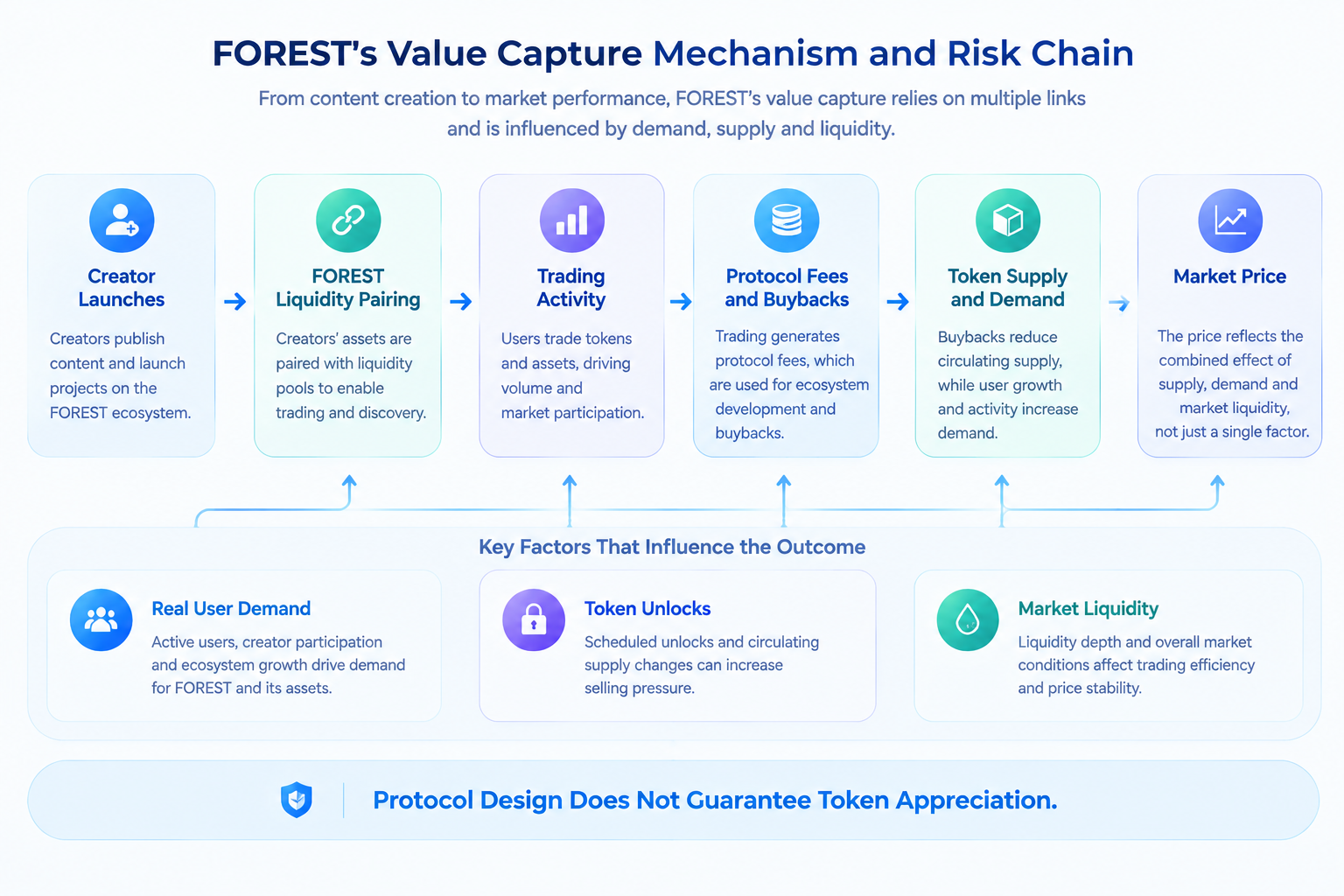
Forest Protocol positions FOREST as a core asset within its ecosystem economy. According to public project materials, its design involves base liquidity, trading routing, platform fees, and mechanisms related to staking and ecosystem incentives. The economic logic is that if more creators issue tokens through the protocol, users continue participating in games or applications, and related activity generates real transactions, demand for using FOREST may increase alongside ecosystem activity. This is a value-capture approach that links infrastructure usage with token demand.
However, token utility demand must be distinguished from investment returns. A token used for trade routing or fee payments does not necessarily increase in market price. Whether actual demand can affect price also depends on the scale of that demand relative to circulating supply and whether participants are willing to hold the token over the long term. If users use FOREST only briefly to complete transactions and then immediately exchange it for other assets, higher usage may not correspond to an equivalent increase in holding demand. Conversely, supply and demand dynamics may change more noticeably only if ecosystem growth also generates sustained demand for the base asset without market supply increasing at the same pace.
Project documentation also describes protocol fee buybacks, burns, and application-related buyback mechanisms. When evaluating these mechanisms, it is not enough to look only at labels such as "buyback" or "deflation." Specific rules should be verified: where fees come from, when buybacks are executed, how buyback amounts are determined, whether burns actually occur, and whether these operations have verifiable on-chain records. It is also important to note that buyback funds may come from trading fees, project revenue, or other sources, and the sustainability of each source varies. If ecosystem revenue is insufficient, incentive mechanisms may need to rely on token emissions, reserve funds, or external support to continue operating.
Therefore, FOREST's value-capture capacity should be viewed as an economic hypothesis that requires ongoing verification, rather than a result that can be confirmed solely through protocol design. More persuasive indicators include real application usage, sustained trading users, protocol fees, liquidity quality, and the execution of buybacks and burns. Only when these indicators support one another over a longer period can there be a stronger basis for determining whether ecosystem activity is being converted into sustainable token demand.
Supply Structure and Market Liquidity: Another Perspective on Price Volatility
Token supply is a factor that cannot be overlooked when analyzing FOREST. Public project materials list a total supply of 1 billion tokens, allocated across categories including the team and advisors, investors, public sale, staking, rewards, liquidity, and ecosystem-related allocations. The unlock schedules and actual circulating status of different categories affect the number of tokens available for trading in the market. Total supply is not the same as current circulating supply, and circulating supply is not the same as the number of tokens all holders are willing to sell. Potential selling pressure should be assessed in combination with unlock schedules, holder concentration, market depth, and actual trading activity.
When the circulating supply is relatively small and market depth is limited, even capital inflows that are not particularly large may cause significant price movements. If the market also sees social media attention, traders chasing price gains, or rotation of new capital, price movements may be further amplified. However, price appreciation alone cannot demonstrate that liquidity has improved. If trading is concentrated in a small number of pools or buy and sell orders are unevenly distributed, the market may still decline quickly when trading reverses. For short-term market conditions, trading volume, bid-ask spreads, and actual executable size are generally more informative than price gains alone.
Relevant reports on October 21, 2026, showed that FOREST increased by 133% over 24 hours. This data can help explain how market attention may become concentrated on a particular asset, but it should not be treated directly as confirmation of a long-term trend. First, the time period, quoted market, and data source used for the market statistics should be verified. Second, it is necessary to examine whether trading volume increased significantly during the rise, whether trading concentration was high, and whether the price could be maintained afterward. Without this information, a ranking based on price gains alone cannot determine whether the move resulted from fundamental changes, liquidity shocks, or short-term capital activity.
How to Assess FOREST's Sustainability: Moving From Market Interest to Verifiable Indicators
For Forest Protocol, a more useful approach is to break protocol growth into several interconnected indicators. The first category is product usage, including active applications, actual user participation, user retention, and repeat usage frequency. The second category is on-chain economic activity, including real transaction count, trading volume, liquidity depth, and fee revenue. The third category is token economics, including supply unlocks, changes in circulation, execution records for buybacks and burns, and concentration across different holder groups. The fourth category is market quality, including the sustainability of trading volume, bid-ask spreads, price impact, and liquidity differences across markets.
These indicators need to be interpreted together. For example, increased trading volume may represent stronger user activity, but it may also result from short-term speculation, arbitrage, or concentrated trading by a small number of accounts. An increase in token issuance may indicate that barriers for creators are low, but if most new projects quickly lose users, the number of issued tokens is unlikely to represent ecosystem quality. Likewise, token buybacks may reduce some market supply, but overall supply and demand may still face pressure if unlocks or reward distributions are larger during the same period. What matters is whether there is a sustainable relationship among activity, revenue, token demand, and supply changes.
In practical research, investors should also consider how verifiable disclosures are. Information provided by project websites, technical documentation, on-chain explorers, and market data platforms serves different purposes, but it may not use the same statistical standards. For descriptions involving future incentives, ecosystem partnerships, or potential airdrops, users should distinguish between mechanisms that have already been implemented and planned arrangements. In particular, potential rewards should not be treated as certain returns. Whether Forest Protocol can develop its token issuance infrastructure into a stable application ecosystem ultimately depends on sustained developer adoption, real user demand, execution of economic mechanisms, and market conditions—not the price performance of a single trading day.
Gate and FOREST: From Asset Trading to Project Research
Gate listed FOREST/USDT for spot trading on September 1, 2025. For users following this asset, Gate's market page and project-related announcements can serve as entry points for learning about the trading market, asset information, and platform rules. It is important to note that trading prices on centralized exchanges reflect supply and demand in specific markets and may differ from quotes in different liquidity pools on BNB Chain. When comparing them, users should also consider trading fees, network fees, spreads, withdrawal rules, and actual executable depth.
More importantly, trading channels should not replace project research. For ecosystem tokens such as FOREST, users can track project documentation updates, application activity, token unlocks, and changes in on-chain liquidity while monitoring market prices. Market conditions answer how an asset is traded at a specific point in time, while project research attempts to explain the mechanisms behind that pricing and whether related demand may continue. Combining both is more helpful for forming a complete assessment than relying only on gain rankings or short-term price forecasts.
FAQ
What are FOREST's primary uses?
According to public project materials, FOREST is designed as a base liquidity and trading routing asset within the Forest Protocol ecosystem and is associated with platform fees and ecosystem incentive mechanisms. The latest project documentation and verifiable execution records should be used to confirm whether specific uses and mechanisms have changed.
Does a large increase in FOREST mean the protocol's fundamentals are improving?
This conclusion cannot be drawn from price gains alone. Price may be affected by market sentiment, liquidity, trading concentration, and short-term capital inflows. Determining whether fundamentals are improving requires further examination of user activity, protocol fees, trading quality, and changes in token supply.
How can I determine whether FOREST's liquidity is healthy?
You can observe liquidity pool size, the sustainability of trading volume, bid-ask spreads, trade slippage, holder concentration, and liquidity differences across markets. A sudden increase in trading volume does not necessarily mean that market depth has improved at the same time.
What risks should receive the most attention when researching FOREST?
Key risks include token price volatility, insufficient liquidity, supply unlocks, application adoption below expectations, smart contract risks, and buyback or incentive mechanisms that do not execute as expected. Crypto assets can experience substantial losses, and research conclusions do not constitute a guarantee of investment returns.