The lending market is a vital component of the DeFi ecosystem and the core infrastructure for on-chain capital flows. Aave has long been the benchmark for Ethereum-based lending protocols, while EVAA is gradually becoming a key financial infrastructure within the TON ecosystem.
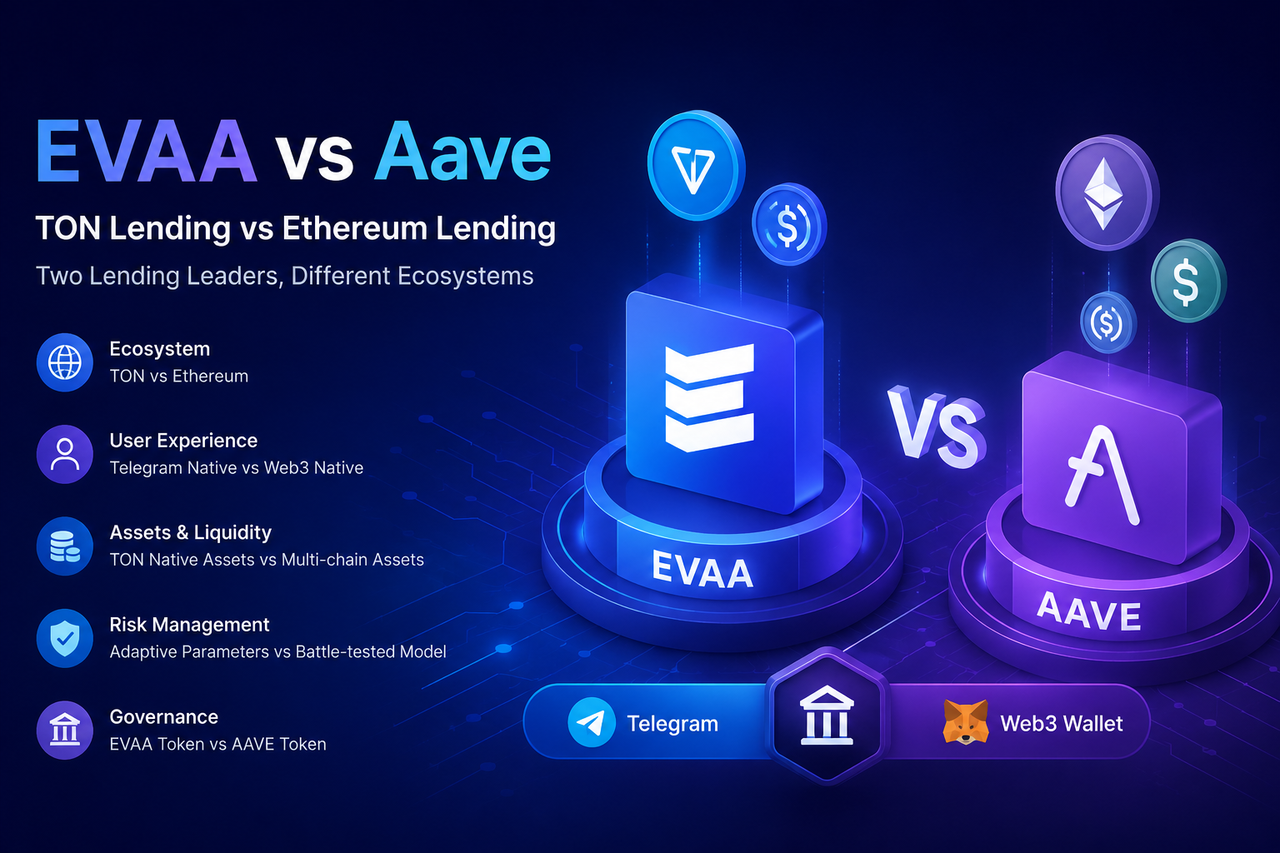
What Is EVAA?
EVAA Protocol, a decentralized lending protocol built on the TON blockchain, offers deposit and borrowing services through a liquidity pool model.
The protocol lets users deposit TON-native assets, stablecoins, and ecosystem tokens to earn yields, while gaining liquidity support via over-collateralization. EVAA aims to become the core capital market of the TON network.
Unlike traditional DeFi products, EVAA prioritizes a Telegram-native experience, using Telegram Mini App and TON Connect to lower the entry barrier for users to access DeFi.
EVAA's development trajectory is closely tied to the expansion of the TON ecosystem, positioning it as a foundational financial layer for TON.
What Is Aave?
Aave, one of the most iconic decentralized lending protocols in the Ethereum ecosystem, is also a pioneering innovation from the early days of DeFi.
Aave connects depositors and borrowers via liquidity pools, supports lending for a wide range of digital assets, and pioneered groundbreaking mechanisms like Flash Loans.
As DeFi expanded, Aave was deployed across multiple blockchain networks, including Ethereum, Polygon, Arbitrum, and Optimism.
Aave's mission is to build an open, cross-chain global capital market that serves a broad spectrum of crypto asset users and institutional participants.
What Are the Differences Between TON and Ethereum Ecosystems?
The most fundamental distinction between EVAA and Aave stems from their underlying networks.
TON was originally built for the Telegram user ecosystem, focusing on high-performance payments, social use cases, and mass user adoption—with the goal of serving hundreds of millions of users.
Ethereum, by contrast, is one of the most mature smart contract platforms, with a vast developer community, robust DeFi infrastructure, and a rich array of on-chain assets.
Accordingly, EVAA primarily serves TON-native users, while Aave targets the broader multi-chain DeFi market.
These ecosystem differences shape their development paths and user demographics.
How Does User Experience Differ?
User experience is one of the most noticeable differences between EVAA and Aave.
Aave users typically rely on Web3 wallets like MetaMask and access DeFi apps through a browser to conduct lending operations.
EVAA, on the other hand, can be accessed directly via Telegram Mini App, allowing users to interact with DeFi services within a familiar social environment.
For crypto-savvy users, the difference is minimal. But for newcomers to blockchain finance, the Telegram-native interface significantly lowers the learning curve.
This design makes EVAA feel more like a consumer-grade internet product.
How Do Liquidity Sources and Asset Systems Compare?
With a longer history and a large user base, Aave supports a broader range of assets.
Aave supports mainstream digital assets such as ETH, USDC, DAI, and WBTC, and features a mature cross-chain liquidity framework.
EVAA, by contrast, builds its liquidity market primarily around TON ecosystem assets, including TON, USDT-TON, and other TON-native tokens.
In terms of market size, Aave generally commands higher total liquidity, while EVAA is more focused on meeting the needs within the TON network.
This difference reflects their distinct stages of development and market positioning.
Are the Risk Management Mechanisms the Same?
Both protocols use an over-collateralized lending model.
Users must provide collateral worth more than the loan amount to minimize the risk of protocol bad debt.
They also set asset-specific risk parameters, including Loan-to-Value (LTV) ratio, liquidation threshold, and liquidation bonus.
When the value of collateralized assets drops, the protocol automatically triggers a liquidation mechanism to protect the liquidity pool.
While the underlying logic is similar, specific parameters are adjusted according to asset risk profiles and ecosystem conditions.
What Are the Differences in Governance Models?
EVAA and Aave both adopt a community governance model.
Aave's governance system has evolved over many years, allowing community members to propose and vote on protocol upgrades, risk parameter changes, and fund allocation using AAVE tokens.
EVAA drives governance through the EVAA Token and is gradually transitioning toward a DAO structure.
Given differences in ecosystem scale and maturity, Aave's governance is more established, while EVAA is still expanding and refining its framework.
Both reflect the broader trend of DeFi protocols evolving into decentralized autonomous organizations.
Which Scenarios Suit EVAA and Which Suit Aave?
For users primarily active in the TON ecosystem, EVAA offers a more natural environment.
They can directly use TON assets for lending and complete most operations through Telegram.
For users who need access to multi-chain assets, complex DeFi strategies, or institutional-grade liquidity, Aave provides broader market coverage.
The two are not competitors; they serve as similar financial infrastructure across different ecosystems.
Core Differences Between EVAA and Aave
| Comparison Dimension |
EVAA |
Aave |
| Ecosystem |
TON |
Ethereum and Multi-Chain |
| Core Positioning |
TON Lending Infrastructure |
Global DeFi Lending Market |
| User Entry |
Telegram Mini App |
Web3 Wallet |
| Primary Users |
Telegram Users |
DeFi Users |
| Asset System |
TON Native Assets |
Multi-Chain Mainstream Assets |
| Liquidity Scale |
TON Ecosystem Level |
Global DeFi Level |
| Governance Token |
EVAA |
AAVE |
| Ecosystem Goal |
Telegram Financial Gateway |
Multi-Chain Open Financial Market |
Summary
EVAA and Aave are both decentralized lending protocols that rely on liquidity pools, over-collateralization, and automatic liquidation. However, because they operate on different blockchain ecosystems, they differ significantly in user demographics, asset structure, product experience, and development goals.
Aave represents the mature lending market of Ethereum and multi-chain DeFi, while EVAA embodies the native financial infrastructure of the TON and Telegram ecosystem.
FAQs
What is the biggest difference between EVAA and Aave?
The main difference lies in the underlying ecosystem. EVAA is built on TON and serves Telegram users, whereas Aave primarily serves the Ethereum and multi-chain DeFi market.
Did EVAA reference Aave’s lending model?
Both EVAA and Aave use liquidity pools and over-collateralized lending, so they share similar basic logic. However, EVAA has been tailored for the TON ecosystem and Telegram environment.
Why does EVAA focus on Telegram integration?
Telegram has a massive user base. By offering a native entry point through Telegram Mini App, EVAA makes on-chain financial services more accessible to ordinary users.
Why is Aave’s liquidity generally higher than EVAA’s?
Aave has a longer track record and broader multi-chain deployment, attracting more capital and assets. EVAA, in contrast, focuses on the TON ecosystem’s internal market.
Source (for reference only):
借贷市场是 DeFi 生态的重要组成部分,也是链上资金流动的核心基础设施。Aave 长期被视为以太坊借贷协议的代表,而 EVAA 则逐渐成为 TON 生态的重要金融基础设施。
EVAA 是什么?
EVAA Protocol 作为构建于 TON 区块链上的去中心化借贷协议,通过流动性池模式为用户提供存款和借款服务。
协议允许用户存入 TON 原生资产、稳定币及生态资产赚取收益,同时通过超额抵押获得流动性支持。EVAA 的设计目标是成为 TON 网络中的核心资金市场。
与传统 DeFi 产品不同,EVAA 强调 Telegram 原生体验,并通过 Telegram Mini App 和 TON Connect 降低用户进入 DeFi 的门槛。
EVAA 的发展方向与 TON 生态扩张高度相关,其定位更接近 TON 金融基础设施层。
Aave 是什么?
Aave 作为以太坊生态最具代表性的去中心化借贷协议之一,也是 DeFi 行业早期的重要创新项目。
Aave 通过流动性池连接存款人与借款人,支持多种数字资产借贷,并率先推动闪电贷(Flash Loan)等创新机制的发展。
随着 DeFi 行业扩张,Aave 已部署至多个区块链网络,包括 Ethereum、Polygon、Arbitrum、Optimism 等。
Aave 的定位是构建开放且跨链的全球资金市场,其服务对象覆盖广泛的加密资产用户和机构参与者。
TON 与以太坊生态有哪些差异
EVAA 与 Aave 最根本的区别来自其所在网络。
TON 最初围绕 Telegram 用户生态发展,重点关注高性能支付、社交场景和大规模用户接入。其目标是让区块链能够服务数亿级用户。
以太坊则是当前最成熟的智能合约平台之一,拥有庞大的开发者社区、完善的 DeFi 基础设施以及丰富的链上资产体系。
因此,EVAA 更多服务于 TON 原生用户,而 Aave 面向整个多链 DeFi 市场。
网络生态的差异决定了两者的发展方向和用户结构。
用户体验有哪些不同
用户体验是 EVAA 与 Aave 最明显的区别之一。
Aave 的用户通常需要使用 MetaMask 等 Web3 钱包,并通过浏览器访问去中心化应用完成借贷操作。
EVAA 则能够直接接入 Telegram Mini App,使用户在熟悉的社交环境中访问 DeFi 服务。
对于加密原生用户而言,两种模式差异有限。但对于首次接触区块链金融产品的普通用户,Telegram 原生入口能够显著降低学习成本。
这种设计使 EVAA 更接近消费级互联网产品的使用体验。
流动性来源和资产体系有何区别
Aave 拥有较长的发展历史和庞大的用户基础,因此能够支持更丰富的资产种类。
Aave 支持包括 ETH、USDC、DAI、WBTC 等在内的大量主流数字资产,并具备成熟的跨链流动性体系。
EVAA 则主要围绕 TON 生态资产构建流动性市场,包括 TON、USDT-TON 以及其他 TON 原生资产。
从市场规模来看,Aave 的整体流动性通常更高,而 EVAA 则更专注于服务 TON 网络内部需求。
这种差异体现了两者不同的发展阶段和市场定位。
风险管理机制是否相同
两者都采用超额抵押借贷模型。
用户需要提供价值高于贷款金额的抵押品,以降低协议坏账风险。
同时,两者都会设置资产风险参数,包括贷款价值比(LTV)、清算阈值以及清算奖励比例。
当抵押资产价值下跌时,协议会自动触发清算机制,从而保护流动性池安全。
虽然底层逻辑相似,但具体参数会根据资产风险特征和生态环境进行调整。
治理模式有哪些差异
EVAA 和 Aave 都采用社区治理模式。
Aave 的治理体系已经发展多年,社区成员能够通过 AAVE 代币参与提案和投票,对协议升级、风险参数调整以及资金使用进行决策。
EVAA 则通过 EVAA Token 推动协议治理,并逐步向 DAO 结构演进。
由于生态规模和发展阶段不同,Aave 的治理体系更加成熟,而 EVAA 仍处于持续扩展和完善过程中。
两者都体现了 DeFi 协议向去中心化自治组织发展的趋势。
哪些场景更适合 EVAA,哪些场景更适合 Aave
对于主要活跃于 TON 生态的用户而言,EVAA 提供了更加自然的使用环境。
用户可以直接利用 TON 资产参与借贷活动,并通过 Telegram 完成大部分操作流程。
对于需要接触多链资产、复杂 DeFi 策略或机构级流动性的用户,Aave 提供更广泛的市场覆盖能力。
两者并非竞争关系,而是在不同生态中承担类似的金融基础设施角色。
EVAA 与 Aave 核心差异对比
| 对比维度 |
EVAA |
Aave |
| 所属生态 |
TON |
Ethereum及多链 |
| 核心定位 |
TON 借贷基础设施 |
全球化 DeFi 借贷市场 |
| 用户入口 |
Telegram Mini App |
Web3 钱包 |
| 主要用户 |
Telegram 用户 |
DeFi 用户 |
| 资产体系 |
TON 原生资产 |
多链主流资产 |
| 流动性规模 |
TON 生态级别 |
全球 DeFi 级别 |
| 治理代币 |
EVAA |
AAVE |
| 生态目标 |
Telegram 金融入口 |
多链开放金融市场 |
总结
EVAA 与 Aave 都属于去中心化借贷协议,并采用流动性池、超额抵押和自动清算等核心机制。然而,两者建立在不同区块链生态之上,因此在用户群体、资产结构、产品体验和发展目标方面形成了明显差异。
Aave 代表以太坊和多链 DeFi 的成熟借贷市场,而 EVAA 则代表 TON 和 Telegram 生态中的原生金融基础设施。
FAQs
EVAA 和 Aave 最大的区别是什么?
EVAA 和 Aave 最大的区别在于底层生态。EVAA 构建于 TON 网络并服务 Telegram 用户,而 Aave 主要服务以太坊及多链 DeFi 市场。
EVAA 是否参考了 Aave 的借贷模式?
EVAA 与 Aave 都采用流动性池和超额抵押借贷模型,因此在基础逻辑上存在相似性。但 EVAA 针对 TON 生态和 Telegram 场景进行了专门优化。
为什么 EVAA 强调 Telegram 集成?
Telegram 拥有庞大的用户基础。EVAA 通过 Telegram Mini App 提供原生入口,使普通用户能够更方便地接触链上金融服务。
Aave 的流动性为什么通常高于 EVAA?
Aave 拥有更长的发展历史和更广泛的多链部署,因此能够吸引更多资金和资产进入协议。EVAA 则主要服务 TON 生态内部市场。