As DeFi, blockchain games, and realtime on-chain applications grow rapidly on the Ethereum network, transaction confirmation speed has become an important factor shaping the user experience. Although the traditional Ethereum network offers strong security, transactions usually need to wait for formal block confirmation before execution is complete. In high-frequency interaction scenarios, this confirmation delay may affect transaction efficiency and increase uncertainty around on-chain execution.
The Pre-confirmation mechanism proposed by ETHGas is an infrastructure exploration centered on the idea of “Realtime Ethereum.” Its goal is to improve on-chain interaction speed and resource scheduling efficiency by confirming transaction execution results in advance, without changing Ethereum mainnet consensus.
What Is Pre-confirmation?
Pre-confirmation is a mechanism that allows transactions to receive execution confirmation before they are formally written into a block.
In the traditional Ethereum network, a transaction must go through broadcasting, ordering, inclusion, and block confirmation before the user can receive a final confirmation result. While this process helps ensure network security, the waiting time may affect execution efficiency in high-frequency trading scenarios.
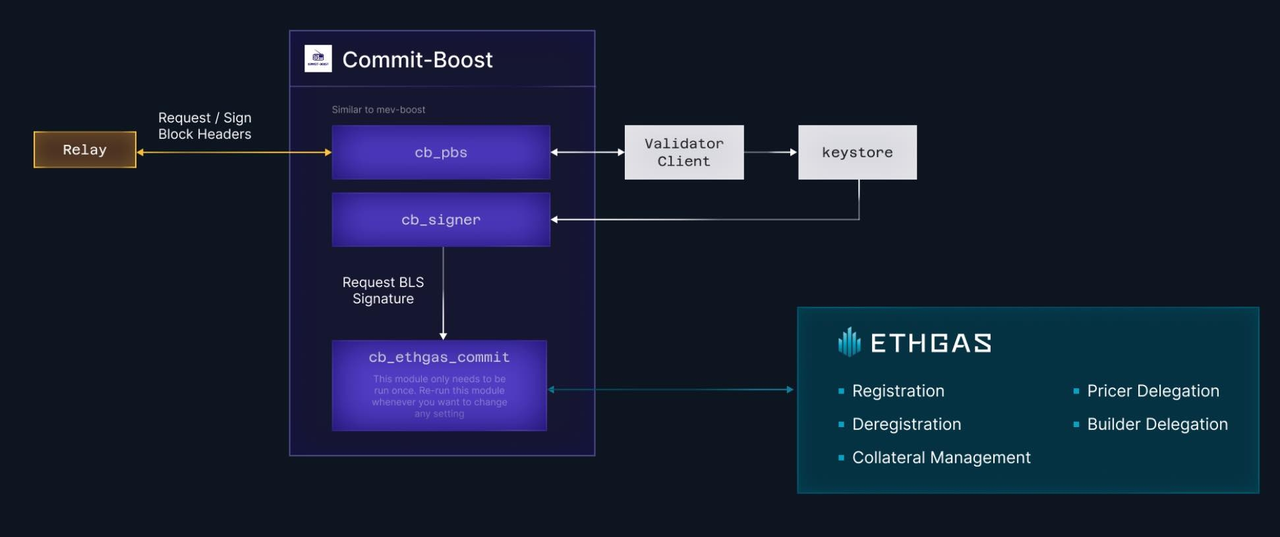
ETHGas’s Pre-confirmation mechanism attempts to provide, before formal on-chain confirmation, a signal from specific network participants that a transaction is expected to be executed. This mechanism allows users to receive transaction result feedback earlier and reduces the time spent waiting for formal block confirmation.
Pre-confirmation is not the same as final on-chain settlement. At its core, it is closer to a realtime execution commitment mechanism.
Why Does Ethereum Need Pre-confirmation?
Ethereum’s core strengths lie in decentralization and security, but the traditional block confirmation model is designed more for final settlement than realtime interaction.
As on-chain applications become more complex, some scenarios have begun to demand lower latency. For example:
-
High-frequency DeFi trading
-
On-chain order books
-
Realtime blockchain games
-
Automated arbitrage systems
-
Instant-interaction applications
In these scenarios, transaction confirmation time can directly affect execution results.
The traditional Ethereum Gas market relies on instant bidding and block ordering. Users usually need to increase their gas bids to compete for faster inclusion. But even with higher gas, they still need to wait for a block to be formally produced before receiving confirmation.
ETHGas aims to improve the realtime interaction experience by providing execution results before formal block confirmation through its Pre-confirmation mechanism.
How Does ETHGas Pre-confirmation Work?
ETHGas’s Pre-confirmation mechanism mainly revolves around Builders, Validators, and blockspace coordination.
After a user submits a transaction, the transaction is sent to a realtime blockspace coordination system. Some Builders then evaluate the transaction for pre-execution based on current block resources and transaction ordering logic.
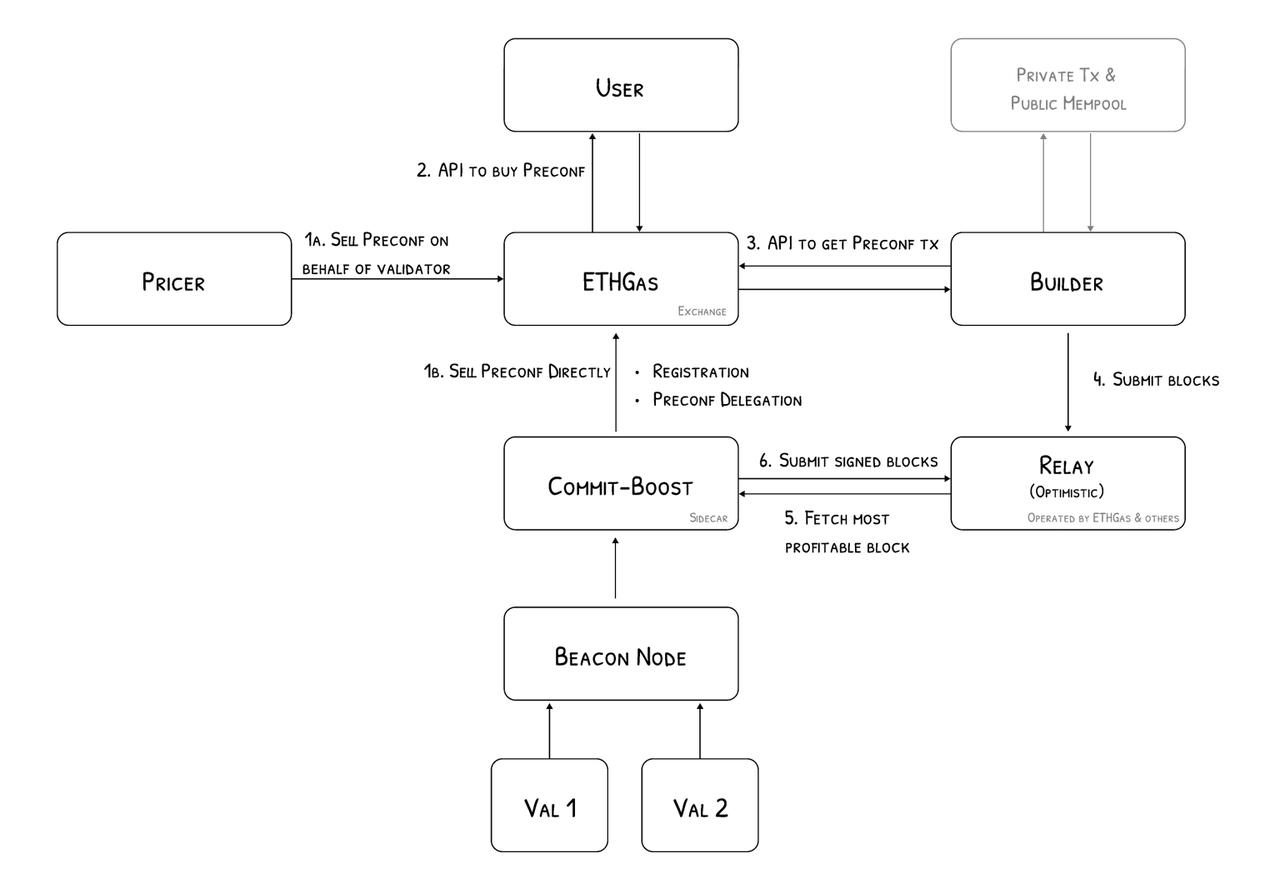
If the transaction meets the preset conditions, the system may return a “Pre-confirmation” result to the user in advance. This means the transaction is expected to be formally executed in a later block.
The process usually includes the following stages:
-
The user submits a transaction
-
A Builder receives and evaluates the transaction
-
Blockspace resources are coordinated
-
The system returns a Pre-confirmation result
-
A Validator completes formal confirmation in a later block
Compared with traditional on-chain confirmation, Pre-confirmation places greater emphasis on “realtime feedback” and “execution certainty.”
What Roles Do Builders and Validators Play in Pre-confirmation?
In ETHGas’s design, Builders and Validators take on different responsibilities.
Builders are mainly responsible for transaction ordering, block construction, and blockspace coordination. In the Pre-confirmation mechanism, Builders evaluate in advance whether a transaction can be included in a future block and provide users with pre-execution results.
Validators are responsible for subsequent formal block confirmation and on-chain consensus execution. Even if a transaction has received Pre-confirmation, its final state still needs to be formally confirmed through Ethereum mainnet.
This structure means:
ETHGas attempts to improve transaction execution efficiency through this layered structure, without changing Ethereum’s original consensus framework.
What Is the Difference Between Pre-confirmation and Final Confirmation?
Pre-confirmation and final confirmation are both used to confirm transaction status, but they differ clearly in execution level and security.
Pre-confirmation is early execution feedback before a transaction is formally recorded on-chain. Its focus is to improve the realtime interaction experience. Users can learn more quickly whether a transaction is expected to execute successfully.
Final confirmation is completed by Ethereum mainnet. Its result is formally written into the blockchain and becomes an irreversible on-chain state.
The differences can be summarized as follows:
| Comparison Dimension |
Pre-confirmation |
Final Confirmation |
| Execution Stage |
Before on-chain inclusion |
After on-chain inclusion |
| Goal |
Improve realtime performance |
Ensure final security |
| Return Speed |
Faster |
Relatively slower |
| State Nature |
Expected execution result |
Formal on-chain result |
| Dependency |
Builder / coordination layer |
Ethereum mainnet |
ETHGas’s design is not intended to replace final confirmation, but to add a realtime execution layer before final confirmation.
What Are the Potential Advantages of Pre-confirmation?
The Pre-confirmation mechanism can improve Ethereum’s interaction efficiency in realtime scenarios.
For users, faster transaction feedback can reduce waiting time and improve the on-chain interaction experience. For application developers, Pre-confirmation can help realtime applications gain more stable execution expectations.
Its potential advantages include:
-
Reducing transaction waiting time
-
Improving realtime on-chain interaction capability
-
Optimizing the high-frequency trading experience
-
Improving blockspace utilization efficiency
-
Strengthening execution certainty at the application layer
As realtime on-chain applications grow, Pre-confirmation may gradually become an important part of next-generation Ethereum infrastructure.
What Challenges Does ETHGas Pre-confirmation Face?
Although the Pre-confirmation mechanism can improve realtime performance, it also faces certain technical and ecosystem challenges.
First, Pre-confirmation needs to balance realtime performance and security. Since a transaction has not yet been formally written into a block, a Pre-confirmation result is not the same as the final on-chain state.
Second, Builders and the block coordination layer may introduce new centralization risks. If some blockspace resources are controlled by only a small number of participants, Ethereum’s original open structure may be affected.
In addition, realtime blockspace markets are still in an early stage of development. Their incentive mechanisms, compatibility, and standardization direction are still being explored.
For ETHGas, how to improve realtime performance while preserving Ethereum’s decentralized characteristics remains one of the key questions for this direction.
Summary
ETHGas’s Pre-confirmation mechanism is an infrastructure design intended to improve Ethereum’s realtime transaction experience. Its core goal is to provide users with faster transaction execution feedback before formal on-chain confirmation.
By combining Builder coordination, blockspace markets, and realtime execution mechanisms, ETHGas attempts to build a new transaction execution layer under the “Realtime Ethereum” direction. Although the related mechanisms are still developing, Pre-confirmation has already become one of the important directions for improving realtime performance in Ethereum infrastructure.
FAQs
No. Pre-confirmation is early execution feedback before formal on-chain confirmation. The final state still needs to be confirmed by Ethereum mainnet.
Why do realtime applications need Pre-confirmation?
Realtime applications usually need lower latency and faster feedback, while traditional Ethereum block confirmation times may affect the interaction experience.
Does Pre-confirmation change Ethereum’s consensus mechanism?
No. ETHGas’s Pre-confirmation mechanism mainly runs on top of Ethereum’s existing infrastructure and does not replace mainnet consensus.
What is the Builder responsible for in the Pre-confirmation mechanism?
The Builder is mainly responsible for transaction ordering, block construction, and blockspace coordination, and returns Pre-confirmation results to users.
Does Pre-confirmation involve risks?
Yes, it involves certain risks. Since the transaction has not yet been formally recorded on-chain, the Pre-confirmation result is not the same as the final on-chain state.
It is related to some extent. Mechanisms such as Pre-confirmation, transaction ordering, and blockspace coordination are connected to Ethereum’s MEV ecosystem.







