In November 2026, DTCC announced plans to expand its tokenization services to Solana, further extending its existing multichain technology strategy. This development raises an important question for the security tokenization market: When stocks exist in tokenized form, do investors actually hold an interest in the underlying securities, or merely digital assets linked to stock prices?
Over the past several years, various on-chain stock products have emerged. Some are backed by real stocks and provide corresponding economic rights through custody, issuance, and redemption arrangements. Others use synthetic structures that track stock prices through derivatives, collateral, or smart contracts. These products may have similar token names, price performance, and on-chain transfer functionality, but their asset sources, legal rights, counterparty risks, and settlement methods differ. Blockchain can improve the efficiency of recording and transferring assets, but technology alone cannot determine whether token holders own rights in the underlying stock.
DTCC's multichain strategy further highlights this distinction. Solana, Canton, and Besu represent different blockchain technology architectures, while tokenized securities backed by real assets and synthetic stock tokens are different financial product structures. Network performance and the legal attributes of an asset must be analyzed separately. This article starts with DTCC's securities custody system, compares tokenized securities and synthetic stock tokens in terms of asset backing, ownership, settlement, and risk management, and analyzes the roles of Solana, Canton, and Besu in institutional-grade security tokenization.
Key Takeaways
-
DTCC tokenized securities are based on eligible securities held in DTC custody. Their goal is to give existing securities interests an on-chain representation rather than create a separate, independent stock.
-
Synthetic stock tokens primarily provide exposure to stock prices through contracts, derivatives, or collateral mechanisms. Holders do not necessarily own securities interests in the underlying stock.
-
Tokenized products backed by real stocks are not necessarily issued by DTCC. Not all on-chain stocks outside DTCC's system should be classified as synthetic assets.
-
Solana, Canton, and Besu primarily involve network architecture, privacy, permissions, and interoperability. None of them alone determines a token's legal attributes.
-
Completing an on-chain transfer does not necessarily mean that the funding leg of a securities transaction, legal finality, and asset-rights updates have all been completed.
-
When adopting securities tokenization infrastructure, institutions need to consider asset custody, investor protection, compliance controls, and consistency across records in different systems.
1. Why Is DTCC Building a Multichain Securities Tokenization Infrastructure?
DTCC is an important post-trade infrastructure institution in the U.S. securities market. Its subsidiary DTC is responsible for centralized securities custody and related asset services. In the traditional securities system, investors trade stocks through brokers, while securities interests are maintained jointly through multiple intermediaries and ledger records. Blockchain can provide a new digital representation for securities, but if these tokens cannot connect with existing custody, settlement, and asset service systems, on-chain records and traditional ledgers could become disconnected. DTCC's core objective in promoting securities tokenization is to bring securities into a new digital financial environment while preserving existing legal and operational safeguards.
On October 28, 2026, DTCC Tokenization Service (DTS) officially launched, initially connecting Canton Network and DTCC's private Besu network. On November 12, DTCC announced plans to expand the service to Solana in the second half of 2027, allowing eligible securities held in DTC custody to receive tokenized representations in a new blockchain environment. DTS is designed to allow eligible participants to convert securities between traditional and on-chain forms and manage the assets through related digital wallets. This model does not involve public companies reissuing stocks. Instead, it connects existing securities interests with blockchain records.
The value of a multichain architecture lies in providing technology choices for different financial institutions. Some institutions prioritize transaction privacy and data-access permissions. Others want to use a smart contract environment compatible with Ethereum, while some want to explore asset liquidity and application scenarios on public blockchains. DTCC needs to maintain consistent asset management logic across different networks and prevent the same securities interest from being counted more than once as a result of conversion or cross-network operations. Compared with simply increasing transaction speed, ensuring that asset records, legal rights, and settlement obligations remain consistent across different systems is the more complex aspect of institutional-grade securities tokenization.
2. How Does DTCC Tokenization Service Ensure That On-Chain Tokens Correspond to Real Securities?
DTS is based on eligible securities already held in DTC custody. Eligible participants can use the service to convert traditional securities holdings into on-chain tokenized representations. This process requires confirmation that the underlying assets exist, that participants have the necessary qualifications, and that token creation and holding-record adjustments are completed in accordance with the service rules. Tokenized and traditional forms can be converted between one another. The goal is to allow the same securities interest to be used in different technology environments rather than create an additional unsupported security through token issuance.
At the asset-management level, DTS needs to maintain the relationship between traditional securities ledgers and blockchain records. For example, after an institution converts part of its DTC-custodied securities into tokenized form, the relevant systems must be able to identify that these interests now exist in another form and prevent the traditional and on-chain accounts from making duplicate claims on the same asset. When the assets are converted back, the relevant burning and record-update processes must also restore the traditional form. DTS also includes controls for minting, burning, suspension, and recovery, and provides related tools to track holdings across traditional ledgers and on-chain records.
This design differs significantly from the issuance of ordinary crypto assets. The value of a typical token may derive primarily from market demand, protocol rules, or an issuer's commitment, while DTC tokenized securities emphasize consistency with existing securities interests. The legal and economic attributes of these tokens come from the underlying securities and their custody arrangements, not from the blockchain network itself. However, this does not mean holders can bypass brokers, custodians, or regulatory requirements to exercise all ownership rights directly. The entities permitted to hold, transfer, and convert the assets remain subject to DTC participant rules, service conditions, and applicable law.
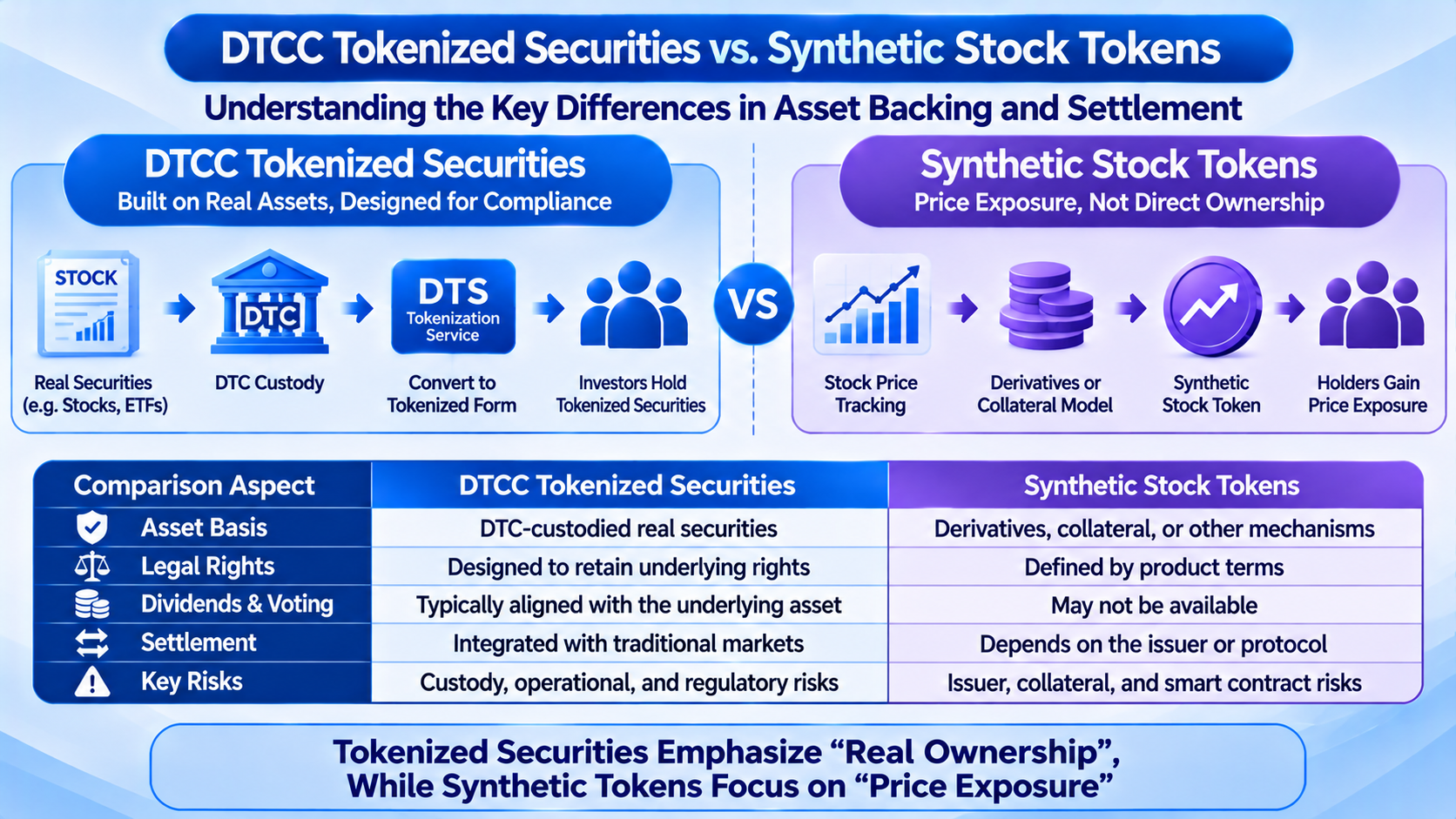
3. What Is the Fundamental Difference Between DTCC Tokenized Securities and Synthetic Stock Tokens?
Synthetic stock tokens generally refer to digital assets that provide economic exposure related to the price of a particular stock through derivatives, collateral arrangements, or other financial contracts. Suppose a token tracks NVIDIA's stock price. The holder may gain if NVIDIA's stock price rises and incur losses if it falls, but this does not mean that the issuer holds one share of NVIDIA stock for each token. Nor does it mean that the holder automatically becomes a NVIDIA shareholder. Whether the product can pay dividend-equivalent returns, whether it supports redemption, and what rights can be asserted in a dispute must all be determined by the specific contract.
DTC tokenized securities, by contrast, are built on real securities held in custody, with the goal of preserving the legal rights, economic benefits, and investor protections associated with traditional securities. The key difference is not whether blockchain is used, but what assets and legal relationships exist behind the tokens. Tokenization of real securities must address the custody of underlying assets, the recording of rights, and conversion. Synthetic stock tokens depend more on how the issuer or protocol maintains price exposure and whether the related collateral, pricing, and contractual mechanisms operate properly. Even if the prices of the two products move closely together, the risks borne by their holders may be entirely different.
It is also necessary to distinguish synthetic stock tokens from other stock tokens backed by real assets. Some products on the market are issued by independent entities that hold real stocks and issue corresponding on-chain tokens. These products are not necessarily synthetic assets, but the rights of their holders may still differ substantially from those associated with DTCC tokenized securities. Actual stock backing, direct registration of equity, indirect securities interests, and contractual claims to returns are different legal concepts. Determining a product's attributes requires examining its underlying assets, custody relationships, issuer, and legal documents. All on-chain stocks outside DTCC's system cannot simply be classified as synthetic tokens.
4. Why Doesn't Holding an On-Chain Stock Token Necessarily Mean Owning the Stock?
In the U.S. securities market, ordinary investors who purchase stocks through brokers generally enjoy securities interests through an indirect holding structure. Stocks may be registered through centralized custody, while investors obtain corresponding economic benefits and rights through securities accounts and related legal arrangements. Shareholders directly registered on a public company's shareholder register differ from investors who hold securities interests through brokers in terms of their holding structure and procedures for exercising rights. Securities tokenization does not automatically eliminate this distinction, and an on-chain token balance alone cannot determine a holder's ultimate legal status.
Blockchain is well suited to recording token issuance, transfers, and balance changes, but stock ownership involves much more, including issuer registration, securities interests, dividend distribution, voting arrangements, and legal recourse. If a token merely provides synthetic price exposure, the holder may have only a contractual claim against the issuer or smart contract. Even if a token is backed by real stocks, investors still need to confirm the legal structure through which they hold the asset, whether they can demand redemption, and how their interests are protected if the issuer or custodian encounters problems.
DTCC's tokenization service emphasizes maintaining investor protections and ownership interests associated with traditional securities. However, this does not mean that all holders of on-chain wallets automatically become directly registered shareholders of a public company. Actual rights are still exercised through the relevant custody and participant structures. For investors, the most important question is not whether the token can be transferred around the clock, but what legal documents support their rights if dividends are distributed, the company undergoes a restructuring, a trading dispute arises, or an institution defaults. Only when these matters are clearly arranged can on-chain stocks potentially develop from price-tracking instruments into securities assets that can be used broadly in financial activities.
5. What Are the Differences Between Solana, Canton, and Besu in DTCC's Tokenization System?
Solana, Canton, and Besu are often discussed together, but they are not exactly the same type of technology product. Solana is a public blockchain that supports smart contracts and an open application ecosystem. Canton is a public network designed for regulated financial use cases, with an emphasis on privacy protection and interoperability. Besu is an open-source client compatible with the Ethereum technology stack that can be used to operate public or permissioned blockchains. DTCC uses a private network built on Besu. When comparing the three, it is necessary to distinguish between the underlying network, software client, and specific deployment environment. Besu should not be treated simply as an independent public blockchain equivalent to Solana.
Canton's defining feature is its ability to allow financial institutions to manage the visibility of transaction data in a shared network environment and connect different applications through interoperability mechanisms. In areas such as securities custody, collateral management, and interinstitutional settlement, participants often need to share asset states while protecting customer information and commercial transaction data. DTCC's private Besu network can support institutional operations through permission management, smart contracts, and customizable operating rules. Solana's open network and high throughput create the possibility of connecting securities tokenization with public blockchain applications, but the technical attributes of a public network do not eliminate transfer restrictions applicable to regulated securities.
| Comparison Dimension |
Solana |
Canton Network |
DTCC Private Besu Network |
| Technology Type |
Public Layer 1 blockchain |
Public blockchain focused on privacy and interoperability |
Private network based on Besu |
| Key Features |
Open ecosystem, high throughput |
Transaction privacy, institutional interoperability |
Permission management, EVM compatibility |
| Asset Permissions |
Can be restricted through applications and contracts |
Controlled through application rules |
Can be controlled through network and contract permissions |
| DTS Status |
Planned connection in the second half of 2027 |
Connected |
Connected |
| Primary Focus |
Public blockchain connectivity and asset availability |
Privacy and cross-application collaboration |
Operational control and system integration |
The differences among the three primarily concern how assets are recorded, who can access the relevant data, and how financial institutions execute and coordinate transactions. Regardless of which network ultimately hosts the securities, their legal attributes still depend on the issuance, custody, and holding arrangements. DTCC's multichain strategy seeks to connect these common asset interests with different networks, allowing market participants to select infrastructure based on their business needs rather than establishing a completely independent securities system for every blockchain.
6. How Do the Settlement Mechanisms for DTCC Tokenized Securities and Synthetic Stock Tokens Differ?
Traditional securities transactions include trade execution, clearing, and settlement. After buyers and sellers agree to a transaction, they must confirm the securities and funds to be delivered and complete final settlement in accordance with applicable rules. The U.S. stock market has adopted a T+1 standard settlement cycle, but the speed of token transfers on a blockchain and the full settlement cycle of a securities transaction are different concepts. Even if an on-chain transaction is confirmed within a short period, this does not mean that the corresponding payment, legal obligations, and custody records have all been completed.
The settlement design for DTC tokenized securities must connect with existing securities market infrastructure. When participants use tokenized securities for trading, collateral, or asset transfers, the system must not only confirm the on-chain token transfer but also ensure that the underlying securities interests remain consistent with traditional ledgers. If a transaction involves payment, the delivery of securities and payment of funds must also be coordinated. A delivery-versus-payment (DvP) mechanism can link securities delivery with the corresponding payment and reduce the risk that one party delivers assets while the other fails to pay. In July 2026, DTCC validated multiple scenarios in production trading activities, including stock DvP, U.S. Treasury repo transactions, securities lending, and collateral transfers.
The settlement of synthetic stock tokens depends on the specific product structure. Some synthetic assets use smart contracts and collateral management to execute on-chain transactions. Holders receive gains or losses related to stock prices rather than direct delivery of the underlying stocks. After a transaction is completed, a smart contract may update token balances or margin status without synchronizing an actual transfer of stock ownership. If the product uses a centralized issuance or derivatives structure, final settlement may also depend on the issuer, trading platform, or other financial intermediaries. Both models may enable faster on-chain operations, but they settle different things: one involves actual securities interests, while the other may primarily settle price exposure specified by a contract.
7. Why Must Multichain Securities Tokenization Address Duplicate Asset Counting and Cross-Chain Settlement?
When the same securities can be converted among traditional ledgers, Canton, Besu, and the future Solana network, one of the most important technical issues is ensuring that asset records remain consistent. Suppose an institution originally holds securities interests equivalent to 1,000 shares of a public company and converts 300 of those shares into on-chain form. The system must be able to confirm that the traditional and tokenized forms together still represent 1,000 shares, rather than creating additional securities interests because both ledgers display holdings simultaneously. If the tokens are subsequently converted to another network, the original representation must also be handled appropriately to prevent different networks from making duplicate claims on the same asset.
Cross-chain settlement also involves coordinating states across networks. Solana, Canton, and the private Besu network have different transaction confirmation methods, permission mechanisms, and operating environments. It cannot be assumed that once a transaction is confirmed on one network, the same result will automatically be synchronized to the others. Cross-network asset transfers may require trusted conversion services, controlled minting and burning processes, or other interoperability mechanisms. Participants must also confirm the asset status during conversion, recovery procedures after a failed transaction, and how to prevent inconsistent records in the event of a network failure.
DTCC's multichain design emphasizes interoperability between traditional and digital asset environments and provides related token lifecycle management capabilities. The value of this architecture lies in reducing asset silos among different networks, but its actual effectiveness still depends on conversion rules, participant access, and cross-system reconciliation capabilities. For institutional markets, the ultimate goal is not merely to view securities tokens across multiple chains. More important is ensuring that every conversion, transfer, and settlement corresponds to clearly defined asset interests that can be verified legally and operationally.
8. Why Are Regulatory Controls an Important Part of DTCC Tokenized Securities?
Securities tokenization does not remove an asset from the traditional securities regulatory framework simply because a public blockchain is used. Stocks, ETFs, and U.S. Treasuries involve different trading, custody, investor protection, and market oversight requirements. Relevant institutions must still identify participants, enforce applicable transfer restrictions, and address erroneous transactions or legal disputes that may arise. Ordinary crypto assets may allow transfers to any address based on protocol design, but regulated securities generally require clearer holder eligibility and asset management rules. Even if DTS connects to Solana in the future, this does not mean that any Solana wallet will be able to freely receive or trade all DTC tokenized securities.
DTS's token management mechanisms include minting, burning, suspension, and recovery functions that can support asset conversion, compliance controls, and the handling of exceptional circumstances. These capabilities allow relevant institutions to manage securities interests within the existing legal framework. They also mean that tokenized securities use a different control model from digital assets that rely entirely on smart contracts that cannot be intervened in. For financial institutions, permissions and operational management are not merely technical limitations. They are part of maintaining the integrity of asset records, resolving disputes, and fulfilling regulatory obligations.
Synthetic stock tokens may also be subject to securities or derivatives regulation, but the applicable rules depend on the product's actual economic structure, issuer, and sales region. The fact that a product does not directly hold stocks does not mean that it is not a regulated financial instrument. Investors need to separately review the issuer's legal status, product disclosures, collateral arrangements, and trading restrictions. A token's operation on a decentralized network does not by itself establish that it is outside regulatory requirements. Likewise, support from a traditional financial institution does not eliminate the need to consider the product's specific risks.
9. How Can Investors Distinguish Real Securities Tokenization from Synthetic Stock Products?
To determine the nature of an on-chain stock product, investors should first confirm the source of the assets behind the token. Products backed by real securities should have verifiable asset custody and issuance arrangements and should explain the relationship between the token and the underlying stock. For synthetic stock tokens, investors need to understand the method used to track prices, the source of collateral, liquidation rules, and the issuer's obligations. If a product merely promises cash settlement based on the price of a particular stock without providing corresponding securities interests, investors should not treat it as direct ownership of the stock. A token name, trading symbol, or price chart is not sufficient on its own to prove asset ownership.
Investors should also analyze the rights they can exercise, including dividends, voting, redemption, and recourse to assets. Some tokens backed by real stocks may provide only certain economic benefits, and holders may not be able to exercise voting rights in the public company directly. Some synthetic products may provide dividend-equivalent adjustments through contracts, but this remains different from receiving a dividend distributed by the public company. Investors should also consider the credit risk of the issuer and custodian, confirm whether the assets are segregated from the issuer's own assets, and determine what procedures apply if the issuer becomes insolvent, redemptions are suspended, or a system failure occurs.
Finally, investors should review the trading and settlement conditions. Whether a token can be freely transferred, whether it supports around-the-clock trading, whether it has sufficient market liquidity, and whether an on-chain transfer changes the legal securities interest can all affect the actual investment experience. For DTC tokenized securities, investors should also consider specific participation eligibility and network support. For synthetic stock tokens, they should focus on collateral ratios, price oracles, liquidation mechanisms, and counterparty risks. Understanding these differences can help investors avoid treating products with similar technical forms as having the same asset protection.
Conclusion
The fundamental difference between DTCC tokenized securities and synthetic stock tokens is not whether they use blockchain technology, but the asset foundation and legal rights behind the tokens. DTS is based on eligible securities held in DTC custody and seeks to give those assets an on-chain representation while preserving existing securities interests, economic benefits, and investor protections. Synthetic stock tokens generally provide price exposure through derivatives, collateral arrangements, or other contracts. Their holders do not necessarily own securities interests in the underlying stocks. Both products may support on-chain transfers, but their ownership, settlement objects, and risk structures differ significantly.
The comparison among Solana, Canton, and Besu concerns a different layer. Canton emphasizes privacy and interoperability. DTCC's private Besu network provides a customizable environment for permissions and smart contracts. Solana offers a new possibility for connecting securities tokenization with the public blockchain ecosystem. DTCC launched DTS in October 2026 and plans to connect it to Solana in the second half of 2027. This reflects the expansion of traditional securities infrastructure into multichain environments, but the choice of network itself cannot determine whether a token represents an interest in real stock.
As the RWA market develops, competition in securities tokenization may gradually shift from simply improving transaction speed toward asset rights, settlement efficiency, and cross-system interoperability. For financial institutions and investors, clearly identifying the ownership of underlying assets, confirming legal rights, ensuring settlement finality, and establishing reliable asset management mechanisms are more important than simply mapping stock prices onto a blockchain.
FAQ
What Is the Difference Between DTCC Tokenized Securities and Synthetic Stock Tokens?
DTCC tokenized securities are based on eligible securities held in DTC custody and are designed to preserve the corresponding securities interests. Synthetic stock tokens generally provide exposure to stock prices through financial contracts, and holders do not necessarily own the underlying stocks.
Do DTCC Tokenized Securities Necessarily Represent Direct Ownership of Stocks?
Not necessarily. Tokenized securities can preserve the corresponding securities interests, but the holding structure may still involve securities intermediaries and centralized custody. This does not mean that holders automatically become directly registered shareholders of a public company.
Are All Tokenized Stocks on Solana Synthetic Assets?
No. A token's asset attributes depend on its issuance and custody structure, not on the blockchain where it operates. Solana can support different types of digital assets, including tokenized products backed by real assets.
What Is the Difference Between Canton and Besu?
Canton is a blockchain network focused on privacy protection and interoperability. Besu is an Ethereum-compatible open-source client that can be used to build different types of blockchains. DTCC uses a private network based on Besu.
Has DTCC Already Launched Tokenized Securities on Solana?
As of November 13, 2026, DTCC has announced plans to connect to Solana, with implementation expected in the second half of 2027. DTS is currently connected to Canton Network and DTCC's private Besu network.
Can Synthetic Stock Tokens Receive Dividends?
This depends on the product's contract. Some products may provide cash adjustments or economic benefits related to dividends, but this is not the same as holders directly receiving dividends distributed by a public company.
Can On-Chain Securities Trading Achieve Instant Settlement?
Blockchain can accelerate asset transfers, but complete securities settlement also involves payment, confirmation of asset rights, and legal finality. Whether faster final settlement is possible depends on the specific settlement architecture.
Why Is DTCC's Multichain Architecture Important?
A multichain architecture can allow eligible securities to be used in different technology environments, but it must ensure consistency between traditional ledgers and on-chain records and prevent the same securities interest from being counted more than once.