On November 12, 2026, DTCC announced plans to expand the DTCC Tokenization Service (DTS) to Solana, allowing eligible DTC-custodied securities to obtain tokenized representations through the Solana blockchain. The integration is expected to launch in the second half of 2027 as part of the next phase of DTCC's plan to expand its multichain securities infrastructure.
The significance of this development is not simply that a traditional financial institution has chosen a public blockchain. Rather, it shows that securities tokenization is gradually moving from technical validation into real-world market infrastructure. On October 28, 2026, DTS officially launched, initially connecting Canton Network and DTCC's private Besu network. The service supports eligible participants in converting traditional custodied securities into on-chain forms. Unlike digital assets that merely track stock prices, DTC-tokenized securities are designed to preserve the ownership interests, economic benefits, and investor protections associated with the underlying securities.
The ability to transfer stocks on a blockchain does not automatically mean that holders have shareholder rights in a publicly listed company. Nor does the completion of an on-chain transfer mean that all settlement steps for a traditional securities transaction have been completed. The legal rights behind the token, asset custody arrangements, transaction settlement structure, and regulatory responsibilities are the factors that determine whether securities tokenization can enter mainstream financial markets. This article examines DTCC's plan to connect to Solana, including how traditional securities can be represented on-chain, how ownership can be confirmed, and how different blockchain networks can connect with existing securities settlement systems.
Key Takeaways
- DTCC announced on November 12, 2026, that it plans to connect DTS to Solana. Related support is expected to become available in the second half of 2027. This does not mean tokenized securities trading has already been fully opened on Solana.
- DTS officially launched on October 28, 2026, initially supporting Canton Network and DTCC's private Besu network.
- DTCC's tokenization solution is based on real securities held in DTC custody and emphasizes legal and economic consistency between on-chain tokens and traditional securities interests.
- Tokenized stocks do not necessarily represent direct registered ownership of shares in a publicly listed company. Investors must distinguish between custodial interests, indirect ownership structures, and on-chain token records.
- On-chain transfers, securities delivery, and cash settlement are separate steps. Faster transaction processing does not mean that all legal and clearing procedures will be completed automatically.
- Solana, Canton, and Besu represent different technical and network architectures. The legal characteristics of a security cannot be determined solely by the type of blockchain involved.
- The broader adoption of securities tokenization depends on the confirmation of asset rights, regulatory controls, cross-system reconciliation, and settlement finality—not merely on blockchain transaction speed.
Why Does DTCC Plan to Expand Its Securities Tokenization Service to Solana?
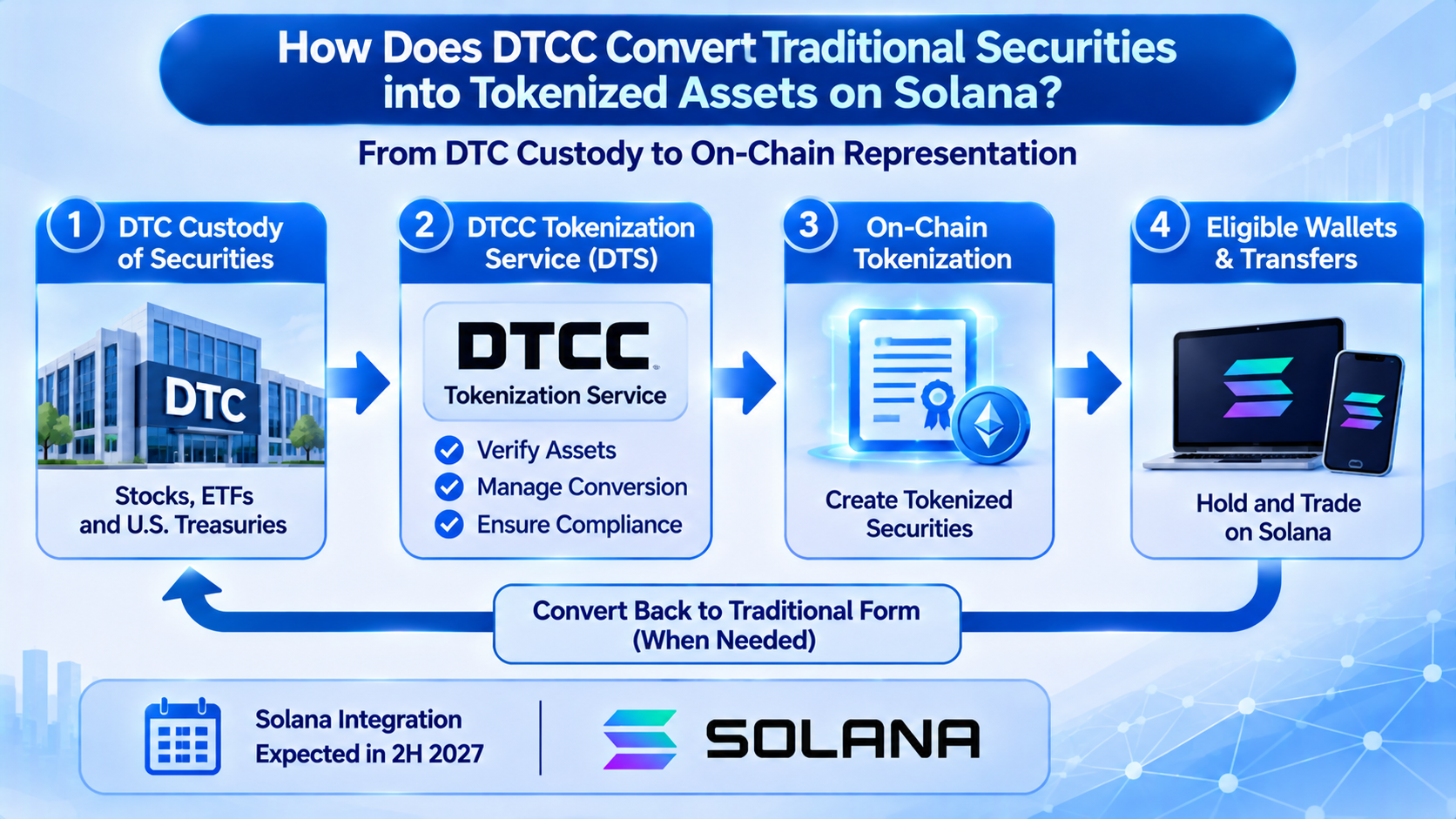
DTCC performs important post-trade infrastructure functions in the U.S. securities market. After a securities transaction is completed, the relevant institutions still need to handle clearing, settlement, asset custody, position records, and corporate actions. As a central securities depository, DTC provides securities custody and asset servicing for financial institutions, helping market participants manage securities interests through shared infrastructure. As blockchain technology enters the financial markets, traditional securities systems face a new question: Can securities be transferred and used on-chain without changing the legal characteristics of the underlying assets?
DTS, which launched in October 2026, was designed to address this question. The service allows eligible DTC participants to convert custodied securities into tokenized forms and use them on supported blockchain networks and in related wallet environments. DTCC initially selected Canton Network and its private Besu network as the foundation for the integration before announcing plans to add Solana to the supported networks. The addition of Solana can provide market participants with more network options and create conditions for future asset flows between traditional financial systems and public blockchain environments. However, the specific functionality will depend on subsequent implementation and participant eligibility.
DTCC's multichain architecture also reflects how securities tokenization has different requirements from general crypto asset issuance. Financial institutions need to consider not only a network's processing capabilities but also asset permissions, data privacy, transaction records, regulatory review, and operational stability. Different institutions may use different blockchain infrastructures. If tokenized securities can circulate only within a single network, new asset silos could emerge. By connecting traditional securities custody systems with multiple networks, DTCC is attempting to improve the usability of securities across different technical environments while preserving existing market infrastructure.
How Does DTCC Tokenization Service Convert Traditional Securities Into On-Chain Assets?
The core function of DTS is not to reissue shares of a publicly listed company. Instead, it establishes corresponding on-chain representations for eligible securities already held in DTC custody. In traditional securities markets, assets such as stocks are generally recorded through centralized custody and the books of intermediaries. The rights held by investors depend on securities accounts, custody arrangements, and applicable legal frameworks. The tokenization service adds blockchain records to this system, allowing eligible securities interests to be converted between traditional and tokenized forms. It does not create a new asset separate from the original security.
This process requires maintaining the relationship between the underlying security and the on-chain token. When an eligible participant applies to convert a security into tokenized form, the system must confirm that the relevant asset is available and generate an on-chain token through the appropriate process. If the participant wants to convert the tokenized position back into traditional form, the relevant conversion and burn mechanisms must be used to update the records. DTS uses a tokenization design linked to securities held in DTC custody. Its objective is to maintain the asset backing relationship and prevent the same securities interests from being counted twice across traditional and on-chain books. Specific operations remain subject to participant rules, technical interfaces, and asset eligibility requirements.
This differs significantly from certain on-chain products that reference stock prices. Some digital assets may track stock prices through derivatives, collateral arrangements, or issuer commitments, but holders may not have the securities interests associated with the underlying stock. DTS emphasizes continuity between the tokenized form and the original securities held in DTC custody. Investors should focus not on whether a token uses a stock's name or ticker, but on what underlying asset it represents, who is responsible for custody, what legal rights the holder has, and whether clear conversion and rights-preservation mechanisms exist.
Why Is Ownership of Tokenized Stocks More Important Than On-Chain Transaction Speed?
In traditional securities markets, investors who purchase stocks through a broker are generally not registered in their own names on the issuing company's shareholder register. Instead, they hold the corresponding interests through securities intermediaries and centralized custody systems. The U.S. market widely uses an indirect holding structure, under which investors' rights are established through securities accounts, securities entitlements, and applicable laws. Investors may receive the corresponding economic benefits, but their legal relationship with the issuer may differ from that of a directly registered shareholder. Converting stocks into on-chain tokens does not automatically change these legal relationships.
A blockchain can record how many tokens an address holds and when the tokens are transferred. However, the on-chain record alone cannot fully answer questions such as who is entitled to dividends, who can exercise voting rights, or how assets can be recovered in the event of a dispute. If a token merely tracks a stock price, the holder may have only a contractual claim against the issuer rather than a securities interest in the underlying stock. If a token represents a real custodied security, it is still necessary to clarify how the related interests are transferred among the on-chain address, the custodian, and the end investor. Ownership concerns the legal characteristics of the asset, not merely the balance displayed in a digital wallet.
DTCC's solution emphasizes preserving the investor protections, ownership interests, and economic benefits associated with traditional securities. Its significance lies in attempting to connect on-chain records with an established securities legal framework.
However, this should not be understood to mean that all token holders automatically become directly registered shareholders of a publicly listed company. Specific rights still depend on the DTC custody structure, the participant's identity, and the relevant legal arrangements. For institutional investors, clear allocation of rights can reduce legal uncertainty in using the assets and help tokenized securities enter financial scenarios that require clearly defined asset interests, such as collateralized financing and securities lending.
How Do DTCC Tokenized Securities Differ From Ordinary On-Chain Stock Products?
On-chain stock products in the market do not all use the same asset structure. Some products are backed by actual stocks and provide corresponding economic benefits through a custodian or a specific issuance arrangement. Others use synthetic asset structures that track stock prices through derivatives, collateral, or other contractual arrangements. Both types of products may use blockchain records to track holdings and transfers, but the rights ultimately received by investors differ. Determining whether a tokenized stock actually represents an underlying security requires more than checking whether the issuance quantity matches the number of shares. Investors must also verify the issuer, custodian, legal documents, and asset conversion rules.
A key feature of DTS is that it provides tokenization services through existing securities market infrastructure, with the relevant assets originating from eligible securities held in DTC custody. The tokenized and traditional forms have a defined conversion structure, while the corresponding securities interests are preserved. By contrast, synthetic stock tokens generally aim to provide price exposure. Whether holders receive dividends, voting rights, or physical delivery rights depends on the product's contract. Even if a synthetic product accurately tracks a stock price, that does not establish that its holders have shareholder rights in the underlying company.
| Comparison Dimension |
DTC-Tokenized Securities |
Synthetic Stock Tokens |
| Asset Basis |
Eligible securities held in DTC custody |
Derivatives, collateral, or other price-tracking arrangements |
| Core Objective |
Convert existing securities interests into on-chain form |
Provide exposure to stock prices |
| Ownership |
Preserves the corresponding securities interests, subject to the holding structure |
Does not necessarily include interests in the underlying stock |
| Dividends and Other Benefits |
Handled according to the relevant securities and service rules |
Depends on the product contract |
| Conversion to Traditional Securities |
Includes a corresponding conversion mechanism |
Not necessarily supported |
| Primary Risks |
Custody, operational, settlement, and compliance risks |
Issuer, collateral, pricing, and contractual risks |
This distinction does not mean that all on-chain stocks issued outside of DTCC are synthetic assets. The market also includes tokenized products backed by real stocks, whose legal structures and redemption mechanisms may differ from those of pure price-tracking instruments. Investors must assess each product's asset characteristics rather than classifying it solely by its issuing platform or blockchain. The significance of DTS is that it directly connects securities tokenization with the existing centralized custody system in the United States, providing traditional financial institutions with another infrastructure option for using securities on-chain.
How Do On-Chain Transfers Differ From Securities Settlement?
A blockchain can complete token transfers in a relatively short time, but transactions and settlement in securities markets are not the same concept. A transaction generally refers to the agreement between a buyer and seller to trade a security. Clearing involves confirming and calculating transaction obligations and managing related risks. Settlement involves delivering the securities and funds as agreed. The traditional U.S. stock market has adopted the T+1 standard settlement cycle, but this cycle covers more than the transfer of securities records. It also involves funding arrangements, counterparty obligations, and coordination among market infrastructures. The rapid transfer of an on-chain token does not automatically mean that all obligations associated with a securities transaction have been fulfilled.
Securities tokenization can change the technical method used to deliver assets. For example, subject to applicable conditions, tokenized securities can be transferred through smart contracts or digital asset infrastructure and connected more closely with on-chain payment instruments. Delivery versus Payment (DvP) is an important settlement principle that links the delivery of securities with the corresponding payment of funds, reducing the risk that one party delivers the asset while the other fails to complete payment. If a security is transferred on-chain while payment still relies on a separate traditional banking system, the two steps require additional coordination mechanisms.
In July 2026, DTCC had already validated multiple scenarios in production trading activity, including DvP for U.S. Treasury repurchase agreements, stock DvP, securities lending, and collateral transfers.
These activities show that the potential applications of securities tokenization are not limited to stock trading. They may also extend to asset transfers and collateral management between financial institutions. However, the speed of asset transfers at the technical level and settlement finality under the law must still be assessed separately. Whether a securities transfer is irrevocable, whether the related payment has been completed, whether participants satisfy the applicable rules, and how errors are handled are all components of a complete settlement mechanism.
What Roles Do Solana, Canton, and Besu Play in DTCC's Multichain Architecture?
DTCC's multichain strategy is not simply about copying the same securities onto different blockchains. Rather, it aims to provide market participants with different technical network options under a unified framework for securities interests and asset management. DTS initially connected Canton Network and DTCC's private Besu network, while Solana is planned to join in the second half of 2027. The three networks have different architectural characteristics, but the security, legality, or investment value of their securities products cannot be determined solely by whether they are public or permissioned blockchains.
Canton Network is designed for financial applications that require privacy protection and interoperability. It allows participants to process relevant data and transactions according to permissions within a shared network environment. Besu is an open-source client compatible with the Ethereum technology stack and can be used to deploy different types of blockchain networks. DTCC uses a private Besu network that can deploy securities tokenization functionality based on specific participant permissions and operational requirements. Solana is a high-performance public blockchain with an open network and smart contract ecosystem. Once connected to DTS, it could provide eligible institutions with another technical environment for using tokenized securities.
| Network |
Technical Characteristics |
Relationship With DTS |
| Canton Network |
Focuses on privacy protection, permissions, and interoperability |
Already connected |
| DTCC Private Besu Network |
Compatible with the Ethereum technology stack and supports customized permission management |
Already connected |
| Solana |
High-performance public blockchain that supports smart contracts and an open ecosystem |
Planned connection in the second half of 2027 |
It is important to emphasize that Solana's public network characteristics do not mean that DTC-tokenized securities will automatically be open to all wallets. Eligibility to transfer the securities remains subject to the applicable participant rules and regulatory requirements. DTS also includes minting, burning, suspension, and recovery controls to support asset management and compliance operations.
The central challenge for a multichain architecture is maintaining consistency across different systems. The same securities interests must not be counted twice when transferred across networks, and verifiable correspondence must be maintained between traditional books and on-chain records.
Why Do Tokenized Securities Still Require Regulatory Controls and Asset Custody?
Blockchain programmability can automate some securities operations, but regulatory responsibilities in traditional securities markets do not disappear when assets move on-chain. The issuance, custody, trading, transfer, and investor protection of securities involve different legal and regulatory requirements. Relevant institutions must still identify participants, process restricted asset transfers, and enforce judicial or regulatory requirements when necessary. For regulated tokenized securities, allowing any address to freely receive and transfer assets may not comply with the applicable legal and operational conditions.
DTS retains corresponding asset control capabilities, including token minting and burning, suspension, and recovery functions. These mechanisms can help operators handle erroneous transfers, compliance restrictions, and other situations requiring intervention. Unlike some crypto assets that emphasize transfers free from intervention, regulated securities may need to retain clear administrative permissions within their technical systems. This design does not mean that blockchain records have no value. Rather, it reflects the need for securities tokenization to satisfy both technical efficiency and legal enforcement requirements.
Custody systems are equally essential. A blockchain wallet can prove that an address controls a specific token, but investors must still confirm who holds the underlying securities, how the asset interests are recorded, and how operational issues at the custodian would be handled. As part of the existing securities custody system, DTC provides tokenized assets with a clear source of underlying assets and an operational framework. Expanding participation in the future will also depend on cooperation among brokers, custodians, wallet service providers, and settlement participants. Securities tokenization does not eliminate intermediaries entirely. Instead, it attempts to reduce repetitive operations through new technology and reorganize certain intermediary functions.
How Will DTCC's Connection to Solana Affect the RWA and On-Chain Stock Markets?
DTCC's plan to connect to Solana provides a new perspective on the RWA market: Traditional financial infrastructure is attempting to bring real securities interests into more blockchain environments, rather than relying solely on independent issuers to launch price-tracking products. For institutional investors, tokenized securities may improve asset transfers, collateral management, and cross-platform settlement efficiency. For example, if a financial institution can convert assets traditionally held in the securities system into on-chain form in compliance with applicable rules, it may be able to use those assets in new digital finance scenarios without establishing an entirely separate underlying securities issuance structure.
Whether these applications can achieve scale will still depend on whether market participants are willing to adopt new asset management processes. Traditional securities markets already have mature custody, clearing, and settlement systems. Institutions will not move substantial business merely because a particular blockchain processes transactions faster. The relevant infrastructure is more likely to generate sustained demand only when tokenization can actually reduce operating costs, improve collateral liquidity, reduce settlement risk, or support financial services that are difficult to provide through traditional systems. Cross-network asset transfers, on-chain cash settlement, and unified asset records also require further solutions for technical compatibility and operational coordination.
For the Solana ecosystem, DTCC's connection plan could expand its use in institutional RWA scenarios. However, it should not be interpreted as meaning that large amounts of U.S. stocks will soon become available to ordinary on-chain users. Nor can it be used to simply conclude that demand for SOL will necessarily increase. Whether tokenized securities can enter specific applications, which institutions are eligible to participate, and which assets must be used for trading and settlement will all depend on the actual implementation plan. To assess the long-term value of this development, observers should focus on the scale of real-world assets, the number of participating institutions, trading and settlement activity, and interoperability with existing financial systems—not judge its market impact solely on the basis of a partnership announcement.
Conclusion
DTCC's plan to connect DTS to Solana is an important development in the expansion of traditional securities market infrastructure into a multichain environment. DTS officially launched in October 2026 and initially connected Canton Network and DTCC's private Besu network. Solana is expected to be added in the second half of 2027, providing eligible market participants with more blockchain network options and creating new possibilities for connecting traditionally custodied securities with public blockchain ecosystems.
The core of this plan is not simply to convert stocks into blockchain tokens. It is to ensure that the tokenized form preserves the legal rights, economic benefits, and regulatory protections of the original securities. Holding tokens at an on-chain address does not necessarily mean directly registered ownership of shares in a publicly listed company. Completing an on-chain transfer does not necessarily mean that all settlement obligations associated with a securities transaction have been fulfilled. Asset custody, confirmation of rights, delivery of funds, and settlement finality remain essential components of the securities market.
As the RWA and tokenized securities markets develop, blockchain performance will continue to affect the efficiency of asset transfers. However, whether institutions can adopt the technology at scale will also depend on legal certainty, consistency of asset records, risk management, and cross-system interoperability. The long-term significance of DTCC's connection to Solana lies in exploring how existing securities interests can enter new digital finance environments while maintaining the rights protections and operating standards on which traditional markets depend.
FAQ
Has DTCC Already Issued Tokenized Stocks on Solana?
As of November 13, 2026, DTCC has announced plans to connect DTS to Solana, with implementation expected in the second half of 2027. This does not mean that the relevant securities have already been fully opened for trading on Solana.
What Is DTCC Tokenization Service?
DTS is a securities tokenization service provided by DTC, a DTCC subsidiary. It supports the conversion of eligible custodied securities between traditional and on-chain tokenized forms while preserving the corresponding securities interests and investor protections.
How Do DTCC Tokenized Securities Differ From Synthetic Stock Tokens?
DTC-tokenized securities are based on actual custodied securities and emphasize the corresponding legal and economic interests. Synthetic stock tokens generally provide price exposure and do not necessarily grant holders interests in the underlying stock. The specific rights depend on the issuance structure and contract.
Does Holding Tokenized Stock Mean That I Am a Shareholder of a Publicly Listed Company?
Not necessarily. Investors may hold securities interests indirectly through securities intermediaries or custody systems rather than being directly registered as company shareholders. Specific rights depend on the legal structure and product rules.
Can Tokenized Securities on Solana Be Transferred Freely?
Not necessarily. Securities related to DTS must comply with participant eligibility, compliance, and transfer restrictions. Solana is a public blockchain, but that does not mean that all tokenized securities can be freely transferred to any wallet.
What Are the Differences Among Canton, Besu, and Solana?
Canton focuses on privacy and interoperability in financial applications. Besu is an Ethereum-compatible blockchain client, and DTCC uses its private network. Solana is a high-performance public blockchain. The three networks have different architectures, but the legal rights associated with securities depend on the specific issuance and custody arrangements.
Does an On-Chain Securities Transfer Mean That Settlement Is Completed Instantly?
Not necessarily. An on-chain transfer can improve the efficiency of asset delivery, but complete securities settlement also involves payment of funds, participant obligations, legal finality, and related operational procedures.