For day traders deciding between Daily High/Low vs. Session High/Low, the practical answer isn't to choose one and ignore the other. Use daily levels to establish context, then session levels to refine entries, stop placement, and profit targets. The catch is that different markets define a trading day and trading session differently, so traders need consistent chart settings before comparing levels.
Key Takeaways
-
Session High/Low usually fits scalping better because session extremes sit closer to current price action and update as London, New York, or Asian trading develops.
-
Daily High/Low gives broader day trading context, showing the full day's price extreme and whether buyers or sellers are controlling the larger range.
-
Prior session highs and lows often become watched liquidity zones where stop orders, breakout entries, and reversal setups can cluster.
-
A break above a high doesn't automatically mean continuation. Price may break the level, trigger orders, and quickly move in the opposite direction in a liquidity sweep.
-
Daily and session levels work best as context rather than standalone trading signals. Volume, trend, volatility, and price reaction still matter.
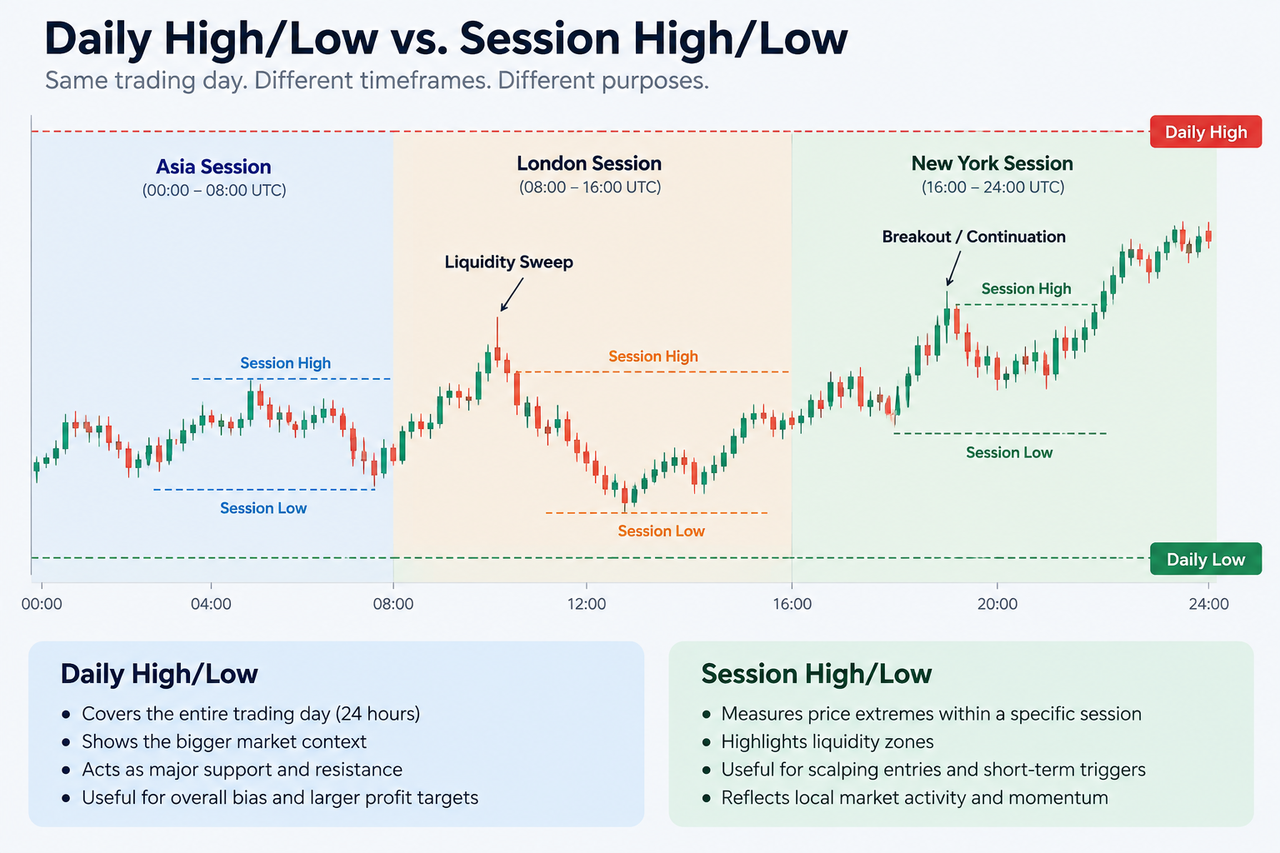
Daily High/Low vs. Session High/Low: The Core Difference
The daily high is the highest price reached during a defined trading day, while the daily low is its lowest price. Together, the two levels describe the complete high-low range for that day.
A Daily High/Low level therefore provides a broad structural boundary. Traders may use it to gauge daily market strength, volatility, support and resistance, or whether price is approaching an extreme where existing positions could be closed.
Session High/Low looks at a smaller window. A Session High/Low measures the highest and lowest prices reached during a specific trading session, such as Asia, London, or New York.
| Feature |
Daily High/Low |
Session High/Low |
| Measurement period |
Entire defined trading day |
Specific trading session |
| Main role |
Broader market structure |
Short-term market structure |
| Scalping usefulness |
Context and larger targets |
Entries, triggers and near-term targets |
| Liquidity focus |
Daily extremes |
Prior/current session extremes |
| Changes during day |
Expands when a new daily extreme forms |
Resets with each session |
| Typical use |
Bias, major support/resistance |
Sweeps, breakouts, reversals |
The distinction becomes especially important in continuously traded markets. Cryptocurrency trades around the clock, while traditional venues can have clearly defined opening, core, and extended sessions. For example, NYSE trading hours define a 9:30 a.m.–4:00 p.m. ET core session for NYSE-listed equities. CME's cryptocurrency derivatives now operate on a largely continuous schedule with specified maintenance periods, showing why a trader shouldn't assume every market uses the same daily boundary.
Why Session High Low Often Fits a Scalping Trading Strategy
Scalping focuses on relatively small moves over short periods. Session levels naturally match that time horizon.
Suppose BTC trades inside a tight range during the Asia session. The Asian session high then becomes an obvious nearby reference point as London liquidity enters the market. If price briefly moves through that high and immediately falls back below it, traders may interpret the move as a possible liquidity grab rather than a clean breakout.
That setup exists because orders can accumulate around obvious highs and lows. Stop-loss orders from short positions may sit above session highs, while stops from long positions may cluster below session lows. Breakout traders may also place entries outside those same levels.
A sweep doesn't guarantee a reversal. The real move could continue through the level, particularly when volume and volatility expand. Scalpers therefore watch what price does after the break instead of treating the high or low itself as a signal.
London Session, Session Highs and Liquidity
The London session is closely watched in many intraday markets because it overlaps with European trading activity and later overlaps with New York. Session highs and lows formed around these active periods can help traders map localized liquidity.
For example, assume price reaches 64,200 during Asia, making that the session high. London opens, BTC pushes to 64,260, then falls rapidly back below 64,200.
A trader might mark the move as a possible liquidity sweep. Confirmation could come from bearish price action, increasing sell volume, rejection from another resistance level, or a trend filter.
Now switch the outcome. Price breaks 64,200, holds above it and forms higher lows while volume remains firm. The same session high has become a potential breakout level rather than a reversal trigger.
That is why scalping session extremes requires context. The level identifies where to watch; price behavior determines whether there is a usable setup.
How Daily High Low Helps With Day Trading Context
Daily High/Low becomes more useful when a trader needs to understand where a short-term setup sits within the larger trading day.
Imagine New York price approaches the London session high, but that level is also only a few points below the current daily high. A breakout now has to clear two closely spaced resistance references. That can matter for entries, stop placement and realistic profit targets.
Daily highs and lows also help traders judge whether the market is already stretched. If price has spent half the trading day moving upward and is now testing the daily high, chasing a late breakout has a different risk profile from entering when price is in the middle of the day's distribution.
This broader role complements tools such as VWAP vs. EMA, where VWAP can provide an intraday price benchmark while the daily extremes define the day's outer structure.
Price Action Around Session High Low
There are three common ways price can interact with a session extreme.
Rejection: Price reaches the high or low, fails to break it convincingly and reverses. Traders may treat the level as short-term resistance or support.
Liquidity sweep: Price briefly trades beyond the extreme before returning inside the previous range. Traders often wait for the reclaim rather than assuming every wick beyond a level is a sweep.
Breakout and continuation: Price clears the level, holds beyond it and continues in the same direction. A rising-volume environment or broader trend can strengthen the context, though neither guarantees continuation.
A SuperTrend and VWAP combination can add trend and intraday-value context, while EMA 9, EMA 20 and EMA 50 can help distinguish immediate momentum from the broader intraday trend.
Using High Low Levels for Entries and Profit Targets
A simple method is to mark the previous session high and low before the next active session starts. Then mark the current daily high and low separately.
Instead of entering as soon as price touches a level, wait for a trigger. That could be a rejection bar, failed breakout, retest, momentum shift, or volume expansion.
Profit targets should also reflect nearby structure. A trader entering after a sweep of the session high might initially watch VWAP, the session midpoint, the opposite session extreme, or another established support level rather than assuming price must travel to the daily low.
For live chart practice, traders can observe how these levels behave on the BTC/USDT perpetual market on Gate.com. Traders who want to practice identifying session highs, stops and targets without committing real capital can also use Gate's futures test environment; its demo trading uses simulated funds rather than live-account assets.
Which High Low Method Is Better for Scalping?
For precise scalping timing, Session High/Low normally has the edge because its levels reflect the most recent localized trading activity.
For market context, Daily High/Low is stronger because it shows where current price sits within the full trading day's range.
The most practical trading strategy combines both:
Daily High/Low → context Session High/Low → setup location Price action → trigger Volume or trend tools → confirmation Risk controls → position management
A scalper could, for example, establish bullish daily context, watch price sweep a London session low, then require price to reclaim that low before considering an entry. Another trader may decide not to take the setup if the daily high is too close to provide a reasonable target.
Neither method makes a setup profitable by itself. The edge comes from consistently defining the levels, waiting for suitable conditions, controlling cost and risk, and avoiding trades where the expected reward doesn't justify the downside.
Risks of Treating High and Low Levels as Signals
The biggest mistake is assuming that a high or low must hold.
Markets regularly trade through obvious levels. Some breaks become genuine continuation moves, while others reverse immediately. News, sudden volatility and high-volume trading can also make an otherwise clean level much less reliable.
Definitions matter too. A crypto exchange, futures venue and equity exchange may use different trading-day boundaries. Daylight-saving changes can also alter the relationship between London, New York and a trader's local clock.
Leverage raises the stakes. The U.S. Commodity Futures Trading Commission notes that leverage can magnify both gains and losses in futures trading, making risk capital and position sizing particularly important for short-term speculation.
Conclusion: Daily High Low vs. Session High Low for Scalping
Session High/Low is generally the more useful tool for scalping entries because it tracks nearby price extremes and localized liquidity, while Daily High/Low is better for understanding the broader trading-day structure.
Using both solves different parts of the same problem. Daily levels show where the market is in the larger range; session levels show where short-term liquidity, support, resistance and potential triggers may form.
The level alone isn't the trade. Scalpers still need price action, volatility, volume, trend context and disciplined risk management before deciding whether to enter, wait or close positions.
FAQ
Is Daily High/Low or Session High/Low better for scalping?
Session High/Low is generally better suited to short-term entry timing because the levels reflect recent trading activity. Daily High/Low is more useful as broader context and for identifying larger intraday boundaries.
What happens when price breaks a session high?
A break of a session high can develop into a breakout, a stop run or a liquidity sweep. Traders usually watch whether price holds above the level or quickly returns below it before interpreting the move.
Why do traders watch prior session highs and lows?
Prior session extremes are visible reference points where stop orders, breakout orders and other liquidity may cluster. That can make them useful areas for observing reversals, continuations and changes in short-term market structure.
Yes. A daily high can form during London, New York, Asia or another period depending on market conditions. No trading session is guaranteed to create the day's final extreme.
Should stop-loss orders be placed exactly at session highs or lows?
Not automatically. Stops placed directly around obvious highs and lows may be exposed to normal volatility or liquidity sweeps. Stop placement should depend on the setup, volatility, invalidation level and acceptable risk.
Do session highs and lows work in crypto markets?
Yes, traders can divide 24/7 crypto trading into regional sessions and track their extremes. Because crypto doesn't have one universal exchange-defined session structure, traders should define their session times consistently and account for timezone and daylight-saving changes.