What is Casper Network maps the chain, consensus, and contract layer; CSPR tokenomics focuses on how the native token funds fees, secures the network, and pays validators. Casper Network is a Proof of Stake blockchain oriented toward enterprise-grade smart contracts and real-world assets; CSPR is a functional asset inside that PoS design—not a standalone narrative detached from protocol rules.
Reading CSPR staking and supply correctly means separating protocol mechanics from third-party staking products and from one-off market-data snapshots. Fee burning, the validator auction, delegation, and unbonding form the main line through Casper’s token economy. Protocol staking can distribute protocol rewards under auction and era rules; that description is not a yield promise.

What Is CSPR Used for on Casper Network?
CSPR is Casper Network’s native utility token. Its core jobs fall into three buckets: paying for network operations, staking (as a validator or through delegation), and supporting validator incentive economics. Separating those jobs helps avoid reading “what CSPR does” as “what CSPR’s price will do.” Holders who stake do not automatically receive a marketed rate—they receive protocol-defined rewards only after choosing validator or delegation participation under auction and bid rules.
On the fee side, users and contract calls spend CSPR to cover execution and related system costs. How fees are handled—paid to the proposer, eliminated, burned, or otherwise—depends on the live mainnet chainspec and protocol version. On the security side, validators and delegators lock CSPR into stake weight that participates in block production and finality; higher weight generally means greater influence in the auction and consensus. On the incentive side, validators receive protocol-issued rewards for proposing and confirming blocks and may share rewards with delegators under protocol and bid rules.
| Utility dimension |
CSPR role |
How to read it |
| Network fees |
Pays for transactions and execution |
Fee, refund, and burn rules follow mainnet config |
| Staking security |
Validator self-stake + delegated stake |
Weight enters the auction and consensus |
| Validator incentives |
Protocol rewards and delegator splits |
Separate protocol rewards from third-party APY UIs |
The table shows that CSPR answers how Casper Network prices work and how it secures state—not what return any holder should expect. When comparing Casper with other smart-contract chains, finality semantics and institutional permissioning often matter more than a generic “native coin utility” checklist; Casper vs Ethereum contrasts finality and RWA-oriented settlement differences.
How Should Readers Interpret CSPR Supply and Circulation?
CSPR supply should be read across circulating supply, total supply, and maximum supply (hard cap), with the data source and observation date stated. Circulating supply is not the same as total supply. When a maximum-supply field shows infinity, the aggregator is not publishing a fixed hard cap—that is not the same claim as “there is no issuance schedule.”
As of July 2026, CoinMarketCap’s illustrative figures show roughly 16.6 billion CSPR circulating, about 19.7 billion CSPR in total supply, and a maximum supply marked as unlimited (∞). Figures move with minting, unlocks, burns, and methodology, so verification should use the live page and explorers rather than treating one snapshot as a permanent constant.
At the macro level, Casper economics materials describe CSPR as growing from a genesis base at a fixed annual rate: issuance is meant to incentivize staking and support onchain activity, not to maximize absolute scarcity in a “digital gold” style. A practical reading order is: separate circulating / total / hard-cap fields, then understand how issuance reaches validators and delegators, then layer fee-burn and other supply-side mechanics—still without price inference.
How Do Fees and Burning Affect CSPR Tokenomics?
Fee handling decides where user-paid CSPR goes. Historically, configurations could pay fees to the block proposer, eliminate fees, or use other modes. Public materials for Casper 2.1 emphasize permanent protocol-level burning of transaction fees, so network activity removes CSPR from circulation rather than redistributing those fees to individual proposers.
Burning does not by itself remove validator incentives: public explanations state that validators continue to receive rewards issued through block validation and related protocol paths. For builders, protocol-level burn mainly changes the accounting path of fees leaving circulation and is often described as a more transparent, predictable fee environment. Exact parameters, refund ratios, and chainspec fields still follow mainnet configuration and docs.casper.network.
Fee burning is a mechanism statement. It describes supply-side accounting and incentive separation; it is not a forecast that scarcity will move market price. Treating “burn” as a guaranteed price catalyst confuses protocol parameters with investment conclusions.
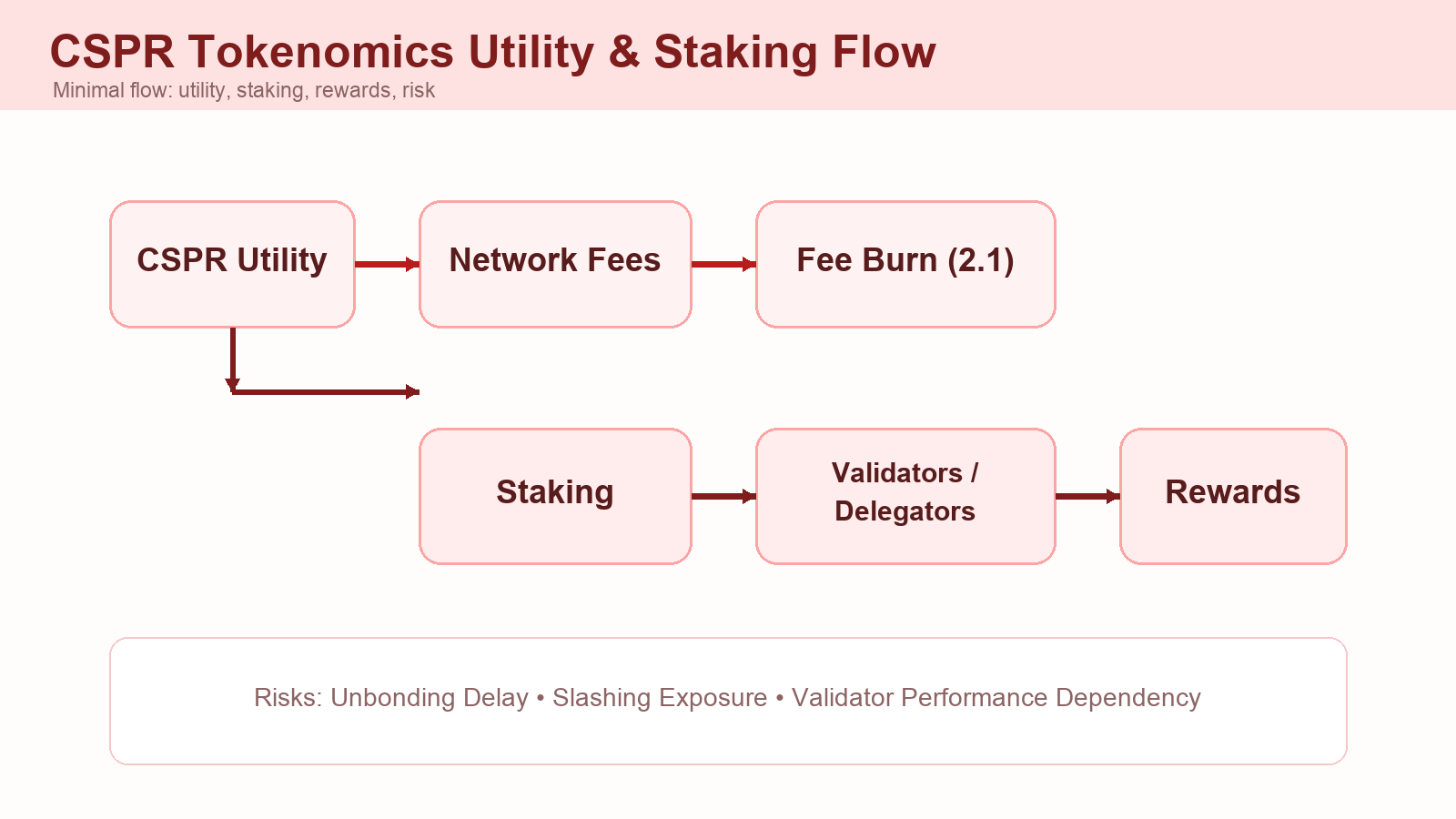
Figure 1. CSPR tokenomics line: utility → fees and protocol-level burn → staking → validators.
How Do CSPR Staking and Validators Work?
Casper Network staking sits inside this blockchain’s PoS security model. Validators use stake weight to propose, echo, and finalize blocks. Delegators can delegate CSPR to validators, increasing auction and consensus weight, and share protocol rewards under the applicable rules when participation conditions are met.
The validator set is typically refreshed each era through an auction: a bid sums a validator’s own stake and delegated stake; winning bids enter the next era’s validator set. Bids can increase freely, but withdrawals are constrained by an unbonding delay and related chainspec parameters—tokens in the unbonding window generally do not count toward auction weight. Rewards are distributed according to stake weight and participation; public economics materials also describe fixed-rate issuance flowing to validators (and indirectly to delegators). Choosing a validator is therefore a mechanics decision about uptime, commission, and auction weight—not a tip to chase displayed APY.
A practical participation path looks like this:
- Hold CSPR available for staking and confirm the path is protocol delegation/validation—not only a market-data widget.
- Run a validator node and bid, or delegate CSPR to an existing validator.
- Form or adjust stake weight through the auction and era transitions.
- Validators perform proposal and signing duties; delegators claim or withdraw their share of rewards under protocol rules.
- To exit, withdraw or undelegate and wait through the unbonding delay before funds are fully free to move; unbonded CSPR can then be transferred onchain.
After funds settle, readers can verify movement on a Casper Blockchain Explorer rather than trusting a product screenshot. Wallet or signer software holds keys that authorize stake, undelegate, and transfer actions, so a compromised device can put assets at risk even when the protocol path is correct.
Protocol staking is not the same layer as third-party custodial or “one-click stake” products, which may add custody, fee disclosure, and reward-accounting layers the base chain never defined. Prefer mapping bid → delegate → unbond on the protocol path when the goal is to understand how staking actually works. Anchor explanations on docs.casper.network and mainnet parameters rather than treating a third-party APY panel as a protocol constant.
What Risks and Constraints Matter before Staking CSPR?
Staking CSPR exposes tokens to protocol rules and operational reality. Unbonding delay reduces immediate liquidity. Poor validator performance or penalty outcomes can reduce effective stake results and expected rewards. Protocol materials describe conditions where bonded weight can be reduced after defined faults; read those rules as consensus risk controls, not yield features. Delegators may lose a portion of stake or forgo rewards when a validator is penalized. Self-operated nodes also face key-management, infrastructure, and misconfiguration risk—including hardware failure on the validator host and misuse of keys on the operator side.
Choosing a validator carefully matters because commission, downtime, and penalty exposure flow through to delegators. Governance disputes or upgrade votes do not remove staking penalties; they sit beside them as separate coordination paths on the same blockchain.
| Risk / constraint |
Mechanism meaning |
What to verify |
| Unbonding delay |
Exiting stake locks liquidity for a period |
Unbonding-related chainspec parameters |
| Validator performance |
Rewards and weight depend on real participation |
Validator history, commission, uptime |
| Penalties / deductions |
Failures or violations can affect stake outcomes |
Mainnet penalty rules vs product disclaimers |
| Third-party products |
Custody and UI may diverge from direct protocol paths |
Protocol mechanics vs product terms |
The table frames staking risk as structural—not a question of “how high the yield looks.” Readers who lose liquidity during unbonding, lose effective stake after a validator penalty, or lose key control of a device should treat those as mechanism outcomes. Fake tokens, phishing sites, and wrong contract addresses remain generic threats; verify assets and entry points via casper.network, a Casper Blockchain Explorer for transfers, and trusted documentation. CSPR as a tradable asset also carries volatility and liquidity risk for assets held outside stake. The points above are mechanism notes only—they are not investment advice and make no yield promises.
Summary
CSPR funds fees, staking, and validator-related incentives on Casper Network. Supply should be read through circulating, total, and hard-cap fields from dated public sources. Casper 2.1 introduces protocol-level fee burning while validator incentives can continue via separate protocol rewards. Staking enters the PoS security model through auctions, delegation, and unbonding rules; readers should separate protocol mechanics from third-party products and account for liquidity, operations, and penalty-related constraints. Prefer the protocol path over one-click wrappers when the goal is to understand how issuance-linked rewards are allocated under published rules.
FAQ
What is CSPR used for?
CSPR is mainly used to pay network fees on Casper Network and to stake—either by running a validator or by delegating to one—to help secure the PoS network. Validator incentives are also linked to CSPR stake weight and related protocol reward paths. Utility explains how the network runs; it is not trading or yield advice.
How does CSPR staking work?
Token holders can delegate CSPR to validators or bid to become validators themselves. Stake weight enters the era-based auction and consensus. After validators perform proposal and signing duties, the protocol issues rewards under its rules, which may be shared with delegators. Confirming each action in a wallet and checking transfers on a Casper Blockchain Explorer keeps the path educational and protocol-native rather than product-marketing led. Exiting usually requires an unbonding delay during which liquidity is limited; mistakes in a third-party UI do not change on-chain penalty or unbonding rules.
What is Casper Network tokenomics?
Casper Network tokenomics centers on CSPR fees, issuance incentives, staking security, and—more explicitly from Casper 2.1—protocol-level fee burning. Macro materials describe fixed annual issuance from a genesis base; micro parameters live in the chainspec for fee handling, auctions, and unbonding. Circulating and total supply figures should follow the live public data source for the date you check.
Is Casper a Proof of Stake blockchain?
Yes. Casper Network organizes validators under proof of stake, with stake weight securing block production and finality. From Casper 2.0 onward, Zug consensus pursues deterministic finality. CSPR staking and delegation are the funding-side entry into that security model; governance coordination does not replace unbonding or penalty rules that secure the network.
What are the risks of staking CSPR?
Key risks include unbonding delay and reduced liquidity, validator performance and possible penalty outcomes, key and ops risk for self-run nodes and compromised wallets, and counterparty or terms differences in third-party staking products. Delegators can lose stake or rewards when a validator is penalized; they can also lose operational control if a device holding keys fails. Fake assets and phishing entry points are additional threats. These points describe mechanism constraints; they do not offer a judgment on whether to stake.